Lifetime or Life Time: What’s the Difference?
Quick Answer
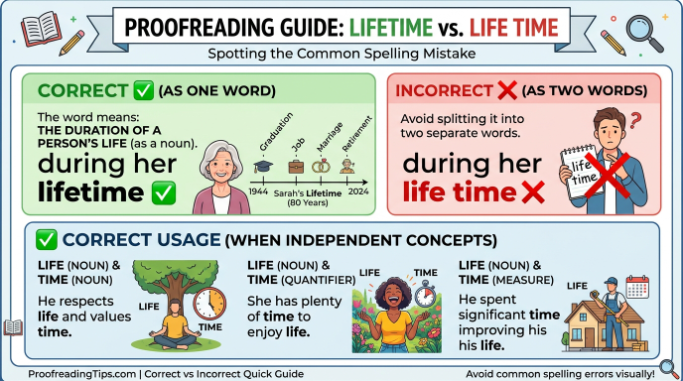
In almost all modern English writing, use lifetime as one word when you mean the period of a person’s, animal’s, object’s, or thing’s existence.
- Correct: She achieved a lot during her lifetime.
- Correct: The battery has a long lifetime.
- Usually incorrect or unnatural: She achieved a lot during her life time.
The two-word form life time can occasionally appear when life and time are being used separately with their own meanings, but this is uncommon. In normal usage, lifetime is the standard spelling.
The hyphenated form life-time is generally unnecessary in modern standard English unless a particular publication’s style guide requires it.
At-a-Glance Table
| Form | Standard? | Main meaning | Example |
|---|---|---|---|
| lifetime | Yes | The whole period something or someone exists | It was the opportunity of a lifetime. |
| life time | Rare as a phrase | Life + time used as separate ideas | The project changed how she spent her life and time. |
| life-time | Usually outdated or style-dependent | Same basic idea as lifetime | A life-time achievement is usually better written as a lifetime achievement. |
The easiest answer to lifetime or life time what’s the difference is this: lifetime is normally one word; life time is only appropriate when the two words genuinely function separately.

The Detailed Difference Between Lifetime and Life Time
What does lifetime mean?
A lifetime is the period during which someone or something lives or exists.
For a person, it can mean the entire span from birth to death:
- He travelled extensively during his lifetime.
- She wrote dozens of books in her lifetime.
For an object, product, system, or process, it means its period of useful existence:
- This machine has an expected lifetime of ten years.
- Proper maintenance can extend the lifetime of a bridge.
- The software’s operational lifetime may be shorter than expected.
The exact length of a lifetime depends on what you are discussing. A person’s lifetime is not a fixed number of years, and an object’s lifetime may refer to either its total existence or its useful working period.
Is lifetime one word or two?
Lifetime is normally one word.
Modern dictionaries and standard English usage treat lifetime as a single word when it refers to a period of existence.
This applies to common expressions such as:
- during my lifetime
- in her lifetime
- a lifetime of experience
- the opportunity of a lifetime
- a lifetime guarantee
- the product’s lifetime
So if you are asking, “Is lifetime one word?”, the practical answer is yes.
When Can “Life Time” Be Two Words?
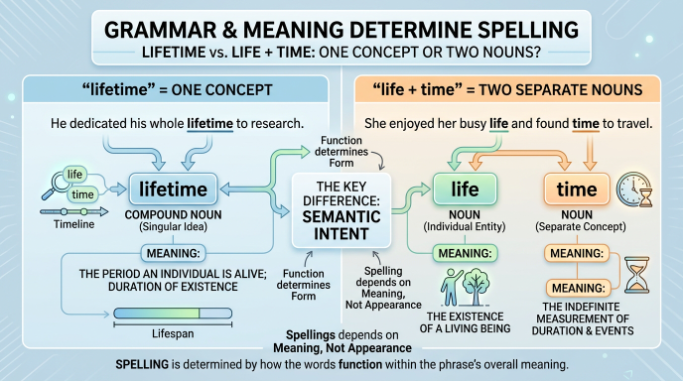
The two-word combination life time is unusual because English normally combines these ideas into the established word lifetime.
However, life and time can appear near each other when they are functioning independently.
For example:
- She wanted more life and time for herself.
Here, the sentence refers separately to life and time, so combining them into lifetime would change the meaning.
Another example might involve a coordinated phrase:
- The program helped him balance his life, time, and responsibilities.
Again, life and time are separate nouns.
The important point is that simply seeing the words life and time together does not automatically create the noun lifetime. Grammar and meaning determine whether they should be treated as one established word or as separate words.
What Part of Speech Is “Lifetime”?
Lifetime is most commonly a noun.
It names a period of existence:
- A human lifetime can contain many major changes.
- The device’s lifetime depends on how it is used.
It can also appear as an attributive modifier before another noun:
- a lifetime achievement
- a lifetime membership
- a lifetime warranty
- a lifetime ban
In these examples, lifetime modifies the noun that follows.
Why does “lifetime membership” stay as two words?
This sometimes confuses writers.
Lifetime is one word, but lifetime membership is a noun phrase containing two words:
- lifetime = modifier
- membership = main noun
The same pattern appears in:
- lifetime experience
- lifetime access
- lifetime achievement
You do not normally write these as:
- lifetimemembership ✗
- lifetimeachievement ✗
The fact that lifetime is one word does not mean every phrase containing it becomes one long compound word.
When to Use Lifetime
Use lifetime when you mean the entire period of existence or life of someone or something.
For a person’s life
- During her lifetime, she saw enormous social change.
- He never forgot that experience for the rest of his lifetime.
- That invention became famous within the inventor’s lifetime.
For an object’s useful existence
- Regular servicing can increase the engine’s lifetime.
- The company tested the expected lifetime of the components.
- Extreme temperatures may reduce the battery’s lifetime.
For a unique or rare opportunity
The phrase the opportunity of a lifetime means an exceptionally valuable or rare opportunity.
- Working on the expedition was the opportunity of a lifetime.
- Winning the scholarship felt like a chance of a lifetime.
For something lasting permanently or for someone’s whole life
- She received a lifetime membership.
- The museum offered him lifetime access.
- The athlete received a lifetime ban from the competition.
The precise meaning depends on context. Lifetime does not always mean a literal period from birth to death. In technical and commercial contexts, it may refer to the useful duration of something.
Lifetime in Different Contexts
Everyday conversation
In ordinary conversation, lifetime usually refers to a person’s whole life or a very long period.
- I’ve never seen anything like it in my lifetime.
- It was a once-in-a-lifetime experience.
The expression once in a lifetime describes something extremely rare.
Science and technology
In technical writing, a lifetime may describe how long a component, material, system, or process remains functional.
- Engineers estimated the lifetime of the solar panels.
- The sensor has a limited operational lifetime.
Be aware that technical fields may define lifetime very precisely. It could mean average service life, expected duration, operational duration, or another measurement established by the field.
Business and legal language
You may see phrases such as:
- lifetime membership
- lifetime appointment
- lifetime access
- lifetime warranty
These phrases should always be interpreted according to their specific terms. For example, a lifetime warranty may define whose lifetime is relevant or what conditions apply. The word itself does not automatically explain every contractual detail.
Literature and formal writing
Lifetime works naturally in formal and literary writing:
- The scientist’s discoveries transformed her field during her lifetime.
- A lifetime of experience shaped his perspective.
It is neither especially casual nor slangy. It is standard English across many registers.

Lifetime, Lifetimes, and Possessive Forms
Lifetime
Singular:
- One lifetime is not enough to learn everything.
Lifetimes
Plural:
- The tradition has survived for generations and many lifetimes.
- Their discoveries may influence people for lifetimes to come.
The plural lifetimes refers to more than one lifetime.
Lifetime’s
The apostrophe form can be possessive:
- The machine’s lifetime’s performance was carefully recorded.
This construction is grammatically possible but often awkward. Writers usually prefer a clearer structure:
- The performance of the machine over its lifetime was carefully recorded.
Its lifetime
When referring to something that belongs to or relates to an object:
- The company monitored the device throughout its lifetime.
Here, its is possessive and lifetime remains a standard one-word noun.
Common Mistakes
Mistake: Writing “life time” when you mean a period of existence
Incorrect: She achieved many things during her life time.
Correct: She achieved many things during her lifetime.
Why: The sentence refers to the complete period of her life, which is the standard meaning of the noun lifetime.
Mistake: Assuming “life time” is always wrong
Too simple: Never write life and time separately.
The words can be separate when they have independent grammatical roles.
Correct: He needed to manage his life and time more effectively.
This is not the noun lifetime. It refers to two separate things.
Mistake: Adding a hyphen unnecessarily
Usually unnecessary: life-time
Standard modern form: lifetime
Some older texts, house styles, or unusual editorial conventions may use a hyphen, but lifetime is the normal modern spelling.
Mistake: Confusing “lifetime” with “lifelong”
These words are related but not interchangeable.
- lifetime experience = an experience connected with or lasting a lifetime, depending on context
- lifelong friend = a friend for your whole life
Compare:
- She has a lifetime of memories.
- She has had a lifelong interest in music.
A lifetime is primarily a period of existence. Lifelong describes something that continues throughout a person’s life.
A Fast Decision Rule
Ask yourself:
Do I mean the whole period that someone or something lives or exists?
If the answer is yes, use lifetime.
Quick checklist
Use lifetime when you mean:
- someone’s entire life
- an object’s period of existence
- a period of useful operation
- a rare opportunity
- something lasting for someone’s whole life
Examples:
- during my lifetime
- the product’s lifetime
- an opportunity of a lifetime
- lifetime membership
Use life and time separately only when they are genuinely separate words with separate roles or meanings.
A Practical Proofreading Test
Try replacing the phrase with:
“the entire period of existence.”
If the sentence still makes sense, lifetime is probably the correct word.
For example:
She made the discovery during her lifetime.
Replace it:
She made the discovery during the entire period of her existence.
The meaning remains clear, so lifetime is correct.
Now consider:
He wanted more life and time outside work.
You cannot replace life and time with the entire period of existence without changing the meaning. The two nouns are functioning separately.
This test is especially useful when proofreading quickly.
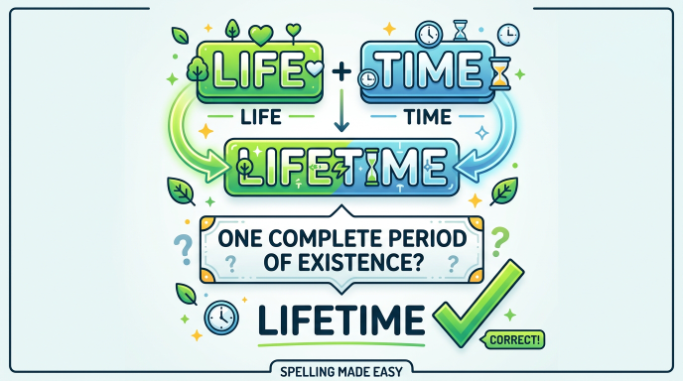
A Simple Memory Trick
Think of lifetime as one complete concept.
A lifetime is one continuous span or period, so English normally writes the established noun as one word:
LIFE + TIME → LIFETIME
Do not use this as a general rule for every English compound word. English spelling does not always work that neatly. It is simply a useful memory aid for this particular word.
Formal, Casual, British, and American Usage
Formal vs casual English
Lifetime is appropriate in both formal and informal English.
Casual:
- That’s the trip of a lifetime!
Formal:
- The research examined changes occurring throughout the patient’s lifetime.
The spelling does not normally change with formality.
British English vs American English
Both British English and American English normally use lifetime as one word for the noun.
- during his lifetime
- a lifetime of work
- lifetime achievement
This is not generally a British-versus-American spelling difference.
What about “life-time”?
You may encounter life-time in older writing or material following a particular editorial style. However, for modern general writing, lifetime is usually the safest and most standard choice.
If you are writing for a publication, academic institution, or organization with a house style, follow that style guide when it specifically gives different instructions.
Pronunciation of Lifetime
Lifetime is commonly pronounced:
/ˈlaɪf.taɪm/
It has two clear parts:
- life — rhymes with wife
- time — rhymes with rhyme
The pronunciation remains essentially the same whether you are thinking about the word historically as a compound or using its modern one-word spelling.
How Long Is a Lifetime?
There is no single answer to “How long is a lifetime?”
For a person, a lifetime means the entire duration of that person’s life.
For an animal, it means the duration of that animal’s life.
For an object or product, the word may mean:
- its expected useful life
- its operational period
- its actual period of functioning
- another duration defined by the relevant context
So lifetime describes a span rather than a universal number of years.
What Does “A Lifetime” Mean?
The phrase a lifetime usually means one complete period of life or existence.
Examples:
- It took a lifetime to build that knowledge.
- A lifetime can pass surprisingly quickly.
It can also be used figuratively:
- Waiting for the results felt like a lifetime.
In that sentence, the speaker does not literally mean an entire life. They mean the wait felt extremely long.
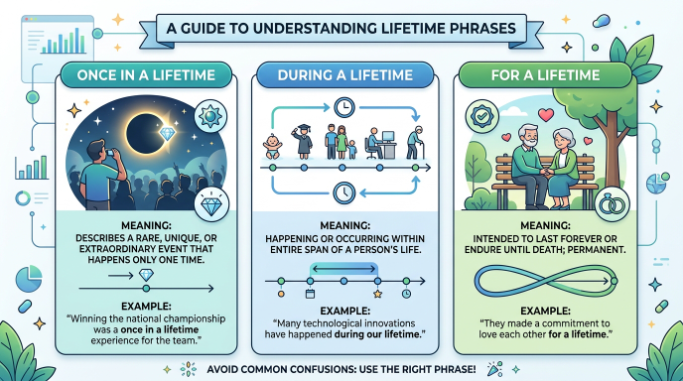
“Once in a Lifetime” vs “For a Lifetime”
These phrases have different meanings.
Once in a lifetime
Means something extremely rare.
- Seeing the event in person was a once-in-a-lifetime experience.
For a lifetime
Means for the duration of someone’s life.
- The experience gave her memories she would carry for a lifetime.
The surrounding words determine the meaning, but lifetime remains one word in both expressions.
FAQs
Is lifetime one word or two words?
Lifetime is normally one word when it means the period during which someone or something lives or exists.
Is “life time” one word?
No. Life time is two separate words, but that combination is rarely correct when you mean the established noun lifetime.
What is the dictionary meaning of lifetime?
A lifetime is the period during which a person, animal, object, or other thing lives or exists. Its exact meaning can vary according to context.
What does lifetime mean for a product?
For a product, lifetime usually means its period of useful operation or existence. The exact definition may depend on technical specifications or stated terms.
What is the difference between lifetime and lifelong?
Lifetime usually refers to a period of existence, while lifelong describes something that continues throughout a person’s life.
- a lifetime of experience
- a lifelong passion for music
Can I write “life-time” with a hyphen?
You may encounter the hyphenated form in older or style-specific writing, but lifetime is the standard modern spelling for general English.
What does “in my lifetime” mean?
It means during the period I have been alive.
Example:
- I have never seen a change like this in my lifetime.
Is “once in a lifetime” hyphenated?
Before a noun, the compound expression is commonly hyphenated:
- a once-in-a-lifetime opportunity
When used after the noun or independently, punctuation may be handled differently depending on sentence structure and editorial style:
- This opportunity comes once in a lifetime.
Final Takeaway
The answer is straightforward in most situations: use lifetime as one word when you mean the period during which a person or thing lives, exists, or remains operational.
Use life and time as separate words only when they genuinely have separate meanings and grammatical roles.
If you are unsure, use this proofreading question:
“Am I talking about one complete period of existence?”
If yes, the correct choice is almost certainly lifetime.
Remember these common examples:
- during her lifetime
- a lifetime of experience
- the opportunity of a lifetime
- lifetime membership
- the product’s lifetime
- a once-in-a-lifetime experience