Masonary vs Masonry: Which Spelling Is Correct?
Quick Answer
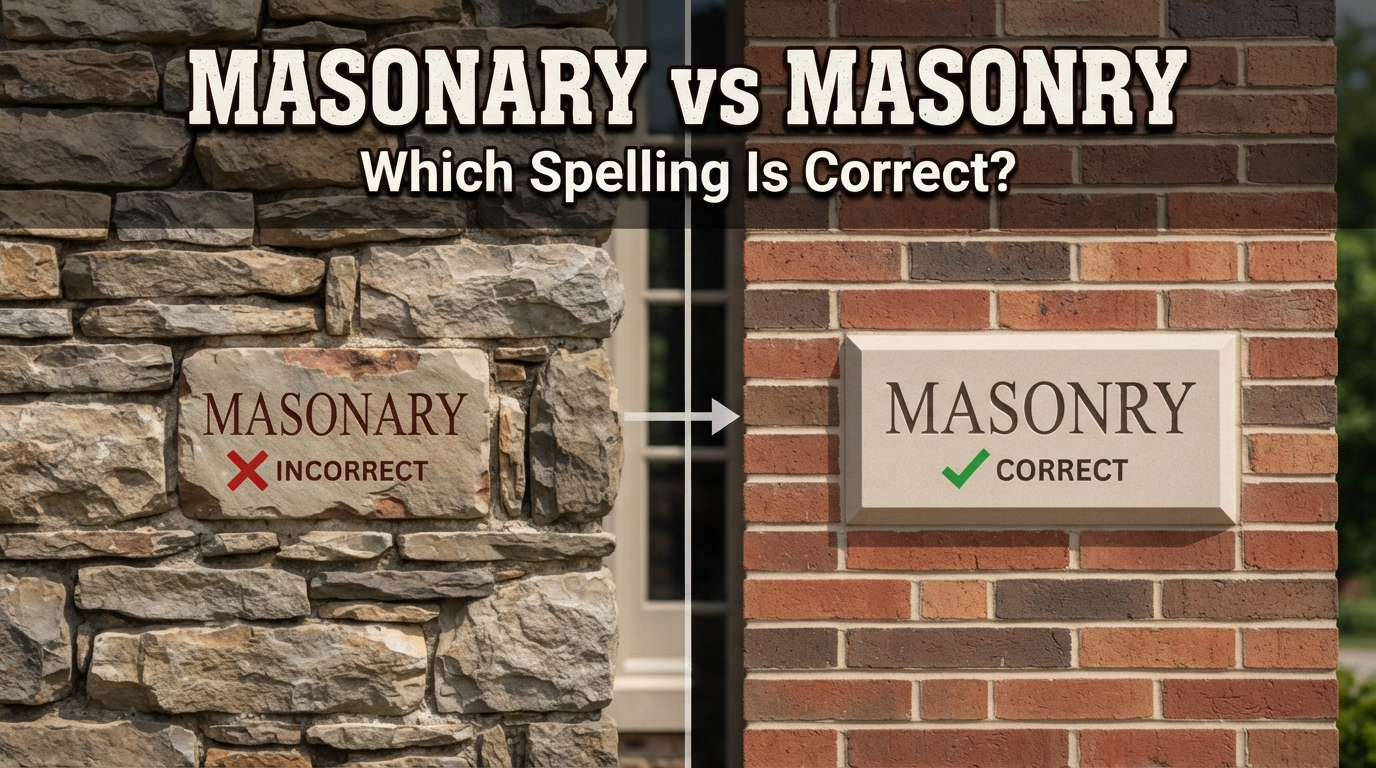
Masonry is the correct spelling. Masonary is a common misspelling and is not the standard spelling in modern English.
The correct word is masonry, pronounced with the ending found in words such as primary and boundary. It refers to the craft, work, or construction of structures using materials such as brick, stone, concrete blocks, or similar units.
So, if you are asking “masonary vs masonry,” “masonry or masonary,” or “masonary or masonry,” use masonry.
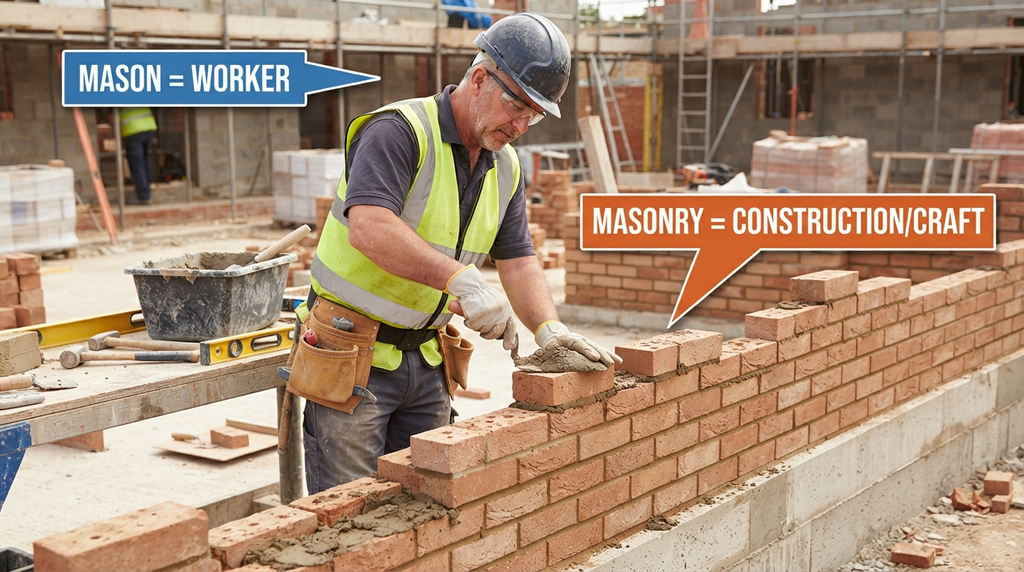
The word mason is also correctly spelled with one n after the o: m-a-s-o-n. A person who works with brick, stone, or other building materials can be called a mason. Masonry is the related noun for the craft or the resulting construction.

Correct Forms Table
| Word or form | Correct? | Meaning or use |
|---|---|---|
| masonry | Yes | The craft, work, or construction involving brick, stone, blocks, or similar materials |
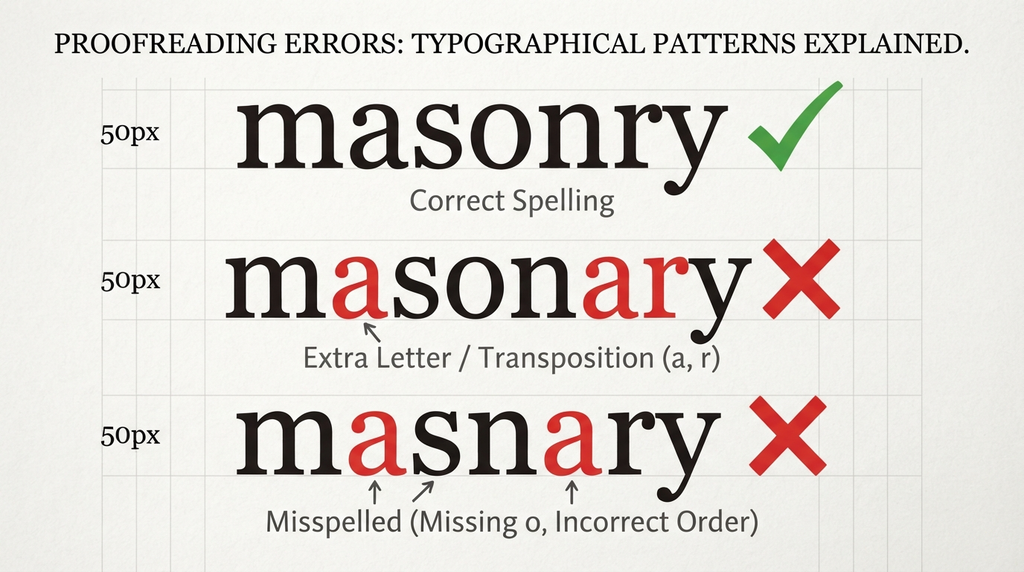
| masonary | No | Common misspelling of masonry |
| mason | Yes | A person who works with masonry; also a related occupational noun |
| masons | Yes | Plural of mason |
| mason’s | Yes | Possessive form of mason |
| masons’ | Yes | Plural possessive form |
| masonry work | Yes | Work involving masonry construction |
| masonry wall | Yes | A wall constructed from masonry units |
| masnary | No | Typographical misspelling of masonry |
There is no standard English noun masonary that should be substituted for masonry. It is generally the result of spelling the word as though it were directly formed by adding a familiar ending to mason.
Likewise, masnary is simply another spelling error. It does not represent a recognized British or American variant of masonry.
Why the Difference Exists
The confusion becomes easier to understand when you look at the relationship between mason and masonry.
A mason is a skilled worker who builds or repairs structures using materials such as brick, stone, and concrete blocks. Masonry refers to the craft or construction itself. For example:
- The mason repaired the stone wall.
- The building has extensive stone masonry.
- Masonry requires careful alignment and bonding of materials.
The tricky part is that masonry does not simply preserve the entire spelling of mason and then add a suffix. The word has an established historical form, and the ending is -ry, producing masonry, not masonary.
This is why writing mason + ary can feel logical but still produce the wrong result.
The same issue occurs with many English words whose modern spelling cannot always be predicted by mechanically attaching a familiar suffix. English vocabulary contains words shaped by historical changes, borrowing, pronunciation, and established word formation.
Mason and Masonry
The relationship can be summarized simply:
mason → masonry
The first word names the worker or craftsperson. The second names the craft, technique, or construction.
For example, a contractor might hire a mason to complete masonry work.

The Spelling Rule and Word Pattern
There is no productive spelling rule that says every noun related to a person or occupation ending in -on should become a word ending in -onary.
That is the main trap behind masonary.
The correct form is an established lexical form:
masonry
The ending is -ry, not -ary.
This matters because English spelling often reflects the history of individual words rather than a perfectly predictable formula. You can use word families to make spelling easier, but you should not assume that every related word is created by simply attaching the same visible suffix.
For spelling purposes, learn the pair together:
mason → masonry
rather than trying to construct masonry letter by letter from an assumed rule.
Why “Masonary” Looks Plausible
Masonary looks plausible because English has many words ending in -ary, including customary, secondary, temporary, and stationary.
A writer may therefore unconsciously divide the word as:
mason + ary
But the standard spelling is:
masonry
That small difference is responsible for a large number of searches for masonary meaning, masonary definition, and masonry masonary.
In standard contemporary English, searching for masonary usually means the person is looking for information about masonry.
How Do You Spell Masonry?
You spell it:
M-A-S-O-N-R-Y
The important detail is the sequence after mason. The correct form does not insert an a before the final r.
Correct:
masonry
Incorrect:
masonary
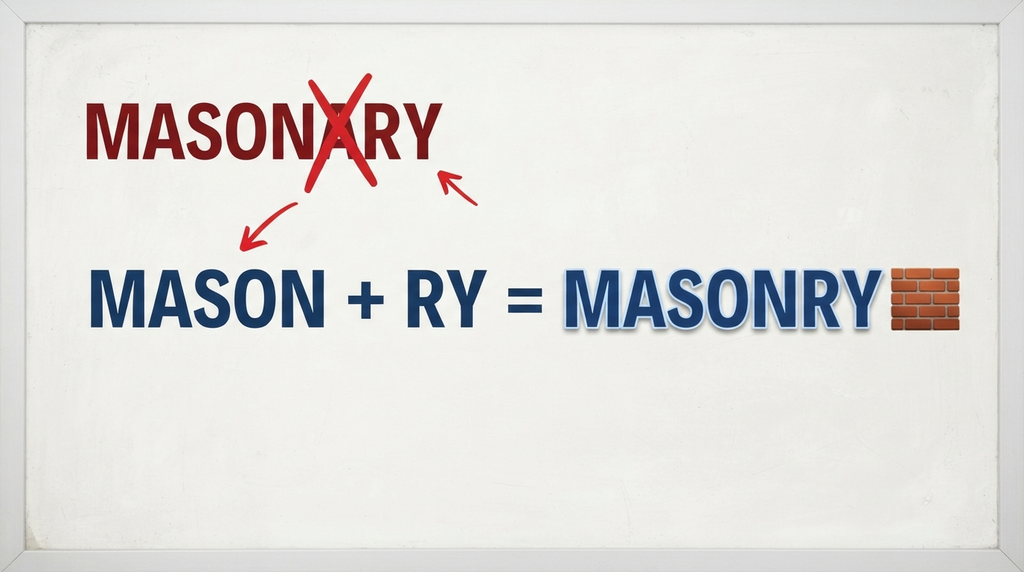
If you are unsure how to spell masonry while writing about construction, remember the compact form mason + ry, rather than mason + ary.
How Do You Spell Mason?
The spelling of the related occupation is simpler:
M-A-S-O-N
Mason is a standard English word for a person who works with brick, stone, concrete blocks, or related building materials.
Examples include:
- The mason repaired the damaged brickwork.
- We hired a mason to rebuild the stone steps.
- An experienced mason can recognize problems in a wall’s construction.
The plural is masons, and the possessive forms are mason’s and masons’ depending on the grammatical context.
Masonry Mason: How the Words Relate
It is useful to keep the distinction clear:
mason = the person or craftsperson
masonry = the craft, work, or construction
For example:
The mason specializes in traditional stone masonry.
Here, mason identifies the worker, while masonry identifies the type of work.
Examples of Masonry in Real Contexts
The best way to reinforce the spelling is to see masonry used naturally.
Construction
The contractor inspected the masonry before beginning the renovation.
Architecture
The historic building is known for its detailed stone masonry.
Engineering and building maintenance
Water had entered through cracks in the masonry wall.
Materials
Brick masonry can provide substantial durability when properly designed and constructed.
Skilled trades
She learned traditional masonry techniques from an experienced craftsman.
Restoration
The restoration team carefully matched the new masonry to the original stonework.
General description
The house combines timber framing with exposed masonry.
Notice that none of these contexts requires masonary. The standard noun is always masonry.
Common Mistakes
Masonary
Masonary is the most common error in this comparison.
Incorrect:
The building has extensive masonary work.
Correct:
The building has extensive masonry work.
The extra a is the problem.
Masnary
Masnary is another misspelling. Here, the letters are rearranged or omitted rather than adding the incorrect a.
Incorrect:
The masnary needs repair.
Correct:
The masonry needs repair.
Masonary vs Masonry
If you are specifically deciding between these two spellings, there is no standard modern English distinction in meaning:
masonry = correct
masonary = misspelling
The second form should not be treated as an alternative spelling simply because it appears in search results, user-generated writing, or occasional documents.
Masonry vs Mason
These words should not be used interchangeably.
The mason arrived at 8 a.m.
Here, mason means the worker.
The masonry was damaged by moisture.
Here, masonry means the construction or material.
Regional and Style Notes
British and American English
Masonry is the standard spelling in both British English and American English.
There is no ordinary British-American spelling distinction in which British writers use masonary and American writers use masonry. Both varieties use masonry.
This is important because some English words genuinely have regional spelling differences, such as colour/color and centre/center. Masonry is not one of those cases.
Is “Masonary” Archaic or Dialectal?
In ordinary modern English, masonary should be treated as a misspelling of masonry, not as a standard archaic or dialectal alternative.
Older historical texts can contain spelling variation, as English spelling was less standardized in earlier periods. But that does not make masonary an accepted modern variant that should be used in contemporary writing.
For current professional, academic, construction, technical, or general-purpose English, use masonry.
Is Masonry a Noun?
Yes. Masonry is primarily a noun.
It can refer to:
- The craft or occupation of building with masonry materials.
- The construction produced using those materials.
- The materials or structural elements themselves in an appropriate context.
For example:
The masonry was carefully restored.
Here, the noun refers to the constructed masonry rather than to a person.
Masonry Pronunciation
The pronunciation of masonry can vary slightly by accent, but the standard word has three syllables in common English pronunciation.
The first syllable carries the main stress. The middle vowel is commonly reduced in natural speech, which can make the word sound less like the spelling suggests.
This is one reason pronunciation alone may not make the spelling obvious. Someone who knows the spoken word may still accidentally write masonary.
How to Pronounce Mason
Mason is pronounced with two syllables, with the stress on the first syllable.
The pronunciation relationship between mason and masonry is useful, but it does not mean their spellings are interchangeable.
How to Remember the Correct Spelling
The simplest memory trick is:
MASON + RY = MASONRY
Do not insert A before the R.
You can also connect the meaning:
Mason = person
Masonry = work
For example:
A mason does masonry work.
That sentence puts both words together and makes their relationship easier to remember.
Another useful approach is to memorize the visual ending:
-RY
not:
-ARY
When writing about brickwork, stonework, or block construction, think masonry.
FAQs About Masonary vs Masonry
Is masonry or masonary correct?
Masonry is correct. Masonary is a common misspelling and is not the standard modern English form.
How do you spell masonry?
The correct spelling is masonry: M-A-S-O-N-R-Y.
What does masonry mean?
Masonry refers to the craft, work, or construction involving materials such as brick, stone, concrete blocks, and similar units. It can describe both the practice and, depending on context, the resulting construction.
What does masonary mean?
Masonary is generally a misspelling of masonry. If you see it in contemporary English, the intended word is normally masonry.
How do you spell mason?
The correct spelling is mason: M-A-S-O-N.
A mason is a skilled worker who builds or repairs structures using materials such as brick and stone.
Is “masonary” a word?
It is not the standard spelling of the construction-related noun. In contemporary standard English, use masonry.
Are there different ways to spell mason?
The standard spelling is mason. Forms such as maison should not be substituted when you mean the construction trade. Masonary is also not a different spelling of mason; it is a misspelling of masonry.
Is masonry the same as brickwork?
Not exactly. Brickwork specifically concerns construction or work involving bricks, while masonry is a broader term that can include brick, stone, concrete masonry units, and other masonry materials.
Is masonry a construction term?
Yes. Masonry is widely used in construction and architecture to describe both a building method and masonry construction itself.
Is masonry singular or plural?
Masonry is normally a mass noun, so it is generally used without a plural ending when referring to the material, craft, or construction as a general concept.
For example:
The masonry is damaged.
You would not normally write masonries simply to refer to several sections of masonry.
In specialized contexts, masonries can theoretically occur when referring to distinct types or systems, but ordinary construction writing generally uses the uncountable form masonry.
Summary
When choosing between masonary vs masonry, the correct modern English spelling is masonry.
The key forms to remember are:
- mason = a worker or craftsperson
- masonry = the craft, work, material, or construction
- masonary = common misspelling
- masnary = another misspelling
The spelling is the same in standard British and American English. The most reliable memory aid is simply mason + ry = masonry.
If you are writing a construction report, academic paper, website, specification, estimate, or everyday sentence, use masonry.