
Underwent or Undergone: What’s the Difference?
Quick Answer
“Underwent” and “undergone” are both correct forms of the verb “undergo,” but they are used in different grammatical situations.
- Underwent is the simple past tense of undergo:
She underwent surgery last year. - Undergone is the past participle of undergo:
She has undergone surgery.
The key test is simple: use “underwent” for a completed past event without an auxiliary verb; use “undergone” after forms of “have” or in certain passive constructions.
So, if you are asking for the past tense of undergo, the answer is underwent.

At-a-Glance Table
| Form | Grammatical role | Typical construction | Example |
|---|---|---|---|
| undergo | Base form / present | will, can, do, to + undergo | Patients may undergo testing. |
| underwent | Simple past | Subject + underwent | He underwent treatment in 2024. |
| undergone | Past participle | have/has/had + undergone | He has undergone treatment. |
| undergoing | Present participle / -ing form | be + undergoing | He is undergoing treatment. |
The most important distinction is between underwent and undergone. They are not two alternative spellings for the same tense.
Underwent tells you that something happened in the past. Undergone normally needs a helping verb such as has, have, or had.
For example:
- Correct: Maria underwent surgery in June.
- Correct: Maria has undergone surgery.
- Incorrect: Maria has underwent surgery.
- Incorrect: Maria undergone surgery in June.
underwent
ˌʌn.dərˈwɛntAdd to flashcards
Give feedback
undergone
ˌʌn.dərˈɡʌnAdd to flashcards
Give feedback
Underwent vs. Undergone: The Detailed Difference
The verb undergo means to experience, endure, or be subjected to something, especially a process, treatment, examination, change, or difficult experience.
Its principal forms are:
undergo → underwent → undergone → undergoing
The important point is that English verbs do not always form their past tense and past participle in the same way. Undergo is an irregular verb.
Underwent is the simple past
Underwent is the simple past form of undergo. Use it when describing an event that happened and was completed in the past.
Examples:
- The patient underwent surgery last Monday.
- The company underwent major changes after the merger.
- She underwent several interviews before receiving an offer.
- The building underwent extensive repairs.
- He underwent training before starting the job.
Notice that underwent can stand as the main verb by itself.
The patient underwent surgery.
There is no need for has, have, or had.
This is why “past tense of undergo” = “underwent.”
Undergone is the past participle
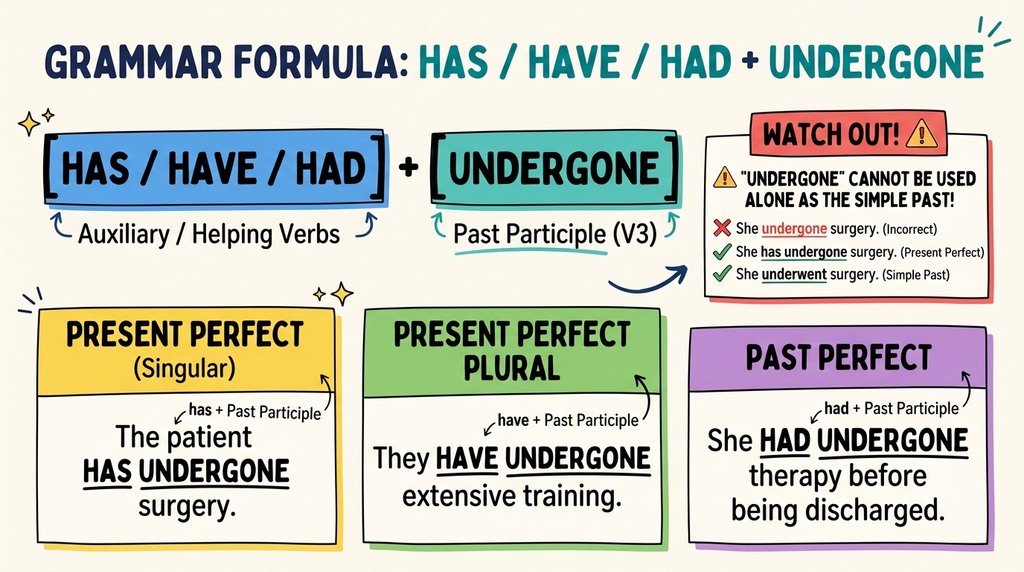
Undergone is the past participle of undergo. It is normally used with an auxiliary verb, particularly forms of have.
Examples:
- The patient has undergone surgery.
- The company has undergone significant changes.
- She had undergone extensive training.
- The building has undergone major renovations.
- They have undergone several rounds of testing.
The construction is:
has/have/had + undergone
This is a perfect-tense construction.
For example:
The company underwent restructuring in 2023.
This uses the simple past.
The company has undergone restructuring.
This uses the present perfect.
Both sentences are grammatical, but the grammatical structure and meaning are slightly different.

When to Use “Underwent”
Use underwent when the sentence describes a past event and the verb itself carries the past tense.
For a specific completed past event
If the sentence contains a clear past-time reference such as yesterday, last year, in 2020, or two months ago, underwent is often the natural choice.
- She underwent surgery last year.
- The hospital underwent renovation in 2022.
- He underwent testing yesterday.
- The company underwent a leadership change in March.
- The team underwent intensive training before the tournament.
With a simple past narrative
When telling a story or reporting a sequence of completed events, underwent works naturally.
After the accident, he underwent several examinations and returned home two days later.
The verb underwent fits because the sentence is describing completed events in a past sequence.
After a subject without “have”
A useful structural clue is that underwent can directly follow the subject:
- She underwent treatment.
- They underwent testing.
- The house underwent repairs.
- The organization underwent reform.
You do not need another auxiliary verb.
When to Use “Undergone”
Use undergone when the grammar requires the past participle.
After “has,” “have,” or “had”
This is the most important pattern:
has + undergone
have + undergone
had + undergone
Examples:
- He has undergone surgery.
- They have undergone extensive testing.
- She has undergone significant changes.
- The system has undergone several updates.
- The patient had undergone treatment before the second examination.
These are perfect constructions.
In the present perfect
The present perfect often connects a past experience with the present.
Compare:
She underwent surgery in 2021.
This simply reports a past event.
She has undergone surgery.
This presents surgery as part of her experience or history, with some connection to the present context.
The difference is not merely about time. It is also about how the speaker frames the event.
In the past perfect
Use had undergone when one past event happened before another past event.
By the time the specialist arrived, the patient had undergone several tests.
The earlier event is had undergone several tests. The later event is the specialist arrived.
Examples by Context
The distinction becomes easier when you see the forms in realistic contexts.
Medical treatment and surgery
Both forms are common in medical writing.
Simple past:
- The patient underwent surgery on Tuesday.
- He underwent chemotherapy in 2023.
- She underwent a medical examination last month.
Perfect construction:
- The patient has undergone surgery.
- He has undergone several treatments.
- She had undergone two procedures before the diagnosis was confirmed.
A common error is:
❌ The patient has underwent surgery.
The correct form is:
✅ The patient has undergone surgery.
The reason is grammatical: has requires the past participle, not the simple past.
Business and organizations
The same distinction applies outside medicine.
- The company underwent a major restructuring last year.
- The company has undergone a major restructuring.
- The organization underwent several changes after the acquisition.
- The organization has undergone several changes since the acquisition.
Personal experiences
- She underwent a difficult period after moving abroad.
- He underwent extensive training before becoming a manager.
- She has undergone a remarkable transformation.
- He has undergone significant professional development.
Scientific and technical contexts
- The material underwent testing under extreme conditions.
- The device underwent extensive laboratory testing.
- The material has undergone repeated stress tests.
- The system had undergone several modifications before production began.
Legal, administrative, and institutional contexts
- The proposal underwent a formal review.
- The application underwent further examination.
- The proposal has undergone several revisions.
- The document had undergone review before it was approved.
These examples demonstrate that the choice depends on grammar, not on whether the subject is medical, business-related, technical, or personal.
“Underwent or Undergone” in Direct Comparisons
Consider these pairs:
| Underwent | Undergone |
|---|---|
| She underwent surgery in May. | She has undergone surgery. |
| The building underwent repairs. | The building has undergone repairs. |
| He underwent training last year. | He has undergone training. |
| The company underwent restructuring. | The company has undergone restructuring. |
| They underwent several tests. | They have undergone several tests. |
The left side uses the simple past. The right side uses the past participle with has/have.
A useful way to think about it is:
Underwent = did it in the past.
Undergone = has/have/had experienced it.
This is a memory aid rather than a complete description of every possible grammatical construction, but it works well for ordinary usage.
Common Mistakes
“Has underwent”
❌ She has underwent surgery.
✅ She has undergone surgery.
After has, use the past participle undergone.
“Had underwent”
❌ He had underwent several tests.
✅ He had undergone several tests.
After had, use undergone.
“Undergone” as a standalone past-tense verb
❌ She undergone surgery last year.
✅ She underwent surgery last year.
Undergone cannot normally replace underwent as the simple past.
“Underwent” after “has”
❌ The company has underwent significant changes.
✅ The company has undergone significant changes.
The auxiliary has signals a perfect construction, so the past participle is required.
Confusing the verb forms with meaning
It is tempting to think that underwent means one thing and undergone means something different. They share the same basic lexical meaning.
The major difference is grammatical form.

Is “Underwent” a Word?
Yes. Underwent is a standard English word.
It is the simple past tense of undergo.
For example:
The patient underwent surgery.
There is nothing informal, obsolete, or incorrect about underwent. It is standard English and is widely used in both American and British English.
Likewise, undergone is also a standard English word. It is the past participle of undergo.
What Does “Underwent” Mean?
Underwent means experienced, endured, or was subjected to something in the past.
For example:
- She underwent surgery. = She experienced or received surgery.
- The company underwent changes. = The company experienced changes.
- He underwent training. = He received or completed training.
- The building underwent repairs. = The building was subjected to repairs.
The exact interpretation depends on the noun following the verb.
What Does “Undergone” Mean?
Undergone has essentially the same core meaning as underwent, but it functions as a past participle.
For example:
The building has undergone extensive repairs.
Here, undergone means that the building has experienced or been subjected to extensive repairs.
The difference between underwent and undergone is therefore primarily grammatical rather than semantic.
Past Tense of “Undergo”
The simple past tense of undergo is:
underwent
The past participle is:
undergone
So the principal forms are:
| Form | Word |
|---|---|
| Base form | undergo |
| Simple past | underwent |
| Past participle | undergone |
| Present participle | undergoing |
Examples:
- I undergo regular testing.
- I underwent testing last year.
- I have undergone testing.
- I am undergoing testing.
This four-form pattern is especially useful for proofreading.

A Fast Decision Rule
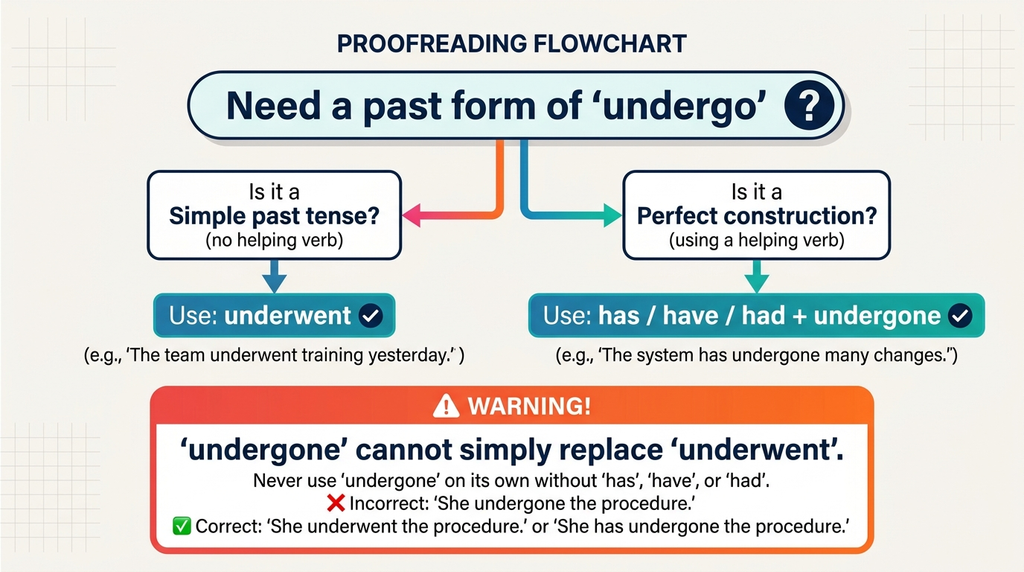
When deciding between underwent and undergone, check the words immediately before the verb.
Choose “underwent” when:
- The sentence is in the simple past.
- There is no has, have, or had requiring a past participle.
- You are describing a completed past event.
Example:
The patient underwent surgery yesterday.
Choose “undergone” when:
- It follows has, have, or had.
- The sentence uses a perfect construction.
Examples:
The patient has undergone surgery.
The patient had undergone surgery before the follow-up examination.
The five-second test
Try inserting has or had.
If your intended sentence is:
She ___ major changes.
Ask what structure you want.
Simple past:
She underwent major changes.
Present perfect:
She has undergone major changes.
Do not mix the two:
❌ She has underwent major changes.
A Practical Proofreading Test
Look for an auxiliary verb before the blank.
If you see:
- has
- have
- had
then undergone is usually the correct form.
If you simply need a past-tense verb, use underwent.
For example:
The patient ___ surgery last year.
There is no auxiliary verb.
Underwent is correct.
The patient has ___ surgery.
The word has requires a past participle.
Undergone is correct.
This test works in the overwhelming majority of ordinary sentences involving these two forms.
Formal vs. Casual and British vs. American Usage
There is no meaningful British-versus-American difference in the basic distinction between underwent and undergone.
Both varieties of English use:
- underwent as the simple past
- undergone as the past participle
Both are also standard in formal and informal writing.
However, undergo itself can sound somewhat formal depending on the context. In everyday conversation, people may sometimes choose a simpler expression such as go through, have, experience, or get.
Compare:
She underwent extensive testing.
with:
She had a lot of tests.
The first is more formal and is especially natural in medical, academic, technical, legal, and professional writing.
That does not make underwent or undergone unnecessarily complicated. In the right context, they are precise and conventional choices.
Pronunciation Notes
The two forms have different vowel sounds and endings.
Underwent ends with the same stressed vowel sound found in went.
Undergone ends with the vowel sound associated with gone in the relevant English pronunciation.
The stress falls on the second syllable of both words.
When speaking clearly, avoid treating undergone as though it were simply underwent with a different spelling. They are distinct forms with distinct pronunciations.
Edge Cases: When “Undergone” Appears Without “Has”
The rule “undergone needs has/have/had” is useful for learners, but it is not an absolute statement about every possible English construction.
The past participle can appear in other grammatical environments, including passive and reduced constructions.
For example:
The undergone procedure…
This particular construction is generally unnatural because undergone is not normally used as a straightforward adjective before a noun in ordinary modern prose.
Instead, writers would usually say:
the procedure she underwent
or:
the procedure she had undergone
This illustrates an important point: knowing that undergone is a past participle does not mean that it can be placed freely anywhere an adjective or past-tense verb might appear.
Good grammar requires both the correct verb form and the correct syntactic construction.
FAQs
Is “underwent” the past tense of “undergo”?
Yes. Underwent is the simple past tense of undergo.
Example: She underwent surgery last year.
Is “undergone” the past tense of “undergo”?
Not exactly. Undergone is the past participle, not the simple past.
Example: She has undergone surgery.
Which is correct: “underwent surgery” or “undergone surgery”?
Both can be correct depending on the sentence.
- She underwent surgery yesterday.
- She has undergone surgery.
Use underwent for the simple past and undergone after an appropriate auxiliary such as has, have, or had.
Is “has underwent” correct?
No. In standard English, use has undergone.
❌ He has underwent surgery.
✅ He has undergone surgery.
Is “had underwent” correct?
No. Use had undergone.
❌ She had underwent treatment.
✅ She had undergone treatment.
What does “underwent” mean?
Underwent means experienced, endured, or was subjected to something in the past.
For example, The building underwent repairs means the building experienced or received repairs.
What does “undergone” mean?
Undergone has the same basic meaning as underwent, but it is the past participle form. It is commonly used with has, have, or had.
Is “underwent” a word?
Yes. Underwent is a standard English word and is the simple past form of undergo.
Should I say “she underwent” or “she has undergone”?
It depends on the intended tense.
Use she underwent to report a completed past event, especially with a definite past time:
She underwent surgery in 2022.
Use she has undergone when using the present perfect:
She has undergone surgery.
Is there a British or American difference?
No significant difference exists in the basic grammar. British and American English both use underwent as the simple past and undergone as the past participle.
Final Takeaway
The distinction is straightforward once you identify the grammatical form:
Undergo → underwent → undergone
- Undergo = base form
- Underwent = simple past
- Undergone = past participle
Use underwent when you are simply reporting something that happened in the past:
The patient underwent surgery last year.
Use undergone when it is part of a perfect construction:
The patient has undergone surgery.
The most useful proofreading rule is:
No auxiliary + past event → underwent.
Has/have/had + past participle → undergone.
If you remember only one thing, remember this: “underwent” is the past tense; “undergone” is the past participle.