Led vs Lead: What Is the Difference?
Quick Answer
Led and lead are both correct English words, but they are used differently.
- Lead /liːd/ is usually the present tense of the verb meaning “to guide, direct, or cause someone or something to move toward a result.”
- Led /led/ is the past tense and past participle of lead.
- Lead /led/ is also a completely different noun meaning the metal.
So:
Today, she leads the team.
Yesterday, she led the team.
And:
The pipes contain lead.
The most important point is pronunciation: the verb lead is pronounced like “leed,” while its past tense led is pronounced like “red” with an L. The metal lead is pronounced like “led.”

At-a-Glance Table
| Word | Main role | Pronunciation | Meaning | Example |
|---|---|---|---|---|
| lead | Verb | /liːd/ | Guide, direct, or cause | She will lead the meeting. |
| led | Verb | /led/ | Past tense of lead | She led the meeting yesterday. |
| lead | Noun | /led/ | A heavy metal | The old paint contained lead. |
| lead | Noun | /liːd/ | The first position or advantage | Our team has the lead. |
| leads | Verb | /liːdz/ | Present-tense form for he/she/it | He leads the department. |
| leading | Verb/adjective | /ˈliːdɪŋ/ | Present participle or describing something primary | She is leading the project. |
The apparent difficulty comes from the fact that lead has two common pronunciations. As a verb meaning “guide,” it is pronounced /liːd/. When it refers to the metal, it is pronounced /led/. Led, however, is always pronounced /led/.
Lead and Led: The Detailed Difference
The simplest grammatical relationship is:
lead → led → led
The first form is the base form. The second and third forms are the past tense and past participle.
For example:
- I lead the group every Monday.
- I led the group last Monday.
- I have led the group several times.
Notice that led does not mean something different from the verb lead. It is simply the past form of that verb.
Lead as a Verb
When lead is used as a verb, it can mean to guide someone, direct an activity, be in charge of something, or cause something to happen.
Examples include:
- The manager leads a small research team.
- Maya will lead the discussion.
- This road leads to the old village.
- Good planning can lead to better results.
- The evidence may lead investigators to a new conclusion.
In each case, lead is pronounced /liːd/.
Led as a Verb
Led is the past tense and past participle of the verb lead.
Use it when the action happened in the past:
- The captain led the players onto the field.
- Her research led to an important discovery.
- They led the project for three years.
- His advice led me to reconsider the plan.
You also use led after auxiliary verbs such as has, have, and had:
- She has led the department since 2023.
- They have led several successful projects.
- He had led the team before becoming director.
This is why has led is correct, while has lead is normally incorrect when you mean the past participle of the verb.

Lead vs Led in Grammar
Understanding the surrounding verb is often enough to choose the correct form.
Use Lead After “Will,” “Can,” “Should,” and Similar Modals
Modal verbs are followed by the base form of a verb:
- We will lead the discussion.
- She can lead the group.
- They should lead the investigation.
- He may lead the project.
- Who will lead the ceremony?
Not:
- We will led the discussion.
- She can led the group.
The modal already carries the grammatical information about tense or possibility, so the main verb remains in its base form.
Use Led for a Completed Past Action
When the action happened in the past, led is generally required:
- She led the team last year.
- He led us through the forest.
- The study led to a change in policy.
- Their decision led to unexpected consequences.
Use Led After Have, Has, or Had
The past participle is led, not lead:
- I have led several workshops.
- She has led the company since January.
- They had led the negotiations before the agreement was signed.
This is one of the most common sources of the “has led or has lead” confusion.
Use Lead After “To” When It Is an Infinitive
When to is part of an infinitive, use the base form:
- We hope to lead the project.
- She wants to lead the discussion.
- They expect the decision to lead to further changes.
But to can also be a preposition, followed by a noun or gerund. The surrounding grammar matters:
- The decision led to a delay.
- The decision led to delaying the launch.
In led to, the word led is the past-tense verb, while to introduces what resulted from the action.
When to Use Lead
Use lead when the grammar calls for the base or present form of the verb.
For Present Actions
- I lead a weekly training session.
- They lead the market in this category.
- She leads the design team.
- This path leads to the entrance.
Remember that leads is used with third-person singular subjects such as he, she, it, or a singular noun.
For Future Actions
Use lead after will:
- She will lead the meeting tomorrow.
- The new manager will lead the department.
- This initiative will lead to further research.
For Infinitives
Use lead after to when forming an infinitive:
- He hopes to lead the project.
- She wants to lead the discussion.
- We need someone to lead the team.
In Conditional Sentences
The base form is also common in conditional structures:
- If you lead carefully, the team will follow.
- If she leads the project, the process should be clearer.
When to Use Led
Use led when describing a past action or when the grammar requires the past participle.
Simple Past
- The coach led the players onto the field.
- She led the company through a difficult period.
- His question led to a long discussion.
Present Perfect
- She has led the team for five years.
- Their research has led to new questions.
- We have led several training sessions.
Past Perfect
- He had led the group before moving abroad.
- The earlier decision had led to serious delays.
Passive Constructions
The past participle led can also occur in passive constructions:
- The expedition was led by an experienced guide.
- The investigation was led by an independent committee.
- The discussion was led by the chairperson.
Examples by Context
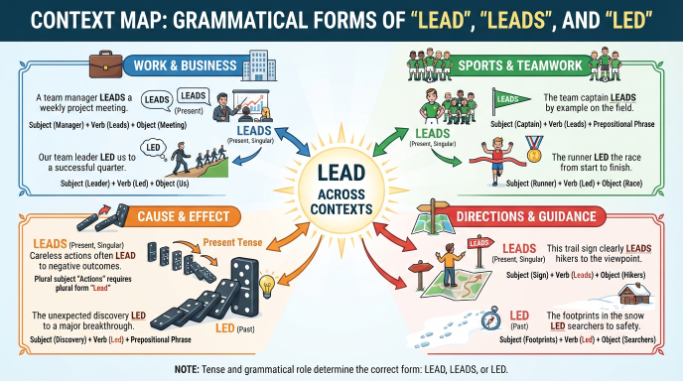
Work and Business
Use lead for a current or future responsibility:
Sarah leads the marketing team.
David will lead the presentation tomorrow.
Use led when the leadership occurred in the past:
Sarah led the marketing team last year.
David led the presentation yesterday.
Use has led when an action began in the past and is being described in relation to the present:
Sarah has led the marketing team since 2024.
Education
- Professor Khan leads the seminar every Friday.
- Professor Khan led yesterday’s seminar.
- She has led several research projects.
- The discussion may lead to a new research question.
Sports
- The home team leads by three points.
- The home team led by three points at halftime.
- The victory led to a place in the final.
- The captain will lead the team onto the field.
Notice another meaning here: lead can be a noun meaning an advantage.
The team has a five-point lead.
In that sentence, lead is not a verb. It means an advantage or position ahead of another competitor.
Cause and Effect
The expression lead to is particularly common when explaining consequences:
- Poor communication can lead to confusion.
- The error led to a costly delay.
- The new evidence may lead to further investigation.
- Several small changes have led to a significant improvement.
A useful test is to ask whether you are describing something that causes or caused a result.
Present or future:
The change could lead to better results.
Past:
The change led to better results.
Perfect:
The change has led to better results.
Directions and Physical Movement
Lead can describe guiding someone or something:
This road leads to the station.
The guide led us through the narrow passage.
The path will lead you directly to the entrance.
Here, the tense determines whether lead or led is appropriate.
Evidence, Research, and Conclusions
Academic and professional writing frequently uses lead to and led to:
The findings led to a revised interpretation.
Further testing may lead to a different conclusion.
The research has led to several new questions.
The form depends on when or how the relationship is being presented, not on whether the writing is formal.
The Other Meaning of Lead: The Metal
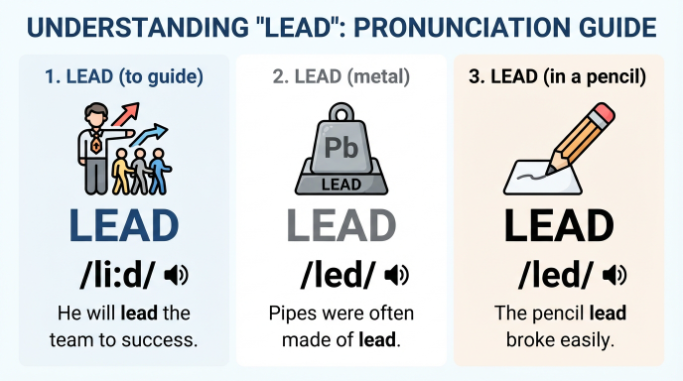
One reason lead vs led is confusing is that lead has another pronunciation and meaning.
The noun lead, meaning the chemical element, is pronounced /led/.
For example:
The paint was tested for lead.
Old pipes may contain lead.
Exposure to lead can be dangerous.
This lead sounds exactly like led, but the two words have different meanings and grammatical histories.
Compare:
The guide led the group.
Here, led is the past tense of lead /liːd/.
The pipe contains lead.
Here, lead is the metal and is pronounced /led/.
Context tells you which meaning is intended.
Lead in a Pencil
The material traditionally called pencil lead is also spelled lead, although modern pencil “lead” is generally graphite mixed with clay rather than metallic lead.
In:
I need to replace the lead in my mechanical pencil.
Lead is pronounced /led/.
So pencil lead is not spelled pencil led.
Lead, Leads, Led, and Leading
These forms are related, but they perform different grammatical jobs.
Lead
Base form:
I lead the team.
It also follows modal verbs:
She will lead the team.
Leads
Third-person singular present:
She leads the team.
It can also be a noun in some contexts, such as business prospects:
The sales team followed up with several new leads.
That is a different meaning from the verb leads.
Led
Past tense and past participle:
She led the team last year.
She has led the team for several years.
Leading
Present participle:
She is leading the team.
It can also function as an adjective:
The company is a leading provider of educational software.
Common Mistakes: Lead vs Led
“I have lead the team”
Incorrect:
I have lead the team for two years.
Correct:
I have led the team for two years.
Why? Have requires the past participle, and the past participle of lead is led.
“She will led the meeting”
Incorrect:
She will led the meeting.
Correct:
She will lead the meeting.
Why? After will, use the base form.
“He lead the team yesterday”
Incorrect:
He lead the team yesterday.
Correct:
He led the team yesterday.
Why? Yesterday identifies a completed past event, so the simple past form is required.
“The decision lead to problems”
If the sentence refers to a past event:
Incorrect:
The decision lead to several problems.
Correct:
The decision led to several problems.
For a present or general relationship:
The decision leads to several problems.
For a possible future result:
The decision could lead to several problems.
“She has lead to this result”
The correct form depends on who or what is causing the result:
Her actions have led to this result.
Not:
Her actions have lead to this result.
The auxiliary have signals the need for the past participle led.
“I was lead by the guide”
Incorrect:
I was lead by the guide.
Correct:
I was led by the guide.
The passive construction uses the past participle:
I was led by the guide.
“Led” vs “Leed”
Led is the correct spelling for the past tense of lead.
Leed is not the standard spelling of this verb form.
The pronunciation of lead as a verb can make learners think its past form should be spelled leed, but English spelling does not work that way here.

A Fast Decision Rule
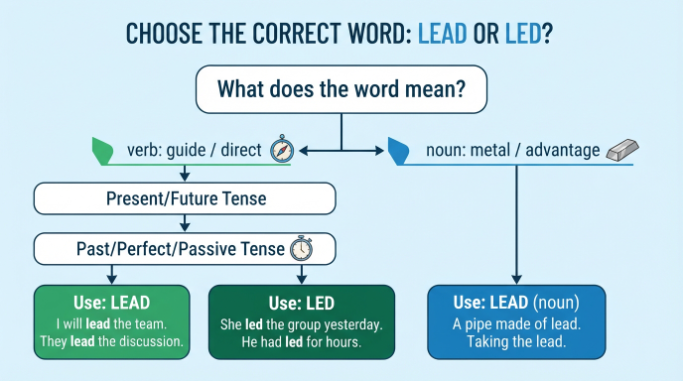
When you are unsure whether to write lead or led, check the sentence in this order.
Step 1: Is It the Metal?
If lead means the chemical element, use lead:
The sample contained lead.
It is pronounced /led/.
Step 2: Is It a Past Action?
If the verb means “guided,” “directed,” or “caused” and the action happened in the past, use led:
She led the team.
Step 3: Does It Follow Will, Can, Should, May, or Another Modal?
Use lead:
They will lead the project.
She can lead the discussion.
Step 4: Does It Follow Have, Has, or Had?
For the verb meaning “guide” or “cause,” use led:
He has led the team.
They had led the negotiations.
Step 5: Is It a Present-Tense Verb?
Use lead or leads, depending on the subject:
I lead the group.
She leads the group.
Step 6: Is It a Noun Meaning an Advantage?
Use lead:
Our team has the lead.
Here it is pronounced /led/.
The Practical Proofreading Test
A particularly useful test is to replace lead/led with another irregular verb whose forms are easier to recognize.
Try write/wrote/written:
- “She will write the report.” → “She will lead the report.”
- “She wrote the report yesterday.” → “She led the team yesterday.”
- “She has written the report.” → “She has led the team.”
The exact meanings are different, but the grammatical pattern is the same:
will + base form
simple past + past form
has/have/had + past participle
If you can identify the grammatical position, the choice between lead and led becomes much easier.
Memory Trick
Think:
Lead today, led yesterday.
Or remember the three-part pattern:
lead → led → led
You can also associate the pronunciation with another familiar word:
- lead /liːd/ rhymes with need when it means “guide.”
- led /led/ rhymes with red.
- lead /led/ meaning the metal also rhymes with red.
So:
I lead = “leed”
I led = “led”
lead metal = “led”
The spelling is easiest to remember through grammar rather than pronunciation alone.
Formal vs Casual Usage
There is no major formal-versus-casual distinction between lead and led. The choice is grammatical and semantic.
Both forms are standard in:
- academic writing
- business writing
- journalism
- everyday conversation
- technical writing
- legal writing
- professional communication
For example:
The evidence led to further investigation.
This works in both ordinary conversation and formal prose.
A more formal sentence might use a complex construction around the same verb:
The available evidence has led investigators to conclude that further review is necessary.
But led itself is not especially formal or informal.
British vs American English
The basic distinction between lead and led is essentially the same in British and American English.
In both varieties:
- lead /liːd/ is the verb meaning “guide.”
- led /led/ is its past tense and past participle.
- lead /led/ refers to the metal.
There is therefore no meaningful British-versus-American spelling difference comparable to colour/color or organise/organize.
The pronunciation distinction is also standard in both major varieties of English.
Lead vs Led in Legal Writing
Legal and administrative texts often use led in phrases describing consequences, evidence, decisions, or actions:
The investigation led to further proceedings.
The evidence led investigators to identify another issue.
The expression led to simply means that something caused or contributed to a particular result.
Led does not have a special legal definition merely because it appears in legal writing.
When people search for “led meaning in law,” the important point is that the ordinary verb led generally retains its ordinary grammatical meaning. Its exact interpretation depends on the sentence and legal context.
“Led By” vs “Lead By”
This distinction follows the same grammatical rule.
Led by
Use led by when describing something that was guided or directed in the past or in a passive construction:
The workshop was led by an experienced instructor.
The expedition was led by a local guide.
Lead by
Lead by can be correct when lead is the base verb and another grammatical structure calls for it:
We plan to lead by example.
But if you mean a passive construction, led by is normally what you need:
The team was led by its captain.
A useful question is: Who is doing the leading, or is someone being led?
“Led Me” vs “Lead Me”
Again, tense determines the choice.
Present or future:
Please lead me to the entrance.
The guide will lead me through the building.
Past:
She led me to the entrance.
His explanation led me to a different conclusion.
The same distinction applies to lead us, led us, lead them, and led them.
“Have Led” vs “Have Lead”
When the verb means “guided,” “directed,” or “caused,” the standard construction is:
have led
and
has led
Examples:
These changes have led to better results.
The decision has led to further discussion.
Their research has led to several new discoveries.
Have lead is not the standard past-participle construction for this verb.
The confusion exists because lead and led are spelled differently even though the base form and past form are closely related.
“Lead to” vs “Led to”
Both are correct. The tense is different.
Lead to
Use lead to for present, habitual, general, possible, or future situations:
Too much noise can lead to stress.
This route leads to the city center.
The new policy may lead to additional changes.
Led to
Use led to for a past result:
The storm led to widespread delays.
The mistake led to a revised schedule.
Her discovery led to further research.
Have led to
Use have led to for a result connected to the present:
Recent changes have led to higher demand.
Had led to
Use had led to when describing a cause that occurred before another past event:
The earlier decision had led to several complications before the review began.
Is Led a Verb?
Yes.
Led is a verb form: specifically, it is the simple past and past participle of lead when lead is the verb meaning “guide,” “direct,” or “cause.”
Examples:
She led the team.
He has led the investigation.
It can also appear in passive constructions:
The group was led by an experienced teacher.
So led is absolutely a word and a verb form.
Is Lead a Verb?
Yes.
Lead can be a verb meaning:
- guide
- direct
- be in charge of
- cause
- result in
- move toward
Examples:
She leads the team.
The road leads to the coast.
The decision could lead to problems.
But lead is also a noun, including the metal and the idea of an advantage or position at the front.
Is “Leaded” Correct?
For the ordinary verb lead meaning “guide” or “direct,” the standard past tense is led, not leaded.
So:
She led the group.
Not:
She leaded the group.
However, leaded can occur in specialized contexts where lead is being used in another sense, especially technical or historical uses. That does not make leaded an alternative past tense of the ordinary verb meaning “guide.”
For ordinary writing, use:
lead → led
“Leads” or “Leds”?
For the verb meaning “guides” or “directs,” the third-person singular present form is:
leads
Not:
leds
Examples:
She leads the department.
He leads the discussion.
The road leads to the harbor.
There is no standard verb form leds corresponding to the past tense led.
“Lead Lead Led” and Other Confusing Combinations
English can produce apparently strange sequences because lead has multiple meanings and pronunciations.
For example:
Lead, led, and lead are not pronounced the same way.
The first lead may be the verb /liːd/, while led and the metal lead are /led/.
A sentence can even contain multiple meanings:
The captain led the team while the team held the lead.
The first word means “guided.” The second means “an advantage.”
This is why relying only on spelling can be misleading. Grammar and context are more reliable.
Frequently Asked Questions
What is the difference between lead and led?
Lead is the present/base form of the verb meaning “guide,” “direct,” or “cause,” while led is its past tense and past participle.
I lead the team.
I led the team yesterday.
Is “led” the past tense of “lead”?
Yes. When lead means “guide” or “direct,” its past tense is led.
The three principal forms are:
lead – led – led
Has led or has lead?
Use has led when lead means “guide,” “direct,” or “cause.”
The change has led to better results.
“Has lead” is not the standard construction for this verb.
Have led or have lead?
Use have led:
They have led several projects.
The auxiliary have requires the past participle, which is led.
What does “led” mean in text?
Usually, led means that someone or something guided, directed, or caused something in the past.
For example:
“Her research led to a discovery” means her research caused or contributed to that discovery.
The exact meaning depends on context.
Is led a word?
Yes. Led is a standard English word and is the past tense and past participle of lead when the verb means “guide,” “direct,” or “cause.”
How do you spell the past tense of lead?
The correct spelling is led.
lead → led
It is not leed.
What is the pronunciation of lead and led?
The verb lead meaning “guide” is pronounced /liːd/, like “leed.”
Led is pronounced /led/, like “red.”
Lead meaning the metal is also pronounced /led/.
Is “lead” pronounced like “led”?
Sometimes.
When lead is the verb meaning “guide,” it is pronounced /liːd/.
When lead means the metal, it is pronounced /led/.
So spelling alone does not tell you the pronunciation.
When should I use lead or led?
Use lead for the base or present form and after modal verbs:
We will lead the meeting.
Use led for the past and past participle:
We led the meeting yesterday.
We have led the meeting several times.
Is “led to” correct?
Yes.
Led to is the past-tense form of lead to, meaning that something caused or contributed to a result.
The mistake led to a delay.
Is “lead to” correct?
Yes.
Use lead to when the grammar calls for the present/base form:
Poor planning can lead to problems.
The road leads to the station.
What is the difference between lead and led in British English?
The distinction is essentially the same in British and American English. The verb lead is pronounced /liːd/, while led is pronounced /led/.
What is the difference between lead and led in American English?
The grammatical distinction is the same: lead is the base/present form, while led is the past and past participle.
Is “lead” the same as “leed”?
No. Leed is not the standard spelling of the verb lead.
The verb is spelled lead but pronounced /liːd/.
Is pencil lead the same spelling?
Yes. The material inside a traditional pencil is conventionally called pencil lead, and the word lead in this expression is pronounced /led/.
What is “led by” used for?
Led by is commonly used when someone or something is guided or directed:
The project was led by an experienced engineer.
What is “lead by” used for?
Lead by can occur when lead is the base verb:
The manager tries to lead by example.
But a passive sentence normally uses led by:
The team was led by its captain.
Final Takeaway
The core distinction is simple once you separate tense, pronunciation, and meaning.
Lead is the base or present form of the verb:
I lead the team.
Led is the past tense and past participle:
I led the team yesterday.
I have led the team before.
Lead can also be a noun referring to the metal or to an advantage, and those meanings can have the pronunciation /led/.
The fastest grammar rule to remember is:
lead → led → led
If you see will, can, should, may, or another modal, use lead. If you see has, have, or had and the verb means “guide” or “cause,” use led. If the action happened in the past, led is normally the form you need.