Next Friday vs This Friday: Meaning, Difference, and Examples
Quick Answer
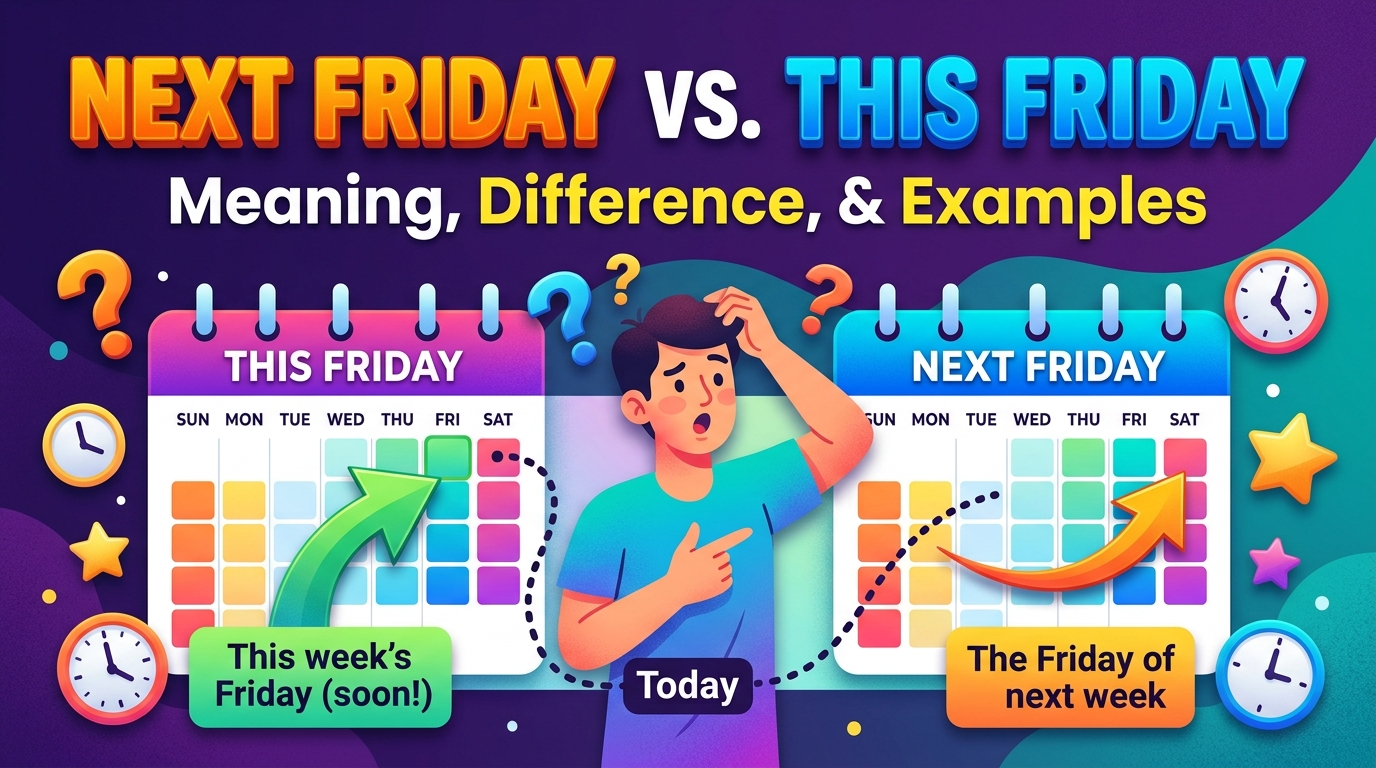
“This Friday” usually means the Friday in the current week, while “next Friday” can mean either the upcoming Friday or the Friday in the following week. The exact meaning depends on the speaker, the day of the week, and the context.
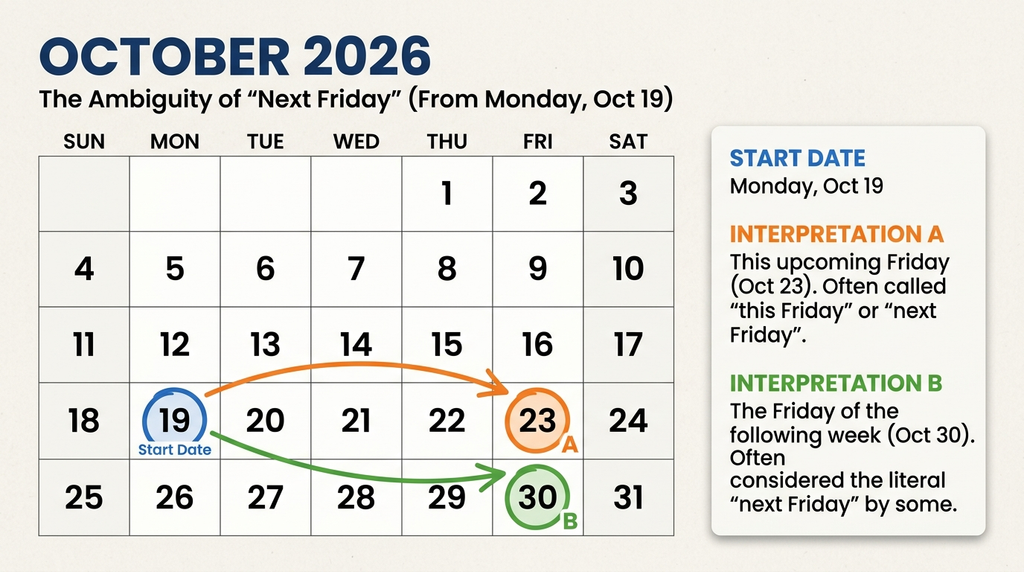
For example, if today is Monday, October 19, 2026:
- This Friday: October 23, 2026 — the Friday in the current week.
- Next Friday: October 23 or October 30, 2026 — depending on how the speaker uses the phrase.
The important point is that next Friday is not always unambiguous. If the date matters, say the exact date or ask for clarification.
At-a-Glance Table
| Feature | This Friday | Next Friday |
|---|---|---|
| Basic meaning | Usually the Friday associated with the current week | The upcoming Friday or the Friday of the following week |
| Typical reference | The current week’s Friday | Depends on the speaker and context |
| If today is Monday | Usually October 23, 2026 | October 23 or October 30, 2026 |
| If today is Friday | Often today’s Friday | May mean today or the following Friday |
| Grammar | Demonstrative determiner + day name | Time-related determiner + day name |
| Part of speech | Noun phrase | Noun phrase |
| Formality | Neutral | Neutral |
| Is the meaning always clear? | Usually, but not in every context | No; it can be ambiguous |
| Best choice for precise scheduling | Use with a date if necessary | State the exact date to avoid confusion |
Quick verdict: Use this Friday when you mean the Friday associated with the current week. Use next Friday when that is how you naturally refer to the intended Friday, but specify the date when a misunderstanding would matter.
Detailed Difference Between Next Friday and This Friday
1. What Does “This Friday” Mean?
“This Friday” refers to a particular Friday connected to the present time, usually the Friday in the current calendar week.
The word this identifies the day as belonging to the speaker’s current time frame. It does not automatically mean the nearest Friday in every possible situation; the current day and the speaker’s calendar conventions can affect the interpretation.
Examples:
- “I have a dentist appointment this Friday.” The appointment is usually on the Friday of the current week.
- “Are you free this Friday?” The speaker is asking about the Friday associated with the present week.
- “This Friday is my last day at work.” The speaker identifies a specific Friday as the final working day.
- “We’re submitting the assignment this Friday.” The deadline is associated with the current week’s Friday.
Why it works: The word this connects the day to the current time frame, making it useful for talking about an upcoming event that is already on the calendar.
2. What Does “Next Friday” Mean?
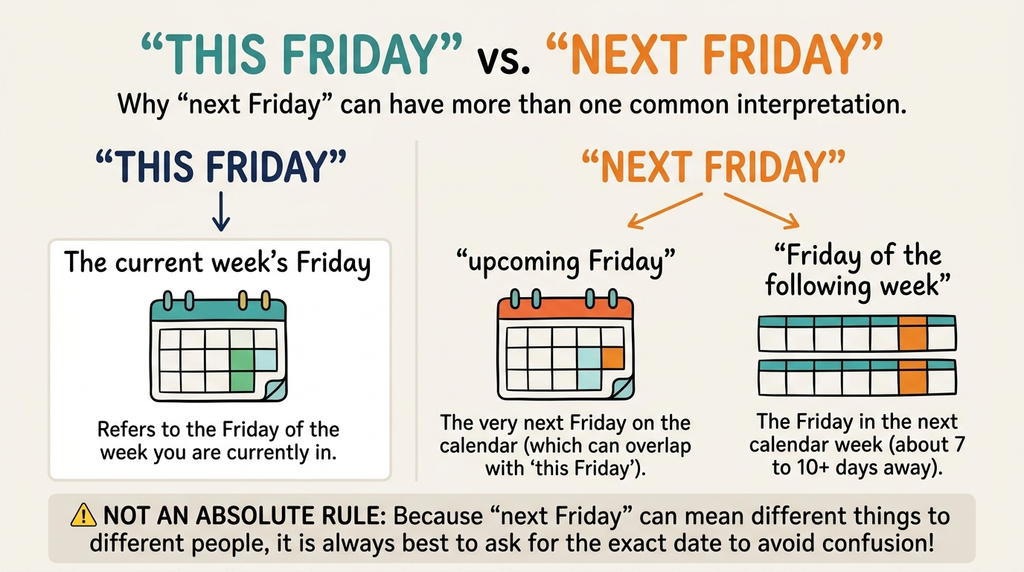
“Next Friday” identifies a Friday that is upcoming or next in a relevant sequence. In everyday English, however, people use it in two common ways:
- To mean the nearest upcoming Friday.
- To mean the Friday in the week after the current week.
For example, on Monday, October 19, 2026, one person might say “next Friday” to mean October 23, while another might mean October 30.
Examples:
- “Let’s meet next Friday.” The intended date needs context if the week is unclear.
- “The report is due next Friday.” The deadline could be interpreted differently by different readers.
- “I’ll call you next Friday, October 30.” The date removes the ambiguity.
- “We met last Friday, and we’re meeting again next Friday.” The surrounding context may help identify the intended Friday, but the exact date is still the clearest option.
Why it works: The word next expresses a following point in time or sequence. What counts as “next” depends on the reference point and the way the speaker organizes the week.
3. Is “Next Friday” the Same as “This Friday”?
Not necessarily. The expressions can refer to the same date, but they can also refer to different dates.
Consider this example:
Today is Monday, October 19, 2026.
- “I’ll see you this Friday” most naturally points to October 23.
- “I’ll see you next Friday” might point to October 23 or October 30.
Now consider a different situation:
Today is Saturday, October 24, 2026.
- “I’ll see you this Friday” may sound as though the speaker means the Friday that just passed, although some speakers may use it differently when discussing the current calendar week.
- “I’ll see you next Friday” commonly points to October 30.
The key is that this Friday and next Friday are not perfectly interchangeable. Their interpretation depends on the speaker’s reference point, the day the conversation takes place, and shared expectations.
4. What Is the Grammatical Difference?
Both expressions are noun phrases that can function as subjects, objects, or time expressions in a sentence.
| Expression | Grammatical structure | Example |
|---|---|---|
| This Friday | Demonstrative determiner + noun | This Friday works for me. |
| Next Friday | Temporal determiner + noun | Next Friday works for me. |
In both cases, Friday is a noun naming a day of the week.
The difference lies in the determiner:
- This identifies a day in relation to the present context.
- Next identifies a day as upcoming or following in a sequence.
Both phrases can appear naturally at the beginning or end of a sentence.
- “This Friday, we’re visiting the museum.”
- “We’re visiting the museum this Friday.”
- “Next Friday, we’re visiting the museum.”
- “We’re visiting the museum next Friday.”
All four sentences are grammatically correct. The potential problem is not grammar; it is whether the listener understands which date the speaker means.
When to Use Each Expression
Use “This Friday” When Referring to the Current Week
Choose this Friday when you mean the Friday associated with the current week and your audience is likely to interpret the phrase the same way.
Examples:
- “The school event is this Friday.”
- “Can we finish the project this Friday?”
- “I’m travelling this Friday, so I won’t be available.”
- “This Friday is the final day to register.”
- “Our team presentation is scheduled for this Friday.”
In each example, this Friday connects the event to the present week’s schedule.
However, if the conversation takes place late on Friday, Saturday, or Sunday, the phrase may require clarification.
Use “Next Friday” When Referring to a Following Friday
Choose next Friday when it fits the way you naturally describe the intended date, particularly when the surrounding conversation makes the date clear.
Examples:
- “Let’s discuss the proposal next Friday.”
- “My driving lesson is next Friday.”
- “The results should be announced next Friday.”
- “We’ll review the new design next Friday.”
- “Are you available next Friday afternoon?”
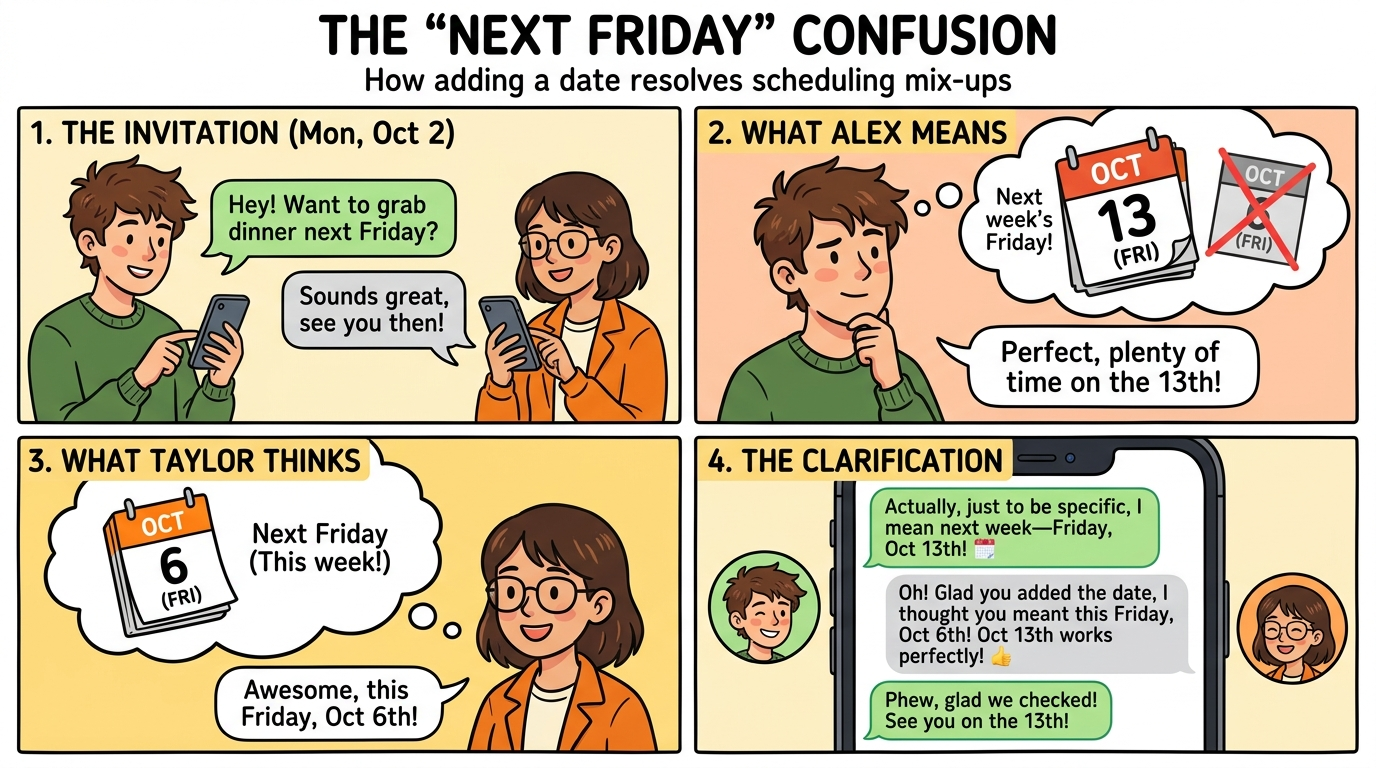
These sentences are natural English. Nevertheless, if the exact date is important, add it.
For example:
- Ambiguous: “The interview is next Friday.”
- Clear: “The interview is next Friday, October 30.”
Use an Exact Date When Precision Matters
In professional, academic, medical, travel, and other time-sensitive situations, an exact date is safer than relying on either phrase alone.
Compare these examples:
| Less precise | More precise |
|---|---|
| Submit the form this Friday. | Submit the form by Friday, October 23. |
| The meeting is next Friday. | The meeting is Friday, October 30. |
| Your appointment is this Friday morning. | Your appointment is Friday, October 23, at 10 a.m. |
| The payment is due next Friday. | The payment is due Friday, October 30. |
Practical rule: If a missed appointment, late submission, or scheduling error would cause a problem, write the date in full.
Examples of “Next Friday vs This Friday” in Different Contexts
1. Everyday Conversation
These phrases are common in casual conversation.
- “Do you want to get lunch this Friday?”
- “Let’s watch a movie next Friday.”
- “I’m visiting my cousins this Friday.”
- “Can we catch up next Friday?”
The phrases sound natural, but the listener may need to confirm the intended date.
2. School and Education
Students and teachers frequently use these expressions when discussing lessons, tests, and deadlines.
- “Our science project is due this Friday.”
- “The English test will take place next Friday.”
- “We have a parent-teacher meeting this Friday.”
- “I’ll hand in the essay next Friday.”
For school deadlines, adding the date is particularly useful when the announcement is made near the end of the week.
3. Workplace and Business Communication
In workplace messages, ambiguous scheduling can lead to missed meetings or delayed work.
- “I’ll send you the revised document this Friday.”
- “The client presentation is planned for next Friday.”
- “Let’s schedule a follow-up call this Friday.”
- “The quarterly review will be held next Friday.”
A clearer business version might be:
“Let’s schedule the follow-up call for Friday, October 23, 2026, at 2 p.m.”
This states the date and time without relying on an interpretation of this or next.
4. Text Messages and Casual Chats
In text messages, the surrounding conversation may help establish the date.
- “Are we still meeting this Friday?”
- “Can we move it to next Friday?”
- “Friday works for me!”
- “See you next Friday 😊”
The expression Friday works for me is often less specific than either this Friday or next Friday. It confirms availability on a Friday but may not identify which one.
5. Travel, Appointments, and Events
When the date determines where someone needs to be, precision matters.
- “My flight leaves this Friday.”
- “The doctor wants to see me next Friday.”
- “The wedding is this Friday.”
- “The conference starts next Friday.”
A better version for an important appointment is:
“My appointment is on Friday, October 30, 2026, at 11 a.m.”
This wording is clear even if the message is read days later or forwarded to someone in another time zone.
6. When Asking About a Date
The following questions are all natural, but they do not always produce an unambiguous date.
- “When is this Friday?”
- “What is the date of next Friday?”
- “What’s next Friday?”
- “What day is next Friday?”
- “What is the date for next Friday?”
If you need the calendar date, a direct question is usually more effective:
“Do you mean Friday, October 23, or Friday, October 30?”
That question identifies the ambiguity instead of assuming that everyone uses next Friday in the same way.
What Day Is Next Friday? How to Calculate the Date
To work out the date of next Friday, first identify today’s date and then decide which interpretation of next Friday you need.
Using Monday, October 19, 2026, as an example:
19
Mon
Today: October 19
The week begins on Monday in this example.
23
Fri
This Friday: October 23
Four days after Monday, October 19.
30
Fri
The following Friday: October 30
Eleven days after Monday, October 19.
Both October 23 and October 30 may be called next Friday in everyday speech. The calendar tells you the dates, but the phrase alone does not always reveal which date the speaker intended.
How to Work It Out Quickly
- Check today’s date.
- Find the next Friday on the calendar.
- Decide whether the speaker means that upcoming Friday or the Friday in the following week.
- Confirm the date if there is any doubt.
What Does “Next Next Friday” Mean?
“Next next Friday” is an informal expression sometimes used when people want to distinguish a later Friday from the nearest upcoming one.
For example, someone might say:
- “Not this Friday, but next next Friday.”
- “I can’t make it next Friday. How about next next Friday?”
- “Let’s meet two Fridays from now.”
The phrase next next Friday is understandable in casual conversation, but it is not a precise or universally standardized way to identify a date. Different speakers may count the Fridays differently.
For clearer communication, say:
- “Friday, October 30.”
- “Friday, November 6.”
- “Two Fridays from today, on November 6.”
The exact date is the most reliable option.
Common Mistakes and How to Correct Them
Mistake 1: Assuming “Next Friday” Always Means the Following Week
Incorrect assumption: “Next Friday can never mean the upcoming Friday.”
Correction: In everyday English, next Friday can refer to the upcoming Friday or the Friday of the following week.
Why: The word next depends on the speaker’s reference point and calendar conventions.
Mistake 2: Assuming “This Friday” Always Means the Nearest Future Friday
Potentially unclear: “I’ll do it this Friday,” said on Saturday.
Clearer: “I’ll do it on Friday, October 30.”
Why: On a weekend, the relationship between this Friday and the current calendar week may be interpreted differently.
Mistake 3: Treating the Expressions as Grammatically Incorrect
Incorrect: “You can’t say ‘next Friday’ because it’s confusing.”
Correct: “Next Friday is perfectly grammatical, although it can be ambiguous.”
Why: Ambiguity does not make an expression grammatically wrong.
Mistake 4: Using “Friday Next Day” in Place of “Next Friday”
Unnatural: “My appointment is Friday next day.”
Natural alternatives:
- “My appointment is tomorrow, Friday.”
- “My appointment is next Friday.”
- “My appointment is the following Friday.”
Why: Friday next day is not the usual English expression for identifying a Friday. Use tomorrow when the event is the next calendar day and next Friday when identifying a Friday.
Mistake 5: Writing “Friday or Friday” Without Clarification
Unclear: “Do you want Friday or Friday?”
Clearer: “Do you want Friday, October 23, or Friday, October 30?”
Why: The weekday is the same, so the dates are necessary to distinguish the options.
Mistake 6: Giving a Deadline Without a Date
Potentially unclear: “The application is due next Friday.”
Clearer: “The application is due Friday, October 30, 2026.”
Why: Readers may interpret next Friday differently, especially if they receive the message late in the week.
Mistake 7: Assuming British and American English Have a Strictly Different Rule
Incorrect: “Americans always mean the upcoming Friday, while British speakers always mean the Friday after that.”
Correction: Usage varies among individuals and contexts in both varieties of English.
Why: There is no universal national rule that removes the ambiguity. Context and explicit dates are more reliable than assumptions about nationality.
A Simple Memory Trick
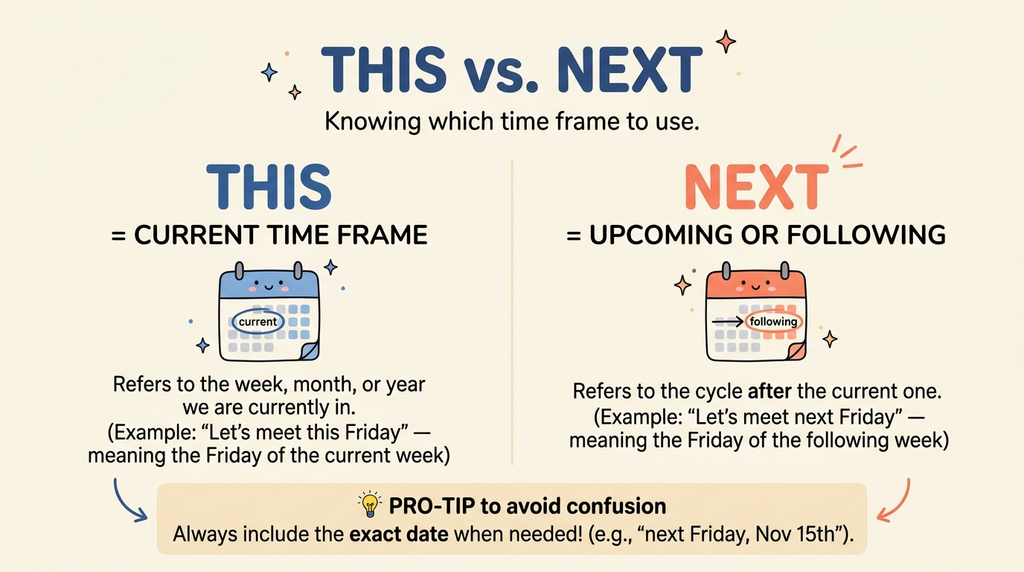
Remember the basic contrast:
- This = connected to the current time frame.
- Next = the upcoming or following point in a sequence.
Think of this Friday as the Friday associated with the current week and next Friday as a phrase that may point to the upcoming Friday or the following week’s Friday.
The trick helps you remember the general distinction, but it cannot guarantee that every listener will interpret next Friday the same way.
A Quick Decision Rule and Proofreading Test
Before sending a message, use this checklist.
Choose the clearest wording
Select the answers that match your situation.
1. Which Friday do you mean?The Friday associated with the current weekThe Friday in the following weekThe nearest upcoming Friday, regardless of week wording
2. Do you know the exact date?YesNo
3. Would a misunderstanding cause a problem?YesNo
Get a wording recommendation
The Five-Second Proofreading Test
Before sending a message containing this Friday or next Friday, ask yourself:
- Can the reader identify the exact date?
- Is the conversation taking place near the end of the week?
- Could the reader interpret next Friday differently from me?
- Would writing the date prevent confusion?
If the answer to the last question is yes, include the date.
For example:
- Original: “I’ll send the file next Friday.”
- Revised: “I’ll send the file on Friday, October 30.”
The revised sentence is more precise because it identifies the date rather than relying on the reader’s interpretation of next.
Formal vs Casual and Regional Notes
Formal English
In formal writing, business correspondence, announcements, and official schedules, exact dates are preferable whenever timing matters.
Instead of:
“The application closes next Friday.”
Write:
“The application closes on Friday, October 30, 2026.”
Both versions are grammatical. The second is more precise and easier to interpret outside the original conversation.
Casual English
In conversation with friends, family, or colleagues who share the same schedule, this Friday and next Friday are perfectly natural.
For example:
“Are we going out this Friday?”
“Actually, can we do next Friday instead?”
If both people understand the intended dates, there is no need to make ordinary conversation unnecessarily formal.
British vs American English
There is no absolute British-versus-American distinction that reliably resolves this Friday and next Friday.
Speakers in both the UK and the US may use next Friday for the upcoming Friday or the Friday of the following week. Individual habits, the day of the conversation, and the surrounding context all influence interpretation.
The safest approach is to specify the date rather than rely on a regional assumption.
Pronunciation
Both expressions use the standard pronunciation of Friday.
- This Friday: “this FRY-day”
- Next Friday: “next FRY-day”
In ordinary speech, the words may run together slightly, but pronunciation does not establish which calendar date is intended. The distinction is semantic, not a difference in pronunciation.
Frequently Asked Questions
1. What is the difference between next Friday and this Friday?
This Friday usually refers to the Friday associated with the current week. Next Friday can refer to the upcoming Friday or the Friday in the following week. Context determines the intended meaning.
2. What day is next Friday?
It depends on today’s date and the intended meaning of next Friday. Find the upcoming Friday on a calendar, then determine whether the speaker means that Friday or the Friday of the following week.
3. What is the date of next Friday?
The date changes from week to week. For example, if today is Monday, October 19, 2026, the upcoming Friday is October 23, while the following week’s Friday is October 30.
4. When is this Friday?
Usually, it is the Friday associated with the current calendar week. To avoid confusion, particularly late in the week, confirm the exact date.
5. Can “next Friday” mean tomorrow?
Yes, if tomorrow is Friday and the speaker uses next Friday to mean the nearest upcoming Friday. However, some people would interpret next Friday as the Friday of the following week. Saying “tomorrow, Friday” is clearer.
6. Does “next Friday” mean seven days from today?
Not necessarily. If today is Monday, the upcoming Friday is four days away, while the following Friday is eleven days away. Next Friday does not inherently mean exactly seven days from today.
7. Is “this Friday” correct on a Saturday or Sunday?
It can be used, but the intended date may be unclear because the current week is ending or has just ended. Naming the exact date is the safest option.
8. Is “next Friday” more correct than “this Friday”?
No. Both expressions are grammatically correct. The right choice depends on the intended date and the context.
9. What does “next next Friday” mean?
It is an informal phrase people sometimes use for a Friday farther in the future than the one they call next Friday. Because counting conventions vary, it is better to name the date or say “two Fridays from now” when that accurately describes the intended timing.
10. Is “Friday next day” correct English?
It is not the usual expression for this meaning. Say “tomorrow, Friday” if Friday is the next calendar day, or use “next Friday” to refer to a Friday in the upcoming schedule.
11. Should I write “on this Friday” or simply “this Friday”?
Both can occur in English, but “this Friday” is generally the more natural and concise choice in everyday modern usage.
For example:
- Natural: “I’ll see you this Friday.”
- Also possible, but often less natural: “I’ll see you on this Friday.”
When using a specific date, the preposition on is standard: “I’ll see you on Friday, October 23.”
12. What is the clearest way to ask which Friday someone means?
Ask directly: “Do you mean Friday, October 23, or Friday, October 30?”
This question is clearer than asking whether the person means this Friday or next Friday, because those expressions may be interpreted differently.
Final Takeaway
“This Friday” usually means the Friday associated with the current week. “Next Friday” may mean the upcoming Friday or the Friday in the following week.
Both phrases are correct English, and neither has a universally fixed interpretation in every context. The distinction is primarily about time reference and everyday usage, not grammar.
For casual conversations, either expression can work when everyone shares the same understanding. For appointments, deadlines, travel, and professional communication, writing the exact date is the most reliable solution.