Situation vs Circumstance: What’s the Difference?
Quick Answer
Situation and circumstance are closely related nouns, but they are not always interchangeable.
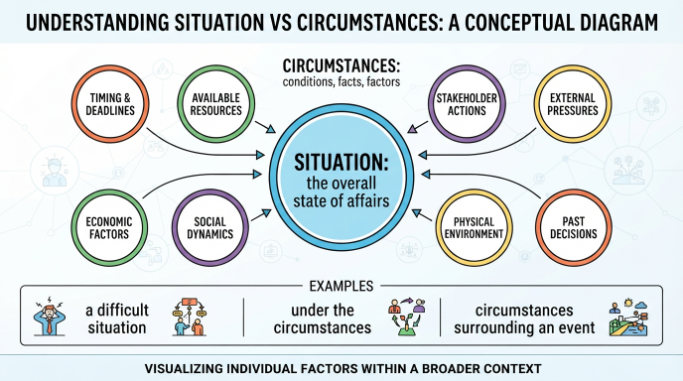
A situation is the overall state of affairs or condition that someone is dealing with. A circumstance is a particular fact, condition, or surrounding factor that affects that situation.
A useful shortcut is:
Situation = the overall state of affairs.
Circumstance = a condition or factor surrounding it.
For example:
- “I’m in a difficult situation.” → You are describing the overall problem.
- “Under the circumstances, I had to leave.” → You are referring to the conditions or factors that made leaving necessary.
- “The circumstances surrounding the accident are unclear.” → You mean the particular facts and conditions connected with the accident.
The words overlap substantially, so there are contexts in which either one can work. The key difference is usually perspective and emphasis, not a strict grammatical rule.
At-a-Glance Table
| Point | Situation | Circumstance |
|---|---|---|
| Basic meaning | An overall state of affairs or condition | A condition, fact, or factor affecting a situation |
| Part of speech | Noun | Noun |
| Typical focus | What is happening | What surrounds or influences what is happening |
| Common forms | a situation, the situation, situations | a circumstance, circumstances, the circumstances |
| Common expressions | “explain the situation,” “difficult situation” | “under the circumstances,” “given the circumstances” |
| Can be plural? | Yes: situations | Yes: circumstances |
| Countability | Usually countable | Singular is countable; plural is especially common |
| Typical question | “What is happening?” | “What conditions or factors are involved?” |
| Register | Neutral and widely used | Neutral to formal, especially in fixed expressions |
| Example | “We need to understand the situation.” | “We need to understand the circumstances.” |
The Detailed Difference Between Situation and Circumstance
What Does “Situation” Mean?
Situation refers to the particular state of affairs that exists at a given time and place.
It can describe something simple, serious, temporary, complicated, social, personal, political, professional, or practical.
Consider:
“The situation is getting worse.”
Here, situation refers to the whole set of events or conditions currently taking place. The speaker is not necessarily identifying every individual cause.
Other examples include:
- “We need to improve the situation.”
- “She found herself in an uncomfortable situation.”
- “The situation at work has changed.”
- “Can you explain the situation?”
- “What should we do in this situation?”
- “The situation is more complicated than it first appeared.”
The word is particularly natural when you are talking about what is happening overall.
What Does “Circumstance” Mean?
Circumstance refers to a condition, fact, or factor that accompanies an event or affects a person or situation.
It is frequently used in the plural:
“The circumstances were unusual.”
Here, circumstances means the various conditions and facts surrounding the matter.
For example:
- “We don’t know the circumstances of his departure.”
- “Under the circumstances, waiting seemed sensible.”
- “She succeeded despite difficult circumstances.”
- “The circumstances surrounding the decision remain unclear.”
A circumstance can therefore be thought of as one part of the context surrounding something.
Why the Words Sometimes Seem Interchangeable
The distinction becomes less obvious because both words can describe conditions.
Compare:
“She is in a difficult situation.”
and:
“She is living under difficult circumstances.”
Both communicate that her life is difficult, but they frame the information differently.
The first emphasizes the state she is currently dealing with.
The second emphasizes the conditions affecting her life.
This is why dictionaries and ordinary usage can show considerable overlap. You should not treat situation and circumstance as two completely separate categories.
Situation vs Circumstance: The Main Conceptual Difference
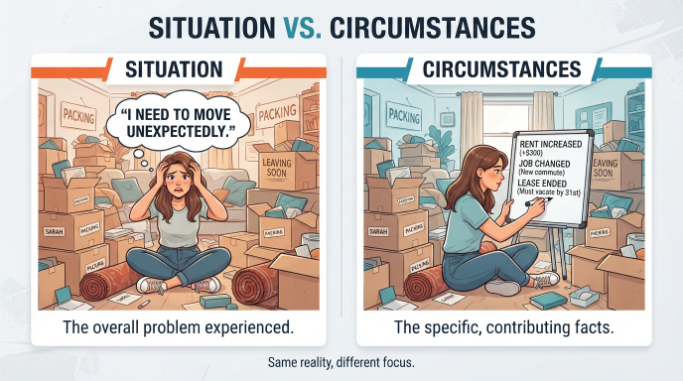
A helpful way to understand the relationship is to imagine a photograph.
The situation is the picture as a whole.
The circumstances are the surrounding details that help explain why the picture looks that way.
Suppose a student misses an examination.
The situation might be:
“The student missed the examination.”
The circumstances might include:
- the student became ill,
- public transportation was delayed,
- the examination date had been changed,
- the student received incorrect information.
You could therefore say:
“We need to understand the situation before deciding what to do.”
But you might also say:
“We need to consider the circumstances that led to the missed examination.”
The first focuses on the overall problem. The second focuses on the factors surrounding it.
When to Use “Situation”
Use situation when you want to describe the overall state of affairs.
When explaining what is happening
“Let me explain the situation.”
This is one of the most natural uses of situation. You are preparing to describe the overall circumstances, events, or problem.
When describing a problem
“This is a difficult situation.”
“We are trying to resolve the situation.”
Here, situation identifies the problem as a whole.
When talking about a particular context
“What would you do in this situation?”
The phrase refers to a hypothetical or actual set of conditions in which someone must act.
When referring to changing conditions
“The situation has changed since yesterday.”
This means the overall state of affairs is now different.
When discussing social or interpersonal circumstances
“She didn’t know how to handle the situation.”
The word can describe an awkward conversation, disagreement, emergency, workplace problem, family issue, or other social context.
When to Use “Circumstance”
Use circumstance when you want to emphasize particular conditions, facts, or surrounding factors.
When discussing the facts surrounding an event
“The circumstances of the accident are still being investigated.”
The focus is on the facts and conditions connected with the accident.
When explaining why something happened
“The circumstances forced him to reconsider his plans.”
The circumstances are the external conditions that influenced the decision.
When referring to conditions affecting someone’s life
“People respond differently depending on their circumstances.”
Here, circumstances can include financial, social, family, professional, geographical, or other conditions.
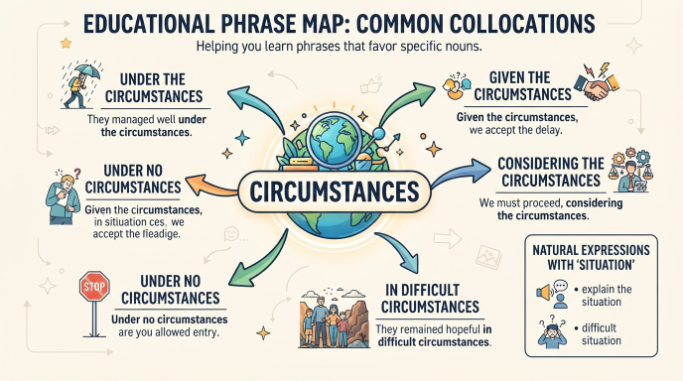
When using established expressions
Some expressions strongly favor circumstances:
- under the circumstances
- given the circumstances
- considering the circumstances
- in the circumstances
- in difficult circumstances
- in favorable circumstances
- under no circumstances
For example:
“Given the circumstances, we decided to postpone the meeting.”
“Under no circumstances should the equipment be operated without training.”
These expressions are conventional, so replacing circumstances with situation can sound unnatural or change the meaning.
Situation or Circumstance in Different Contexts
Everyday Problems
Situation is usually the more natural choice when referring to an immediate problem.
“We need to deal with this situation.”
“I don’t know what to do in this situation.”
“The situation at home is complicated.”
You can use circumstances when emphasizing the conditions behind the problem:
“Her circumstances made it difficult to find another job.”
Explaining an Event
Both words can work, but their focus differs.
“Can you explain the situation?”
This asks someone to describe what is happening.
“Can you explain the circumstances?”
This more strongly suggests a request for the facts or conditions surrounding what happened.
Compare:
“The police are trying to understand the situation.”
with:
“The police are investigating the circumstances of the incident.”
The second formulation naturally emphasizes the surrounding facts.
Personal Life
Both words are common:
“He is in a difficult situation.”
“He is living in difficult circumstances.”
The first describes his current predicament.
The second describes the conditions of his life.
Work
“The situation at the company has changed.”
This describes the overall state of the workplace.
“The circumstances surrounding her resignation remain unclear.”
This focuses on the particular facts and conditions connected with her resignation.
Decisions
Both can occur:
“We need to consider the situation carefully.”
“We need to consider the circumstances carefully.”
The first is broader. The second draws attention to the factors that should influence the decision.
Emergencies
“Stay calm and assess the situation.”
This is highly natural because an emergency requires understanding what is happening overall.
You might then say:
“The circumstances of the emergency are still being investigated.”
That second sentence focuses on the surrounding facts.
“The Circumstances” vs “The Situation”
These expressions are sometimes interchangeable, but not always.
“The situation”
The situation usually means the current state of affairs.
“The situation is under control.”
“We need to monitor the situation.”
“Nobody understands the situation.”
“The circumstances”
The circumstances usually means the relevant conditions or facts surrounding a person, event, or decision.
“The circumstances were beyond our control.”
“We need to consider the circumstances.”
“The circumstances surrounding the agreement are unusual.”
A useful test is:
If you could replace the word with “what is happening,” try situation.
If you could replace it with “the conditions or facts involved,” try circumstances.
“Under the Circumstances” vs “In This Situation”
These expressions are related but have slightly different uses.
“Under the circumstances, we left early.”
This means that considering the conditions that existed, leaving early was understandable or necessary.
“In this situation, we should leave early.”
This describes the appropriate action in the situation being discussed.
Both can communicate a similar practical conclusion, but under the circumstances specifically highlights the conditions influencing the decision.
“Considering the Circumstances”
Considering the circumstances means taking relevant conditions or facts into account.
For example:
“Considering the circumstances, her response was understandable.”
This does not necessarily mean that her response was ideal. It means that the surrounding facts should be taken into account when interpreting it.
Similarly:
“Considering the circumstances, the delay was relatively short.”
This expression is especially useful when context changes how an event should be interpreted.
“Given the Circumstances”
Given the circumstances has a similar meaning:
“Given the circumstances, postponing the event was sensible.”
It means taking the existing conditions into account.
The phrase is common in both everyday and formal English.
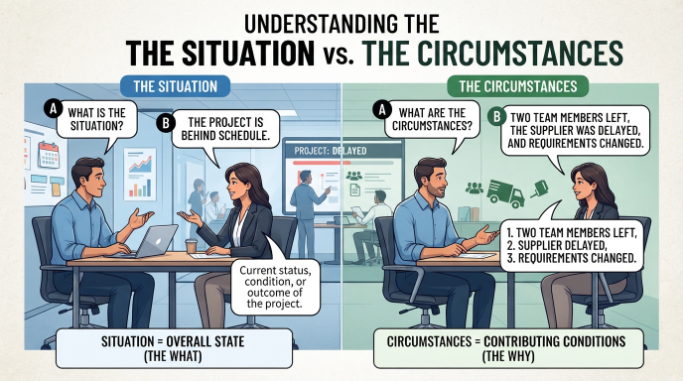
“What Are the Circumstances?”
The question “What are the circumstances?” is grammatically correct.
It usually asks about the facts or conditions surrounding something.
For example:
“What are the circumstances surrounding the agreement?”
“What are the circumstances that led to the decision?”
By contrast:
“What is the situation?”
usually asks for an explanation of what is happening overall.
So:
What is the situation? → Tell me what is happening.
What are the circumstances? → Tell me about the conditions or facts surrounding it.
Circumstance or Circumstances?
This is an important grammar point.
Circumstance is a countable noun when referring to an individual condition or fact.
“One unusual circumstance affected the decision.”
“This circumstance made the problem more difficult.”
But circumstances is extremely common when referring to a collection of conditions.
“The circumstances were difficult.”
“We considered all the circumstances.”
“Under the circumstances, there was little we could do.”
The plural is especially natural when you mean the overall conditions surrounding something.
“What Is Circumstance?” vs “What Is a Circumstance?”
The more natural question when asking about the noun itself is:
“What is a circumstance?”
For example:
“A circumstance is a condition or fact that affects a situation or event.”
“What is circumstance?” is generally not the normal way to ask for the meaning of the noun in standard English.
If you mean the plural concept, ask:
“What are circumstances?”
or more naturally:
“What does ‘circumstances’ mean?”
Can “Situation” Be Plural?
Yes.
“Different situations require different responses.”
“She has encountered similar situations before.”
“We discussed several possible situations.”
Situations refers to multiple states of affairs or contexts.
This is different from circumstances, which usually refers to multiple conditions or factors.
Compare:
“People behave differently in different situations.”
This emphasizes different contexts or settings.
“People respond differently depending on their circumstances.”
This emphasizes different personal conditions or surrounding factors.
Different Circumstances
The phrase different circumstances is completely natural.
It can refer to differences in people’s lives, conditions, or situations:
“People may make different decisions in different circumstances.”
“The same approach may not work in different circumstances.”
“They grew up in very different circumstances.”
In the final example, circumstances can include social, economic, family, geographical, or other conditions.
Circumstances Surrounding an Event
The expression “the circumstances surrounding…” is particularly common when discussing events.
For example:
“The circumstances surrounding the decision remain unclear.”
“Researchers examined the circumstances surrounding the incident.”
“The circumstances surrounding her departure were never fully explained.”
Here, circumstances means the relevant facts and conditions connected with the event.
Contemporary Circumstances
Contemporary circumstances means the conditions or situation existing in the present period or in a particular modern context.
For example:
“The policy should be reconsidered in light of contemporary circumstances.”
The phrase is relatively formal. In everyday English, speakers might simply say:
“The policy should be reconsidered because circumstances have changed.”
or:
“The policy needs to reflect current conditions.”
What Is a Contemporary Circumstance?
A contemporary circumstance is a condition or fact that exists in the present period.
For example:
“Digital communication has changed the contemporary circumstances in which many businesses operate.”
However, the singular expression is less common than contemporary circumstances because real-world conditions usually involve multiple factors.
“Situation” and “Circumstance” in Formal Writing
Both words are acceptable in formal writing, but circumstances can sound more formal when referring to surrounding conditions.
Compare:
“The situation requires further investigation.”
with:
“The circumstances surrounding the incident require further investigation.”
The second sentence is more specific because it identifies the focus as the conditions and facts surrounding the incident.
However, using circumstances simply to sound formal can make writing unnecessarily abstract.
For example:
“We must respond appropriately to the situation.”
is often clearer than:
“We must respond appropriately to the circumstances.”
if you simply mean the overall problem.
Good editing is therefore not about choosing the more formal-looking word. It is about choosing the word that expresses the intended meaning most precisely.

Common Mistakes
Mistake 1: Treating the Words as Perfect Synonyms
They overlap, but they are not identical in emphasis.
Less precise:
“The circumstances is getting worse.”
Correct:
“The situation is getting worse.”
Why? Situation is singular here, and the phrase refers to the overall state of affairs.
Mistake 2: Using “Situation” in a Fixed Expression
“Under the situation, we decided to leave.”
This is generally unnatural.
Prefer:
“Under the circumstances, we decided to leave.”
Or:
“Given the situation, we decided to leave.”
Both natural expressions exist, but their constructions differ.
Mistake 3: Confusing “Circumstance” With “Situation”
“The circumstances at work are stressful.”
This can be correct, but it emphasizes the conditions affecting the workplace or people there.
“The situation at work is stressful.”
This more directly describes the overall state of affairs.
Neither sentence is automatically wrong. The intended emphasis matters.
Mistake 4: Using “Circumstances” When You Mean One Specific Condition
“One circumstances caused the delay.”
Incorrect.
Use:
“One circumstance caused the delay.”
Or:
“Several circumstances caused the delay.”
Mistake 5: Writing “Circumstand”
Circumstand is not the standard English noun.
The correct spelling is:
circumstance
Plural:
circumstances
Mistake 6: Misspelling “Situation”
Forms such as situartion are misspellings.
The standard spelling is:
situation
Pronunciation can help reinforce the spelling: situation is commonly pronounced /ˌsɪtʃuˈeɪʃən/ in both major varieties of English, with some regional variation.
Situation Pronunciation
Situation is pronounced approximately:
sit-choo-AY-shən
IPA: /ˌsɪtʃuˈeɪʃən/
The stress falls on -ay-.
Circumstance Pronunciation
Circumstance is commonly pronounced approximately:
SUR-kum-stans
IPA: /ˈsɜːrkəmstæns/ in many British pronunciations and /ˈsɝːkəmstæns/ in many American pronunciations.
The plural circumstances adds the final /ɪz/ or similar plural sound:
circumstances
Pronunciation differences between British and American English do not create a meaningful difference in the words’ basic meanings.
British vs American English
There is no major British-American distinction between situation and circumstance.
Both words are standard in British and American English, and their core meanings are substantially the same.
There can be small differences in preferred phrasing or pronunciation from speaker to speaker, but you do not need separate vocabulary rules for the two varieties.
Expressions such as:
- “under the circumstances”
- “given the circumstances”
- “the current situation”
- “a difficult situation”
- “the circumstances surrounding the event”
are standard across both varieties.
Situation vs Circumstance: A Fast Decision Rule
Ask yourself what you are trying to describe.
Choose “situation” if you mean:
What is happening overall?
“The situation is serious.”
What problem are we dealing with?
“We need to solve this situation.”
What context are we in?
“What would you do in this situation?”
Choose “circumstance” or “circumstances” if you mean:
What conditions surround or affect it?
“Her circumstances changed.”
What facts explain the event?
“The circumstances of the case are unusual.”
What conditions should we take into account?
“Given the circumstances, we left.”
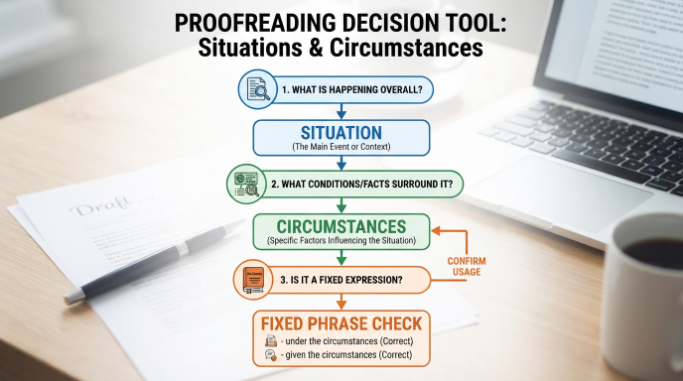
The Practical Proofreading Test
When editing your own sentence, try these substitutions.
Test 1: “What is happening?”
If that question captures your meaning, situation is often the better choice.
“Can you explain the situation?”
= “Can you explain what is happening?”
Test 2: “What conditions or facts are involved?”
If that captures your meaning, circumstances is often better.
“We need to understand the circumstances.”
= “We need to understand the relevant conditions and facts.”
Test 3: Check the expression
If you have written a familiar phrase such as:
“under ___”
the standard expression is usually:
under the circumstances
not under the situation.
If you mean:
“the overall problem”
then:
the situation
is often the natural choice.
Examples of Situation and Circumstance
Here are natural examples showing the difference in emphasis.
Situation Examples
“The situation has become more complicated.”
“I understand your situation.”
“We need to assess the situation before acting.”
“She handled the situation calmly.”
“What is the situation at the moment?”
“This situation requires careful planning.”
“I have never been in a situation like this before.”
“The situation changed unexpectedly.”
Circumstance Examples
“He grew up in difficult circumstances.”
“We don’t know the circumstances of the decision.”
“Under the circumstances, they did what they could.”
“Her circumstances have changed considerably.”
“The circumstances surrounding the event remain unclear.”
“Given the circumstances, the delay was understandable.”
“They had to adapt to changing circumstances.”
“The decision was reasonable under the circumstances.”
Paired Examples: Same Topic, Different Focus
A delayed flight
Situation:
“The situation at the airport is chaotic.”
Overall state of affairs.
Circumstances:
“The circumstances causing the delays include severe weather and equipment problems.”
Specific contributing factors.
A workplace disagreement
Situation:
“The situation between the two departments is becoming difficult.”
Overall relationship or problem.
Circumstances:
“The circumstances surrounding the disagreement are more complicated than they appear.”
Relevant background factors.
A financial problem
Situation:
“We need to improve our financial situation.”
Overall financial condition.
Circumstances:
“His financial circumstances changed after he lost his job.”
Conditions affecting his finances.
A missed appointment
Situation:
“There was a problem with the appointment.”
Overall problem.
Circumstances:
“The circumstances that caused the missed appointment were unusual.”
Specific factors behind it.
What Is the Difference Between Site and Situation?
This is a different distinction from situation vs circumstance, but the words are sometimes confused because site and situation have a specialized meaning in geography.
In human geography:
- Site refers to the physical characteristics of the actual location where a settlement is situated.
- Situation refers to the settlement’s location in relation to other places and surrounding features.
For example, a settlement’s site might involve a river terrace, fertile soil, a defensive hill, or access to water.
Its situation might describe its position relative to nearby cities, trade routes, rivers, roads, or regions.
So:
Site = the characteristics of the place itself.
Situation = the place’s relative position and connections to its surroundings.
This geographical meaning of situation is related to the broader idea of context or position, but it is more specialized than the everyday use of the word.
How Are Site and Situation Different?
A simple geographical example makes the distinction clearer.
Imagine a town built on slightly elevated land beside a river.
Its site includes the elevated ground and the river beside which it was established.
Its situation includes its location relative to nearby cities, roads, ports, markets, and other settlements.
Therefore, a place can have a particular site and a particular situation at the same time.
This meaning should not be confused with everyday expressions such as “a difficult situation.”
Related Words: Context, Condition, Circumstance, Situation
These words overlap, but they have different typical uses.
| Word | Typical emphasis |
|---|---|
| Situation | Overall state of affairs |
| Circumstance | A condition or factor surrounding something |
| Context | Information or conditions that help something be understood |
| Condition | A particular state or requirement |
| Environment | The surrounding physical, social, or organizational setting |
| Setting | The place or context in which something occurs |
For example:
“The situation is difficult.”
describes the overall state.
“The circumstances are difficult.”
emphasizes the conditions affecting it.
“The context is important.”
emphasizes information needed to understand it.
“The working conditions are difficult.”
focuses on particular conditions.
“The social environment is difficult.”
focuses on the surrounding social setting.
These words should therefore not be treated as interchangeable in every sentence.
Frequently Asked Questions
Is “situation” the same as “circumstance”?
Not exactly. They overlap, but situation usually describes the overall state of affairs, while circumstance refers more specifically to a condition, fact, or factor surrounding or affecting it.
Is it “circumstance” or “circumstances”?
Both are grammatically correct. Circumstance refers to one condition or fact, while circumstances commonly refers to several conditions collectively.
“One circumstance affected the decision.”
“The circumstances affected the decision.”
What is meant by “circumstances”?
Circumstances means the conditions, facts, or factors surrounding a person, event, decision, or situation.
What does “under the circumstances” mean?
It means considering the conditions that existed at the time.
“Under the circumstances, leaving early was reasonable.”
Can I say “under the situation”?
Usually not when you mean the conventional expression. Use “under the circumstances” or, depending on your meaning, “given the situation.”
Is “given the circumstances” correct?
Yes. Given the circumstances is a standard expression meaning that the relevant conditions have been taken into account.
What does “considering the circumstances” mean?
It means taking the surrounding facts or conditions into account when making a judgment or understanding an event.
Is “explain the situation” correct?
Yes. Explain the situation is a very common and natural expression. It normally asks someone to describe what is happening or to provide an account of the overall circumstances.
Is “explain the circumstances” correct?
Yes. It usually places more emphasis on the facts or conditions surrounding an event.
What are examples of circumstances?
Circumstances can include factors such as someone’s financial position, family responsibilities, location, timing, available resources, health of an organization, weather, legal conditions, or other facts relevant to an event. The appropriate circumstances depend on the context.
What does “different circumstances” mean?
It means different conditions or sets of factors affecting a person, event, decision, or situation.
Is “circumstand” a word?
No. Circumstand is not the standard English spelling. The correct noun is circumstance.
Is “situartion” a word?
No. Situartion is a misspelling. The correct spelling is situation.
What is a contemporary circumstance?
A contemporary circumstance is a condition or fact belonging to the present period or current context. The plural contemporary circumstances is often more natural because several conditions are usually involved.
What is the difference between site and situation?
In geography, site refers to the physical characteristics of a location itself, while situation describes its position relative to surrounding places and features.
Final Takeaway
The clearest distinction is:
Situation = the overall state of affairs.
Circumstance = a condition, fact, or factor surrounding or affecting that state of affairs.
Use situation when you want to explain what is happening overall:
“Can you explain the situation?”
Use circumstance/circumstances when you want to discuss the conditions or facts surrounding it:
“We need to understand the circumstances.”
When in doubt, ask yourself:
Am I describing the whole problem or state of affairs? → situation.
Am I describing the conditions or factors surrounding it? → circumstances.
And remember that the distinction is not absolute. In ordinary English, the two nouns overlap, so context determines the most natural choice. Fixed expressions such as “under the circumstances,” “given the circumstances,” and “considering the circumstances” are especially important to learn as complete phrases.