Sell vs Sale: Meaning, Difference, Examples, and Correct Usage
Quick Answer
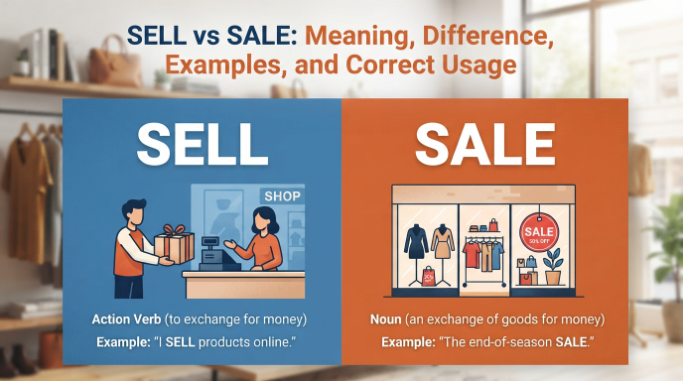
Sell and sale are related words, but they do different grammatical jobs.
- Sell is primarily a verb. It means to give something to someone in exchange for money.
- Sale is primarily a noun. It means the act or process of selling something, or an occasion when goods are offered for purchase, often at reduced prices.
Compare:
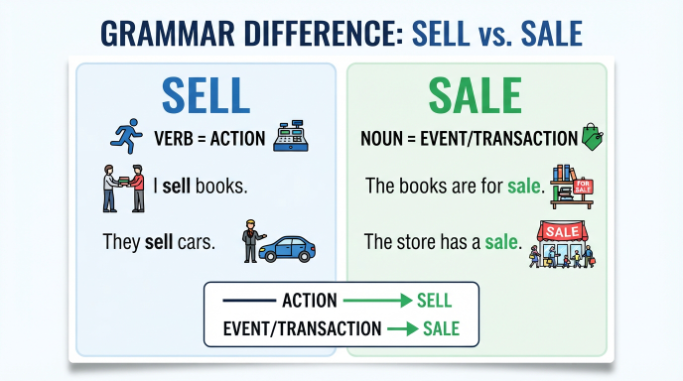
- I want to sell my car. → Sell is the action.
- My car is for sale. → Sale describes its availability for purchase.
- The store sells shoes. → Sells is a verb.
- The store is having a shoe sale. → Sale is a noun.
A simple rule is:
If you need an action, use sell. If you need a noun for the transaction or an event involving selling, use sale.
There is an important exception to this simple rule: sales can also be a noun referring to the activity or amount of goods sold, while sells is a verb used with a singular third-person subject.
Sell vs. sale in one sentence
The shop sells furniture, and its weekend sale starts Friday.
Here, sells tells us what the shop does, while sale names the promotional event.
At-a-Glance Table
| Word | Main part of speech | Basic meaning | Example |
|---|---|---|---|
| sell | Verb | To exchange something for money | I want to sell my laptop. |
| sells | Verb | Third-person singular form of sell | She sells handmade bags. |
| sold | Verb/adjective-like participle | Past tense and past participle of sell | He sold his old bike. |
| selling | Verb/gerund/present participle | The act of exchanging something for money | They are selling their house. |
| sale | Noun | An act, transaction, or event involving selling | The store is having a sale. |
| sales | Noun | Selling activity, revenue, or multiple sales | Sales increased this year. |
Pronunciation
Sell is pronounced approximately /sel/, rhyming with bell and tell.
Sale is pronounced approximately /seɪl/, rhyming with mail, tail, and scale.
The vowel sound is different, so sell and sale are not homophones.
The Detailed Difference Between Sell and Sale
The biggest difference between sell and sale is grammatical.
Sell is a verb
Sell describes an action.
When someone sells something, they offer it to another person in exchange for money or another agreed form of payment.
Examples:
- I want to sell my old phone.
- They sell fresh vegetables.
- She sold her apartment last year.
- We are selling tickets online.
- Does this shop sell batteries?
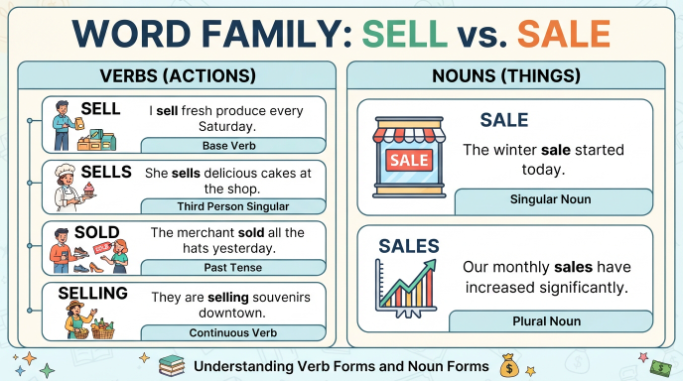
The form changes depending on tense and subject:
- Present: sell
- Third-person singular present: sells
- Past: sold
- Past participle: sold
- Present participle/gerund: selling
So sale cannot normally replace sell when the sentence needs a verb.
Incorrect:
I want to sale my car.
Correct:
I want to sell my car.
The reason is grammatical: want to must be followed by the base form of a verb, and sell is the verb.
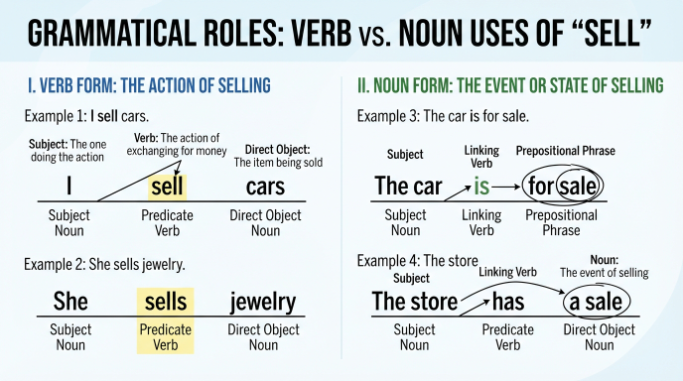
Sale is a noun
Sale is a noun. It can refer to the act or transaction of selling, or to an event in which products are offered for purchase.
Examples:
- The sale of the property was completed yesterday.
- The store is having a summer sale.
- The house is for sale.
- The company reported a large sale.
- The painting was withdrawn from the sale.
It can also refer specifically to a period when goods are offered at reduced prices:
The clothing store is having a sale this weekend.
This is why you see expressions such as:
- for sale
- on sale
- a sale
- sale price
- sales department
- sales figures
- sales tax
- sale agreement
When to Use Sell
Use sell when you are describing what a person, business, or organization does.
Talking about an action
I want to sell my old camera.
The speaker is describing an intended action.
Talking about what a business offers
This company sells office furniture.
Here, sells is the verb because it describes what the company does.
Talking about a transaction
They sold the house in June.
Because the transaction happened in the past, sold is required.
Talking about an ongoing activity
She is selling handmade candles online.
Selling describes an activity that is happening or continuing.
Asking whether something is available from a business
Do you sell replacement parts?
Not:
Do you sale replacement parts?
The question requires a verb after do.
When to Use Sale
Use sale when the sentence needs a noun.
For a promotional event
The store is having a sale.
Here, sale names the event.
For something available to purchase
The house is for sale.
This is one of the most important fixed expressions to remember.
For sale means that something is available for someone to buy.
Is this bicycle for sale?
The property has been for sale for several months.
For a reduced-price event
Everything is 30% off during the winter sale.
For the transaction itself
The sale of the company was announced yesterday.
In this meaning, sale refers to the transaction rather than a discount event.
Sell vs Sale Examples by Context
Understanding the words in real contexts is more useful than memorizing isolated definitions.
Buying and selling products
We sell computers and accessories.
The business performs the action of selling.
Our computers are currently on sale.
Here, sale means they are being offered at a reduced price.
Real estate
They want to sell their house.
Their house is for sale.
The sale of the house was completed last month.
All three are correct, but each word performs a different grammatical function.
Online shopping
I want to sell this jacket online.
The jacket is now for sale.
The website is running a winter sale.
The jacket sold within an hour.
Notice how the forms change depending on the sentence.
Business
The company sells software to small businesses.
Its annual sales reached a record level.
The sale of the division was completed in July.
Here, sells, sales, and sale are all nouns or verbs with related meanings, but they cannot simply be substituted for one another.
Tickets
Where can I sell these concert tickets?
The tickets are for sale.
Ticket sales opened at noon.
The first batch sold out quickly.
These examples demonstrate four related forms:
sell → sale → sales → sold
but each has a different grammatical role.
Used cars
I am trying to sell my car.
My car is for sale.
The sale is still being negotiated.
The car was sold yesterday.
Again, the underlying idea is the same, but grammar determines the correct form.
Sell, Sells, Sold, Selling, and Sale
A major source of confusion is treating all these words as interchangeable.
They are related forms, but they do not work in the same places.
Sell
Base verb:
I sell handmade furniture.
They sell fruit at the market.
Sells
Third-person singular present:
He sells watches.
The company sells electronics.
A useful test is to look at the subject.
She sells books.
They sell books.
I sell books.
Sold
Past tense and past participle:
She sold her car.
The house was sold last week.
Selled is not the standard past tense of sell.
Incorrect:
I selled my bike yesterday.
Correct:
I sold my bike yesterday.
Selling
Present participle or gerund:
They are selling their old furniture.
Selling products online requires patience.
Sale
Noun:
The store announced a big sale.
Sales
Plural noun or uncountable business noun
The company reported strong sales.
Sales increased during December.
This is especially important for searches such as “sells or sales meaning” and “sales vs sells.”
Compare:
She sells clothes.
Here, sells is a verb.
Her clothing sales are increasing.
Here, sales is a noun.
“For Sale” vs “For Sell”
This is one of the most common questions involving these words.
The standard expression is:
for sale
Not:
for sell
Examples:
- The house is for sale.
- Is this table for sale?
- The painting is for sale.
- Those bikes are for sale.
Why?
Because sale is the noun that fits after the preposition for in this established construction.
Compare:
I want to sell the house.
but:
The house is for sale.
A useful way to remember this pair is:
I sell it. It is for sale.
“On Sale” vs “Sell”
On sale is also a fixed expression.
These shoes are on sale.
This usually means the shoes are being offered at a reduced price, especially in American English.
Do not replace sale with sell:
These shoes are on sell. ❌
The correct expression is:
These shoes are on sale. ✅
Sale price
You can also say:
The sale price is $40.
Here, sale modifies the noun price.
“Sale” Does Not Always Mean “Discount”
A common oversimplification is to assume that sale always means a discount.
It does not.
Sale can refer to a transaction more generally.
For example:
The sale of the building was finalized yesterday.
There is no necessary suggestion that the building was discounted.
Likewise:
The sale of the business took several months.
Here, sale means the transfer or transaction.
In retail contexts, however, a sale often refers to a promotional period in which products are sold at reduced prices.
Context determines the meaning.
Sale vs Selling
Selling is a verb form, while sale is a noun.
Compare:
Selling a house can take time.
The sale of the house took six months.
The first sentence focuses on the activity or process.
The second focuses on the transaction.
Another example:
Selling products online requires good customer service.
Online sales have increased.
Selling describes an activity. Sales describes the business results or transactions.
Is “saleing” correct?
No. The standard spelling is:
selling
Not:
saleing
The confusion probably occurs because sale and sell look related, but the present participle of sell is formed as:
sell → selling
The word sale does not produce saleing.
Incorrect:
She is saleing clothes online.
Correct:
She is selling clothes online.
“Sell It” vs “Sale It”
When you mean the action of getting money for something, use sell:
Sell it if you no longer need it.
Not:
Sale it if you no longer need it.
The same distinction applies to questions:
Should I sell it?
Not:
Should I sale it?
The verb is sell, while the noun is sale.
“I Want to Sell” or “I Want to Sale”?
The correct sentence is:
I want to sell my car.
Why?
The structure is:
want + to + base verb
Examples:
- I want to buy it.
- I want to sell it.
- I want to keep it.
- I want to return it.
Because sale is a noun, it cannot normally occupy this position.
The same applies to:
I need to sell my laptop.
They plan to sell the property.
We decided to sell the old equipment.
“Do You Sell or Sale?”
The correct question is:
Do you sell this product?
Not:
Do you sale this product?
The auxiliary do is followed by the base form of the verb:
Do + subject + sell…?
For example:
Do you sell shoes?
Do they sell tickets?
Does she sell handmade products?
Notice that after does, the verb returns to its base form:
Does she sell jewelry?
Not:
Does she sells jewelry?
“Who Sells” or “Who Sales”?
The correct form is:
Who sells this product?
Here, sells is a verb.
Sales is a noun:
Our sales team handles customer accounts.
So:
- Who sells it? → asks about the person doing the selling.
- Who handles sales? → asks about the people responsible for the sales function.
Common Mistakes
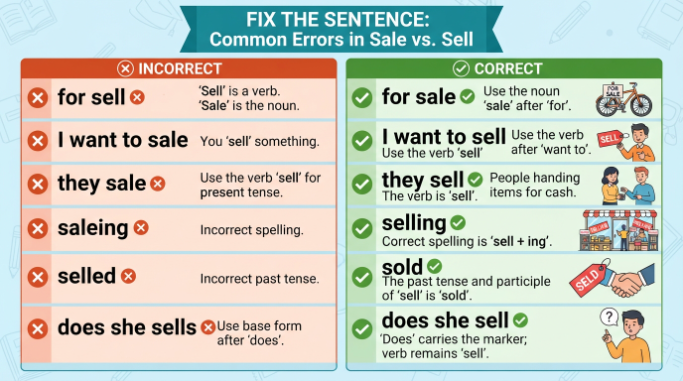
Mistake 1: “I want to sale my car.”
❌ I want to sale my car.
✅ I want to sell my car.
Why: Sell is the verb required after want to.
Mistake 2: “The house is for sell.”
❌ The house is for sell.
✅ The house is for sale.
Why: For sale is the standard expression meaning available to purchase.
Mistake 3: “The shop has a sell.”
❌ The shop has a sell.
✅ The shop has a sale.
Why: The event is a noun, so sale is required.
Mistake 4: “They sale clothes.”
❌ They sale clothes.
✅ They sell clothes.
Why: The sentence needs a verb.
Mistake 5: “She saleed her car.”
❌ She saleed her car.
✅ She sold her car.
Why: The past tense of sell is irregular: sell → sold.
Mistake 6: “They are saleing furniture.”
❌ They are saleing furniture.
✅ They are selling furniture.
Why: The present participle is formed from sell, giving selling.
Mistake 7: “Does she sells products?”
❌ Does she sells products?
✅ Does she sell products?
Why: After does, use the base verb sell.
Mistake 8: “The sales starts tomorrow.”
❌ The sales starts tomorrow.
Depending on meaning, the natural form may be:
✅ The sale starts tomorrow.
If you mean multiple transactions or business activity, sales may be appropriate:
Ticket sales start tomorrow.
The choice depends on what sales refers to.
A Fast Decision Rule
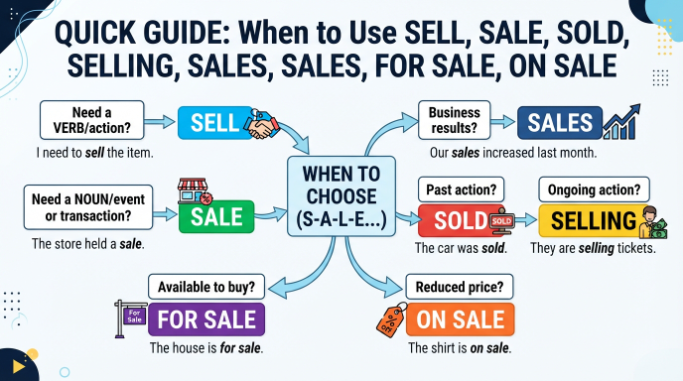
When you are unsure whether to use sell or sale, ask:
1. Am I describing an action?
Use sell.
I want to sell my phone.
2. Am I naming the transaction or event?
Use sale.
The sale starts tomorrow.
3. Am I describing something available to buy?
Use for sale.
The phone is for sale.
4. Am I describing reduced prices?
Usually use on sale or a sale.
These jackets are on sale.
5. Am I describing business performance or revenue from selling?
Use sales.
Sales increased this quarter.
6. Am I talking about past selling?
Use sold.
She sold her car.
The Practical Proofreading Test
Try replacing the questionable word with buy.
If the sentence needs the opposite action, sell is probably the correct verb.
I want to ___ my laptop.
The opposite of buy is sell, so:
I want to sell my laptop.
For a noun, think about whether you could use purchase or transaction instead.
The ___ of the house was completed.
You could say:
The purchase of the house was completed.
Therefore, sale works:
The sale of the house was completed.
This is not a universal substitution rule, but it is a useful proofreading aid.
Memory Trick: “Sell Does, Sale Names”
A simple memory trick is:
Sell does; sale names.
Sell usually tells you what someone does:
They sell cars.
Sale names the event or transaction:
The car sale was completed.
Another useful pair is:
I sell it. It is for sale.
If you remember those two sentences, many common mistakes disappear.
Formal vs Casual and Regional Notes
There is no major British-American spelling difference between sell and sale. Both varieties of English use these forms with the same basic meanings.
British and American English both use:
- sell
- sale
- for sale
- on sale
- sold
- selling
- sales
There can be differences in how particular retail expressions are interpreted in context, but the fundamental distinction remains the same.
For example:
The house is for sale.
is standard in both British and American English.
Likewise:
The shop is having a sale.
is grammatical in both varieties.
The more important issue is context, not regional spelling.
“On sale” can have context-dependent meaning
In American English, on sale very commonly means available at a reduced price:
These shoes are on sale for $50.
In British English, on sale can also mean available for purchase or being offered to the public, depending on context. It can therefore sometimes be understood more broadly than simply “discounted.”
For example:
The new tickets are now on sale.
Here, the phrase means the tickets have become available to buy; it does not necessarily mean the tickets are discounted.
This is an important edge case because context can change the interpretation of on sale.
Is “Sale” Ever a Verb?
In standard modern English, sale is normally used as a noun, not as the ordinary verb meaning “to sell.”
For everyday writing, use:
We sell products online.
not:
We sale products online.
Similarly:
She sold her car.
not:
She saled her car.
Some specialized, historical, or dialectal uses can differ, but they do not change the standard rule for ordinary contemporary English.
Sale, Sell, and Sales in Business English
Business writing creates another important distinction.
Sell
The action:
Our representatives sell software subscriptions.
Sale
An individual transaction or selling event:
The sale was finalized yesterday.
Sales
The broader commercial activity, department, volume, or revenue:
Sales increased by 12% this quarter.
Compare these carefully:
The company sells software.
The company reported strong sales.
The sale of the subsidiary was completed.
These sentences are all correct because the grammatical function and meaning differ.
“Sale vs Sold”
Sale and sold are especially easy to confuse because both relate to a completed transaction.
Compare:
The sale was completed yesterday.
Sale is a noun.
The house was sold yesterday.
Sold is the past participle of the verb sell.
A quick test:
What happened? The house was sold.
What was completed? The sale.
“Sell vs Sold”
These are both forms of the same verb.
Use sell for the base/present form:
I sell books.
Use sold for the past:
I sold the books yesterday.
Use sold as a past participle after auxiliary verbs:
The books were sold quickly.
She has sold her old car.
The incorrect form selled is not standard English.
“Selling” vs “Sale”
These words can sometimes describe similar real-world events but have different grammatical functions.
Selling a house can be stressful.
The sentence focuses on the activity or process.
The sale of the house was completed yesterday.
The sentence focuses on the transaction.
Similarly:
Selling handmade products takes time.
Handmade-product sales have increased.
The first focuses on the activity; the second focuses on commercial results.
More Natural Examples
Everyday conversation
I might sell my old phone.
Is this chair for sale?
They are having a big sale this weekend.
Who sells these headphones?
I sold my bike last month.
Shopping
Are these shoes on sale?
Does this store sell children’s clothing?
The summer sale ends tomorrow.
Online sales have increased.
Property
We are planning to sell the house.
The house is for sale.
The sale of the house took longer than expected.
The house was sold last week.
Business
The company sells medical equipment.
Annual sales reached a new high.
The sale of the company was announced publicly.
The company is selling one of its divisions.
Grammar-focused examples
I want to sell it.
She wants to sell it.
Does he sell it?
He sells it.
He sold it.
He is selling it.
It is for sale.
Each sentence is correct because the form matches the grammatical structure.
FAQs
What is the difference between sell and sale?
Sell is primarily a verb meaning to exchange something for money. Sale is a noun referring to the act or transaction of selling, or an event in which goods are offered for purchase.
I want to sell my car.
The car is for sale.
Is it “for sell” or “for sale”?
The standard expression is for sale.
The house is for sale.
Sell is the verb, while sale is the noun used in this expression.
Is it “I want to sell” or “I want to sale”?
Use I want to sell.
I want to sell my laptop.
The construction want to + base verb requires the verb sell.
Is it “sale it” or “sell it”?
Use sell it.
You should sell it.
Sale is not the standard verb used for this meaning.
Is it “sell or sale” in a sentence?
It depends on the grammatical role.
I want to sell my car.
The car is for sale.
The dealership is having a sale.
What is the difference between sells and sales?
Sells is a verb:
She sells books.
Sales is a noun:
Her book sales are growing.
What is the difference between selling and sale?
Selling refers to the activity or process of exchanging something for money.
Sale refers to the transaction, event, or occasion involving selling.
Selling a house can be difficult.
The sale of the house was completed yesterday.
Is “saleing” a word?
Saleing is not the standard spelling of the present participle of sell. The correct word is selling.
They are selling furniture.
Is “selled” correct?
No. The standard past tense and past participle of sell is sold.
She sold her car.
The car was sold yesterday.
What is the difference between sale and sales?
Sale can refer to one transaction or a promotional event.
The sale starts Friday.
Sales can refer to multiple transactions or the broader activity, volume, or revenue associated with selling.
Sales increased this year.
Is “on sale” the same as “for sale”?
Not always.
For sale means something is available to buy.
The house is for sale.
On sale can mean available for purchase or, especially in retail contexts, offered at a reduced price.
These shoes are on sale for $40.
Context determines the intended meaning.
What is the difference between sale and selling?
Selling is the activity of selling and functions grammatically as a verb form or gerund. Sale is a noun referring to a transaction or selling event.
Selling cars is his job.
The sale of the dealership was completed yesterday.
What is the difference between sell and sale in business?
Sell describes the action a company performs:
The company sells software.
Sale refers to a transaction or event:
The sale of the business was completed.
Sales can refer to overall commercial activity or revenue:
Sales increased significantly.
Is “sale” a verb?
In standard contemporary English, sale is normally a noun. For the ordinary action of exchanging something for money, use sell as the verb.
What is the correct phrase: “do you sell” or “do you sale”?
The correct phrase is do you sell.
Do you sell laptops?
After the auxiliary do, the base verb sell is required.
Final Takeaway
The difference between sell and sale is mainly a difference in grammar and function.
Sell is the verb:
I want to sell my car.
Sale is the noun:
The sale of the car was completed.
Remember the most useful combinations:
- sell a product
- sells products
- sold a product
- selling products
- for sale
- on sale
- a sale
- sales figures
The fastest memory rule is:
Sell = the action. Sale = the noun for the transaction or selling event.
And for the two most commonly confused expressions:
I sell it. It is for sale.
Once you separate the verb from the noun, most sell vs. sale questions become straightforward.