True or False: Meaning, Usage, Grammar, and Examples
Quick Answer
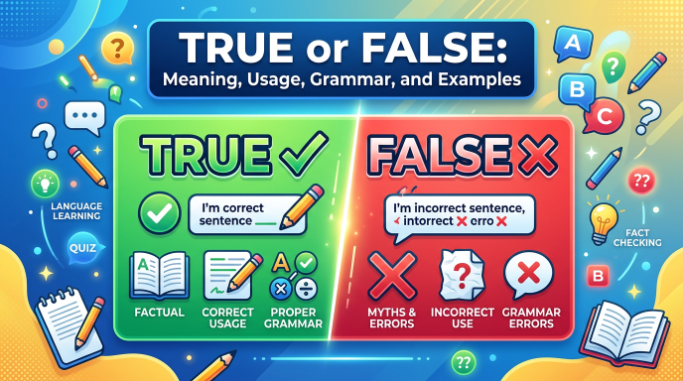
True and false are opposite words used to describe whether something is correct, factual, accurate, or not.
- True = correct, factual, or real.
- False = incorrect, untrue, or not factual.
When an instruction says “Write true if the statement is correct and false if it is incorrect,” you should evaluate the statement and choose one of the two words.
For example:
- The Earth orbits the Sun. → True
- The Sun is a planet. → False
The usual expression is “true or false,” with or showing that one of two possible answers should be selected. True and false is also correct when discussing both concepts together.

True and False at a Glance
| Feature | True | False |
|---|---|---|
| Basic meaning | Correct, factual, real, or accurate | Incorrect, untrue, or not factual |
| Common opposite | False | True |
| Part of speech | Usually adjective; can also be an adverb or noun in specific uses | Usually adjective; can also be an adverb or noun in specific uses |
| Example | The information is true. | The information is false. |
| Quiz answer | The statement is true. | The statement is false. |
| Common pair | True or false | True or false |
| Spelling | One word | One word |
A key point is that true and false are separate words. The phrase “true or false” is not written as one word.
The Detailed Difference Between True and False
At the most basic level, true means that something corresponds with reality, facts, or accepted conditions. False means that it does not.
Compare these statements:
- Water freezes at approximately 0°C under standard atmospheric pressure. → True
- Water always freezes at 50°C. → False
The distinction often appears simple, but context matters. Some statements are clearly factual, while others involve opinions, predictions, incomplete information, or situations where the answer cannot fairly be reduced to a simple yes-or-no choice.
For example:
Chocolate is the best flavor.
This is not normally a true-or-false factual statement because “best” expresses an opinion.
By contrast:
Chocolate contains cocoa.
This can be evaluated as a factual claim, although the exact definition of “chocolate” may matter in unusual contexts.

When to Use “True”
Use true when something is correct, factual, genuine, accurate, or consistent with reality.
True for facts
- It is true that plants need water.
- Her statement was true.
- The report contains true information.
True for correct answers
- Your answer is true.
- Statement number three is true.
- Select true if the statement is correct.
True for genuine or real things
The word true can also mean genuine or authentic.
- He remained a true friend.
- This is a true story.
- The painting is believed to be a true original.
The exact meaning depends on context. A true friend does not simply mean a friend who is factually correct. It means a loyal or genuine friend.
True in common expressions
- That is true.
- It is true that…
- True or false?
- True enough.
- Come true
For example:
Her dream finally came true.
Here, true relates to something becoming real or fulfilled.
When to Use “False”
Use false when something is incorrect, untrue, mistaken, or not genuine.
False for incorrect statements
- The statement is false.
- Your answer is false.
- The claim turned out to be false.
False for incorrect information
- The article contains false information.
- He made a false statement.
- The alarm gave a false signal.
False for things that are not genuine
The word can also describe something artificial, misleading, or wrongly represented.
- She wore false eyelashes.
- The report created a false impression.
- The system produced a false result.
Again, context determines the exact meaning. A false impression is not necessarily a deliberate lie. Someone may create a false impression accidentally.
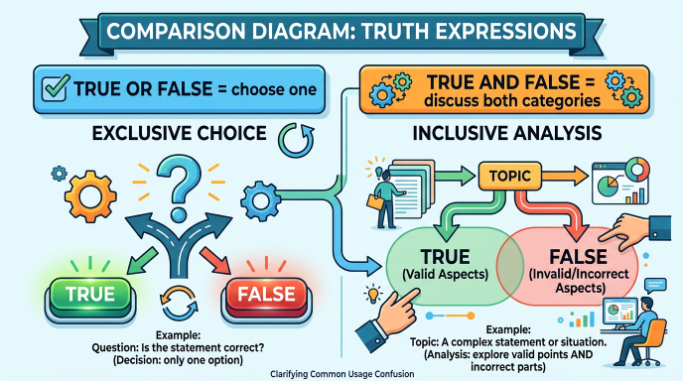
“True or False” vs. “True and False”
These expressions are both correct, but they are used differently.
Use “true or false” when choosing between two alternatives
True or false presents a choice.
- Is the statement true or false?
- Select the correct response: true or false.
- State whether the following statements are true or false.
The word or means that you are choosing between alternatives.
Use “true and false” when discussing both categories
True and false refers to the two concepts together.
- The test contains true and false questions.
- Students must understand the difference between true and false statements.
- The exercise teaches children how to identify true and false information.
So this is a useful rule:
Choosing one answer? Use “true or false.” Discussing both concepts? “True and false” may be appropriate.
Is “True or False” Written as One Word?
No. True or false is written as three separate words.
Correct:
- true or false
- true and false
Incorrect:
- trueorfalse
- truefalse
- true-and-false as a normal replacement for the phrase
If you see searches such as “true false one word” or “true and false written together,” the answer is straightforward: these are normally written as separate words.
However, a publisher, software interface, game, or brand could create a stylized title using unusual formatting. That would be a design or naming choice, not the normal spelling rule.
How True and False Work Grammatically
Both true and false are most commonly used as adjectives.
An adjective describes a noun or follows a linking verb.
Before a noun
- a true statement
- a false claim
- true information
- false information
After a linking verb
- The statement is true.
- The answer is false.
- His claim appears true.
- The information proved false.
In a true-or-false exercise, the words can also function as short answer labels:
Question: The Pacific Ocean is larger than the Atlantic Ocean.
Answer: True.
The single-word answer represents a complete judgment about the statement.
True and False as Adverbs
Both words can appear in special grammatical structures, although their most common everyday use is adjectival.
For example:
- The arrow flew true toward the target.
- The accusation was proven false.
Here, the grammar and meaning depend on the structure of the sentence.
Do not assume that every use of true or false follows the same simple adjective pattern. English allows words to take different grammatical roles in different contexts.
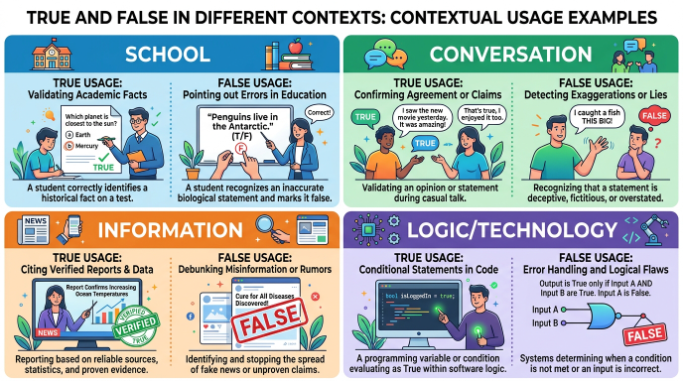
Examples by Context
In school exercises
- Write true if the statement is correct and false if it is incorrect.
- State whether the following statements are true or false.
- Select the correct response: true or false.
Example:
Penguins are mammals.
False. Penguins are birds.
In everyday conversation
- Is that story true?
- Yes, it is completely true.
- I thought the rumor was true, but it was false.
In news and information
- Readers should check whether a claim is true or false.
- The article included several false statements.
- The evidence supports the conclusion that the report is true.
In technology
Computers and programming often use true and false as logical values.
For example:
truemay represent a condition that is satisfied.falsemay represent a condition that is not satisfied.
This use is related to logic, but programming languages have their own rules about capitalization, spelling, and syntax.
In formal logic
In logic, a proposition may be assigned a truth value such as true or false.
However, ordinary language is more complicated. A vague statement may not have a clear truth value until important terms are defined.
For example:
Alex is tall.
Is this true or false? That depends on what tall means in the relevant context.
Common Mistakes With True and False
Mistake: Writing “true false” when a choice is intended
Incorrect:
Is the statement true false?
Correct:
Is the statement true or false?
Why? When choosing between alternatives, English normally uses or.
Mistake: Using “and” when only one answer is possible
Incorrect:
The answer is true and false.
Usually better:
The answer is true.
or:
The answer is false.
However, there are important exceptions. A complex statement might contain multiple claims, with some true and some false.
For example:
Paris is the capital of France and the largest city in Germany.
The first part is true, while the second part is false.
In that case, you should explain the mixed result rather than carelessly labeling the entire sentence without considering how the question is structured.
Mistake: Treating opinions as facts
Question:
Summer is the best season.
This is generally an opinion, not a straightforward true-or-false statement.
Better wording for a factual exercise might be:
Summer begins after spring in the yearly seasonal cycle.
That statement can be evaluated more objectively.
Mistake: Assuming “false” always means a deliberate lie
A false statement is not automatically a lie.
A person can say something false because they are mistaken.
A lie usually involves intentional deception. Therefore:
- False describes whether the information is correct.
- Lie often concerns whether someone intentionally tried to deceive.
That distinction is important.
Mistake: Writing the phrase as one word
Incorrect:
truefalse
Correct:
true or false
Correct:
true and false
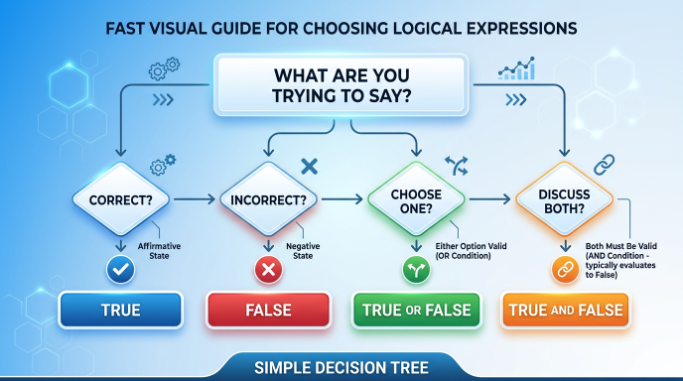
A Fast Decision Rule
Use this quick checklist when deciding between true, false, true or false, and true and false.
Step 1: Are you describing something correct?
Use true.
The statement is true.
Step 2: Are you describing something incorrect?
Use false.
The statement is false.
Step 3: Are you asking someone to choose between two answers?
Use true or false.
Is the statement true or false?
Step 4: Are you discussing both categories together?
Use true and false when appropriate.
The lesson explains true and false statements.
The Practical Proofreading Test
Before writing your sentence, ask:
Am I choosing between alternatives, or am I talking about both ideas together?
If you are choosing:
true or false
If you are discussing both:
true and false
Then check whether your statement can actually be judged objectively.
Ask:
- Is this a factual claim?
- Are the important terms clearly defined?
- Is this an opinion instead?
- Does the sentence contain more than one claim?
- Could the answer depend on context?
This final check prevents many mistakes in true-or-false exercises.
Formal, Casual, British, and American Usage
The basic meanings of true and false are the same in standard British and American English.
There is no major spelling difference such as:
- British: true / American: tru
- British: false / American: fals
Both varieties use the same standard spellings: true and false.
The expression true or false is also widely understood and used in both British and American English, especially in education, quizzes, logic, and factual discussions.
Capitalization
Capitalization depends on style and context.
In ordinary prose:
The statement is true.
In a quiz or answer key, capitalization is often used for visibility:
TRUE
FALSE
Both styles can be acceptable depending on the formatting system.
In programming, capitalization may matter because different languages use different conventions. Always follow the rules of the specific programming language rather than general English punctuation or capitalization habits.
Pronunciation
True
True is commonly pronounced:
/truː/
It rhymes with:
- blue
- new
- through
False
False is commonly pronounced:
/fɔːls/ in many British pronunciations and /fɑːls/ or a similar vowel pattern in many American pronunciations.
The exact vowel can vary by accent, but the word remains clearly recognizable.
Important Edge Cases: Is Everything True or False?
No. Real language and real-world questions are not always perfectly binary.
Statements can be vague
That restaurant is expensive.
The answer may depend on location, income, expectations, and comparison standards.
Statements can change over time
The store is open.
This may be true at 10:00 a.m. and false at midnight.
Statements can be partly true
A sentence may combine multiple claims:
The company was founded in London and opened its first office in 1995.
One claim could be true while the other is false.
Statements can depend on definitions
A tomato is a vegetable.
In everyday cooking, people often classify tomatoes as vegetables. In botanical classification, tomatoes are fruits. Context matters.
This does not mean facts are meaningless. It means that good true-or-false questions need clear wording and appropriate context.

Frequently Asked Questions
What does “true or false” mean?
True or false means choosing whether a statement is correct or factual (true) or incorrect or untrue (false).
What does “true and false” mean?
True and false usually refers to both concepts or categories together, rather than asking someone to choose one.
How do you write “true if the statement is correct and false if it is incorrect”?
That sentence is correctly written as:
Write true if the statement is correct and false if it is incorrect.
In a worksheet, the words may also be capitalized:
Write TRUE if the statement is correct and FALSE if it is incorrect.
Is “true or false” one word?
No. True or false consists of three separate words.
Is “true false” correct?
Not usually as a normal sentence or question. If you are presenting alternatives, write true or false.
Can something be both true and false?
In ordinary factual discussion, a single clearly defined claim is generally treated as true or false. However, a sentence can contain multiple claims, unclear language, changing circumstances, or context-dependent definitions. In those cases, the question may need clarification.
Does false mean someone is lying?
Not necessarily. Something can be false because it is mistaken. A lie usually involves deliberate deception.
Should I write “TRUE” and “FALSE” in capital letters?
You can use capital letters for answer choices, headings, buttons, or worksheets. In normal sentences, lowercase is usually appropriate unless the word begins a sentence.
Final Takeaway
The basic distinction is simple:
- True means correct, factual, genuine, or accurate.
- False means incorrect, untrue, mistaken, or not factual.
- Use true or false when someone must choose between two alternatives.
- Use true and false when discussing both concepts together.
The most important proofreading habit is to check the context. Ask whether you are evaluating a factual claim, choosing between answers, discussing both categories, or dealing with an opinion or statement that needs more context.
Once you understand that difference, choosing between true, false, true or false, and true and false becomes much easier.