Thick, Fat, and Chubby: What’s the Difference?
Quick Meaning
Thick, fat, and chubby are not interchangeable, although people sometimes use them to describe overlapping body types.
- Fat is the most direct word for having a relatively large amount of body fat or a larger body size.
- Chubby usually means pleasantly or noticeably round and slightly fat, often with a softer and less severe tone.
- Thick is an informal body-description term that usually emphasizes a fuller, broader, or more visibly substantial figure, especially in areas such as the hips, thighs, buttocks, or legs. It does not automatically mean fat.
The biggest difference is nuance and focus. Fat focuses most directly on body fat or size. Chubby suggests roundness and softness. Thick often focuses on a fuller body shape and proportions.

Definitions
Thick
Thick has several general dictionary meanings. It can describe something with a large distance between opposite sides, something dense, or something occurring closely together.
When used to describe a person’s body, however, thick is informal and has a more specialized modern meaning.
A thick person usually has a fuller, broader, or more substantial build. In contemporary informal usage, thick often refers to someone with noticeably full hips, thighs, legs, or buttocks. A person may be described as thick and curvy, but the two terms are not identical.
Importantly, does thick mean fat? Not necessarily. Someone can be thick without being generally described as fat. The word often emphasizes shape and proportions rather than body weight alone.
Fat
Fat, as an adjective describing a person, traditionally means having a large amount of body fat or having a body size considered large.
For example:
- He was a fat child.
- She described herself as fat.
- The doctor discussed excess body fat.
Unlike chubby, the word fat does not necessarily imply a small or moderate degree of roundness. It can describe a wide range of larger body sizes.
However, when used directly about another person, fat can be sensitive or offensive depending on context, tone, and relationship. Some people use fat as a neutral self-description or identity term, while others strongly dislike it.
Chubby
Chubby generally means somewhat fat, rounded, or pleasantly plump-looking.
The word often suggests:
- Softness
- Round cheeks
- A rounded body
- Slight or moderate extra fullness
Examples include:
- a chubby baby
- chubby cheeks
- a slightly chubby body type
In everyday usage, chubby is often softer than fat. Still, describing an adult as chubby can feel patronizing or unwanted in some situations.

Part of Speech
Thick
Part of speech: adjective
Common forms include:
- thick
- thicker
- thickest
- thickness
Examples:
- She has thick hair.
- The book is thicker than I expected.
- In informal body description, he described her as thick.
The expression thick-bodied may also appear, although it is less common and can sound descriptive or clinical depending on context.
Fat
Part of speech: adjective and noun
As an adjective:
- a fat cat
- a fat person
As a noun:
- body fat
- animal fat
- dietary fat
Related forms include:
- fatty
- fatness
Be careful with fatty. It is common in scientific or food-related language, such as fatty acids, but when used about a person, it can be insulting.
Chubby
Part of speech: adjective
Common related forms include:
- chubbiness
- chubby-cheeked
Examples:
- He was chubby as a child.
- The baby had chubby hands.
- She described the character as slightly chubby.
How Thick, Fat, and Chubby Are Used
The words differ because they answer slightly different questions.
Fat describes body size or body fat more directly
If the focus is simply on whether someone has substantial body fat, fat is the most direct word.
This is why fat vs chubby is not simply a difference in dictionary definition. The difference is often one of degree, tone, and social context.
Someone described as chubby may also be fat in a literal sense, but chubby usually suggests a softer and often less extreme description.
Chubby emphasizes roundness and softness
A chubby body is usually imagined as rounded or soft-looking. The term is especially common for babies and children.
For adults, expressions such as slightly chubby or a little chubby are common, although they can still be sensitive.
Compare:
- He has a chubby face.
- He is fat.
The first sentence focuses on rounded appearance. The second makes a broader statement about body size.
Thick often emphasizes proportions
The modern informal meaning of thick frequently focuses on a body that looks substantial or full in particular areas.
For example, a thick woman may be described as having:
- Fuller thighs
- Broad hips
- A prominent lower body
- A strong or substantial overall build
This explains why thick vs fat is not a simple size comparison. A person can be thick because of body shape, muscle, bone structure, fat distribution, or a combination of factors.

Common Collocations
Common expressions with thick
Natural combinations include:
- thick body
- thick build
- thick thighs
- thick legs
- thick-bodied
- thick and curvy
- thick body type
The phrase thick body type is common in informal discussions, but it does not have a precise medical or scientific definition.
Common expressions with fat
Common combinations include:
- body fat
- excess fat
- fat distribution
- fat person
- fat cells
- low-fat
- fat and muscle
The phrase fat person is grammatically straightforward but may be socially sensitive. In many situations, more neutral wording may be preferred depending on the context.
Common expressions with chubby
Common combinations include:
- chubby cheeks
- chubby face
- chubby baby
- chubby body
- slightly chubby
- chubby fingers
- chubby body type
A chubby body shape generally suggests visible roundness rather than a precisely defined category.
Examples
Here are examples showing how the words behave naturally in sentences.
Thick
- She has a thick, athletic build.
- He is known for his thick legs and broad frame.
- In informal fashion discussions, “thick” often describes a fuller figure.
- The word can describe body proportions rather than weight alone.
Fat
- The report discusses how the body stores fat.
- She prefers to use the word “fat” as a neutral description of herself.
- Calling someone fat without knowing their preferences can sound rude.
- Body size and body composition are not always the same thing.
Chubby
- The toddler had chubby cheeks.
- He was slightly chubby when he was younger.
- The illustrator gave the character a round, chubby face.
- “Chubby” often suggests softness and roundness.

Similar and Confusable Words
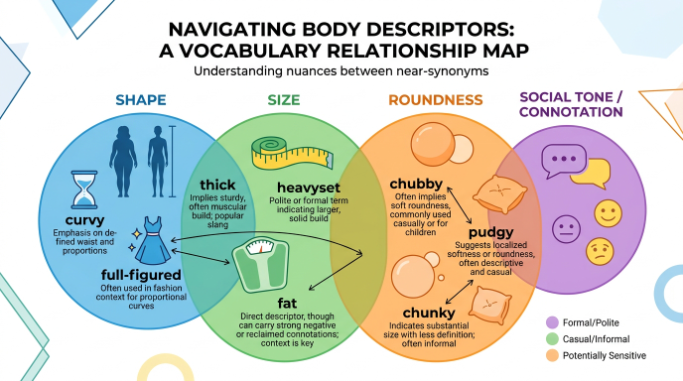
Curvy vs thick
Curvy describes a body with noticeable curves, often involving the relationship between the waist, hips, and bust.
Thick generally suggests fullness, breadth, or substantial proportions.
A person can be:
- curvy but not thick
- thick but not especially curvy
- both thick and curvy
Therefore, curvy vs thick is mainly a difference in what the speaker emphasizes: curves versus fullness and proportions.
Curvy vs chubby
Curvy does not necessarily mean having extra body fat. A person may have a curvy figure at many different body sizes.
Chubby, by contrast, usually suggests visible roundness or extra softness.
So a curvy chubby body type is possible, but the words describe different features.
Curvy vs fat
The question “Is curvy fat?” has no simple yes-or-no answer.
No, curvy does not automatically mean fat. Curvy refers primarily to shape. Fat refers more directly to body fat or larger body size.
Thick vs plus size
Plus-size is primarily a clothing and fashion sizing term. It does not mean exactly the same thing as thick.
A person may be:
- thick but not plus-size
- plus-size but not describe themselves as thick
- both plus-size and thick
The categories depend on context and are not interchangeable.
Pudgy vs chubby
Pudgy and chubby are close in meaning.
However, pudgy often suggests small, rounded areas of extra flesh and can sound more informal or negative.
For example:
- pudgy fingers
- a pudgy face
Chubby is often warmer in tone, especially when describing children.
Chunky
Chunky can describe someone with a large, solid, or heavily built appearance.
It may suggest:
- A broad build
- A stocky shape
- A substantial frame
When used about people, chunky can sound informal and may be unwelcome.
Heavyset
Heavyset generally describes someone with a large or solid build. It often sounds more neutral and less emotionally loaded than some alternatives.
However, it still describes body size and should be used thoughtfully.
Full-figured
Full-figured is often used as a polite or euphemistic description for a larger body, especially in fashion or appearance-related contexts.
It tends to have a more formal or complimentary tone than fat, but not everyone prefers euphemisms.
Register and Regional Notes
These words do not all belong to the same register.
Thick
The body-related meaning of thick is strongly informal. It is especially common in modern popular culture, social media, fashion discussions, and conversations about physical appearance.
The spelling thicc is internet slang. It is an intentionally altered spelling used online to emphasize a particularly full or exaggerated appearance. It is highly informal and generally unsuitable for formal writing.
Fat
Fat is an ordinary English word, but its use about people is socially sensitive.
In medical or scientific writing, terms such as body fat, adipose tissue, or specific health terminology may be more precise depending on the subject.
In personal conversation, the preferred language varies widely.
Chubby
Chubby is informal to neutral and is especially common when describing children, babies, cheeks, hands, and other rounded features.
Describing adults as chubby can sometimes sound affectionate, but it can also sound dismissive or patronizing.
Thick, curvy, and identity labels
Terms such as thick, curvy, and full-figured are subjective descriptions, not standardized body classifications.
There is no universal measurement that determines what is considered thick or what is considered chubby. Cultural preferences and personal interpretations vary significantly.
Common Mistakes
Mistake: Assuming thick always means fat
This is inaccurate.
Thick can overlap with fat, but the words focus on different things. Thick often emphasizes shape and proportions rather than body fat alone.
Mistake: Treating chubby as a precise body category
There is no official chubby body type with a fixed measurement.
Chubby is a subjective descriptive word.
Mistake: Assuming curvy means overweight
A curvy body can exist at many body sizes. Curvy and overweight are not synonyms.
Mistake: Using all appearance words as if they are medically precise
Words such as thick, chubby, chunky, and curvy are subjective.
They are useful for everyday description but are not scientific measurements.
Mistake: Ignoring tone and personal preference
The same word can feel neutral to one person and offensive to another.
When describing a real person, especially directly to them, context matters.
FAQs
What is the difference between fat and chubby?
Fat is a more direct description of having substantial body fat or a larger body size. Chubby usually suggests softer, rounder, and often more moderate fullness.
Is chubby and fat the same thing?
Not exactly. They can overlap, but chubby usually emphasizes roundness and softness, while fat is broader and more direct.
Does thick mean fat?
No. Thick does not automatically mean fat. In informal usage, it often describes a fuller or more substantial body shape, particularly the hips, thighs, or overall proportions.
What is considered chubby?
There is no universal measurement for being chubby. The word is subjective and usually refers to a noticeably rounded or somewhat fat appearance.
What is considered thick?
There is also no official definition of a thick body type. In informal usage, thick usually refers to a fuller, broader, or more substantial figure.
Can someone be thick and chubby?
Yes. A person can reasonably be described as thick and chubby because the terms emphasize different characteristics. Thick may describe fuller proportions, while chubby suggests softness and roundness.
Can someone be curvy and chubby?
Yes. A curvy and chubby person may have both noticeable curves and a rounded or soft appearance.
Is curvy the same as thick?
No. Curvy emphasizes body contours and curves, while thick generally emphasizes fullness and substantial proportions. A person can be either or both.
What does “thicc” mean?
Thicc is informal internet slang based on thick. It is often used humorously or emphatically to describe someone or something as especially full, substantial, or rounded. It is not appropriate for formal writing.
Is “fat” always offensive?
No, but it can be sensitive. Some people use fat neutrally as a self-description, while others consider it insulting when used by someone else. Context and personal preference matter.

Summary
Thick, fat, and chubby describe body appearance differently.
- Fat is the most direct term relating to body fat or larger body size.
- Chubby usually suggests softness, roundness, and moderate fullness.
- Thick is an informal term that often emphasizes a fuller, broader, or more substantial body shape and proportions.
The terms can overlap, but they are not exact synonyms. Curvy focuses on shape and contours, while words such as pudgy, chunky, heavyset, and full-figured add their own differences in tone and meaning.
Because body-description language is subjective and can be sensitive, the most accurate word depends not only on appearance but also on context, tone, and the preferences of the person being described.