Many a Time: Meaning, Usage, Examples, and Common Mistakes
Quick Meaning
“Many a time” means “many times,” “often,” or “on numerous occasions.” It is an English adverbial expression used to describe something that has happened repeatedly.
Although it contains the singular noun time, the phrase refers to multiple occasions. It is grammatically correct and is often used in reflective, literary, formal, or slightly old-fashioned writing.
Examples:
- Many a time, I have wondered why people change.
- I have told you many a time to be careful.
- Many a time, experience teaches us more than advice.
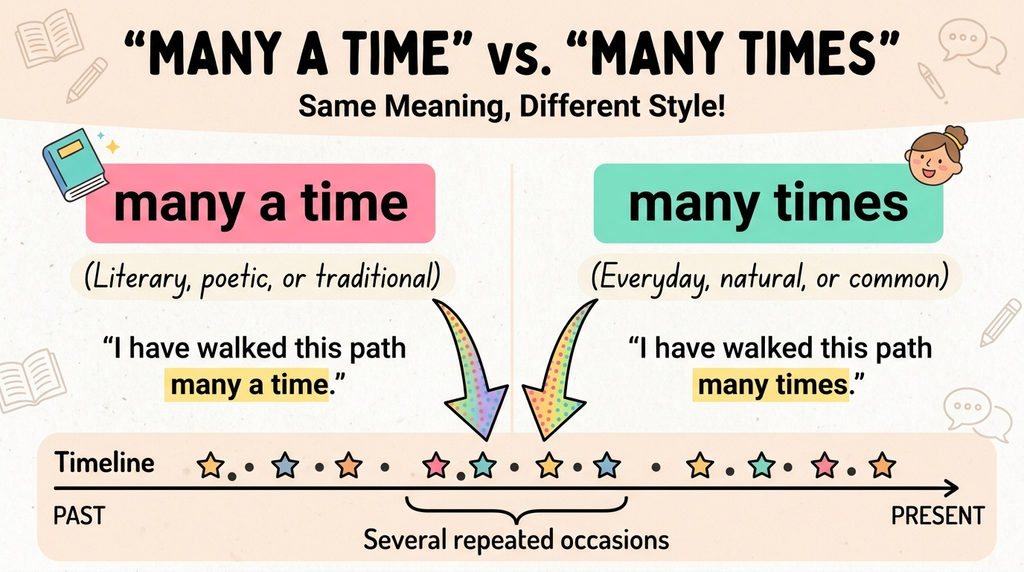
In everyday conversation, “many times” is generally more common and natural. However, “many a time” remains a valid expression, especially when the writer wants a more emphatic or literary tone.
Definitions
1. Many a time — on numerous occasions
Dictionary meaning: On many occasions; repeatedly; frequently.
The expression describes an event, action, thought, or experience that occurs or has occurred more than once.
Examples:
- Many a time, she has helped people without expecting anything in return.
- We have discussed this matter many a time.
- Many a time, the simplest solution turns out to be the best.
2. Many a time — repeatedly over a period
The phrase can also emphasize repetition across a person’s life, a relationship, or a period of experience.
Examples:
- Many a time, he remembered the advice his grandfather had given him.
- Many a time, the team faced difficulties but continued working.
- I have seen this happen many a time in my career.
This use often conveys reflection or accumulated experience rather than merely counting separate events.
Dictionary meaning versus actual usage
The core meaning is the same in dictionaries and ordinary usage: on many occasions. The difference lies in tone and context.
| Expression | Typical effect |
|---|---|
| Many a time | More literary, emphatic, or reflective |
| Many times | Neutral and common in everyday English |
| Often | Concise and natural in most contexts |
| On many occasions | More formal and explicit |
| Time and again | Emphasizes repeated occurrence |
“Many a time” does not necessarily mean that something happens regularly. It can describe repeated events that occur irregularly.
For example:
– Many a time, I have met him unexpectedly. — Several separate occasions, not necessarily at regular intervals.
Part of Speech
“Many a time” is an adverbial phrase. It modifies a verb, clause, or sometimes an entire sentence by indicating how often something happens.
It is not a verb, adjective, or noun phrase functioning as the main subject in the usual construction.
Consider these examples:
- She has visited us many a time. — Modifies has visited.
- Many a time, I wondered what had gone wrong. — Modifies the clause as a whole.
- He has many a time demonstrated his patience. — Modifies has demonstrated.
The word time is a singular countable noun in this expression, but the complete phrase functions adverbially.
Why does it use singular “time”?
The construction many a + singular countable noun is an established English pattern.
Examples include:
- Many a person has made this mistake.
- Many a student struggles with this topic.
- Many a day has passed since we last met.
- Many a time, I have heard that explanation.
In this pattern, many a expresses plurality in meaning while taking a singular noun. The noun is therefore not made plural.

How It Is Used
1. With the present perfect tense
“Many a time” commonly appears with the present perfect when someone describes repeated experiences up to the present.
Examples:
- I have many a time wondered whether I made the right decision.
- She has many a time offered to help us.
- We have heard that argument many a time.
The phrase can appear before or after the main verb phrase. Its placement depends on emphasis and sentence rhythm.
In contemporary conversation, these versions are often more natural:
- I have often wondered whether I made the right decision.
- She has offered to help us many times.
- We have heard that argument many times.
2. With the simple past tense
The expression also works with the simple past to describe repeated events in a completed period or a remembered experience.
Examples:
- Many a time, we walked home together after school.
- He told the same story many a time.
- Many a time, they tried to solve the problem without outside help.
The expression itself does not determine the tense. The surrounding sentence establishes when the events occurred.
3. At the beginning of a sentence
Placing “many a time” at the beginning creates emphasis and can make the sentence sound thoughtful or literary.
Examples:
- Many a time, I have questioned my own judgment.
- Many a time, the truth was hidden in plain sight.
- Many a time, a small act of kindness made a lasting difference.
This construction is grammatically sound, although “often” or “many times” may sound more conversational.
4. In the middle of a sentence
The phrase can appear before the main verb or between an auxiliary and a participle.
Examples:
- He has many a time reminded us of our responsibilities.
- I have many a time considered changing careers.
- They would many a time return to the same question.
The last example is grammatically possible but noticeably literary. In everyday English, “They would often return to the same question” is more natural.
5. At the end of a sentence
This is a straightforward placement, especially when the expression follows the action being described.
Examples:
- I have heard that explanation many a time.
- She has visited the village many a time.
- We have faced similar challenges many a time.
In ordinary modern English, the equivalent with “many times” is usually more common.
6. In storytelling and reflective writing
“Many a time” is particularly effective when a writer refers to repeated memories, lessons, regrets, or experiences.
Examples:
- Many a time, the old teacher had warned his students against judging too quickly.
- Many a time, she remembered the promise she had made as a child.
- Many a time, success came only after the team had reconsidered its approach.
The expression can create a measured rhythm and a slightly traditional narrative voice.

Common Collocations
A collocation is a combination of words that occurs naturally in a language. “Many a time” can accompany a wide range of verbs, particularly those describing memories, experiences, repeated actions, and reflections.
| Collocation | Example |
|---|---|
| Have wondered many a time | I have wondered many a time why the plan failed. |
| Have heard many a time | We have heard that excuse many a time. |
| Have seen many a time | I have seen this pattern many a time. |
| Have told someone many a time | She has told me many a time to be patient. |
| Have tried many a time | They have tried many a time to reach an agreement. |
| Have thought many a time | I have thought many a time about that conversation. |
| Have asked many a time | He has asked many a time for an explanation. |
| Have experienced many a time | We have experienced this difficulty many a time. |
| Have observed many a time | Researchers have observed this phenomenon many a time. |
| Have remembered many a time | She remembered many a time when her friends had supported her. |
These are useful combinations, not fixed expressions that must always appear together.
Useful sentence patterns
Pattern 1: Many a time + clause
– Many a time, I have wished for a simpler solution.
Pattern 2: Subject + verb phrase + many a time
– I have explained the procedure many a time.
Pattern 3: Many a time + subject + past-tense verb
– Many a time, the villagers gathered beneath the old tree.
Pattern 4: Subject + auxiliary + many a time + past participle
– She has many a time demonstrated exceptional patience.
The fourth pattern is more formal or literary than the more usual placement at the end of the sentence.
Examples of “Many a Time” in Context
The following original examples illustrate different meanings, contexts, and levels of formality.
Everyday situations
- I have told you many a time to check your work before submitting it.
- We have visited that bookstore many a time.
- Many a time, I have forgotten where I put my keys.
- She has asked the same question many a time.
- I have heard this advice many a time, but I understand it better now.
Education and work
- Many a time, students learn more from correcting mistakes than from memorizing answers.
- The manager has explained the new procedure many a time.
- I have considered that possibility many a time during the project.
- Many a time, a careful review reveals an error that was previously overlooked.
- Our teacher has reminded us many a time that clear writing requires revision.
Relationships and personal experiences
- Many a time, a thoughtful conversation has resolved a misunderstanding.
- I have remembered your advice many a time when making difficult decisions.
- Many a time, friends support one another without needing to say much.
- She has wondered many a time whether she chose the right path.
- Many a time, patience has helped people understand one another.
Literature and reflective writing
- Many a time, the traveler paused to admire the quiet landscape.
- Many a time, the old house seemed to preserve the memories of its former residents.
- The poet had many a time returned to the same image in his work.
- Many a time, history has shown that a seemingly small decision can have lasting consequences.
- Many a time, the answer appeared only after the question had been reconsidered.
Formal and academic contexts
- Similar concerns have been raised many a time in discussions of public policy.
- The limitations of this approach have been documented many a time.
- Many a time, researchers must distinguish correlation from causation.
- The issue has been debated many a time without producing a clear consensus.
For highly technical or strictly academic writing, repeatedly, frequently, or on numerous occasions may be more precise and stylistically consistent.
Similar and Confusable Words
Several English expressions have a similar meaning, but they differ in frequency, emphasis, and grammatical behavior.
| Expression | Meaning and nuance | Example |
|---|---|---|
| Many a time | Repeated occasions; often literary or emphatic | I have seen this many a time. |
| Many times | On numerous occasions; neutral | I have seen this many times. |
| Often | Frequently; concise and versatile | I often see this happen. |
| Frequently | At frequent intervals or on many occasions; somewhat formal | This problem occurs frequently. |
| Repeatedly | Again and again; emphasizes recurrence | She repeatedly asked for clarification. |
| Time and again | Repeatedly; often emphasizes a recurring pattern | Time and again, the plan has succeeded. |
| On many occasions | On numerous separate occasions; explicit and often formal | On many occasions, we discussed the issue. |
| Over and over again | Repeatedly, often with emphasis on repetition | He read the passage over and over again. |
| Again and again | Repeatedly; common in speech and writing | Again and again, the same mistake occurred. |
| Many times over | Many times the amount, degree, or number; context-dependent | The benefits outweigh the costs many times over. |
“Many a time” vs. “many times”
Both expressions generally mean “on numerous occasions.”
- Many a time: More literary, traditional, or emphatic.
- Many times: More common and neutral in modern English.
Compare:
- Many a time, I have wondered about the future.
- I have wondered about the future many times.
Both are correct. The second is generally the more natural choice in everyday conversation.
“Many a time” vs. “often”
These expressions overlap, but their emphasis differs.
“Many a time” usually presents repeated occasions as separate experiences. “Often” describes frequency more generally.
- I have met her many a time at the library. — Emphasizes multiple encounters.
- I often meet her at the library. — Describes a recurring pattern.
The difference is one of emphasis, not a strict grammatical distinction.
“Many a time” vs. “time and again”
“Time and again” emphasizes recurrence and may suggest that an event or pattern keeps repeating despite expectations.
- I have explained the rule many a time.
- Time and again, people have underestimated the difficulty of the task.
The expressions can sometimes be substituted for each other, but the second often sounds more forceful.
“Many a time” vs. “many times over”
These are not always interchangeable.
- I have read that book many a time. — I have read it on numerous occasions.
- The final cost was many times over the original estimate. — The cost exceeded the estimate by a large multiple.
The second expression concerns degree or multiplication rather than simply repeated occasions.
Register and Regional Notes
Is “many a time” formal or informal?
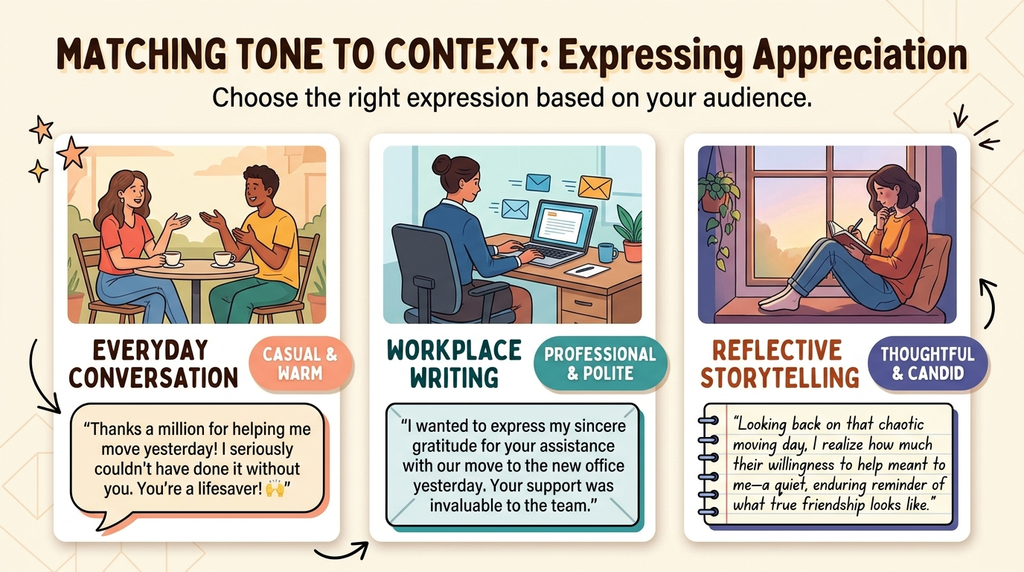
“Many a time” is grammatically standard English, but it often sounds literary, traditional, or slightly old-fashioned compared with “many times.”
It can appear in:
- Literary fiction and storytelling
- Essays and reflective prose
- Speeches and rhetorical writing
- Formal or traditional styles of English
It is also used in ordinary conversation, especially by speakers who naturally favor this construction. However, it is not usually the first choice in casual contemporary American or British English.
British English and American English
The expression is understood in both British and American English. There is no major difference in its core meaning.
The more noticeable distinction is stylistic: “many a time” may sound more traditional or literary, while “many times” is a common everyday alternative in both varieties.
Is “many a time” archaic?
It is not obsolete. It remains a valid expression, although some of its uses can sound old-fashioned.
Writers should choose it intentionally when its rhythm, emphasis, or tone suits the sentence. It need not be avoided simply because a more conversational alternative exists.
Is “many a time” common in Indian or Pakistani English?
The expression is understood in South Asian English, including Indian and Pakistani contexts. It may appear in formal writing, educational materials, speeches, and traditional prose.
However, usage varies among speakers and settings. It would be inaccurate to treat the expression as exclusive to South Asian English or to assume that every speaker in the region prefers it.
Origin and grammatical history
The construction follows the established English pattern many a + singular countable noun, as in “many a person” and “many a day.” The singular form of the noun is part of that grammatical construction.
Without a reliable historical source establishing a more specific derivation, it is better not to claim a precise origin or date for the phrase.
Common Mistakes
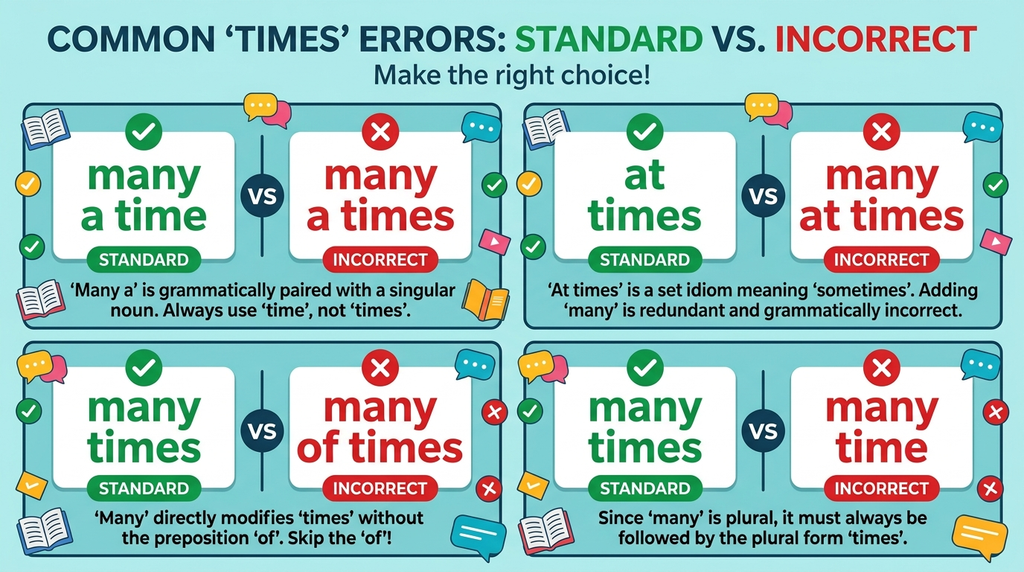
Mistake 1: Writing “many a times”
Incorrect: I have visited that place many a times.
Correct: I have visited that place many a time.
Why? The construction is many a + singular noun. The word times is plural, so it does not fit this pattern.
If you want the plural form, remove a:
– I have visited that place many times.
Mistake 2: Confusing “many at times” with “many a time”
Incorrect in the intended sense: Many at times, I have wondered about this.
Better: Many a time, I have wondered about this.
Or, more naturally in everyday English:
At times, I have wondered about this.
“At times” means occasionally or on some occasions. “Many a time” means on numerous occasions. They overlap in some contexts but are not identical.
Mistake 3: Using “many of the times” when “often” is intended
Awkward: Many of the times, he forgets his notebook.
More natural: He often forgets his notebook.
Or: He forgets his notebook many times.
“Many of the times” may be possible when referring to a specific, identifiable set of occasions, but it is generally unnecessary when expressing frequency.
For example, “Many of the times we met, it was raining” is understandable, though “It was raining on many of the occasions when we met” is more polished.
Mistake 4: Writing “many of times”
Incorrect: I have seen this many of times.
Correct: I have seen this many times.
“Many of” normally requires a determiner or a specified group, such as “many of the students” or “many of those occasions.” It does not normally precede the bare plural times in this construction.
Mistake 5: Treating “many time” as the standard expression
Incorrect for the intended meaning: I have told him many time.
Correct: I have told him many times.
Or: I have told him many a time.
“Many time” can occur in specialized contexts involving quantities or nonstandard varieties, but it is not the standard form for describing repeated occasions in general English.
Mistake 6: Using the expression when a different meaning is intended
Consider these sentences:
- I have visited London many a time. — Repeated visits.
- I have spent many hours in London. — Duration.
- I have visited London from time to time. — Occasional visits.
These expressions are related to time but convey different meanings. Choose the one that matches the intended idea.
FAQs
1. What does “many a time” mean?
It means “many times,” “often,” or “on numerous occasions.” It describes something that happens repeatedly.
Example: I have heard that story many a time.
2. Is “many a time” grammatically correct?
Yes. It is a standard English expression. The singular noun time is correct because the phrase follows the construction many a + singular countable noun.
3. Is it “many a time” or “many a times”?
The correct expression is “many a time.” The noun remains singular after many a.
Use “many times” if you want the plural form.
4. What is the meaning of “many a times”?
“Many a times” is generally considered a nonstandard form when the intended meaning is “on numerous occasions.”
The standard expressions are:
- Many a time
- Many times
In edited English, use one of these instead.
5. Is “many at times” correct?
Not usually when you mean “on numerous occasions.” Depending on the intended meaning, use “many a time,” “many times,” or “at times.”
“At times” means occasionally; “many times” emphasizes repeated occurrences.
6. What does “many of the times” mean?
It can refer to many occasions within a particular set, but it is often awkward when used simply to mean “often.”
For example, “Many of the times we met, she was busy” can be rewritten as “She was busy on many of the occasions when we met.”
7. What does “many of times” mean?
“Many of times” is not the standard expression for repeated occasions. Use “many times” instead.
8. What is the difference between “many a time” and “many times”?
They generally have the same meaning. “Many a time” sounds more literary, traditional, or emphatic, while “many times” is more common in everyday English.
9. What is the meaning of “many a time” in Hindi?
“Many a time” can be translated into Hindi as “कई बार” (kai baar) or “अनेक बार” (anek baar), depending on context.
Examples:
- I have told you many a time. — मैंने तुम्हें कई बार बताया है।
- Many a time, people make this mistake. — लोग कई बार यह गलती करते हैं।
The Hindi translation should follow the meaning of the sentence rather than reproduce the English grammar literally.
10. Is “many time” correct English?
Not for the usual meaning of “on numerous occasions.” The standard forms are “many times” and “many a time.”
11. What is a synonym for “many a time”?
Depending on the sentence, suitable alternatives include “many times,” “often,” “frequently,” “repeatedly,” “time and again,” and “on many occasions.” They differ slightly in tone and emphasis.
12. How do you pronounce “many a time”?
It is pronounced naturally as a connected phrase, with the main stress generally falling on many or time according to sentence emphasis. In fluent speech, the article a is usually unstressed.
13. What is the likely answer to the crossword clue “many a time”?
The answer depends on the number of letters and the other intersecting clues. Possible answers include OFTEN, OFT, or MANY TIMES, depending on the puzzle’s wording and grid.
For a precise answer, the clue length and crossing letters are needed.
14. Is “many a time” still used today?
Yes. It remains grammatically correct and understandable, though it is less common in casual contemporary English than “many times” or “often.”
15. Can “many a time” be used at the beginning of a sentence?
Yes. For example: “Many a time, we learn the most from our mistakes.” This placement emphasizes the repeated experience and can create a reflective tone.
Summary
“Many a time” is a standard English adverbial phrase meaning many times, often, or on numerous occasions. It follows the grammatical pattern many a + singular countable noun, which explains why time remains singular.
The key distinctions are straightforward:
- Many a time: Correct, often literary or emphatic.
- Many times: Correct, neutral, and common in everyday English.
- Many a times: Generally incorrect in standard edited English.
- Many at times: Usually incorrect for the intended meaning; consider “many times” or “at times.”
- Many of the times: Sometimes possible with a specific set of occasions, but often unnecessarily wordy.
- Many of times: Not the standard form for repeated occasions.
- Many time: Not the standard form when describing repeated events.
For most everyday situations, choose “many times” or “often.” Use “many a time” when its traditional, reflective, or emphatic tone improves the sentence.