Is It Correct to Say “Feeling Nostalgic”? Meaning, Grammar, and Examples
Quick Answer
Yes, “feeling nostalgic” is grammatically correct and natural English. It means experiencing a sentimental longing for the past, often because you remember a person, place, experience, or period of your life fondly.
Examples:
- “I’m feeling nostalgic today.”
- “This old photograph is making me feel nostalgic.”
- “Listening to those songs makes me feel nostalgic about my childhood.”
- “Feeling nostalgic about school? Look through your old photographs.”
The phrase is especially common in everyday conversation, text messages, social media captions, and personal writing.
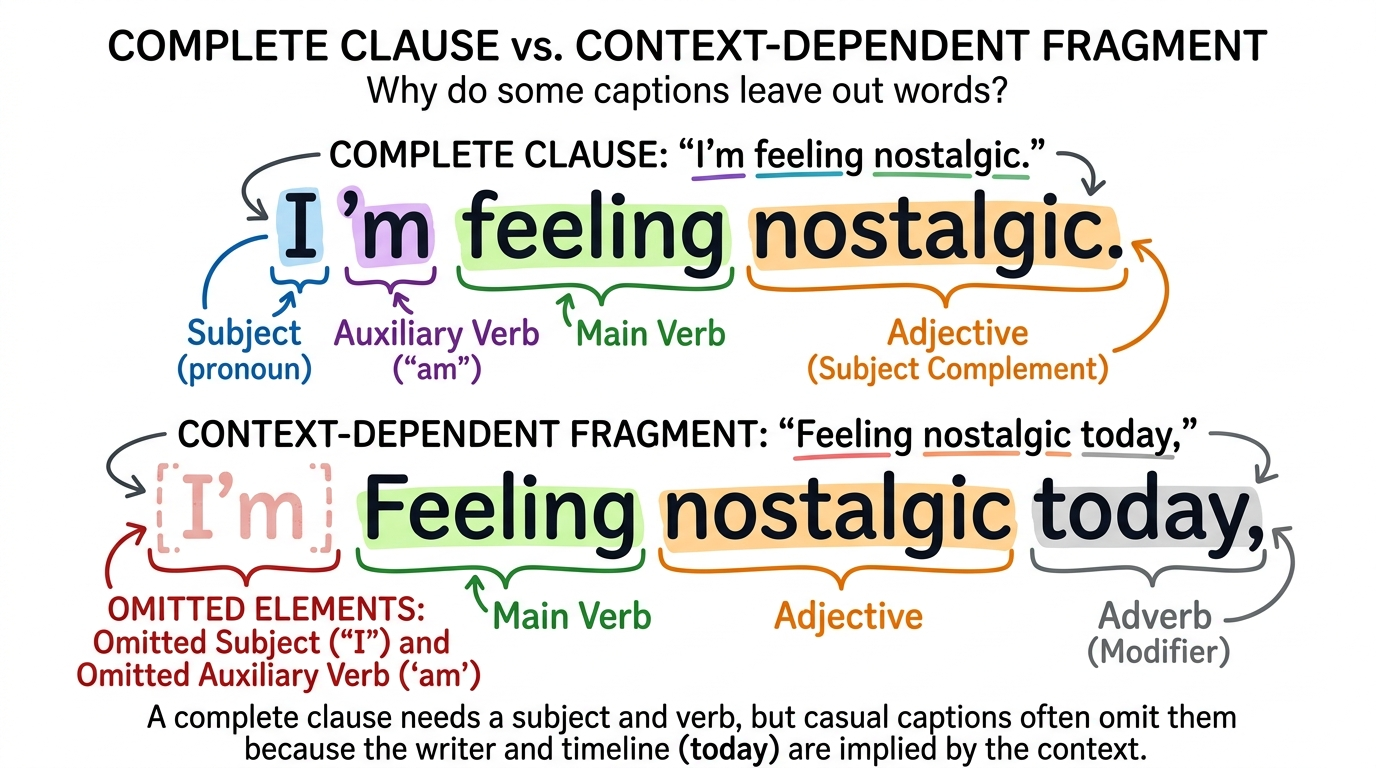
However, “feeling nostalgic” is a phrase, not necessarily a complete sentence. It becomes a complete sentence when it has the necessary grammatical structure.
| Expression | Correct? | Explanation |
|---|---|---|
| I’m feeling nostalgic. | Yes | Complete sentence |
| Feeling nostalgic today. | Yes, in context | Informal expression or caption |
| I feel nostalgic. | Yes | Complete sentence |
| I’m feeling nostalgia. | Yes | Grammatically possible, though less conversational |
| I’m feeling nostalgically. | Usually unnatural | The adverb does not fit the intended meaning well |
| I’m feeling nostalgics. | No, in the intended meaning | Nostalgics is not the correct adjective here |
The most natural everyday choices are “I’m feeling nostalgic” and “I feel nostalgic.”

Rule in Plain English
Use nostalgic when describing a person or thing associated with a feeling of longing for the past. Use nostalgia when naming the feeling itself.
Think of the distinction this way:
- Nostalgic = the adjective describing the feeling or the person experiencing it.
- Nostalgia = the noun naming the emotion.
- Feel = the verb expressing the experience of that emotion.
Compare these examples:
| Word | Part of speech | Example |
|---|---|---|
| Nostalgic | Adjective | I feel nostalgic. |
| Nostalgia | Noun | I feel nostalgia for my childhood. |
| Feel | Verb | I feel nostalgic when I hear this song. |
| Nostalgically | Adverb | She smiled nostalgically at the old photograph. |
A useful rule to remember is:
Say “I feel nostalgic” to describe your emotional state. Say “I feel nostalgia” to name the emotion itself.
Both are correct, but the adjective construction is generally more natural in casual conversation.
Core Grammar Explanation
1. What does “feeling nostalgic” mean?
Feeling nostalgic means experiencing nostalgia: a sentimental connection to the past that may involve happiness, sadness, affection, or a mixture of emotions.
For example:
- “I’m feeling nostalgic for my school days.”
- “He felt nostalgic when he visited his childhood home.”
- “We were feeling nostalgic about our family holidays.”
- “That familiar smell makes me feel nostalgic.”
The phrase often refers to memories that matter emotionally. Nostalgia can involve a time you experienced yourself, such as childhood, or a period you know through stories, photographs, films, or music.
It does not necessarily mean that you want to return to the past. You can feel nostalgic while being perfectly happy with your present life.
2. Why is “feeling nostalgic” grammatically correct?
The phrase works because feel can function as a linking verb, connecting a person to a description of their state.
In this construction, nostalgic is an adjective that describes the subject’s emotional state.
Consider:
I am feeling nostalgic.
The grammatical structure is:
I
Subject — who experiences the feeling
am feeling
Verb phrase — describes the current state
nostalgic
Adjective — describes the emotional state
In technical grammar, am feeling is a verb phrase in the present progressive, also called the present continuous. The adjective nostalgic functions as a subject complement: it describes the subject, I.
The same pattern appears in these sentences:
- I am feeling happy.
- She is feeling anxious.
- They are feeling hopeful.
- We are feeling nostalgic.
Because nostalgic is an adjective, it does not need to become a noun or an adverb after feeling.
3. “I feel nostalgic” versus “I’m feeling nostalgic”
Both expressions are correct, but their emphasis can differ.
| Sentence | Typical emphasis |
|---|---|
| I feel nostalgic. | A general feeling, tendency, or present state |
| I’m feeling nostalgic. | A feeling being experienced now or around this time |
| I felt nostalgic. | A feeling experienced in the past |
| I’ve been feeling nostalgic lately. | A feeling continuing or recurring over a recent period |
| I’ll feel nostalgic when I leave. | A feeling expected in the future |
These are tendencies, not rigid rules. English speakers can use the simple present to describe a current emotion and the progressive to emphasize a temporary or developing experience.
For instance:
- “I feel nostalgic whenever I hear this song.” — A recurring response.
- “I’m feeling nostalgic after looking through these photographs.” — A current response to a recent experience.
4. Is “feeling nostalgic” a complete sentence?
Not always. It depends on how the expression is used.
A complete sentence normally contains a main clause: a grammatical unit that can stand independently as a statement, question, or command.
| Example | Grammatical status | Why |
|---|---|---|
| I’m feeling nostalgic. | Complete sentence | Has a subject and finite verb |
| She was feeling nostalgic. | Complete sentence | Has a subject and past-tense auxiliary |
| Feeling nostalgic about the old days. | Fragment in ordinary prose | No explicit subject or finite auxiliary |
| Feeling nostalgic about the old days? | Natural conversational question | The missing words are understood from context |
| Feeling nostalgic makes me smile. | Complete sentence | The phrase feeling nostalgic functions as the subject |
The last example is particularly useful. In “Feeling nostalgic makes me smile,” the words feeling nostalgic form a gerund-participial clause functioning as the subject of makes.
A gerund-participial clause is a clause built around an -ing form that can perform different jobs in a sentence.
You do not need to use this technical term in everyday conversation. Just remember that an -ing phrase can sometimes function as a noun-like unit within a larger sentence.
Examples: How to Use “Nostalgic” and “Nostalgia” in a Sentence
The most useful way to learn these words is to see how they behave in different grammatical structures.
1. Nostalgic in a sentence
Nostalgic is an adjective. It can describe a person, a memory, a song, a photograph, a film, or an atmosphere that evokes the past.
Examples:
- I am feeling nostalgic about my childhood.
- This song makes me nostalgic for the 1990s.
- She became nostalgic while reading her old diary.
- He felt nostalgic when he returned to his hometown.
- The film has a nostalgic atmosphere.
- We shared some nostalgic memories of our school days.
- That old video game makes me feel nostalgic.
- The restaurant’s interior has a nostalgic charm.
- I sometimes get nostalgic when I see photographs of my grandparents.
- The reunion left everyone feeling nostalgic.
Notice that nostalgic does not always describe a person. It can also describe something that evokes memories or resembles an earlier period.
2. How to use “nostalgia” in a sentence
Nostalgia is a noun. It names the emotion rather than directly describing someone as experiencing it.
Examples:
- I feel nostalgia when I hear our old school song.
- She felt a wave of nostalgia while looking through her childhood photographs.
- The smell of freshly baked bread filled him with nostalgia.
- Nostalgia can make ordinary memories feel especially meaningful.
- He has a deep sense of nostalgia for his hometown.
- The film brought back a feeling of nostalgia.
- Their conversation was full of nostalgia for the past.
- I look back on those years with nostalgia.
- The exhibition explores nostalgia for earlier decades.
- A little nostalgia can make a family reunion feel special.
3. “Feeling nostalgic” in everyday conversation
The phrase is especially natural in informal contexts.
Looking at old photographs
“I’m feeling nostalgic after looking through our family album.”
Listening to music
“This playlist is making me feel nostalgic.”
Remembering school
“Feeling nostalgic for my school days today.”
Other everyday examples include:
- “Anyone else feeling nostalgic today?”
- “I’m feeling nostalgic for the good old days.”
- “This place makes me feel nostalgic.”
- “Feeling nostalgic about our last summer together.”
- “A little nostalgia never hurts.”
- “I suddenly felt nostalgic for home.”
4. Example sentences with “felt nostalgic”
Felt nostalgic is the past-tense form used to describe an earlier emotional experience.
Examples:
- I felt nostalgic when I saw my old school.
- She felt nostalgic for her childhood after visiting her hometown.
- We felt nostalgic while watching our old home videos.
- He felt nostalgic about the days when his friends lived nearby.
- They felt nostalgic after hearing the song they used to sing together.
The structure is:
Subject + felt + nostalgic + optional additional information
For example:
She + felt + nostalgic + when she saw her childhood home.
5. Nostalgic synonyms
The best synonym depends on the precise feeling you want to express.
| Word or phrase | Meaning and distinction |
|---|---|
| Sentimental | Emotionally attached to a person, object, or memory |
| Reflective | Thinking carefully about past experiences |
| Reminiscent | Bringing something else to mind, often from the past |
| Wistful | Showing gentle sadness or longing for something absent |
| Homesick | Missing one’s home or familiar surroundings |
| Longing | Strongly wanting something absent or distant |
| Melancholy | A thoughtful or subdued sadness |
| Evocative | Bringing memories or emotions to mind |
| Retrospective | Looking back at the past, often in a reflective way |
These words are not interchangeable in every context.
For example, homesick is more specific than nostalgic: a person can feel nostalgic about a holiday without wanting to go home.
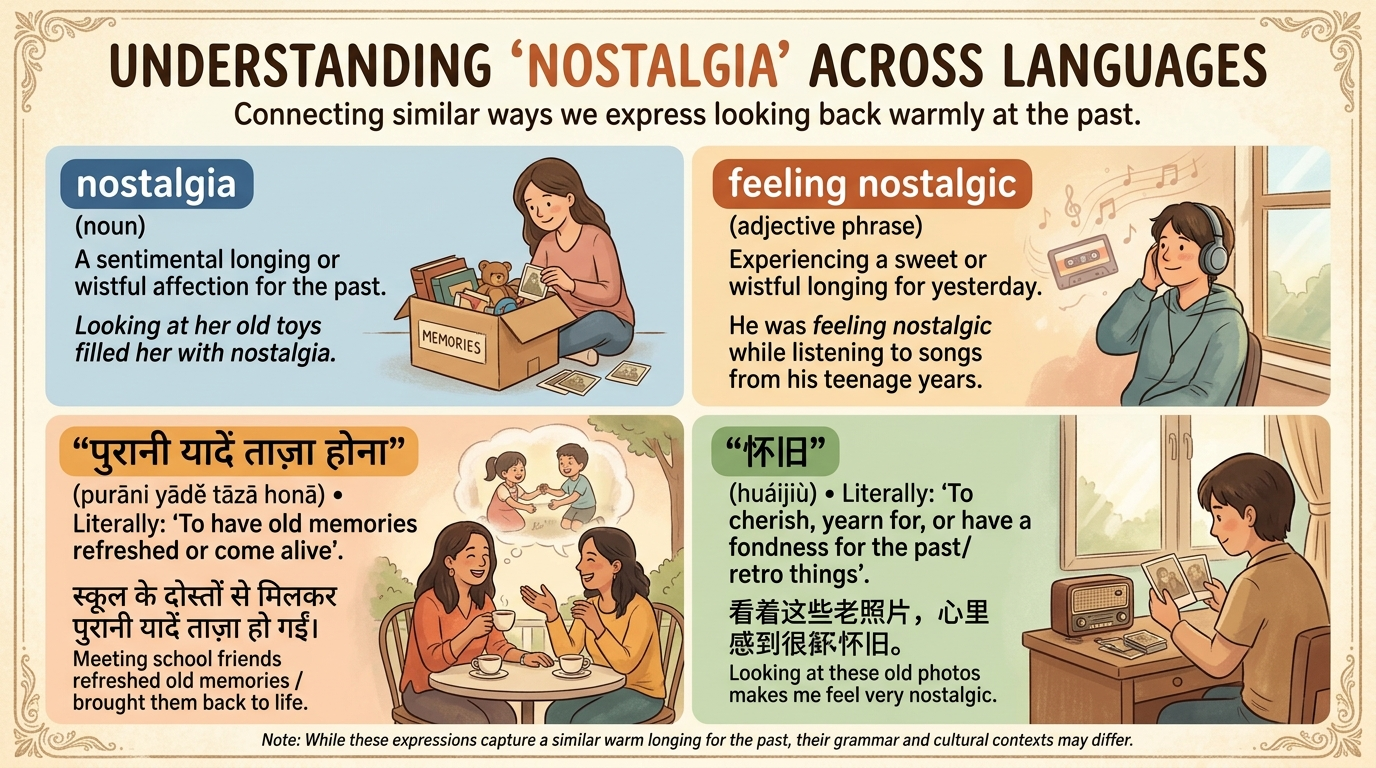
6. What does “feeling nostalgic” mean in Hindi?
A natural Hindi translation depends on the context.
- पुरानी यादें ताज़ा होना — old memories coming back.
- बीते दिनों की याद आना — remembering past days.
- पुरानी यादों में खो जाना — becoming absorbed in old memories.
- पुराने दिनों को याद करके भावुक होना — becoming emotional while remembering the old days.
For example:
“I’m feeling nostalgic about my school days.”
A natural Hindi rendering is:
“मुझे अपने स्कूल के पुराने दिनों की याद आ रही है।”
A more emotional rendering is:
“अपने स्कूल के पुराने दिनों को याद करके मैं भावुक हो रहा/रही हूँ।”
The best translation depends on whether the sentence emphasizes remembering, longing, or becoming emotional.
7. “Nostalgic” in Chinese
In Mandarin Chinese, common translations include:
- 怀旧 (huáijiù) — nostalgic; to cherish or look back fondly on the past.
- 怀旧的 (huáijiù de) — nostalgic, when an adjective-like modifier is needed.
- 怀旧情绪 (huáijiù qíngxù) — a nostalgic feeling or mood.
Example:
“I feel nostalgic.”
A natural Mandarin translation is:
“我感到很怀旧。” (Wǒ gǎndào hěn huáijiù.)
Depending on context, a more natural sentence may describe missing the old days or remembering them fondly.
Contrast and Minimal Pairs
A minimal pair is a pair of expressions that differ in one important feature, making the difference in meaning or grammar easier to understand.
1. Nostalgic vs. nostalgia
This is the most important distinction.
| Nostalgic | Nostalgia |
|---|---|
| Adjective | Noun |
| Describes an emotional state or quality | Names an emotion |
| I feel nostalgic. | I feel nostalgia. |
| She is nostalgic for her childhood. | She feels nostalgia for her childhood. |
| It is a nostalgic film. | The film evokes nostalgia. |
Incorrect: “I feel nostalgia for my childhood, so I am nostalgia.”
Correct: “I feel nostalgia for my childhood, so I am nostalgic.”
The noun and adjective cannot simply replace one another because they perform different grammatical jobs.
2. “I feel nostalgic” vs. “I feel nostalgia”
Both are correct.
- “I feel nostalgic when I hear this song.” — Focuses on your emotional state.
- “I feel nostalgia when I hear this song.” — Focuses on the emotion itself.
The first is generally more conversational. The second is also natural, especially in reflective or descriptive writing.
3. “Nostalgic about” vs. “nostalgic for”
Both prepositions are possible, but they can emphasize different relationships.
| Expression | Example | Typical emphasis |
|---|---|---|
| Nostalgic about | I’m nostalgic about my school years. | Reflecting fondly on a period or experience |
| Nostalgic for | I’m nostalgic for my school days. | Longing for or missing a past time |
| Nostalgic about | She feels nostalgic about the old neighbourhood. | Memories and feelings associated with a place |
| Nostalgic for | He feels nostalgic for his hometown. | A stronger sense of longing for a place |
This is a tendency, not an absolute rule. Both about and for occur in natural English with overlapping meanings.
4. “I feel nostalgic” vs. “I am nostalgic”
Both are grammatical, but the emphasis can differ.
- “I feel nostalgic today.” — Emphasizes the experience of an emotion.
- “I am nostalgic about the past.” — Describes a state or disposition toward the past.
The second can sound broader or more enduring, but context determines the interpretation.
5. “Nostalgic” vs. “sentimental”
These adjectives overlap without having exactly the same meaning.
- “I feel nostalgic when I revisit my childhood home.” — The feeling is connected to the past.
- “I feel sentimental when I read my grandmother’s letters.” — The feeling is tender or emotionally significant.
A person can be sentimental about something in the present without feeling nostalgic.
6. “Nostalgic” vs. “reminiscent”
Compare:
- “I feel nostalgic about my childhood.” — I experience a feeling about the past.
- “This song is reminiscent of my childhood.” — This song reminds me of my childhood.
Nostalgic can describe the person experiencing the emotion or something that evokes it. Reminiscent typically describes something that brings another thing to mind.
Exceptions and Nuance
1. Is “nostalgic” a tone?
Yes, “nostalgic” can describe a tone, particularly in writing, films, music, advertising, and photography.
A tone is the attitude or emotional quality communicated by a speaker or piece of writing.
Examples:
- “The essay has a nostalgic tone.”
- “The film adopts a nostalgic tone when depicting childhood.”
- “Her speech was warm and nostalgic.”
- “The advertisement uses nostalgic imagery to appeal to older memories.”
In literary analysis, nostalgic tone describes the emotional atmosphere created by the language or presentation.
However, nostalgic is not itself a grammatical tone marker. It is an adjective that can be used to describe tone.
2. Can “feeling nostalgic” be used as a social media caption?
Yes. Captions often use fragments rather than complete sentences.
Examples:
- “Feeling nostalgic.”
- “Feeling nostalgic for the old days.”
- “A little nostalgic today.”
- “Nostalgic for simpler times.”
- “Just feeling nostalgic.”
These expressions are natural as captions because the context supplies the speaker and situation.
In formal prose, use a complete sentence when one is required:
- Informal caption: “Feeling nostalgic about our school days.”
- Formal prose: “I am feeling nostalgic about our school days.”
The caption is not necessarily a grammatical mistake. It is a context-appropriate fragment.
3. Can a song, photograph, or place feel nostalgic?
Yes. English permits nostalgic to describe objects, media, and environments that evoke the past.
Examples:
- “This photograph feels nostalgic.”
- “The song has a nostalgic quality.”
- “The room looks nostalgic.”
- “The film creates a nostalgic atmosphere.”
Some constructions are more natural than others. “The photograph feels nostalgic” is understandable, while “The photograph evokes nostalgia” is often more precise in formal writing.
4. Can you feel nostalgic about something you never experienced?
Yes. Nostalgia is often associated with personal memories, but English also allows expressions such as nostalgia for an imagined past or nostalgia for a bygone era.
For example:
- “The film gives viewers a nostalgic vision of the 1950s.”
- “She feels nostalgic for an era she knows only through old photographs.”
- “The design creates nostalgia for a time before digital technology.”
The experience may be based on cultural images, family stories, or an idealized picture of the past rather than personal memories.
5. Is “many a time” related to “feeling nostalgic”?
No. These expressions serve different grammatical purposes.
Many a time is a formal or literary expression meaning many times or often. It does not describe an emotion.
For example:
- “I have felt nostalgic many a time.”
- “I have felt nostalgic many times.”
Both sentences are correct, although the first sounds more literary.
Similarly, many a times is not the standard form in edited English. The conventional alternatives are many a time and many times.
6. Is “nostalgic” always positive?
No. Nostalgia can be pleasant, bittersweet, or sad.
- “I felt nostalgic and smiled at the memories.”
- “The photographs filled her with a bittersweet nostalgia.”
- “He felt nostalgic for friends he had lost touch with.”
The word often suggests affection for the past, but it does not guarantee happiness.
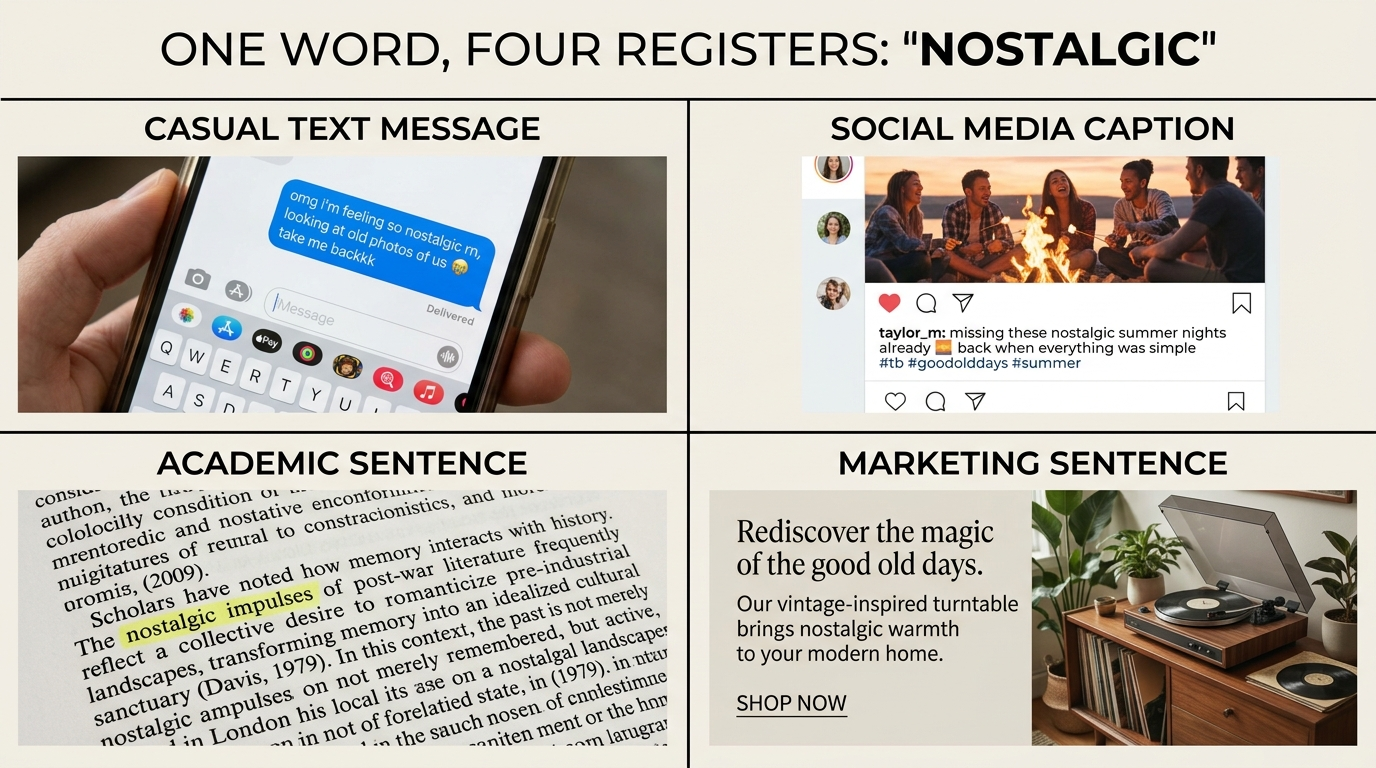
7. Register: casual, academic, and professional English
Register means the style of language appropriate to a particular situation.
| Context | Natural example |
|---|---|
| Casual conversation | “I’m feeling nostalgic today.” |
| Social media | “Feeling nostalgic for the old days.” |
| Personal essay | “I felt nostalgic as I revisited my childhood home.” |
| Academic writing | “The novel constructs a nostalgic representation of the past.” |
| Professional marketing | “The campaign uses nostalgic imagery to connect with its audience.” |
| Literary criticism | “The passage establishes a wistful, nostalgic tone.” |
The word itself is suitable for both everyday and formal English. What changes is the surrounding vocabulary and sentence structure.
Common Errors
Error 1: Using the noun instead of the adjective
Incorrect: “I am nostalgia.”
Correct: “I am nostalgic.”
Why: Nostalgia names an emotion; nostalgic describes the person experiencing it.
Error 2: Adding an unnecessary adverb
Awkward: “I am feeling nostalgically about my childhood.”
More natural: “I am feeling nostalgic about my childhood.”
Why: The sentence needs an adjective to describe the subject’s emotional state. Nostalgically is an adverb and is more natural when describing an action, as in “She looked nostalgically at the photograph.”
Error 3: Assuming every “-ing” phrase is incorrect without a subject
Incorrect reasoning: “Feeling nostalgic is always a sentence fragment.”
Better understanding:
- “I am feeling nostalgic.” — Complete sentence.
- “Feeling nostalgic today.” — Natural as a caption or conversational fragment.
- “Feeling nostalgic makes me smile.” — Complete sentence with an -ing clause as its subject.
The grammatical role of the phrase depends on the sentence.
Error 4: Confusing “nostalgic” with “nostalgia”
Incorrect: “The movie made me feel nostalgia for my childhood, and I was nostalgia.”
Correct: “The movie made me feel nostalgic for my childhood.”
Also correct: “The movie filled me with nostalgia for my childhood.”
Error 5: Using the wrong preposition automatically
Awkward in some contexts: “I am nostalgic to my childhood.”
Natural alternatives:
- “I am nostalgic about my childhood.”
- “I am nostalgic for my childhood.”
- “I feel nostalgia for my childhood.”
Use about or for rather than to in these ordinary constructions.
Error 6: Treating “nostalgic” as a synonym for “old”
Incorrect assumption: “This is a nostalgic building because it is old.”
Better: “This old building has a nostalgic atmosphere because it reminds me of my childhood.”
Something can be old without evoking nostalgia. The adjective refers to an emotional connection or an effect, not simply age.
Error 7: Using “nostalgic” when “homesick” is more precise
Less precise: “I’m nostalgic because I miss my family and want to go home.”
More precise, if the emphasis is missing home: “I’m homesick.”
The words can overlap, but homesick specifically emphasizes missing one’s home or familiar surroundings.
Error 8: Using “nostalgia” as an adjective
Incorrect: “It was a nostalgia film.”
More natural:
- “It was a nostalgic film.”
- “It was a film filled with nostalgia.”
- “It was a film that evoked nostalgia.”
In some specialized contexts, nostalgia can modify another noun, as in nostalgia marketing. That does not mean it can replace nostalgic in every adjective position.
Practical Test: How to Check Your Own Sentence
Use these quick tests whenever you are unsure whether to write feeling nostalgic, nostalgic, or nostalgia.
Test 1: Are you describing a person or naming an emotion?
If you are describing how someone feels, try the adjective.
- “I feel nostalgic.” — Correct.
- “She seems nostalgic.” — Correct.
If you are naming the emotion, use the noun.
- “I feel nostalgia.” — Correct.
- “She experienced nostalgia.” — Correct.
Test 2: Can you replace “nostalgic” with another adjective?
Try replacing it with happy, sad, or hopeful.
- “I am feeling nostalgic.”
- “I am feeling happy.”
- “I am feeling hopeful.”
All three follow the same grammatical pattern. This is a useful indication that nostalgic is functioning as an adjective.
Test 3: Does the sentence have a main verb?
Consider:
- “I am feeling nostalgic.” — Has a subject and a finite verb.
- “She was feeling nostalgic.” — Has a subject and a finite verb.
- “Feeling nostalgic about my childhood.” — Usually a fragment when used as ordinary prose by itself.
- “Feeling nostalgic about my childhood, I opened my old diary.” — Complete sentence with an introductory participial clause.
If you are writing a formal paragraph, check whether each sentence can stand grammatically on its own.
Test 4: Is the preposition natural?
Common patterns include:
- nostalgic about the past
- nostalgic for childhood
- nostalgic for home
- nostalgia for the past
- nostalgia about a particular period
The combinations overlap, but nostalgia for and nostalgic for are especially common when the focus is something missed or longed for.
Test 5: Does your sentence sound natural in context?
Choose the most natural expression
Select the meaning and context to see a suitable example.
1. What are you trying to express?Describe how I feelName the emotionWrite a short caption
2. Which context are you writing for?Everyday conversationFormal writingSocial media
SUGGESTED EXPRESSION
I’m feeling nostalgic today. Copy example
Advanced Notes
1. The grammar of “feel”
The verb feel can be used in different grammatical patterns.
Pattern A: Feel + adjective
This describes a state or condition.
- I feel nostalgic.
- She feels tired.
- They felt optimistic.
Here, the adjective functions as a subject complement.
Pattern B: Feel + noun
This identifies an emotion or sensation.
- I feel nostalgia.
- She felt relief.
- They felt excitement.
Here, the noun names the experience.
Pattern C: Feel + object + adjective
This describes a state experienced by another person or object.
- The song made me feel nostalgic.
- The news made her feel hopeful.
- The conversation left them feeling uneasy.
In the first example, me is the object of made, while nostalgic describes the state that the song causes the speaker to experience.
2. Why “I’m feeling nostalgic” uses the present progressive
The present progressive is formed with a present-tense form of be plus an -ing verb form.
The structure is:
\[ \text{Subject} + \text{am/is/are} + \text{verb-ing} \]
Examples:
- I am feeling nostalgic.
- She is feeling nostalgic.
- They are feeling nostalgic.
Although feel can describe a relatively stable state in the simple present, it also occurs naturally in the progressive when the speaker emphasizes a current, temporary, or developing experience.
Compare:
- “I feel nostalgic whenever I visit this town.” — A recurring response.
- “I’m feeling nostalgic after visiting this town.” — A current reaction.
This is not a strict distinction between permanent and temporary feelings. It is a difference in how the speaker presents the situation.
3. Can “feeling nostalgic” be a subject?
Yes.
In this sentence:
“Feeling nostalgic makes me want to revisit my hometown.”
The -ing clause feeling nostalgic functions as the subject of makes.
A useful structural breakdown is:
- Subject: Feeling nostalgic
- Verb: makes
- Object: me
- Complement: want to revisit my hometown
This is why the phrase cannot automatically be labelled incorrect merely because it begins with feeling.
4. The difference between emotional state and emotional effect
Compare the following:
- “I am nostalgic.” — Describes the person’s state.
- “The song is nostalgic.” — Describes the song as evoking or expressing nostalgia.
- “The song evokes nostalgia.” — Explicitly states that the song brings the emotion to mind.
- “The song reminds me of my childhood.” — Identifies the memory the song evokes.
The most precise choice depends on what you want to emphasize.
In editorial writing, evokes nostalgia can be more explicit than is nostalgic, especially when the subject is an object or a piece of media.
5. Is “feeling nostalgia” correct?
Yes. It is grammatically possible to use feel with the noun nostalgia.
Examples:
- “I am feeling nostalgia for my childhood.”
- “She felt nostalgia for the place where she grew up.”
- “We have been feeling nostalgia for the old neighbourhood.”
However, the construction feeling nostalgic is often more idiomatic in casual speech.
Compare:
- Natural conversational style: “I’m feeling nostalgic.”
- Also correct: “I’m feeling nostalgia for those days.”
- More formal or literary: “A sense of nostalgia overcame him.”
Grammar determines whether a sentence is well formed; idiomatic usage helps determine which correct sentence sounds most natural in a particular context.

FAQs
1. Is it correct to say “feeling nostalgic”?
Yes. It is a natural and grammatically correct phrase. “I’m feeling nostalgic” is a complete sentence, while “Feeling nostalgic” can work as a caption or conversational fragment.
2. What does feeling nostalgic mean?
It means experiencing a sentimental longing for the past, often triggered by memories, music, photographs, people, or familiar places.
3. Is “I am feeling nostalgia” grammatically correct?
Yes. Nostalgia is a noun, so the construction is grammatically possible. However, “I am feeling nostalgic” is generally more natural in everyday conversation.
4. How do you use nostalgia in a sentence?
Use nostalgia as a noun.
Examples:
- “The song filled me with nostalgia.”
- “She felt nostalgia for her childhood.”
- “The exhibition explores nostalgia for earlier decades.”
5. What is a sentence using nostalgic?
“I felt nostalgic when I visited my old school.”
Here, nostalgic is an adjective describing the speaker’s emotional state.
6. What is the difference between nostalgic and nostalgia?
Nostalgic is an adjective that describes a feeling or emotional quality. Nostalgia is a noun that names the emotion.
- “I feel nostalgic.”
- “I feel nostalgia.”
Both are correct.
7. Is “feeling nostalgic for the old days” correct?
Yes. It is natural English. It can be used as an informal caption or expanded into a complete sentence: “I’m feeling nostalgic for the old days.”
8. Is nostalgic a tone?
Yes. Nostalgic can describe the tone of a piece of writing, film, speech, song, or advertisement when it conveys longing or affection for the past.
Example: “The author creates a nostalgic tone through descriptions of childhood.”
9. Which is correct: “nostalgic about” or “nostalgic for”?
Both are correct. Nostalgic about often emphasizes memories or experiences, while nostalgic for can emphasize longing for something absent. The meanings overlap.
10. What is the meaning of “felt nostalgic”?
It means that someone experienced nostalgia in the past.
Example: “I felt nostalgic when I found my old school notebook.”
11. Can I say “I’m nostalgic”?
Yes. “I’m nostalgic about my childhood” is grammatical. “I’m feeling nostalgic” places more emphasis on the experience of the emotion at the moment.
12. What are common synonyms for nostalgic?
Depending on the context, possible alternatives include sentimental, wistful, reminiscent, and reflective. They are related words, not exact substitutes in every sentence.
13. How do you say nostalgic in Chinese?
In Mandarin, 怀旧 (huáijiù) is a common translation. Depending on the sentence, 怀旧的 (huáijiù de) can express the adjective-like meaning “nostalgic.”
14. Is “many a time” correct in a sentence about nostalgia?
Yes. Many a time means many times and has a somewhat formal or literary tone.
Example: “I have felt nostalgic many a time.”
The more ordinary alternative is “I have felt nostalgic many times.”
15. Is “feeling nostalgic” formal or informal?
It is suitable for both. The bare phrase is particularly common in casual captions and conversation, while a complete sentence such as “I felt nostalgic when I revisited my hometown” works well in formal prose.
Summary
“Feeling nostalgic” is correct English. The most natural complete sentence is often “I’m feeling nostalgic.” Use nostalgic as an adjective to describe an emotional state and nostalgia as a noun to name the emotion.
Remember these patterns:
- Feel + adjective: I feel nostalgic.
- Feel + noun: I feel nostalgia.
- Be + feeling: I’m feeling nostalgic.
- Noun + evoke + noun: The song evokes nostalgia.
- Feel + adjective + about/for: She feels nostalgic about her childhood.
If you remember one rule
Use “nostalgic” to describe the feeling and “nostalgia” to name it. Both “I’m feeling nostalgic” and “I feel nostalgia” are correct, but “I’m feeling nostalgic” is usually the more natural choice in everyday conversation.