Is It Correct to Say “Well Said”? Meaning & Usage
Quick Answer
Yes, “well said” is correct and natural English. It is a short expression used to show that you agree with, appreciate, or strongly approve of something someone has just expressed.
For example:
“We should judge ideas by their evidence, not by who presents them.”
“Well said.”
Here, well said means roughly “That was expressed very clearly or effectively” or “I agree with what you said.”
The expression is especially common as a standalone response in conversations, speeches, meetings, comments, interviews, and online discussions.
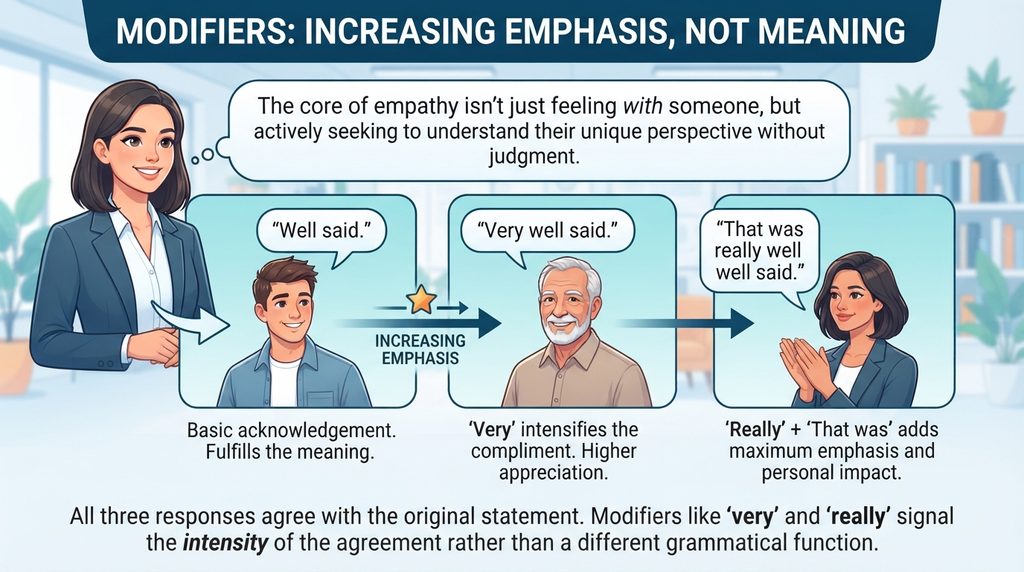
It is also correct to say “very well said” when you want to make the praise stronger:
“You explained the problem without blaming anyone. Very well said.”
“Well stated” is another correct alternative, often with a slightly more formal tone.
well said
wel SEDAdd to flashcards
Give feedback
Rule in Plain English
“Well said” is an idiomatic shortened form of “That was well said.”
The word said is the past participle of the verb say, and well tells us how the speaking or expressing was done.
Compare:
- You said that well.
- That was well said.
- Well said!
The third version is an abbreviated conversational expression. English frequently leaves out words when their meaning is obvious from context.
For instance:
“That was a brilliant answer.”
“Thank you.”
Similarly:
“That was very well said.”
“Well said.”
The full grammatical sentence and the shorter conversational expression serve essentially the same communicative purpose.
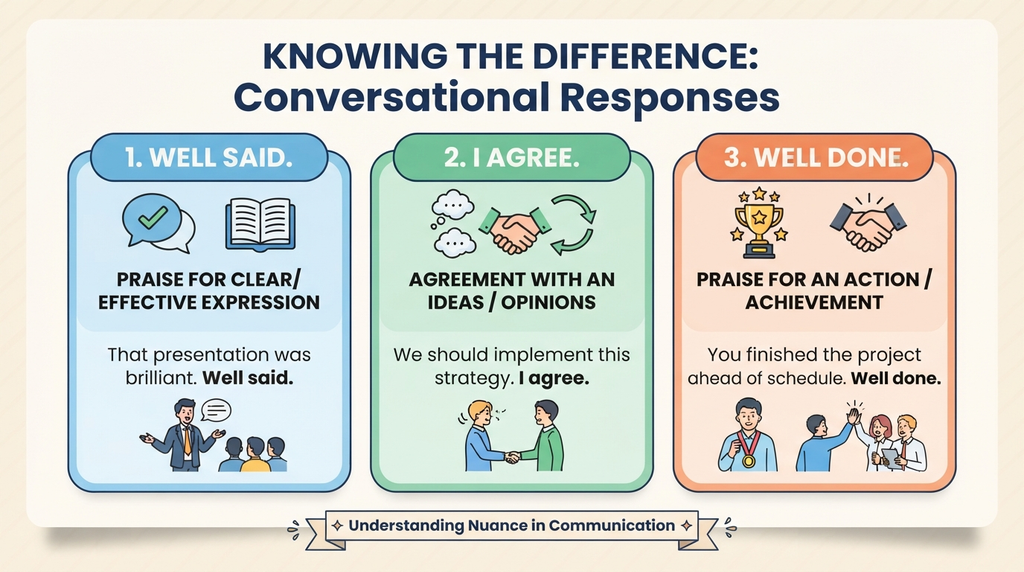
If you remember one rule
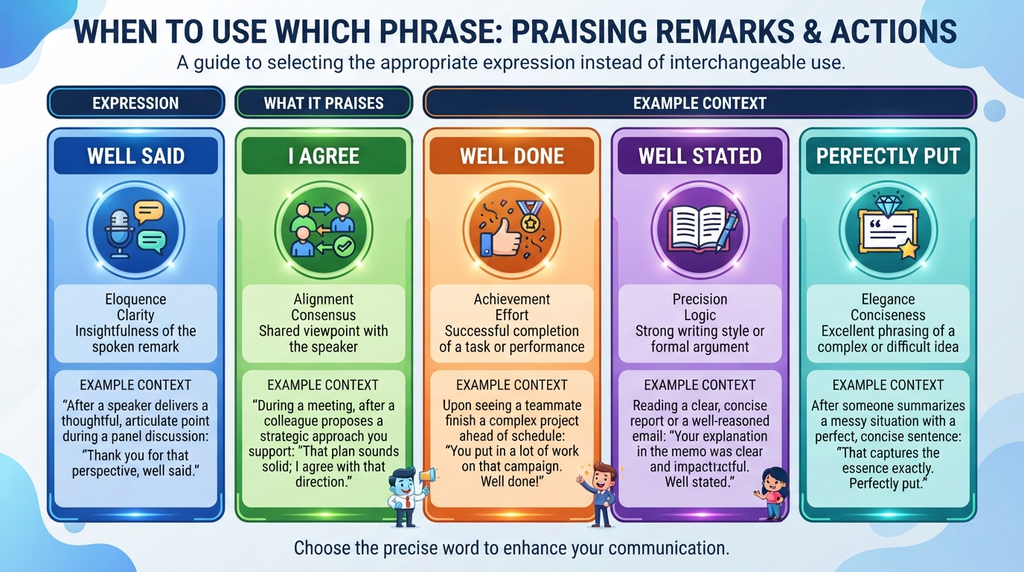
Use “well said” when you are praising the way someone has expressed an idea, opinion, observation, or feeling.
Use “I agree” when your main point is agreement.
Use “well done” when you are praising an action, achievement, or performance.
Core Grammar Explanation
What kind of expression is “well said”?
Well said is commonly used as a standalone interjectional expression or conversational response.
An interjection is a word or expression that communicates a reaction, feeling, or response without necessarily forming a complete traditional sentence.
Examples include:
- “Wow!”
- “Exactly!”
- “Absolutely!”
- “Well said!”
- “Good point!”
In well said, the expression can be understood as a shortened version of a fuller construction such as:
“That was well said.”
or:
“You said that very well.”
The omitted words are recoverable from the situation, so the short version works naturally in conversation.
Why is “well” correct instead of “good”?
This is an important grammar distinction.
Good is normally an adjective.
Well is commonly an adverb.
When we describe a thing, we often use an adjective:
That was a good statement.
When we describe how an action was performed, we use an adverb:
You expressed that idea well.
Therefore:
You said it well.
That was well said.
The participle said is functioning within a passive construction, and well describes the quality of the expression.
Compare:
| Expression | Main idea |
|---|---|
| You gave a good answer. | The answer itself was good. |
| You answered well. | You performed the answering effectively. |
| That was well said. | The idea was expressed effectively. |
| That was a well-written article. | The article was written effectively. |
Is “well said” a complete sentence?
Not in the same way that “You said that well” is a complete clause.
But that does not make it incorrect.
English conversation regularly uses sentence fragments and abbreviated expressions:
“Good idea.”
“Excellent point.”
“Well said.”
“Absolutely.”
“Sounds good.”
These are perfectly normal in conversational English.
So the distinction is:
Grammatically expanded form:
“That was well said.”
Natural shortened response:
“Well said.”
The shortened form is conventional and idiomatic.
Examples of “Well Said”
In everyday conversation
“We don’t have to agree with someone to treat them respectfully.”
“Well said.”
In a meeting
“If we want better results, we need to improve the process rather than simply work longer hours.”
“Well said.”
In a classroom
“The character’s silence tells us as much as his dialogue does.”
“Well said.”
In professional writing
“The proposal focuses on solving the underlying problem rather than treating the symptoms.”
“Well said. That distinction is important.”
In online comments
“Being busy isn’t necessarily the same as being productive.”
“Well said.”
As stronger praise
“Very well said.”
This emphasizes the compliment more strongly than the shorter version.
With “really”
“That was really well said.”
This is also natural when the speaker wants to emphasize how effectively something was expressed.
Contrast and Minimal Pairs
Understanding what well said means becomes easier when it is compared with related expressions.
“Well said” vs. “I agree”
These expressions can overlap, but they are not identical.
Well said praises the speaker’s expression.
“We should listen before we criticize.”
“Well said.”
The listener may agree, but the explicit compliment is about how the thought was expressed.
I agree directly expresses agreement.
“We should listen before we criticize.”
“I agree.”
You can combine them:
“Well said. I completely agree.”
“Well said” vs. “Well done”
These are frequently confused by learners.
Well said → words or an idea were expressed effectively.
“You explained the issue very clearly. Well said.”
Well done → an action or achievement was performed successfully.
“You finished the project ahead of schedule. Well done.”
Incorrect in the intended meaning:
“You finished the project ahead of schedule. Well said.”
That would suggest the project was something that was verbally expressed, which is not the intended meaning.
“Well said” vs. “Well stated”
Both can praise someone’s expression.
“Your argument was well stated.”
“Well stated.”
Well stated can sound somewhat more formal, analytical, or professional.
Well said is broader and more conversational.
Compare:
| Expression | Typical tone |
|---|---|
| Well said. | Natural, conversational |
| Very well said. | Stronger praise |
| Well stated. | Formal or analytical |
| Nicely put. | Friendly, conversational |
| Good point. | Focuses on the idea |
| I agree. | Focuses on agreement |
| Exactly. | Strong agreement |
| You put that well. | Directly praises expression |
“Perfectly said”
Perfectly said is understandable and used in English, especially in informal online communication.
However, “perfectly put” or “very well said” may sound more idiomatic in many contexts.
For example:
“That captures exactly how I feel. Perfectly said.”
This is possible, but:
“That captures exactly how I feel. Very well said.”
is also highly natural.
And:
“That captures exactly how I feel. Perfectly put.”
is another natural option.
“Well Said” or “Well Said”?
If you are asking whether there is a different grammatical form such as “well-said”, the answer depends on how the expression is being used.
As a standalone response, write:
Well said.
Usually, it is not hyphenated.
However, well-said can appear as a compound adjective in some writing:
It was a well-said observation.
That said, well-stated, well-expressed, or simply clearly expressed may often be more natural depending on the sentence.
The important distinction is between the standalone expression and a compound modifier.
Standalone expression
“Well said!”
Predicate construction
“That was well said.”
Before a noun
“It was a well-expressed argument.”
The hyphenation of compounds involving well can vary according to style and grammatical structure, so it is better not to turn well-said into a universal rule.
Common Errors
Error 1: “Good said”
❌ “Good said!”
✅ “Well said!”
The standard expression uses well, not good.
Why? Because well describes the manner or quality of the expressing.
Error 2: Using “well done” for speech
❌ “Your explanation was excellent. Well done” — when the intended compliment is specifically about the wording.
✅ “Your explanation was excellent. Well said.”
However, well done can still be appropriate if you are praising the person’s overall performance rather than their wording.
Error 3: Treating “well said” as agreement in every situation
Suppose someone says:
“I think we should cancel the meeting.”
You could respond:
“I agree.”
But “Well said” is not necessarily the natural response because the sentence may not have involved a particularly skillful expression. The speaker may have simply stated a preference.
Well said works especially well when someone has expressed an insight, argument, observation, principle, or feeling clearly.
Error 4: Writing “well said” in every agreement
Not every disagreement or agreement calls for praise of expression.
Compare:
“The train leaves at 8:00.”
“I agree.”
This is more natural than:
“Well said.”
The second is possible as a playful response, but it would sound unusual because there is little expressive skill to praise.
Error 5: Assuming “well said” always means complete agreement
Someone can say:
“Well said, although I disagree with your conclusion.”
This may sound contradictory at first, but it is perfectly possible.
The speaker can admire the way an argument was expressed without accepting the argument itself.
That distinction is particularly important in academic and professional discussion.
Exceptions and Nuance
It can praise wording without endorsing the conclusion
Consider:
“Your argument is clearly structured, but I don’t agree with the conclusion.”
Here, the listener could reasonably say:
“Well said, although I reach a different conclusion.”
The phrase can therefore praise clarity, precision, or rhetorical effectiveness rather than truth.
It can be sincere or sarcastic
Context and intonation matter.
Sincere:
“You explained the problem with remarkable clarity. Well said.”
Potentially sarcastic:
“Well said.”
If the speaker uses a mocking tone after an obviously foolish remark, the literal words remain positive while the intended meaning can become ironic.
Written communication makes this harder to detect because tone is absent.
“Well said” can refer to writing
Although said literally relates to speech, English often uses speech verbs more broadly for things communicated in writing.
For example:
“That article explains the issue perfectly.”
“Well said.”
A person might also comment “well said” beneath a social-media post, essay, letter, or written argument.
The meaning is essentially:
“That was expressed effectively.”
Other Ways to Say “Well Said”
The best alternative depends on what you want to communicate.
If you are praising expression
- Nicely put.
- Well put.
- You put that well.
- Very well stated.
- Clearly expressed.
- That’s well expressed.
- You expressed that beautifully.
- That’s a good way of putting it.
If you are emphasizing agreement
- I agree.
- Exactly.
- Absolutely.
- That’s exactly right.
- I couldn’t agree more.
- You have a point.
- That’s a good point.
If you want a professional tone
- That’s a well-articulated point.
- That’s clearly stated.
- You’ve expressed that very clearly.
- That’s a thoughtful observation.
- That’s a strong way to frame the issue.
If you want a warm, conversational tone
- Nicely put!
- So true.
- Exactly!
- You said it perfectly.
- Couldn’t have put it better myself.
These alternatives are not perfect synonyms in every context. Some praise the expression, while others emphasize agreement, accuracy, or insight.
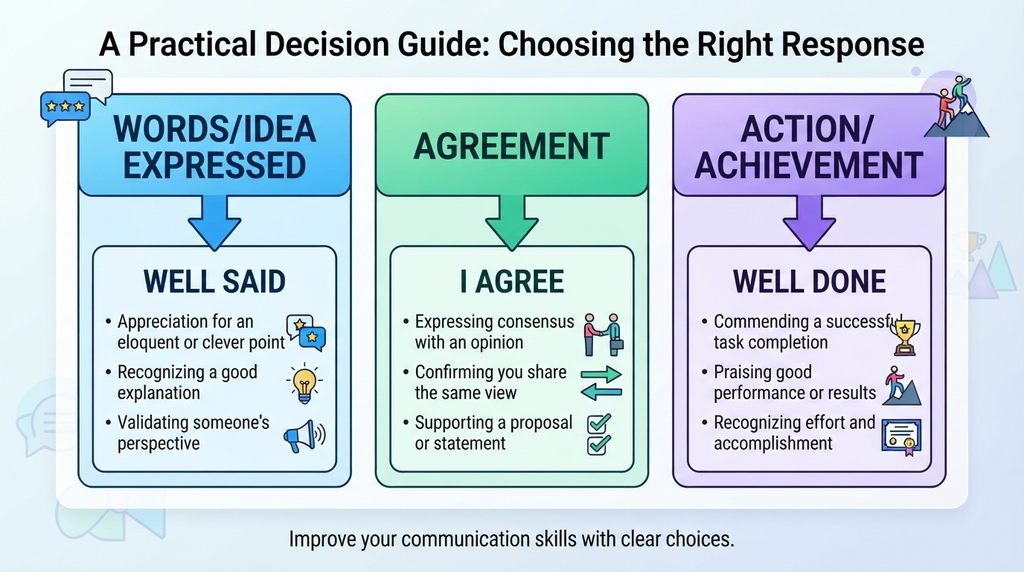
Practical Test: Should You Use “Well Said”?
Try this three-question test.
Question 1: Did someone express an idea?
If yes, continue.
“We need to solve the cause of the problem, not just its symptoms.”
Yes.
Question 2: Do you want to praise the way they expressed it?
If yes:
“Well said.”
works naturally.
Question 3: Do you only want to show agreement?
Then choose:
“I agree.”
or:
“Exactly.”
instead.
This distinction makes your response more precise.

Advanced Grammar Notes
The passive structure behind “well said”
The expression can be analyzed through a passive construction.
Active:
You said the idea well.
Passive:
The idea was well said.
Conversational reduction:
Well said.
The active sentence places emphasis on the person who spoke.
The passive version places emphasis on the expression or idea.
The standalone expression removes the obvious subject and auxiliary verb because the conversational context supplies them.
A simplified structure is:
That + was + well + said
becoming:
Well said.
This is not a rule that says every passive sentence can simply lose its first words. Rather, well said has become an established conventional expression.
Why “said well” and “well said” both occur
Both forms can be grammatical, but they appear in different structures.
You said it well.
Here, well follows the verb phrase.
It was well said.
Here, well precedes the past participle in a passive construction.
The standalone:
Well said!
inherits the pattern of the second construction.
“Well-said” as a modifier
When a compound adjective appears before a noun, writers sometimes use a hyphen:
a well-said comment
But many writers may prefer:
a well-expressed comment
or:
a clearly expressed comment
because well-said can sound less natural than the established standalone expression well said.
Style guides can differ about hyphenation in compound modifiers, so punctuation should be considered according to the particular sentence and style system rather than treated as an absolute grammar rule.
Why “very well said” works
In:
“Very well said.”
very modifies well, strengthening the evaluation.
Compare:
Well said.
Very well said.
That was extremely well said.
The basic grammatical relationship remains the same.
However, very well said is an expression of stronger praise, not a different grammatical category.
Meaning in Malayalam and Telugu
The phrase well said does not have one single translation that works in every context because its exact meaning depends on whether the speaker is praising clarity, agreement, or the quality of an observation.
In Malayalam, a contextually appropriate rendering might communicate the idea of:
“നന്നായി പറഞ്ഞു” / “വളരെ നന്നായി പറഞ്ഞു”
depending on the context and desired tone.
In Telugu, an equivalent can communicate:
“బాగా చెప్పారు” / “చాలా బాగా చెప్పారు”
Again, the most natural translation depends on whether the speaker is addressing one person, several people, or responding formally.
For English learners, it is better to understand the function of the phrase rather than memorize one translation.
Frequently Asked Questions
What does “well said” mean?
Well said means that someone has expressed an idea, opinion, observation, or feeling clearly, effectively, or appropriately. It can also imply agreement, but its primary function is often praise for the expression.
Is it correct to say “very well said”?
Yes. Very well said is grammatical and natural. It is a stronger version of well said.
“You captured the issue perfectly. Very well said.”
Is “well stated” correct?
Yes. Well stated is correct and often sounds somewhat more formal or analytical than well said.
“That is a well-stated argument.”
Is “perfectly said” correct?
Yes, perfectly said is understandable and used, particularly in informal contexts. Depending on the sentence, perfectly put, very well said, or beautifully expressed may sound more idiomatic.
What is another phrase for “well said”?
Possible alternatives include well put, nicely put, well stated, good point, exactly, and you expressed that well. The appropriate alternative depends on whether you want to praise the wording or express agreement.
Is “well said” formal or informal?
It works in both settings. Well said is natural in everyday conversation, professional meetings, classrooms, interviews, and written comments. More formal alternatives include well stated, well articulated, or clearly expressed.
Should “well said” be hyphenated?
As a standalone expression, normally write “well said”, without a hyphen:
“Well said.”
When the words function together as a modifier before a noun, hyphenation may depend on the construction and style guide. Do not assume that well-said should replace the standard standalone expression.
Can I say “well said” when I disagree?
Yes. You can praise how someone expressed an argument without agreeing with its conclusion.
“Well said, although I interpret the evidence differently.”
Is “well said” the same as “I agree”?
Not exactly. Well said praises the expression; I agree explicitly communicates agreement. They can overlap, but they serve different functions.
What is the difference between “well said” and “well done”?
Well said praises someone’s words or expression. Well done generally praises an action, achievement, or performance.
“Your explanation was very clear. Well said.”
“You completed the task early. Well done.”
Summary
“Well said” is completely correct English. It is a conventional conversational expression used to praise the way someone has communicated an idea.
The most important distinctions are:
- Well said → praise for an expression or idea.
- Very well said → stronger praise for an expression.
- Well stated → similar meaning, often somewhat more formal.
- I agree → directly communicates agreement.
- Well done → praises an action or achievement.
- Perfectly put → praises especially precise or effective wording.
The underlying grammar is connected to constructions such as “You said it well” and “That was well said.” The standalone “Well said!” is a natural shortened expression whose missing elements are understood from context.
So if someone makes a thoughtful observation and you want to acknowledge that they expressed it effectively, you can confidently say:
“Well said.”