Is It Correct to Say “Thanks for Letting Me Know”? A Deep, Clear Guide
Quick Answer
Yes, “Thanks for letting me know” is grammatically correct, natural, and widely used in everyday English. It is a polite way to acknowledge information someone has shared with you.
You can use it in text messages, emails, workplace conversations, and casual discussions. The expression works when someone informs you about a change, shares news, gives you an update, or tells you something you did not previously know.
Examples:
- Your friend says, “The meeting has been moved to Friday.” You reply, “Thanks for letting me know.”
- Your colleague says, “The client will arrive at 3 p.m.” You reply, “Thank you for letting me know.”
- Someone texts, “I might be a little late.” You reply, “Okay, thanks for letting me know.”
- Your manager says, “We have updated the project deadline.” You reply, “Thank you for letting us know.”
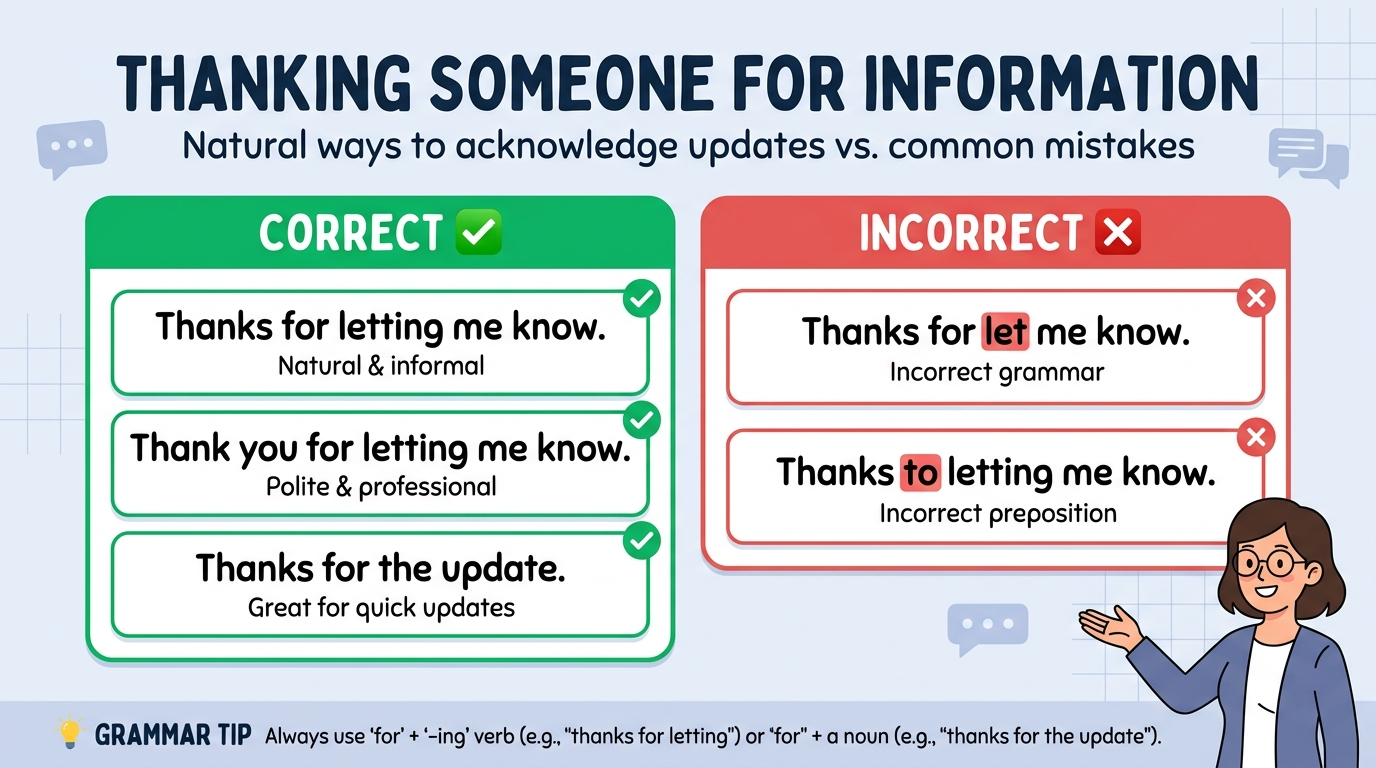
The key grammatical point is that “thanks for” is followed by a noun or a verb ending in -ing when the verb describes the action being appreciated. That is why letting is correct in this expression.
| Expression | Is it correct? | Explanation |
|---|---|---|
| Thanks for letting me know. | Yes | Correct and natural |
| Thank you for letting me know. | Yes | Slightly more formal or emphatic |
| Thanks to letting me know. | No, for this meaning | Use thanks for letting me know |
| Thanks to let me know. | No, for this meaning | The construction does not fit |
| Thanks for let me know. | No | Use the -ing form |
| Thanks letting me know. | Usually incorrect in standard English | The preposition for is normally needed |
| Thanks for the update. | Yes | A natural noun-based alternative |
Rule in Plain English
The simplest way to remember the rule is this:
Use “thanks for” followed by a noun or an -ing verb form.
For example:
- Thanks for your help.
- Thanks for the information.
- Thanks for calling.
- Thanks for explaining.
- Thanks for letting me know.
- Thanks for reminding us.
In each example, the word for introduces the reason for the gratitude.
Consider the structure of the target sentence:
Thanks + for + letting me know
- Thanks expresses gratitude.
- For introduces the reason for that gratitude.
- Letting me know identifies the action being appreciated.
The word letting is the -ing form of the verb let. In this construction, it functions as part of a gerund-participial clause, a grammatical structure that can describe an action without making it the main verb of the sentence.
Compare these two sentences:
- Correct: “Thanks for helping me.”
- Incorrect in standard English: “Thanks for help me.”
The difference is not about the meaning. Both attempts refer to receiving help. The difference is grammatical: after for, the action is expressed using the -ing form.
This pattern works with many other verbs, so learning it helps you form new sentences rather than memorize just one phrase.
Core Grammar Explanation
1. Why Is “Thanks for Letting Me Know” Correct?
The expression follows a common English pattern:
Thanks for + noun or gerund-participial clause
A gerund-participial clause is a group of words built around a verb in its -ing form. It can describe an action, activity, or event.
In the sentence “Thanks for letting me know,” the words letting me know describe the action for which the speaker is expressing gratitude.
Here is the grammatical breakdown:
| Word or phrase | Grammatical role | Function |
|---|---|---|
| Thanks | Expression of gratitude | Communicates appreciation |
| For | Preposition | Introduces the reason for the gratitude |
| Letting | Verb in its -ing form | Expresses the action |
| Me | Object of letting | Identifies the person receiving the information |
| Know | Bare infinitive | Completes the expression let someone know |
The phrase can be represented as a simple structure:
Thanks
Expression of gratitude
for
Preposition introducing the reason
letting me know
The action being appreciated
The construction is natural because for is followed by an appropriate complement, in this case an -ing clause.
2. Why Do We Use “Letting” Instead of “Let”?
This is one of the most common questions English learners have.
The answer depends on the grammatical structure surrounding the verb.
When let follows the preposition for and describes the action being appreciated, it normally takes the -ing form.
- Correct: Thanks for letting me know.
- Incorrect: Thanks for let me know.
- Incorrect for this construction: Thanks for to let me know.
However, let does not always become letting. It depends on its role in the sentence.
Compare:
- “Please let me know when you arrive.” Here, let is the base form used in an instruction.
- “I will let you know tomorrow.” Here, let follows the modal-like future construction will.
- “Thank you for letting me know.” Here, letting follows the preposition for.
The form changes because the grammatical environment changes.
A useful principle is to examine the word immediately before the verb and identify the construction it creates. English verbs do not take the same form in every context.
3. Why Is “Thanks to Letting Me Know” Wrong for This Meaning?
The expression thanks to is grammatical English, but it has a different function.
When you thank someone for sharing information, you say:
“Thanks for letting me know.”
When you use thanks to to identify a cause or something responsible for a result, the meaning changes.
Examples:
- “Thanks to your advice, I avoided a mistake.”
- “Thanks to modern technology, we can communicate instantly.”
- “Thanks to her quick response, the problem was resolved.”
In these examples, thanks to means something like “because of” or “as a result of.”
It does not introduce the action for which the speaker is directly thanking someone in the same way that thanks for does.
Compare the two constructions:
| Construction | Meaning | Example |
|---|---|---|
| Thanks for + noun or -ing clause | Expresses gratitude for something | Thanks for letting me know. |
| Thanks to + noun phrase | Attributes a positive or relevant result to a cause | Thanks to your message, I arrived on time. |
The second construction can also be used ironically, depending on context. For example, “Thanks to the traffic, we missed the train” expresses frustration rather than sincere gratitude.

4. Understanding “Let Me Know”
To understand the full sentence, it helps to examine the expression let someone know.
In everyday English, to let someone know means to tell them, inform them, or make information available to them.
Examples:
- “Let me know when you get home.”
- “Please let us know if you need assistance.”
- “I will let you know as soon as I receive an answer.”
- “She let me know about the schedule change.”
The expression contains the verb let, a person receiving the information, and the verb know.
Its usual pattern is:
let + person + base form of verb
Examples:
- Let me know.
- Let him decide.
- Let her explain.
- Let them choose.
- Let us know.
In this structure, the verb after the person remains in its base form. We say let me know, not let me to know or let me knowing.
The expression is similar to other causative constructions in English, in which one person allows or causes another person to do something.
Compare:
- “Let me speak.”
- “Let him explain.”
- “Let them leave.”
The same grammatical pattern appears in let me know.
5. Why Is It “Letting Me Know,” Not “Letting Me to Know”?
The answer comes from the grammar of let.
When let is followed by a person and another verb, the second verb generally appears in the bare infinitive form. A bare infinitive is the basic form of a verb without to.
| Correct | Incorrect in standard English |
|---|---|
| Let me know. | Let me to know. |
| Let her speak. | Let her to speak. |
| Let him leave. | Let him to leave. |
| Let us decide. | Let us to decide. |
When the whole expression follows for, the first verb changes to its -ing form, but the verb after the person remains in the base form:
for + letting + me + know
The first verb, letting, belongs to the for construction. The second verb, know, belongs to the pattern let someone do something.
This explains why the sentence is correct even though it contains two verbs with different forms.
Examples of “Thanks for Letting Me Know”
The sentence is flexible enough for everyday conversation, professional communication, and more formal correspondence. The best wording depends on your relationship with the recipient and the situation.
1. Everyday Conversation
These examples sound natural in ordinary conversations with friends, family members, and acquaintances.
- “Oh, thanks for letting me know!”
- “Thanks for letting me know. I didn’t realize the shop closed early.”
- “Okay, thanks for letting me know.”
- “Thanks for letting me know about the change.”
- “Thanks for letting me know. I’ll be there a little earlier.”
- “Thanks for letting me know. I’ll keep that in mind.”
The phrase can stand alone as a complete conversational response. You do not need to add another sentence unless you want to explain what you will do with the information.
For instance, if someone tells you that a restaurant is closed, “Thanks for letting me know” is enough. If you want to make your response more helpful, you can add, “I’ll look for another place.”
2. Text Messages and Social Media
In text messages, shorter versions are common because the conversation already provides context.
Examples:
- “Thanks for letting me know 😊”
- “Okay, thanks for letting me know!”
- “Oh okay, thanks for the update.”
- “Got it, thanks for letting me know.”
- “Alr, thanks for letting me know.”
- “Thanks a lot for letting me know!”
Alr is an informal abbreviation of all right or alright in many texting contexts. It does not change the grammar of the sentence that follows it.
Punctuation and emojis can affect the tone, but they do not normally change the underlying meaning.
For example:
- “Okay, thanks for letting me know.” Sounds neutral and polite.
- “Okay, thanks for letting me know!” Sounds a little warmer or more enthusiastic.
- “Okay, thanks for letting me know 🙂” May feel friendly and reassuring.
- “Okay. Thanks for letting me know.” Can sound more distant, depending on the context.
The final interpretation depends on the relationship and the surrounding conversation. A full stop is not inherently rude, and an exclamation mark does not automatically make a message friendlier.
3. Professional Emails and Workplace Communication
“Thank you for letting me know” is especially useful in professional settings because it acknowledges the information without sounding overly casual.
Examples:
- “Thank you for letting me know about the revised deadline.”
- “Thank you for letting me know. I’ll update the schedule accordingly.”
- “Thanks for letting me know about the client’s availability.”
- “Thank you for letting us know about the issue. We’ll review it.”
- “Thank you for keeping me informed about the project’s progress.”
The last example uses a related construction, thank you for keeping me informed. It conveys appreciation for ongoing communication rather than one particular update.
For a formal email, you might write:
“Thank you for letting me know about the change in schedule. I will adjust my plans accordingly.”
For a quick message to a teammate, a shorter response is usually enough:
“Thanks for the update. I’ll take care of it.”
You do not need to use elaborate wording to sound professional. Clear, respectful language is generally more effective than unnecessarily formal expressions.
4. When Someone Shares Bad News
The expression can acknowledge information without suggesting that you are happy about the news itself.
Examples:
- “I’m sorry to hear that. Thank you for letting me know.”
- “Thanks for letting me know. I appreciate you telling me.”
- “Thank you for letting us know about the delay.”
- “I’m sorry things turned out that way. Thanks for keeping me informed.”
This distinction matters because thanking someone for communicating is not the same as thanking them for the event itself.
If a colleague informs you that a project has failed, you are acknowledging their communication, not celebrating the failure.
In sensitive situations, combine the expression with an appropriate response to the news. For example, “I’m sorry to hear about your loss. Thank you for telling me” may be more empathetic than a bare acknowledgment.

Contrast and Minimal Pairs
A minimal pair in grammar is a pair of expressions that differ in one important feature. Comparing similar sentences makes it easier to see why one form works and another does not.
1. “Thanks for Letting Me Know” vs. “Thanks to Letting Me Know”
| Sentence | Judgment | Reason |
|---|---|---|
| Thanks for letting me know. | Correct | For introduces the action being appreciated. |
| Thanks to letting me know. | Incorrect for the intended meaning | Thanks to does not perform the same grammatical function here. |
| Thanks to your message, I understood. | Correct | Thanks to introduces the cause. |
| Thanks for your message. | Correct | For introduces the thing being appreciated. |
A useful test is to replace the words thanks to with because of. If the sentence preserves its intended meaning, the causal construction may be appropriate.
For example:
“Thanks to your message, I understood.”
“Because of your message, I understood.”
Both are grammatically possible, although the second can sound less appreciative.
However, this substitution does not work naturally in the intended expression:
“Thanks to letting me know.”
The intended meaning calls for thanks for letting me know.
2. “Thanks for Letting Me Know” vs. “Thanks for Let Me Know”
The difference is the verb form following for.
- Correct: Thanks for letting me know.
- Incorrect: Thanks for let me know.
- Correct: Thanks for telling me.
- Incorrect: Thanks for tell me.
In the correct sentences, letting and telling introduce the actions being appreciated.
This is not an arbitrary spelling preference. It reflects the grammatical pattern that allows an -ing clause to follow the preposition for.
3. “Thanks for Letting Me Know” vs. “Thanks for the Information”
Both sentences are correct, but their grammatical structures differ.
| Expression | Structure | Effect |
|---|---|---|
| Thanks for letting me know. | For + -ing clause | Emphasizes the act of informing |
| Thanks for the information. | For + noun phrase | Emphasizes the information received |
| Thanks for the update. | For + noun phrase | Emphasizes a new development |
| Thanks for telling me. | For + -ing clause | Emphasizes the act of telling |
The expressions are often interchangeable, but they do not always convey precisely the same emphasis.
If someone gives you a detailed report, “Thanks for the information” may be more specific. If someone tells you about a change you would otherwise have missed, “Thanks for letting me know” is especially natural.
4. “Thank You for Letting Me Know” vs. “Thank You for Letting Us Know”
The difference is the person receiving the information.
- “Thank you for letting me know.” The speaker refers to themselves.
- “Thank you for letting us know.” The speaker refers to themselves and at least one other person as a group.
Both are correct.
Examples:
- A colleague informs you about a meeting: “Thank you for letting me know.”
- A colleague informs your entire team about a deadline: “Thank you for letting us know.”
- A school informs a group of parents about a schedule change: “Thank you for letting us know.”
The choice depends on who received the information, not on whether the expression is more or less grammatical.
5. “Thanks for Letting Me Know” vs. “Thanks for Letting You Know”
The pronouns matter.
“Thanks for letting me know” means that another person informed the speaker.
“Thanks for letting you know” is not normally used to thank someone for informing the speaker. It could make sense in a different context, such as discussing an action involving a third person or quoting someone else’s words, but it is not the ordinary response to receiving information.
Compare:
- “Thanks for letting me know about the meeting.” The speaker received the information.
- “I’ll let you know about the meeting.” The speaker promises to provide information.
- “Thanks for letting her know about the meeting.” The speaker thanks someone for informing another person.
These sentences are all possible, but their meanings differ because the pronouns identify different participants.
Exceptions and Nuance
1. Can You Say “Thanks for Letting Us Know”?
Yes. This is grammatically correct and widely used.
The same rule applies: for is followed by the -ing form letting. The only difference is the object pronoun us instead of me.
Examples:
- “Thanks for letting us know about the delay.”
- “Thank you for letting us know in advance.”
- “Thanks for letting us know that the office will be closed.”
- “Thank you for letting us know about your availability.”
The expression is especially appropriate when a team, family, organization, or group of people is receiving the information.
2. Can You Say “Thanks a Lot for Letting Me Know”?
Yes. This is also correct.
Adding a lot increases the emphasis on gratitude.
Examples:
- “Thanks a lot for letting me know.”
- “Thank you so much for letting me know.”
- “Thanks so much for the update.”
- “Many thanks for letting me know.”
However, tone can affect how thanks a lot is interpreted. It normally expresses genuine appreciation, but it can be sarcastic when the context suggests irritation.
For example:
“Thanks a lot for telling me after the deadline passed!”
Here, the speaker may be expressing frustration rather than gratitude.
The grammar remains correct even when the intended tone is sarcastic.
3. Can You Start With “Okay” or “OK”?
Yes. Both okay and OK are accepted spellings in contemporary English.
These responses are natural:
- “Okay, thanks for letting me know.”
- “OK, thanks for letting me know.”
- “Ok, thank you for letting me know.”
- “All right, thanks for letting me know.”
- “Got it, thanks for the update.”
In edited professional writing, okay or OK may be preferred according to a publication’s style guide. In everyday messaging, ok is also common.
The choice is mainly a matter of style and consistency, not a major grammatical distinction.
4. Can You Say “Thanks for Letting Me Know Meaning”?
Not as a complete, natural English sentence if you intend to thank someone.
The sequence “thanks for letting me know meaning” combines two different purposes:
- Thanking someone: “Thanks for letting me know.”
- Searching for an explanation: “What is the meaning of ‘thanks for letting me know’?”
If you are looking up the phrase, write:
“What does ‘thanks for letting me know’ mean?”
Or:
“What is the meaning of ‘thanks for letting me know’?”
The word meaning is a noun. It needs to be integrated into a grammatical question rather than added directly to the end of the expression.
This distinction is important for search queries because people often type short keyword phrases into search engines rather than complete sentences.
5. Is “Thanks Letting Me Know” Ever Acceptable?
In standard contemporary English, the normal expression is “Thanks for letting me know.”
The word for is expected in this construction. Omitting it makes the phrase sound incomplete or nonstandard.
However, natural speech contains fragments, ellipsis, and informal shortcuts. In a very specific context, speakers may omit words when the meaning is obvious. That does not make the shortened form the recommended choice for standard writing.
For emails, professional messages, schoolwork, and edited content, retain for.
6. What Does “Thanks for Letting Me Know” Mean in Tamil?
The expression communicates gratitude for being informed. Its Tamil translation can vary according to context and the relationship between the speakers.
Possible translations include:
- எனக்குத் தெரிவித்ததற்கு நன்றி. — Thank you for informing me.
- எனக்குச் சொன்னதற்கு நன்றி. — Thanks for telling me.
- எனக்குத் தெரியப்படுத்தியதற்கு நன்றி. — Thank you for letting me know or making me aware.
The first is a broadly useful translation. The second is conversational, while the third can sound more formal depending on the situation.
Translation is not always word-for-word. English uses the construction letting me know, whereas Tamil can express the same idea through a verb meaning inform or tell.
The best choice depends on the context and the desired level of formality.

Common Errors
English learners sometimes memorize a phrase without understanding the pattern behind it. The following errors show how to correct the sentence and apply the same reasoning elsewhere.
Error 1: “Thanks for Let Me Know”
Incorrect: Thanks for let me know.
Correct: Thanks for letting me know.
Why? In this construction, for is followed by an -ing clause, so let becomes letting.
The same correction applies to similar expressions:
- Incorrect: Thanks for help me.
- Correct: Thanks for helping me.
- Incorrect: Thanks for remind me.
- Correct: Thanks for reminding me.
- Incorrect: Thanks for explain it.
- Correct: Thanks for explaining it.
Error 2: “Thanks to Letting Me Know”
Incorrect for the intended meaning: Thanks to letting me know.
Correct: Thanks for letting me know.
Why? Thanks for introduces the action being appreciated. Thanks to usually identifies a cause or source of a result.
Remember that both thanks for and thanks to are grammatical expressions. They simply perform different jobs.
Error 3: “Thanks for to Let Me Know”
Incorrect: Thanks for to let me know.
Correct: Thanks for letting me know.
Why? The construction uses an -ing clause after for, not a to-infinitive.
Compare:
- Thanks for calling.
- Thanks for waiting.
- Thanks for helping.
- Thanks for letting me know.
Error 4: “Thank You to Letting Me Know”
Incorrect: Thank you to letting me know.
Correct: Thank you for letting me know.
Why? The established expression is thank you for, followed by a noun phrase or an appropriate -ing clause.
Compare:
- Thank you for your help.
- Thank you for your patience.
- Thank you for calling.
- Thank you for letting us know.
Error 5: “Thanks for Letting to Me Know”
Incorrect: Thanks for letting to me know.
Correct: Thanks for letting me know.
Why? The verb let takes an object followed by a bare infinitive in this construction. It does not require to before me or before know.
The structure is:
letting + me + know
Not:
letting + to me + to know
Error 6: Confusing “Let Me Know” With “Let Me Knowing”
Incorrect: Please let me knowing.
Correct: Please let me know.
Why? The verb after let + person normally takes its base form.
This is a separate rule from the -ing form after for:
- “Please let me know.” Correct.
- “Thanks for letting me know.” Correct.
The word letting appears in the second sentence because it follows for. The word know remains in the base form because it follows the object me in the let construction.
Error 7: Using an Awkwardly Formal Alternative
Some writers replace a simple expression with language that sounds unnatural.
For example:
- Awkward: “I extend my gratitude for your act of making me aware.”
- Natural: “Thank you for letting me know.”
Formal writing does not require complicated vocabulary. In most professional settings, a clear acknowledgment is more effective than an unnecessarily elaborate sentence.
Error 8: Assuming the Expression Always Sounds Warm
“Thanks for letting me know” is usually polite, but the emotional tone depends on the situation.
Imagine that a friend tells you about a minor schedule change. Your response sounds neutral.
Now imagine that someone tells you about a major problem long after it occurred. The same words may sound disappointed or distant.
If you need to communicate warmth, add a relevant sentence:
“Thanks for letting me know. I appreciate you keeping me updated.”
If you need to acknowledge bad news, respond to the substance as well:
“I’m sorry to hear that. Thank you for letting me know.”
Practical Test: How to Check Similar Sentences
You can apply a few simple tests whenever you are unsure whether an expression such as thanks for letting me know is grammatically correct.
Test 1: Look at the Word After “For”
Ask whether for is followed by a noun phrase or an appropriate -ing clause.
| Sentence | Result |
|---|---|
| Thanks for the update. | Correct: noun phrase |
| Thanks for calling. | Correct: -ing clause |
| Thanks for letting me know. | Correct: -ing clause |
| Thanks for call me. | Incorrect for this construction |
| Thanks for to call me. | Incorrect for this construction |
This test is useful for many common expressions of gratitude.
Test 2: Check the Verb After “Let + Person”
Look at the pattern let + person + verb.
If the expression follows this pattern, the second verb normally takes its base form.
| Sentence | Result |
|---|---|
| Let me know. | Correct |
| Let her speak. | Correct |
| Let us decide. | Correct |
| Let me to know. | Incorrect |
| Let him speaking. | Incorrect in the intended construction |
This test explains why letting me know contains both letting and know without a contradiction.
Test 3: Replace the Action With a Noun
Try replacing the -ing clause with a noun phrase.
- “Thanks for letting me know.”
- “Thanks for the information.”
Both are natural.
- “Thanks for helping me.”
- “Thanks for your help.”
Both are natural.
- “Thanks for reminding me.”
- “Thanks for the reminder.”
Both are natural.
If the noun-based version works, it can help you identify the intended role of the phrase after for. It is a useful learning aid, not a universal test for every possible English construction.
Test 4: Ask What You Are Thanking the Person For
Identify the action or thing that deserves appreciation.
If someone calls you with important news, you can say:
“Thanks for calling.”
If someone informs you about a delay, you can say:
“Thanks for letting me know.”
If someone gives you a document, you can say:
“Thanks for the document.”
This test helps you choose between a verb-based expression and a noun-based expression.
Test 5: Distinguish Gratitude From Cause
Ask whether you are thanking someone directly or explaining why something happened.
- Direct gratitude: “Thanks for letting me know.”
- Cause: “Thanks to your message, I arrived on time.”
If the intended meaning is direct gratitude for an action, thanks for is usually the appropriate choice.

Advanced Notes
1. Is “Letting” a Gerund or a Present Participle?
Traditional grammar often uses the term gerund for an -ing verb form that behaves like a noun. It uses present participle for an -ing form used in progressive verb phrases or participial constructions.
In the sentence “Thanks for letting me know,” traditional explanations often call letting a gerund because it follows a preposition.
That label is useful for learners, but it does not tell the whole story about modern English grammar.
Many contemporary grammars use the term gerund-participle for the shared -ing form because the distinction between gerunds and present participles is not always clear-cut.
For practical purposes, the important point is that letting me know functions as the complement of the preposition for. It identifies the action being appreciated.
You do not need to decide between competing grammatical labels to use the sentence correctly.
2. Is “Thanks for Letting Me Know” a Complete Sentence?
In everyday communication, yes, it is a complete and natural response.
Strictly speaking, it is a conventional expression of gratitude that does not contain a full subject-and-finite-verb clause in the way that “I thank you for letting me know” does.
The two expressions perform the same communicative function:
- “Thanks for letting me know.”
- “I thank you for letting me know.”
The second has an explicit subject (I) and a finite verb (thank). The first uses the conventional expression thanks, which is commonly accepted as a standalone utterance.
This is normal in English. Everyday conversation contains many expressions that function as complete responses even when they are not full declarative clauses.
Examples include:
- “No problem.”
- “Sounds good.”
- “Good to know.”
- “Thanks for your help.”
There is no need to expand a natural conversational expression into a longer sentence merely to make it sound grammatical.
3. Why Does “Thank You for Letting Me Know” Sound More Formal?
The difference is mainly one of style, not a strict grammatical rule.
Thanks is a conventional, relatively informal expression of gratitude. Thank you is also common in everyday English, but it can sound slightly more deliberate or formal depending on the context.
Compare:
- Casual: “Thanks for letting me know!”
- Neutral: “Thank you for letting me know.”
- Professional: “Thank you for informing me of the change.”
- Concise professional: “Thank you for the update.”
All four can be appropriate in the right context.
The more formal phrase informing me of the change may fit a business letter, but it is not inherently better than the simpler version. Tone, audience, and purpose determine the best choice.
4. Can “Thanks for Letting Me Know” Refer to Something That Has Not Happened Yet?
Normally, the expression refers to information that has already been communicated. The communication itself has taken place, even if the event being discussed is in the future.
For example:
“Thanks for letting me know that the meeting will take place tomorrow.”
The meeting has not yet occurred, but the act of informing the speaker has already happened.
This is a useful distinction between the time of the communication and the time of the event being communicated.
The expression can also refer to information about an ongoing situation:
“Thanks for letting me know that the road is still closed.”
Again, the sentence acknowledges the information received rather than the completion of the event.
5. Does “Thank You for Letting Us Know” Require a Different Verb Form?
No. The grammatical pattern remains the same regardless of whether the object is me, us, him, her, or them.
Examples:
- Thank you for letting me know.
- Thank you for letting us know.
- Thank you for letting her know.
- Thank you for letting them know.
The pronoun identifies the person or people being informed. It does not change the basic for + -ing structure.
However, if the person receiving the information changes, the meaning changes too.
“Thank you for letting them know” thanks someone for informing a third party, not necessarily the speaker.
6. Can “Thanks for Letting Me Know” Be Used Sarcastically?
Yes. Grammatical correctness and intended attitude are different matters.
Consider:
“Thanks for letting me know after everyone else had already left.”
The sentence may express annoyance because the information arrived too late to be useful.
Sarcasm can be communicated through context, exaggerated emphasis, punctuation, or the words surrounding the expression.
The same sentence can be sincere in one situation and sarcastic in another. It is therefore unwise to interpret tone from the phrase alone.
7. What Is the Difference Between “Letting Me Know” and “Keeping Me Informed”?
Both expressions concern communication, but their emphasis differs.
“Letting me know” usually refers to a particular act of informing someone.
“Keeping me informed” suggests providing updates over time or maintaining communication as a situation develops.
Compare:
- “Thanks for letting me know about the appointment.”
- “Thanks for keeping me informed about the project.”
The first naturally refers to one piece of information. The second suggests ongoing updates, although neither expression is restricted to only one situation.
FAQs
Is it correct to say “Thanks for letting me know”?
Yes. It is grammatically correct and natural. The preposition for is followed by the -ing form letting, and let someone know is the standard expression for informing someone.
What does “thanks for letting me know” mean?
It means that you appreciate someone informing you about something. You might use it after receiving news, an update, a warning, a schedule change, or any other useful information.
Is it “thanks for letting me know” or “thanks to letting me know”?
Use “thanks for letting me know” to express gratitude for being informed. Thanks to usually introduces a cause, as in “Thanks to your message, I arrived on time.”
Can I say “thanks for let me know”?
No, not in standard English. The correct expression is “thanks for letting me know.” The -ing form is used because for introduces the action being appreciated.
Is “thanks to let me know” correct?
Not for the intended meaning. Say “thanks for letting me know.” You might use to let someone know in another construction, such as “I wanted to let you know,” but it does not fit after thanks to here.
Is “thanks letting me know” correct?
The standard expression includes for: “Thanks for letting me know.” Although speakers sometimes use fragments or omit words in informal contexts, retaining for is the recommended choice.
Should I say “thank you for letting me know” or “thanks for letting me know”?
Both are correct. Thank you can sound slightly more formal or deliberate, while thanks is often more casual. Either is appropriate in many everyday and professional situations.
Is “thank you for letting us know” correct?
Yes. It follows the same grammatical pattern as “thank you for letting me know.” Use us when the information is being acknowledged on behalf of a group.
Can I say “okay, thanks for letting me know”?
Yes. This is a natural response in text messages and conversation. Okay acknowledges what the other person said, and the rest of the sentence expresses gratitude for the information.
What are some synonyms for “thank you for letting me know”?
Useful alternatives include:
- Thanks for the update.
- Thank you for the information.
- I appreciate you telling me.
- Thanks for keeping me informed.
- Thanks for bringing this to my attention.
- I appreciate the heads-up.
- Thank you for informing me.
The best choice depends on context. Heads-up is informal, while bringing this to my attention is useful in professional communication.
What is the meaning of “thanks for letting me know” in Tamil?
It can be translated as எனக்குத் தெரிவித்ததற்கு நன்றி, meaning “Thank you for informing me.” Depending on the context, எனக்குச் சொன்னதற்கு நன்றி (“Thanks for telling me”) may sound more conversational.
Is “thanks for letting me know” polite in an email?
Yes. It is polite in most professional emails. If you want a slightly more formal tone, use “Thank you for letting me know about the change” or “Thank you for the update.”
Is it rude to reply “okay, thanks for letting me know”?
Not inherently. It is a normal, polite acknowledgment. Whether it sounds distant or warm depends on the situation, the relationship, and the rest of the conversation.
What is the difference between “letting me know” and “telling me”?
Both can mean providing information. Letting me know is a common, neutral expression that works especially well for updates. Telling me can emphasize the act of communicating something directly.
Summary: If You Remember One Rule
Use “thanks for” followed by a noun or an -ing clause when expressing gratitude for something.
That is why these expressions are correct:
- Thanks for letting me know.
- Thanks for helping me.
- Thanks for calling.
- Thanks for the information.
Remember the separate pattern let + person + base verb:
- Let me know.
- Let her speak.
- Let them decide.
Combining these two patterns gives you the correct expression:
Thanks + for + letting + me + know.
Use “thanks to” when you mean that something happened because of a particular cause, not when you want to thank someone directly for informing you.
For everyday messages, professional emails, and most other situations, “Thanks for letting me know” is a clear, natural, and grammatically correct choice.