Is It Correct to Say “To Inquire About Something”?
Quick Answer
Yes, “to inquire about something” is grammatically correct, natural, and widely used in English. It means to ask for information about a subject, situation, product, service, or matter.
The verb inquire is commonly followed by the preposition about when introducing the topic of a question.
Examples:
- I would like to inquire about your available courses.
- She called to inquire about the job opening.
- We are inquiring about the status of our application.
- He inquired about the cost of the service.
- They contacted the office to inquire about the requirements.
The expression is particularly common in professional correspondence, customer service, formal requests, and administrative communication. However, it is also correct in ordinary conversation.
Compare these common alternatives:
| Expression | Correct? | Typical meaning |
|---|---|---|
| Inquire about something | Yes | Ask for information about a topic |
| Inquire into something | Yes | Investigate a matter |
| Inquire on something | Usually not in the intended meaning | Often a nonstandard choice when about is needed |
| Inquire to someone | Usually incorrect for this meaning | Use inquire of someone or inquire with someone, depending on context |
| Inquire as to something | Yes | Ask about something, often in formal language |
| Make an inquiry about something | Yes | Ask for information using the noun inquiry |
The simplest rule: Use inquire about when you want to ask for information about a topic.
Rule in Plain English
The verb inquire means to ask for information. The preposition that follows it helps explain what the question concerns, what is being investigated, or whom the question is directed to.
Consider this sentence:
I want to inquire about the application process.
Its parts have different jobs:
- I — the person asking.
- want — the verb expressing intention.
- to inquire — the action the speaker intends to take.
- about the application process — the topic of the question.
The structure is:
Subject + verb + to inquire + about + topic
For example:
- I need to inquire about the schedule.
- She plans to inquire about the refund policy.
- They contacted the university to inquire about admission.
The word to in to inquire is part of the infinitive form of the verb. It does not introduce the person or topic being asked about.
The word about introduces that topic.
This distinction is important because English verbs do not all take the same prepositions. We say ask about a course, inquire about a course, and investigate a complaint. Choosing the correct structure depends on the verb and the intended meaning.
Core Grammar Explanation
1. What Does “To Inquire” Mean?
To inquire means to ask for information, make a formal or informal request for details, or seek an answer to a question.
It is the infinitive form of the verb inquire.
An infinitive is a verb form commonly introduced by to, as in to learn, to speak, to ask, and to inquire.
Examples:
- I called to inquire about the delivery.
- She wants to inquire about the available positions.
- We decided to inquire before making a decision.
- He went to the office to inquire about the documents.
In each example, to inquire expresses an action or purpose.
Notice that to inquire does not always need a preposition after it:
- I would like to inquire.
- She contacted the department to inquire.
- He stopped by to inquire further.
These sentences are grammatical because the topic is understood from context or is not stated.
2. Why Do We Say “Inquire About”?
In English, some verbs are commonly followed by particular prepositions. These combinations are often called verb–preposition patterns.
A verb–preposition pattern is a recurring structure in which a verb is used with a preposition to express a particular relationship.
For example:
- Ask about a problem.
- Listen to a recording.
- Depend on a colleague.
- Apologize for a mistake.
- Inquire about a service.
In inquire about a service, the word about introduces the subject of the question.
The sentence can be represented as follows:
SENTENCE STRUCTURE
I inquired about the course.
I inquired
Action
about
Preposition
the course
Topic
The preposition “about” connects the act of asking with the subject of the question.
The pattern works with many different topics:
- Inquire about a reservation.
- Inquire about the deadline.
- Inquire about the charges.
- Inquire about a scholarship.
- Inquire about the progress of a project.
You can also use inquire about in different verb forms:
| Verb form | Example |
|---|---|
| Base form | I usually inquire about the details first. |
| Infinitive | I would like to inquire about the details. |
| Present continuous | I am inquiring about the details. |
| Past simple | I inquired about the details yesterday. |
| Present perfect | I have inquired about the details. |
| Third-person singular | She inquires about the details. |
| Past participle | The matter was inquired into by the committee. |
The final example uses inquired into, not inquired about, because it describes an investigation.
3. Is “I Am Inquiring About” Correct?
Yes. “I am inquiring about” is grammatically correct and especially useful in emails, phone calls, and professional messages.
The structure is:
Subject + am/is/are + inquiring + about + topic
Examples:
- I am inquiring about the status of my order.
- I am inquiring about the vacancy advertised last week.
- I am inquiring about your upcoming training sessions.
- We are inquiring about the requirements for international applicants.
The present continuous form, am inquiring, presents the inquiry as a current action or an active process.
For a professional email, you could write:
Dear Admissions Team,
I am inquiring about the admission requirements for the upcoming academic year. Could you please share the application deadline and the documents required?
Thank you for your assistance.
The wording is polite and professional without being unnecessarily complicated.
Compare:
- I inquire about the course. Grammatically correct, but it may sound habitual or formal without further context.
- I am inquiring about the course. Natural when asking about a current matter.
- I inquired about the course. Refers to a past inquiry.
- I have inquired about the course. Emphasizes that the inquiry has already been made and may be relevant now.

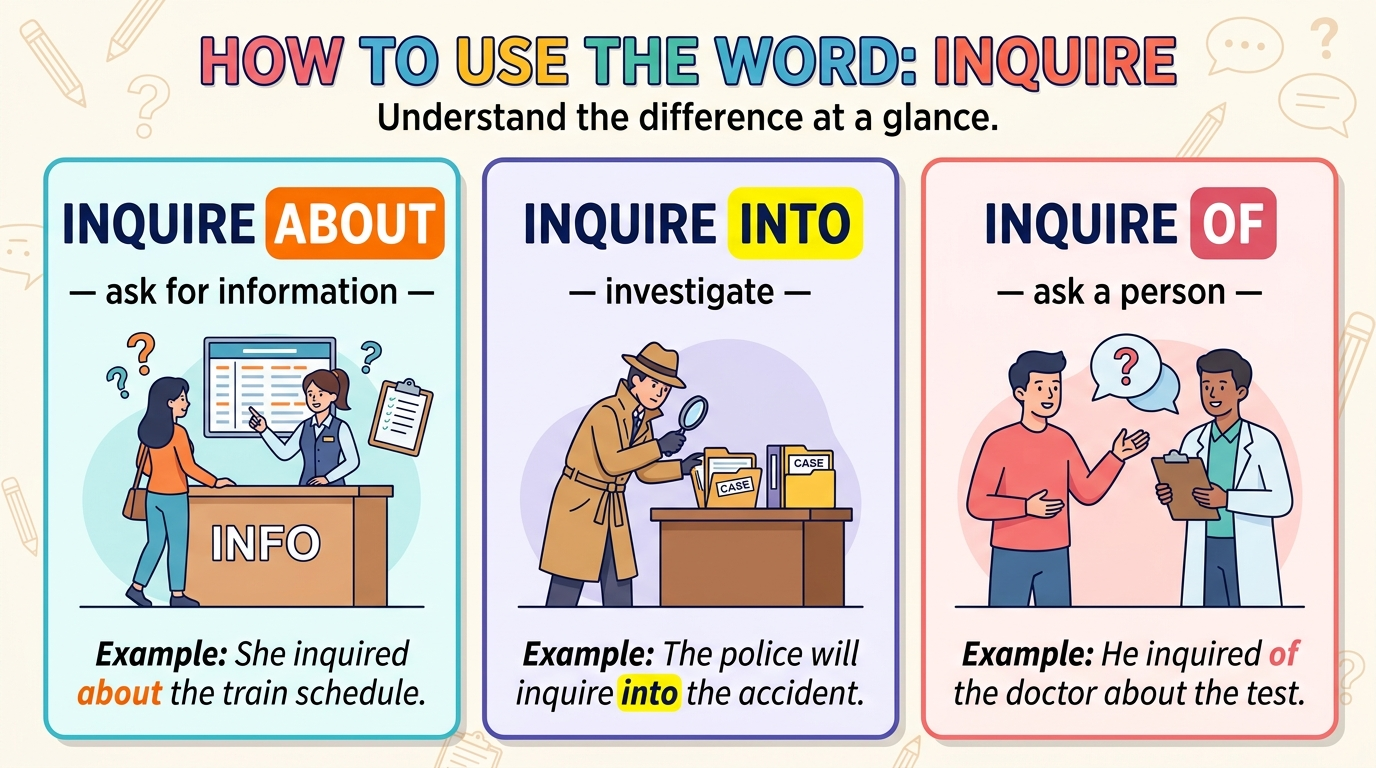
4. “Inquire About” vs. “Inquire Into”
These expressions are both correct, but they usually communicate different intentions.
Inquire about means to ask for information concerning something.
Inquire into means to investigate, examine, or look into the facts of a matter.
Compare the following sentences:
| Inquire about | Inquire into |
|---|---|
| The customer inquired about the delay. | The company inquired into the cause of the delay. |
| She inquired about the complaint procedure. | The committee inquired into the complaint. |
| I inquired about the missing payment. | The bank inquired into the missing payment. |
| The journalist inquired about the incident. | The authorities inquired into the incident. |
The difference is one of emphasis, not simply formality.
If someone asks when a parcel will arrive, they inquire about the delivery.
If an organization examines why the delivery system failed, it inquires into the problem.
The distinction can be summarized as:
- About = information on a topic
- Into = investigation of a matter
However, real usage can overlap. An inquiry about a serious incident may include investigation, and an inquiry into a matter may involve asking questions. The choice reflects the intended emphasis.
5. “Inquire About” vs. “Inquire On”
For the general meaning of asking for information about a topic, inquire about is the safest and most widely accepted choice.
Examples:
- Correct and natural: I am inquiring about the new policy.
- Correct and natural: She inquired about the available rooms.
- Awkward in standard general English: I am inquiring on the new policy.
- Awkward in standard general English: She inquired on the available rooms.
Why does on sometimes appear?
English uses on in expressions such as a lecture on grammar, information on a subject, and research on a topic. That does not mean it can freely replace about after every verb.
For example:
- We need information on the new policy.
- We need to inquire about the new policy.
Both sentences are natural, but their grammatical structures differ.
In certain specialized contexts, inquiry on may occur in titles, institutional terminology, or nonstandard regional usage. Nevertheless, for ordinary correspondence and general English writing, choose inquire about when asking for information.
6. “Inquire Of,” “Inquire With,” and “Inquire To”
These expressions require particular care because the person being asked is different from the subject of the question.
Inquire of
Inquire of someone is a grammatical, relatively formal construction meaning to ask someone for information.
Examples:
- I inquired of the receptionist whether the office was open.
- The editor inquired of the author whether the figures were accurate.
This construction is less common in everyday conversation than ask someone or inquire with someone.
Inquire with
Inquire with someone is used, particularly in contemporary business English, to indicate contacting a person or organization to obtain information.
Examples:
- Please inquire with the admissions office about the deadline.
- I will inquire with our supplier about the delivery date.
- You can inquire with the customer service team for further details.
The construction is accepted in common professional usage, although some editors prefer ask the admissions office or contact the admissions office to inquire about the deadline for a more direct style.
Inquire to
Inquire to someone is generally not the standard construction when you mean to ask that person for information.
Instead of:
– Awkward: I inquired to the manager about the schedule.
Use:
- I inquired of the manager about the schedule.
- I inquired with the manager about the schedule.
- I asked the manager about the schedule.
- I sent an inquiry to the manager about the schedule.
The final example is correct because to belongs to the noun phrase an inquiry to the manager. It is not the same grammatical pattern as inquire to the manager.

Examples: How to Use “Inquire” in a Sentence
The best way to learn this verb is to examine it in different situations.
Everyday situations
- I called the hotel to inquire about room availability.
- She stopped by the office to inquire about the schedule.
- He inquired about the price before buying the laptop.
- We are inquiring about the location of the meeting.
- They inquired about the opening hours.
Professional and academic situations
- I am writing to inquire about the internship opportunity.
- The student inquired about the scholarship application process.
- Our team contacted the supplier to inquire about the revised quotation.
- The applicant inquired about the documents required for admission.
- The researcher inquired into the reasons for the unexpected results.
Customer service situations
- I would like to inquire about the status of my refund.
- A customer inquired about the warranty coverage.
- Please contact our office to inquire about your booking.
- She is inquiring about a possible billing error.
- The customer service representative answered my inquiry about delivery.
Questions and negative sentences
- May I inquire about the purpose of your visit?
- Did you inquire about the additional fees?
- I have not yet inquired about the deadline.
- Why did he inquire about my application?
- If you wish to inquire further, please contact the department.
All these examples are grammatical. Notice that inquire can be used in statements, questions, negative sentences, and clauses expressing purpose.
Is “Inquired About” Correct?
Yes. Inquired about is the past-tense form of inquire followed by the preposition about.
Examples:
- She inquired about the available positions.
- I inquired about the charges yesterday.
- They inquired about the possibility of an extension.
- The customer inquired about the return policy.
The same structure appears in the past perfect and present perfect:
- She had inquired about the position before applying.
- I have inquired about the refund, but I have not received a response.
How to Use “Inquiring” in a Sentence
Inquiring is the -ing form of inquire. It can function in a continuous verb construction or as a participle.
Examples:
- I am inquiring about the course fees.
- She is inquiring into the circumstances of the incident.
- We appreciate you inquiring about our services.
- Anyone inquiring about membership should contact the office.
In the first two examples, inquiring forms part of a verb phrase. In the last two, it appears in a different grammatical construction.
“Inquire Now”: Is It Correct?
Yes. “Inquire now” is a correct imperative expression often used on websites, advertisements, and service pages.
Examples:
- Inquire now for course details.
- Inquire now about available packages.
- Contact our team to inquire about pricing.
The expression is direct and action-oriented. On a website, Inquire Now can function as a button label, although Request Information or Contact Us may be clearer depending on the action offered.
Contrast and Minimal Pairs
A minimal pair is a pair of sentences that differ in a small but meaningful way. Comparing such sentences helps reveal the role of individual words.
1. Inquire about vs. inquire into
– The manager inquired about the complaint. The manager asked for information concerning it.
– The manager inquired into the complaint. The manager investigated it.
2. Inquire about vs. inquire on
– I inquired about the application. Standard, natural wording.
– I inquired on the application. Generally unnatural in standard English for this intended meaning.
3. Inquire of vs. inquire about
– I inquired of the receptionist whether the office was open. The receptionist is the person asked.
– I inquired about the office hours. The office hours are the topic.
Both sentences can describe the same interaction, but the prepositional phrases answer different questions: of whom? and about what?
4. Inquiry about vs. inquiry into
- The inquiry about the payment concerned its status.
- The inquiry into the payment examined a suspected error.
The first highlights the subject of the questions. The second highlights an investigation.
5. Inquire about vs. ask about
- I would like to inquire about the course.
- I would like to ask about the course.
Both are correct. Inquire often sounds more formal or institutional, while ask is more conversational and direct.
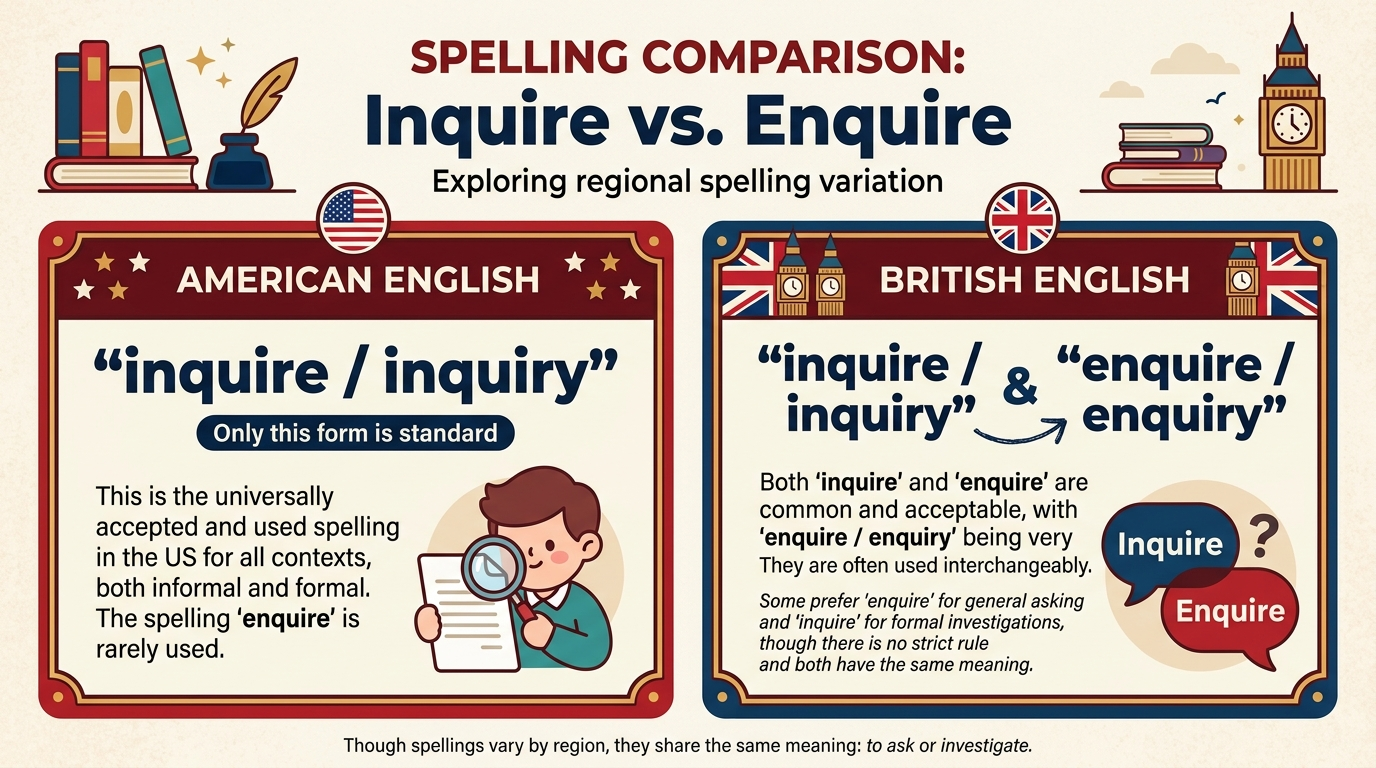
6. Inquire vs. enquire
Both spellings are correct in English, but regional preferences differ.
| Spelling | Typical usage |
|---|---|
| Inquire | Standard in American English; also used in British English |
| Enquire | Common in British English, especially for general questions |
| Inquiry | Common American spelling; also used in British English |
| Enquiry | Common British spelling for a general question |
In British English, some writers distinguish enquire/enquiry for general requests for information from inquire/inquiry for formal investigations. This distinction is not universal, and the two forms overlap.
American English generally favors inquire and inquiry for both meanings.
If you are writing for a specific publication or organization, follow its preferred spelling consistently.
Exceptions and Nuance
1. “Inquire As To” Is Correct
The expression inquire as to means to ask about something or seek information concerning it.
Examples:
- I am writing to inquire as to whether the documents have arrived.
- She inquired as to the reason for the delay.
- We contacted the office to inquire as to the availability of funding.
This construction is grammatically correct, but it can sound formal, bureaucratic, or unnecessarily wordy.
In many contexts, a simpler alternative is preferable:
- Wordier: I am writing to inquire as to whether the documents have arrived.
- Simpler: I am writing to ask whether the documents have arrived.
Use as to when it suits the context, not because it automatically makes a sentence more professional.
2. “Inquire Into” Can Refer to Formal Investigations
Inquire into often appears in official, legal, administrative, and journalistic contexts.
Examples:
- The board will inquire into the allegations.
- An independent panel was appointed to inquire into the incident.
- The committee inquired into the causes of the failure.
The phrase does not always imply wrongdoing. An inquiry may investigate an accident, a process, a policy, or an unexplained event.
3. “Inquiry For” vs. “Inquiry About”
The noun inquiry follows patterns that are related to, but not identical to, the verb inquire.
Inquiry about something generally identifies the topic of a question.
- We received an inquiry about the course fees.
- Her inquiry about the refund was forwarded to the accounts team.
Inquiry for something can be used when the inquiry concerns a requested item, service, or resource, but it is less general and depends on the context.
For example:
- We received an inquiry for accommodation.
- The company received several inquiries for its new service.
These constructions may be appropriate when someone is expressing interest in or requesting a product or service. However, if you simply mean that someone asked for information about a topic, inquiry about is usually the better choice.
Compare:
- A customer inquiry about delivery times.
- A customer’s inquiry for a quotation.
The first concerns a topic. The second concerns a requested commercial response.
In many contexts, the wording request for information or request for a quotation is more precise than inquiry for.
4. “Inquiry Into” vs. “Inquiry About”
The noun inquiry also follows the same broad distinction as the verb:
- An inquiry about the delay asks for information concerning the delay.
- An inquiry into the delay investigates the reasons for it.
Neither expression is automatically more correct. The intended meaning determines the choice.
5. Is “Enquirement” a Word?
Enquirement exists as a rare or historical formation, but it is not the normal modern English noun for the act of asking a question.
Use inquiry or enquiry instead.
Examples:
- Unnatural: We received an enquirement about the service.
- Natural: We received an inquiry about the service.
- Natural: We received an enquiry about the service.
For modern professional writing, enquirement should generally be avoided.
6. Can You Inquire Without Saying What You Are Asking About?
Yes. The topic can be omitted when it is understood or unimportant.
Examples:
- I called to inquire.
- Please contact the office if you wish to inquire further.
- She came in to inquire about the arrangements.
The last sentence names the topic, while the first two do not specify it. All are grammatical.
Common Errors and How to Correct Them
English learners sometimes transfer preposition patterns from their first language or assume that prepositions can be substituted freely. The following corrections address the most common problems.
| Incorrect or awkward | Better version | Explanation |
|---|---|---|
| I want to inquire on the course. | I want to inquire about the course. | About introduces the topic. |
| I am inquiring to the manager. | I am inquiring with the manager. | Use a suitable construction for the person contacted. |
| She inquired to me about the issue. | She asked me about the issue. | Ask someone is the natural direct pattern. |
| I made an inquire about the price. | I made an inquiry about the price. | Inquiry is the noun; inquire is the verb. |
| He is inquire about the order. | He is inquiring about the order. | Continuous forms use -ing. |
| I inquired about into the matter. | I inquired into the matter. | Do not combine the two prepositions in this construction. |
| We inquired the deadline. | We inquired about the deadline. | The topic normally requires about in this pattern. |
| I am inquire about a job. | I am inquiring about a job. | The present continuous requires am + -ing form. |
| They made an enquirement. | They made an inquiry. | Inquiry is the standard modern noun. |
One important qualification: not every sentence containing inquire without about is wrong. The verb can be used without an expressed topic, and it can take other patterns when the meaning changes.
For example:
- I inquired whether the office was open.
- She inquired into the matter.
- I inquired of the receptionist.
These are all grammatical.

Practical Test: How to Choose the Correct Expression
When deciding whether to write inquire about, inquire into, inquire of, or another construction, follow these steps.
Step 1: Identify the meaning
Ask yourself what the sentence is trying to communicate.
- Are you asking for information about a subject? Use inquire about.
- Are you investigating a matter? Use inquire into.
- Are you identifying the person being asked? Consider inquire of someone.
- Are you describing contact with an office or organization? Inquire with may fit, especially in professional usage.
- Are you referring to the person receiving a written request? Use send an inquiry to someone.
Step 2: Check the structure
Look at the words immediately following the verb.
- Inquire about the deadline.
- Inquire into the allegations.
- Inquire of the receptionist.
- Inquire with the department.
- Send an inquiry to the department.
Each pattern has a different grammatical relationship.
Step 3: Substitute a simpler expression
If you are unsure, replace inquire with ask or investigate.
If the meaning is “ask for information about a topic,” inquire about is often the correct choice.
If the meaning is “investigate a problem,” inquire into is often appropriate.
This test is helpful, but it is not a complete grammatical rule. The substitution should preserve the intended meaning, rather than merely produce a similar-looking sentence.
Step 4: Consider the audience
For everyday conversation, ask about is usually simple and natural.
For formal correspondence, inquire about is often appropriate.
For official investigations, inquire into may be more precise.
Practice Exercise
Choose the best expression for each sentence.
1. I am writing to ___ the admission requirements.inquire aboutinquire oninquire to
2. The committee was appointed to ___ the allegations.inquire aboutinquire intoinquire to
3. I received an ___ about the refund policy.inquireinquiryinquiring
4. Please ___ the admissions office about the deadline.inquire withinquire toinquire on
5. She called to ___ whether the office was open.inquireinquiredinquiring
Check answersReset
Advanced Notes: Syntax, Register, and Meaning
1. The Grammar of “To Inquire About Something”
In the phrase to inquire about something, the word to marks the infinitive, inquire is the verb, and about something is a prepositional phrase that identifies the topic.
A prepositional phrase is a group of words beginning with a preposition and containing its complement. In about the course, the preposition is about, and its complement is the course.
The complete structure is:
to inquire about the course
to inquire
The infinitive verb phrase expressing the action of asking.
about
The preposition introducing the topic.
the course
The noun phrase that completes the prepositional phrase.
The expression to inquire about something is therefore not an unusual grammatical construction. It follows ordinary English infinitive and prepositional patterns.
2. Can “Inquire” Be Followed by a Question Clause?
Yes. Inquire can introduce an indirect question, often without about.
An indirect question reports or expresses a question without using its direct-question word order.
Examples:
- She inquired whether the documents were ready.
- He inquired where the meeting would take place.
- I called to inquire when the service would resume.
- They inquired why the application had been rejected.
Compare:
- Direct question: “When will the service resume?”
- Indirect question: I inquired when the service would resume.
In the indirect question, the clause uses statement word order: when the service would resume, not when would the service resume.
This is an important distinction for advanced learners.
3. Is “Inquiring About” an Adjective or a Verb?
It depends on the sentence.
In I am inquiring about the position, the word inquiring forms part of the present continuous verb phrase.
In people inquiring about membership should contact the office, the phrase inquiring about membership describes which people should contact the office.
In her inquiring mind, the word inquiring is an adjective meaning curious or eager to learn.
The same -ing form can therefore perform different grammatical functions depending on its position and construction.
4. Is “Inquire” More Formal Than “Ask”?
Generally, yes, but the difference is not absolute.
| Expression | Typical register | Example |
|---|---|---|
| Ask about | Neutral, conversational | I wanted to ask about the schedule. |
| Inquire about | Neutral to formal | I wanted to inquire about the schedule. |
| Make an inquiry | Formal or administrative | We received an inquiry about the application. |
| Investigate | More explicitly focused on examination | The company investigated the complaint. |
Register means the style of language appropriate to a particular setting, audience, or purpose.
Using inquire can be suitable in professional communication, but it does not automatically make a sentence more polite. A clear, respectful sentence using ask can be just as professional.
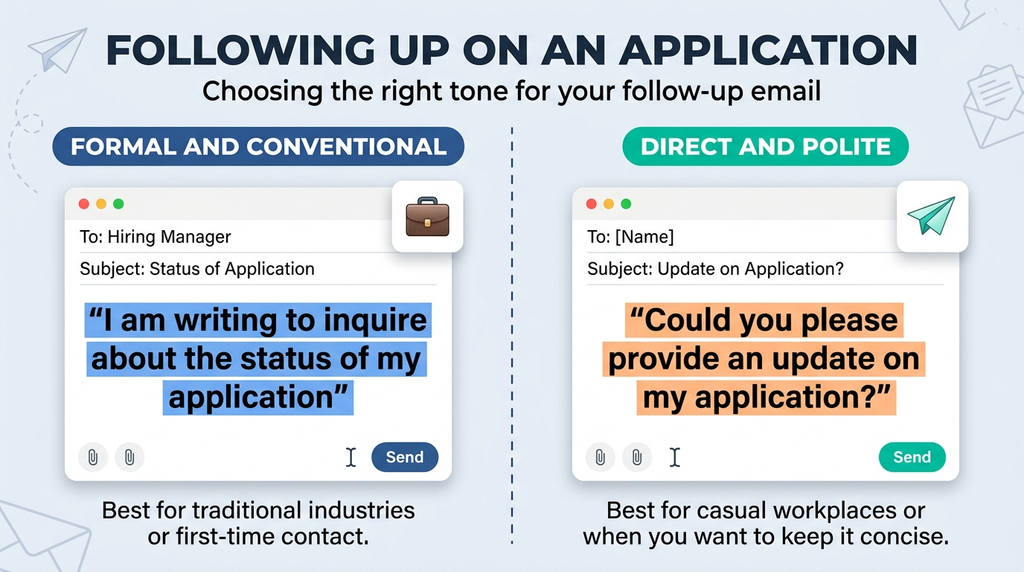
5. Why “I Am Inquiring About” Works Well in Emails
The expression gives the reader an immediate indication of the purpose of the message.
For example:
I am inquiring about the status of my application submitted on 10 October.
The reader can identify both the purpose and the topic.
However, if you want a more direct style, you can write:
Could you please provide an update on my application submitted on 10 October?
Both are appropriate. The best choice depends on the desired tone and the information you need.
Frequently Asked Questions
1. Is it correct to say “to inquire about something”?
Yes. It is a standard, grammatical expression meaning to ask for information concerning a subject, situation, product, or service.
Example: I called to inquire about the delivery date.
2. What does “to inquire” mean?
It means to ask for information or seek an answer to a question.
Example: She contacted the office to inquire about the requirements.
3. What does “inquire about” mean?
It means to ask for information concerning a particular topic.
Example: He inquired about the price of the course.
4. Is “I am inquiring about” grammatically correct?
Yes. It is the present continuous form of inquire followed by about and a topic.
Example: I am inquiring about the available positions.
5. Should I say “inquire about” or “inquire on”?
Use inquire about for the general meaning of asking for information about a topic. Inquire on is generally not the standard choice for this meaning.
6. What is the difference between “inquire about” and “inquire into”?
Inquire about focuses on obtaining information concerning a topic. Inquire into focuses on investigating a matter.
Example: She inquired about the complaint procedure, while the committee inquired into the complaint.
7. Is “inquire to” correct?
Usually not when you mean to ask someone for information. Use ask someone, inquire of someone, or inquire with someone, depending on the context.
However, send an inquiry to someone is correct because to identifies the recipient of the noun inquiry.
8. Is “inquire with” grammatically correct?
Yes, it is used in contemporary English, especially in professional settings, to describe contacting a person or organization for information.
Example: Please inquire with the admissions office about the deadline.
Some writers prefer contact the admissions office to inquire about the deadline.
9. What is the difference between “inquiry for” and “inquiry about”?
Inquiry about identifies the topic of a question. Inquiry for can describe an inquiry seeking a product, service, or other requested item, although the construction is more context-dependent.
For general requests for information, inquiry about is usually the clearest option.
10. Is “inquiry into” correct?
Yes. It commonly refers to an investigation or systematic examination of a matter.
Example: The board launched an inquiry into the incident.
11. What is the difference between “inquire” and “enquire”?
Both mean to ask for information. Inquire is the usual American spelling, while enquire is common in British English. British usage sometimes distinguishes general questions from formal investigations, but the distinction is not universal.
12. Is “inquired about” correct?
Yes. It is the past-tense form of inquire followed by about.
Example: The applicant inquired about the deadline.
13. How do I use “inquiring” in a sentence?
Use it in continuous verb phrases or other constructions that take the -ing form.
Examples:
- I am inquiring about the fees.
- Anyone inquiring about membership should contact the office.
14. Can I say “inquire as to”?
Yes. It is a grammatical but relatively formal expression.
Example: I am writing to inquire as to whether the payment has been received.
In many situations, ask whether the payment has been received is simpler.
15. Is “inquire now” correct?
Yes. It is a common imperative expression used to encourage someone to request information.
Example: Inquire now about our upcoming courses.
16. Is “enquirement” a correct word?
It exists as a rare or historical formation, but it is not standard modern usage for an ordinary request for information. Use inquiry or enquiry instead.
17. Can “inquire” be used without “about”?
Yes. The topic can be omitted, or the verb can take another grammatical construction.
Examples:
- I called to inquire.
- She inquired whether the office was open.
- The committee inquired into the matter.
18. Is “inquire about something” appropriate in formal writing?
Yes. It is widely used in formal correspondence, administrative requests, and professional communication.
Example: I am writing to inquire about the requirements for the position.
Summary: If You Remember One Rule
Use “inquire about” when asking for information about a topic, and “inquire into” when emphasizing an investigation.
Remember these additional patterns:
- Inquire about something: ask for information about a topic.
- Inquire into something: investigate a matter.
- Inquire of someone: ask someone for information, often formally.
- Inquire with someone: contact a person or organization for information.
- An inquiry about something: a request for information concerning a topic.
- An inquiry into something: an investigation.
- I am inquiring about something: a correct and professional way to introduce the purpose of a message.
When you are uncertain, choose the expression that conveys your intended meaning most clearly. In ordinary English and professional correspondence alike, inquire about is a reliable, natural choice.