Is It Correct to Say “Aforementioned”? Meaning, Grammar, and Examples
Quick Answer
Yes, it is correct to say “aforementioned.” It is a standard English word meaning mentioned earlier or referred to previously. It is most common in formal writing, including academic papers, business documents, legal texts, and professional correspondence.
For example:
- Correct: Please review the aforementioned requirements before submitting your application.
- Correct: The aforementioned study provides further evidence of the problem.
- Less formal alternative: Please review the requirements mentioned earlier before submitting your application.
The standard spelling is aforementioned, not forementioned, afore-mentioned, afformentioned, or aforementioend.
The word is grammatically correct, but it can sound unnecessarily formal when a simpler expression such as mentioned earlier, previously discussed, or the above would communicate the same idea more naturally.

Rule in Plain English
Use aforementioned when you want to refer to a person, thing, fact, document, or idea that has already been mentioned in the text or conversation.
The essential rule is simple:
Aforementioned refers backward to something already introduced.
Consider this example:
The committee reviewed three proposals. The aforementioned proposals will be discussed again tomorrow.
The second sentence uses aforementioned to refer to the three proposals in the first sentence.
The word generally appears before a noun:
- the aforementioned proposal
- the aforementioned individual
- the aforementioned circumstances
- the aforementioned documents
It can also appear in other grammatical positions when the sentence structure permits it, but its most familiar use is as a modifier before a noun.
Compare these examples:
| Sentence | Assessment | Reason |
|---|---|---|
| The aforementioned agreement expires in June. | Correct | Refers to an agreement already mentioned. |
| Please sign the aforementioned documents. | Correct | Identifies documents discussed earlier. |
| The aforementioned is a useful word. | Context-dependent | Can work if a previously mentioned item or statement is clearly understood, but often sounds awkward without one. |
| We will discuss the aforementioned proposal for the first time. | Potentially contradictory | It is odd to call something aforementioned if it has not been mentioned before. |
The key is not simply whether the word sounds formal. The reference must make sense in context.
Core Grammar Explanation
1. What does “aforementioned” mean?
Aforementioned means mentioned or referred to earlier.
It combines the older word afore, meaning before or previously, with mentioned, the past participle of mention.
In everyday English, the word is similar in meaning to:
- previously mentioned
- mentioned earlier
- referred to above
- previously discussed
- already noted
These expressions overlap in meaning, but they are not always interchangeable in every sentence. For instance, previously discussed suggests that a topic was discussed, whereas aforementioned simply indicates that it was mentioned or referred to earlier.
Example:
The report identifies several risks. The aforementioned risks require immediate attention.
Here, aforementioned points back to the risks identified in the previous sentence.
2. What part of speech is “aforementioned”?
In contemporary English, aforementioned is generally classified as an adjective, more specifically a participial adjective or modifier.
An adjective describes or identifies a noun. In this case, the word identifies a noun by connecting it to an earlier reference.
Consider the structure:
Sentence structure
The
Determiner
aforementioned
Modifier
contract
Noun
Complete noun phrase: “the aforementioned contract”
In the phrase the aforementioned contract:
- The is the determiner that introduces the noun phrase.
- Aforementioned identifies which contract is intended.
- Contract is the head noun, meaning the central noun of the phrase.
Aforementioned does not usually behave like a typical descriptive adjective such as large, blue, or interesting. It does not primarily describe a quality; it identifies something by its position in the preceding discourse.
3. Why does it normally come before a noun?
Aforementioned typically functions as an attributive adjective, meaning an adjective placed before the noun it modifies.
Correct:
- The aforementioned employee received a promotion.
- We examined the aforementioned evidence.
- The aforementioned changes will take effect in January.
Less natural in ordinary prose:
- The employee aforementioned received a promotion.
- We examined the evidence aforementioned.
The second group is not the normal modern pattern. Although English permits postpositive adjectives in certain expressions and specialized styles, placing aforementioned after an ordinary noun generally sounds archaic or unnatural.
A better revision is:
The employee mentioned earlier received a promotion.
4. Does “aforementioned” need a noun after it?
Usually, yes, in ordinary contemporary writing.
The standard pattern is:
the + aforementioned + noun
For example:
- the aforementioned policy
- the aforementioned customer
- the aforementioned event
However, English sometimes allows an adjective or modifier to stand without an expressed noun when the intended meaning is recoverable from context. This is called ellipsis: leaving out words that readers can understand without them.
For example:
The first proposal was rejected, but the aforementioned was approved.
This is understandable in some contexts, but it is awkward and unusually formal. A clearer version would be:
The first proposal was rejected, but the proposal mentioned earlier was approved.
Or, if the reference is obvious:
The first proposal was rejected, but it was approved later.
The important distinction is between grammatical possibility and good editorial practice. A construction may be interpretable without being the clearest choice.
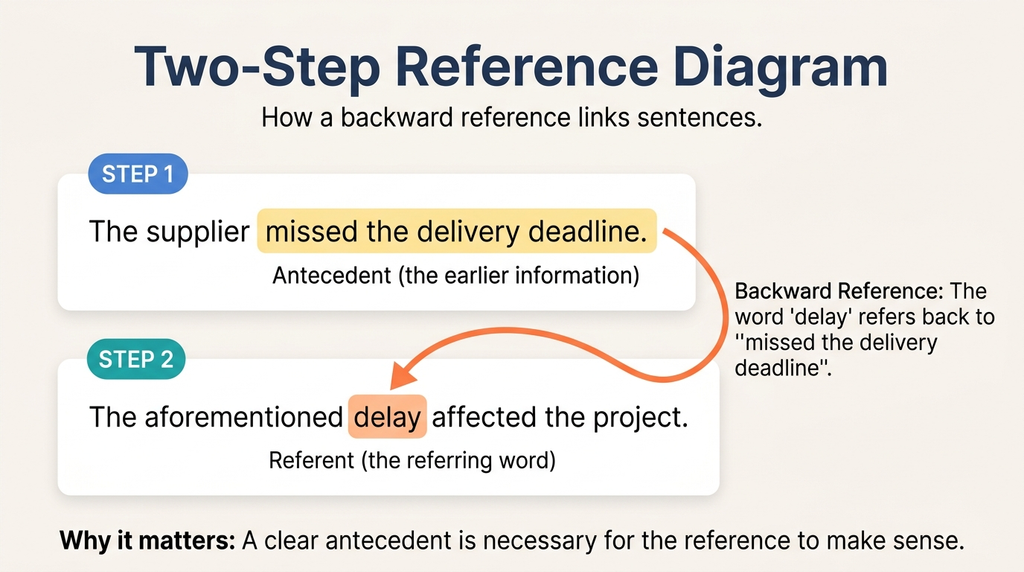
5. How does “aforementioned” connect sentences?
The word is not merely a substitute for a noun. It is also a discourse reference: a way of linking one part of a text to information introduced earlier.
Consider:
The supplier failed to deliver the equipment on time. The aforementioned delay affected the entire project.
The phrase the aforementioned delay connects the second sentence to the first.
This creates cohesion, meaning that different parts of a text fit together logically.
However, readers must be able to identify the intended reference. If a paragraph contains several delays, contracts, suppliers, and deadlines, simply using aforementioned may not tell readers which item is intended.
In that situation, naming the item again is often clearer:
The supplier’s delivery delay affected the entire project.
Examples of “Aforementioned” in a Sentence
The following examples demonstrate how the word works in different contexts.
Everyday and general English
- The aforementioned problem has now been resolved.
- Please read the aforementioned instructions carefully.
- The aforementioned event took place last summer.
- We have already addressed the aforementioned concern.
These sentences are grammatically correct, although the word may sound overly formal in casual conversation.
More conversational alternatives include the problem mentioned earlier, those instructions, that event, and the concern we discussed.
Academic writing
- The aforementioned findings support the study’s central hypothesis.
- The researchers compared the aforementioned variables across three groups.
- The aforementioned limitations should be considered when interpreting the results.
Academic writers can use the word to maintain continuity, but they should avoid repeating it mechanically. A precise noun or a well-chosen pronoun may be more readable.
Business and professional writing
- Please confirm that the aforementioned changes have been implemented.
- The aforementioned invoice remains outstanding.
- We request a response regarding the aforementioned matter by Friday.
These uses are suitable for formal correspondence, reports, and administrative documents when the reference is clear.
Legal and contractual writing
- The aforementioned clause shall remain in effect.
- The parties agree to comply with the aforementioned provisions.
- The aforementioned property is identified in Schedule A.
The word is common in formal legal-style prose, but it should not replace a precise clause number, document title, or defined term when ambiguity could affect interpretation.
Email examples
Formal:
With reference to the aforementioned issue, please provide an update by the end of the week.
Clearer and more natural:
Regarding the issue mentioned earlier, please provide an update by the end of the week.
Concise:
Please provide an update on this issue by Friday.
All three can be correct. The best choice depends on how formal the message needs to be and whether the reference is unmistakable.

“Aforementioned” vs. “Forementioned”: Which Is Correct?
Aforementioned is the standard spelling. Forementioned is not the normal accepted form in contemporary standard English and should generally be treated as a misspelling or nonstandard variant in edited prose.
| Word or expression | Status | Recommendation |
|---|---|---|
| aforementioned | Standard English | Use it when appropriate. |
| forementioned | Nonstandard in ordinary contemporary usage | Replace with aforementioned or previously mentioned. |
| afore-mentioned | Unnecessary hyphenation in standard modern usage | Write aforementioned. |
| before mentioned | Usually incorrectly formed as a substitute for the adjective | Use previously mentioned or mentioned before. |
| fore mentioned | Not the standard spelling | Use aforementioned. |
| afformentioned | Misspelling | Use aforementioned. |
| afromentioned | Misspelling in this intended meaning | Use aforementioned. |
| aforementioend | Typographical error | Use aforementioned. |
| aformentioned | Misspelling | Use aforementioned. |
Why is “aforementioned” the correct form?
The word is formed from afore and mentioned. The element afore means before or previously and appears in several established English words and expressions.
The fact that fore can also mean before does not make forementioned the standard spelling. English vocabulary is shaped by historical development and established usage, not by replacing individual word parts with synonyms.
For example, English speakers write aforethought in a recognized legal expression, but that does not mean they can freely replace afore- with fore- in every compound.
The correct editorial choice is therefore straightforward:
- Write the aforementioned document.
- Do not write the forementioned document in standard edited English.
Is “before mentioned” ever correct?
The phrase before mentioned is not automatically ungrammatical in every conceivable sentence, but it is generally not the right form when you want the established adjective meaning previously mentioned.
Compare:
- Standard: The aforementioned document is attached.
- Standard: The document mentioned before is attached.
- More natural in many contexts: The document mentioned earlier is attached.
- Awkward: The before mentioned document is attached.
The phrase mentioned before works because mentioned is a verb form and before indicates when the mentioning occurred. In the aforementioned document, the entire established word functions as a modifier before the noun.

Exceptions and Nuance
1. Is “aforementioned” too formal?
Not inherently. It is appropriate when a formal register is useful, but it may sound stiff in informal communication.
Register means the style of language suited to a particular situation, audience, or purpose.
| Context | Example | Assessment |
|---|---|---|
| Casual conversation | “That aforementioned movie was great.” | Grammatically possible, but unusually formal. |
| Academic report | “The aforementioned results are consistent with earlier research.” | Appropriate, though repetition should be controlled. |
| Business email | “Please review the aforementioned terms.” | Appropriate in formal correspondence. |
| Plain-language instructions | “Follow the steps mentioned earlier.” | Usually clearer and more approachable. |
| Legal document | “The aforementioned provisions remain applicable.” | Conventional, provided the reference is precise. |
The best rule is not to avoid formal language altogether. It is to use a level of formality that serves the reader.
2. Can “aforementioned” refer to something in the same sentence?
Yes, if the thing has already been mentioned within that sentence or an immediately preceding phrase. However, the reference must be logically clear.
For example:
The report, including the aforementioned recommendations, will be published tomorrow.
This is correct if the recommendations were identified earlier in the text.
By contrast:
The aforementioned recommendations are as follows: reduce costs, improve access, and increase transparency.
This sentence is not necessarily wrong. The recommendations might have been mentioned in an earlier section, and the sentence could now be listing them again. But if the recommendations are being introduced for the first time, aforementioned is misleading.
A better first introduction would be:
The recommendations are as follows: reduce costs, improve access, and increase transparency.
3. Can it refer to an idea rather than an exact noun?
Yes. The reference can point to a fact, event, proposal, claim, or broader idea.
For example:
The company announced a hiring freeze. The aforementioned decision surprised employees.
The noun decision summarizes the earlier announcement. The word does not require the earlier text to contain the exact same noun, provided the relationship is clear.
4. Is it interchangeable with “above-mentioned”?
The forms aforementioned and above-mentioned often overlap in meaning. Both can refer to something already identified in a text.
- The aforementioned conditions apply to all applicants.
- The above-mentioned conditions apply to all applicants.
Both are understandable. In polished contemporary prose, aforementioned is commonly written as one word, while above-mentioned retains its conventional hyphenated form when used before a noun.
However, neither term is necessarily the best option. In a long document, a direct reference such as the conditions listed in Section 2 is often more precise.
5. Does “aforementioned” work in spoken English?
It can be used in speech, but it is uncommon in relaxed conversation because it sounds formal and may require more processing than a simple phrase.
A speaker might say:
As I mentioned earlier, we need to revise the budget.
A formal presenter or lecturer might say:
The aforementioned figures demonstrate a consistent pattern.
Both are grammatical. The difference is stylistic rather than a difference in basic correctness.
6. Can it be used repeatedly?
Yes, but repetition can make writing monotonous or bureaucratic.
Consider:
The aforementioned proposal was reviewed. The aforementioned proposal was then revised. The aforementioned proposal was finally approved.
A more effective version is:
The proposal was reviewed, revised, and finally approved.
The noun does not need to be repeatedly marked as previously mentioned when the reference remains obvious.
Common Errors Learners Make
Error 1: Writing “forementioned”
Incorrect for standard edited English: The forementioned agreement has expired.
Correct: The aforementioned agreement has expired.
Also correct: The agreement mentioned earlier has expired.
The spelling is not determined by which prefix seems most logical. Established lexical form matters.
Error 2: Treating the word as a replacement for any noun
Awkward: Please review aforementioned before the meeting.
Better: Please review the aforementioned document before the meeting.
Also better: Please review the document mentioned earlier before the meeting.
In ordinary writing, the reader generally needs a noun or a clearly established context to understand what is being referenced.
Error 3: Using it before anything has been mentioned
Misleading without prior context: The aforementioned policy will begin tomorrow.
If the policy has not yet been identified, introduce it first:
The company has adopted a new policy. The aforementioned policy will begin tomorrow.
Or write:
The new policy will begin tomorrow.
Error 4: Assuming that longer words are more professional
Overly formal: Kindly respond to the aforementioned matter at your earliest convenience.
Clearer: Please reply to the issue mentioned earlier when you can.
The first version is not automatically wrong, but it uses more formal language than many messages require. Professional writing is judged by clarity, accuracy, tone, and purpose—not by the number of syllables.
Error 5: Using it when the reference is ambiguous
Suppose a report discusses two contracts and three invoices. The sentence The aforementioned document requires revision may leave the reader unsure which document is meant.
Use a specific label instead:
Invoice 104 requires revision.
This is especially important in technical, legal, medical, and administrative documents where precision matters.
Error 6: Adding a hyphen unnecessarily
Preferred: The aforementioned provisions apply.
Avoid in standard modern prose: The afore-mentioned provisions apply.
The closed spelling is the conventional modern form.
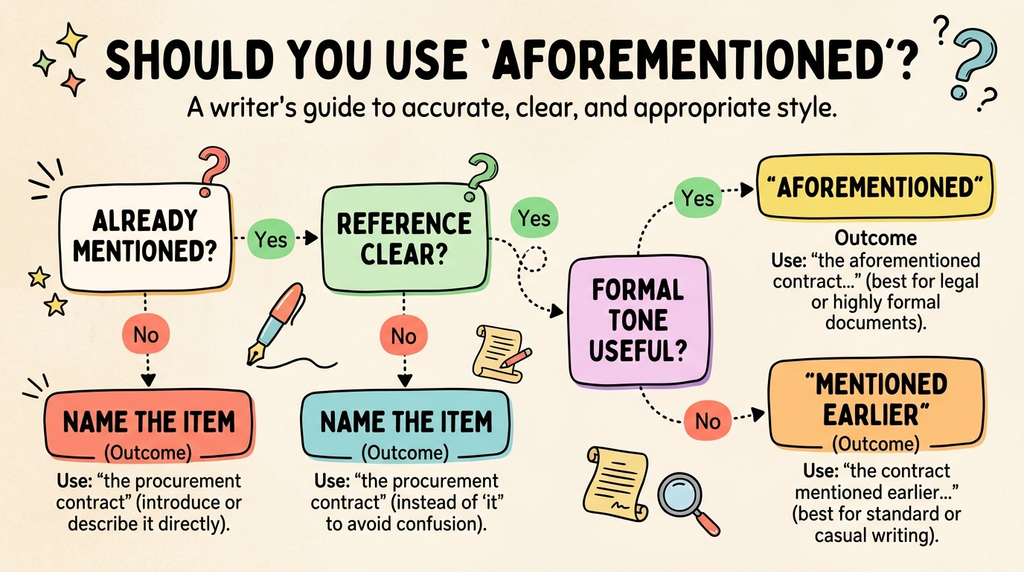
Practical Test: Should You Use “Aforementioned”?
Use these checks whenever you are editing a sentence.
The five-question editing test
Has the person, thing, idea, or fact already been mentioned?
If not, introduce it first or use a direct noun phrase.Can the reader identify exactly what the word refers to?
If several possible references exist, name the intended item.Does the sentence need a formal tone?
If not, consider “mentioned earlier” or a simpler reference.Is the word positioned naturally before its noun?
“The aforementioned report” is the standard pattern.Would a shorter version communicate the same meaning more clearly?
Remove the word if it adds formality but no useful information.
0 of 5 checks reviewedReset
The checks are editorial guidance, not five mandatory grammatical conditions. For example, formal tone is not essential for grammatical correctness; it simply affects whether aforementioned is the best stylistic choice.
A quick substitution test
Try replacing aforementioned with mentioned earlier.
Original:
The aforementioned guidelines should be followed.
Substitution:
The guidelines mentioned earlier should be followed.
If the substitution preserves the intended meaning and reads more naturally, the longer word may not be necessary.
If the document requires a formal register, the original may be preferable. If neither version makes the reference clear, identify the guidelines more specifically.
A quick antecedent test
An antecedent is the earlier word, phrase, or idea that a later expression refers to.
Consider:
The manager discussed the deadline and the budget. The aforementioned issue remains unresolved.
What does issue refer to: the deadline, the budget, or both?
The sentence is ambiguous because the antecedent is not sufficiently clear.
Improve it by writing:
The deadline remains unresolved.
Or:
The deadline and budget issues remain unresolved.
The practical principle is to prioritize the reader’s ability to identify the intended reference.
Advanced Notes
1. The difference between grammar, meaning, and style
Three separate questions help explain why a sentence can be grammatically correct but still be a poor choice.
- Grammar: Does the word fit the sentence structure?
- Meaning: Does it refer to the intended information?
- Style: Is it appropriate for the audience and purpose?
For example:
The aforementioned cat is sleeping.
This is grammatically correct. It makes sense if the cat has already been mentioned. But in a casual conversation, the cat we talked about may sound more natural.
A useful editorial decision considers all three dimensions instead of treating correctness as a simple yes-or-no question.
2. Information structure and backward reference
In linguistics, anaphora is the relationship in which an expression refers back to something already introduced in a text or conversation.
For example:
The research team published a report. The aforementioned report includes three recommendations.
The noun phrase the aforementioned report has an anaphoric function because it retrieves information from the preceding sentence.
This function is related to, but not identical to, the role of pronouns such as it and they.
Compare:
The research team published a report. It includes three recommendations.
Both it and the aforementioned report refer to the report. However, the noun phrase repeats the identity of the object, whereas the pronoun relies more heavily on the reader’s ability to track the reference.
The fuller expression can help when there is a risk of ambiguity. It can also make writing unnecessarily heavy if the reference is already obvious.
3. “Aforementioned” and the principle of cohesion
Cohesion refers to the linguistic connections that help readers follow a text from one sentence to the next.
Aforementioned can contribute to cohesion by explicitly signaling that a noun phrase refers to previously introduced information.
However, cohesion alone does not guarantee good writing. Repeating formal reference expressions can create a mechanical style.
Compare:
The committee received a complaint. The aforementioned complaint was investigated. The aforementioned investigation produced several findings.
A more natural version is:
The committee received a complaint and investigated it. The investigation produced several findings.
The second version maintains clear connections without repeatedly announcing that information has already appeared.
4. Why “aforementioned” can sound legalistic
The word is associated with legal, administrative, and formal institutional writing. In these contexts, explicit backward reference can serve a practical purpose: it identifies material that has already been introduced.
Nevertheless, the word does not automatically make a sentence legally precise. If a contract contains several provisions, the aforementioned provision may still be unclear. A numbered clause or defined term can provide a more exact reference.
This distinction matters in editing: formality is not the same as precision.
5. Is “aforementioned” old-fashioned?
It is an established English word that remains in contemporary use, especially in formal prose. It may sound old-fashioned or bureaucratic to some readers because everyday English often favors shorter expressions.
That does not make the word obsolete or incorrect.
A useful way to assess it is to consider the document’s audience, purpose, and conventions. In a formal report, aforementioned findings may fit naturally. In a text message, those findings is generally more suitable.
6. Pronunciation: How to pronounce “aforementioned”
The word has four syllables in its usual pronunciation, with the main stress on the second syllable.
Pronunciation
1×PlayStop
aforementioned
uh-FOR-men-shuhnd
Add to flashcards
Give feedback
Listen for the main stress on the second syllable. The final part is commonly pronounced with a reduced vowel, as is typical in unstressed syllables in English.
Frequently Asked Questions
Is it correct to say “aforementioned”?
Yes. Aforementioned is a standard English word meaning mentioned earlier or previously referred to. It is especially common in formal writing.
What does “aforementioned” mean in simple English?
It means that something has already been mentioned. For example, the aforementioned book means the book mentioned earlier.
Is it “forementioned” or “aforementioned”?
Aforementioned is the standard spelling in contemporary English. Use it in formal, academic, and professional writing.
Is “forementioned” a real word?
The form forementioned may appear in nonstandard or historical material, but it is not the conventional choice in modern standard English. For normal editing, use aforementioned or previously mentioned.
Is “afore-mentioned” correct?
The hyphenated spelling occasionally appears, but aforementioned is the standard modern form. In ordinary edited prose, write it as one word.
Is “before mentioned” grammatically correct?
It can occur in certain constructions, but it is generally not the appropriate form when you need the established modifier meaning previously mentioned. Write the aforementioned report or the report mentioned earlier.
Can I use “aforementioned” at the beginning of a sentence?
Yes, provided the reference is already clear.
Example: The aforementioned policy will take effect next month.
This works when the policy has been identified earlier. If it is being introduced for the first time, use the new policy instead.
Can “aforementioned” stand alone without a noun?
Sometimes an adjective can be used without an expressed noun if context supplies the missing information. However, using aforementioned alone is often awkward. In most cases, repeat the noun or choose a clearer alternative.
Is “aforementioned” formal or informal?
It is primarily formal. It is suitable for reports, academic prose, business correspondence, and legal-style documents, but may sound stiff in ordinary conversation.
What is another word for “aforementioned”?
Depending on the sentence, suitable alternatives include previously mentioned, mentioned earlier, previously discussed, already noted, and the above. The best alternative depends on whether you are referring to a specific object, an earlier statement, or a topic discussed previously.
Is “aforementioned” the same as “above-mentioned”?
They have similar meanings and frequently refer to information already presented in a document. Aforementioned is written as one word; above-mentioned is commonly hyphenated when used before a noun.
How do you spell “aforementioned”?
The correct spelling is a-f-o-r-e-m-e-n-t-i-o-n-e-d. Common errors include aformentioned, afformentioned, aforementioend, and afromentioned.
Can “aforementioned” be used in an email?
Yes. For example: Please review the aforementioned terms before signing the agreement. For a more conversational email, Please review the terms mentioned earlier may be clearer.
Summary
Aforementioned is correct, standard English. It means mentioned earlier and is most often used before a noun, as in the aforementioned agreement or the aforementioned results.
Remember these key points:
- Spelling: Use aforementioned, not forementioned or afformentioned.
- Grammar: It normally modifies a noun and identifies something mentioned previously.
- Context: The earlier reference must be clear to the reader.
- Register: It is formal and may sound unnecessarily stiff in casual communication.
- Alternatives: Consider mentioned earlier, previously discussed, or a specific noun when these options improve clarity.
- Editing: A grammatically correct word is not always the most natural or precise choice.
If You Remember One Rule
Use “aforementioned” only when the thing you are referring to has already been mentioned and the reader can identify it clearly. If mentioned earlier communicates the idea more naturally, use that instead.