
Well Received: Meaning, Usage, Examples, Synonyms, and Common Mistakes
Quick Meaning
Well received means welcomed, accepted, or reacted to positively. It is commonly used to describe how people respond to an email, message, idea, speech, presentation, product, performance, or other form of communication.
For example:
- “Your presentation was well received by the audience.” — The audience reacted positively to it.
- “The client well received our proposal.” — The client responded favorably to the proposal, although “The client received our proposal well” or “Our proposal was well received by the client” sounds more natural in most contexts.
- “Thank you for your email. It was well received.” — The email arrived and, depending on the context, may also have been welcomed or appreciated.
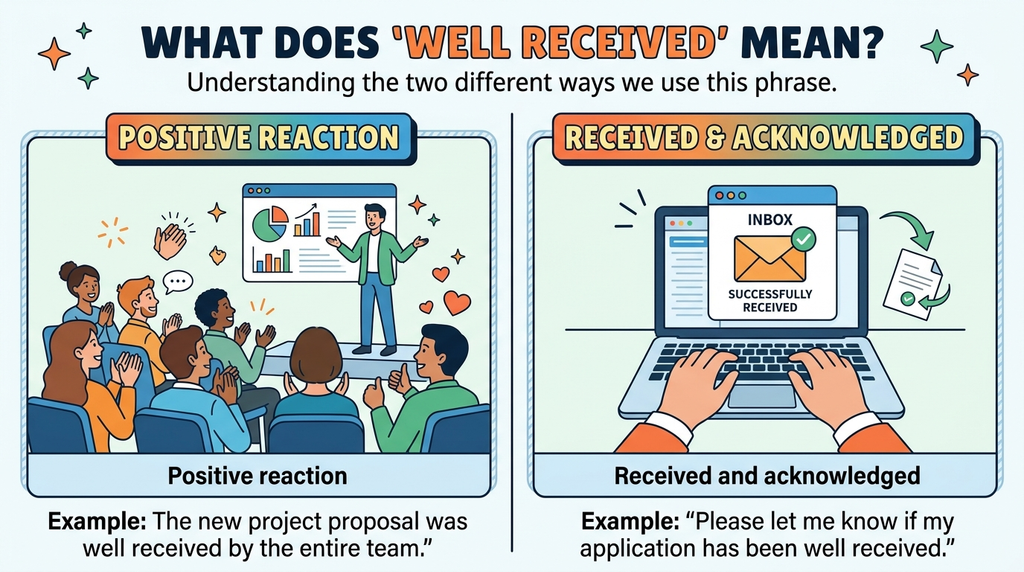
The expression can describe either a positive reaction or, in some contexts, successful receipt. The surrounding sentence determines the intended meaning.
Definitions
1. Welcomed or viewed positively
This is the most common meaning of well received. It describes a favorable response from a person, group, audience, or organization.
Examples:
- “The new policy was well received by employees.”
- “Her latest novel has been well received by critics.”
- “The announcement was well received across the organization.”
In these sentences, the expression communicates approval, appreciation, or a generally positive reaction. It does not necessarily mean that everyone agreed with the decision or liked every detail.
2. Accepted favorably
The phrase can describe how an idea, suggestion, proposal, request, or recommendation is received by someone who has the authority to accept or reject it.
Examples:
- “The committee’s proposal was well received.”
- “His suggestion was well received during the meeting.”
- “The revised budget was well received by management.”
A favorable reception does not always mean formal approval. A proposal may be well received during an initial discussion but still require further review before it is approved.
3. Appreciated or welcomed in interpersonal communication
When used about a message, gesture, invitation, or offer, well received can suggest that the recipient appreciated it or responded positively.
Examples:
- “Your thoughtful message was well received.”
- “The invitation was well received by the guests.”
- “Her apology was well received, and the two colleagues agreed to move forward.”
This meaning is especially useful in professional communication because it conveys a positive response without sounding overly emotional.
4. Successfully received or acknowledged
In certain administrative, technical, or business contexts, the expression can refer to an item that has reached its intended recipient or system. However, well received is less precise than received successfully, received and acknowledged, or delivered when the only concern is whether something arrived.
Compare:
- “Your application was received successfully.” — The application arrived.
- “Your application was well received by the selection committee.” — The committee reacted favorably to it.
Do not assume that a message has been appreciated simply because it has been delivered.
Part of Speech
Well received is primarily a participial adjective or an adjective-like passive expression. It is formed from the adverb well and the past participle received.
The exact grammatical role depends on the sentence.
| Example | Grammatical function |
|---|---|
| “The speech was well received.” | Adjective-like passive complement |
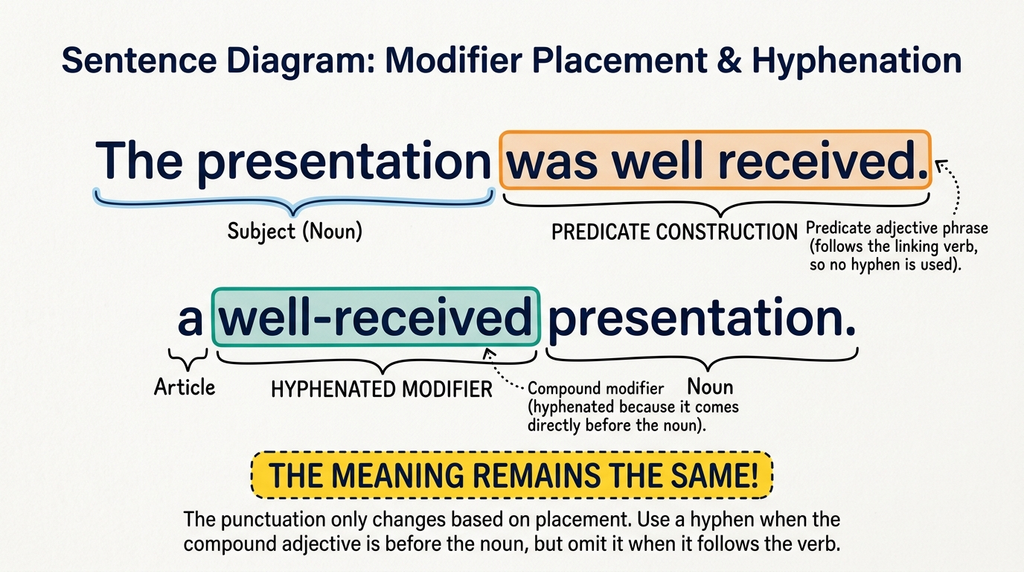
| “It was a well-received speech.” | Compound adjective before a noun |
| “The speech received a warm response.” | Active verb construction with a noun phrase |
| “The audience received the speech well.” | Verb received modified by the adverb well |
The expression is not normally treated as a separate verb or noun. Its grammatical behavior comes from the verb receive and its participle received.
Is “well received” an adjective?
Yes, it commonly functions adjectivally, particularly in passive constructions such as “The book was well received” and in compound modifiers such as “a well-received book.”
In the passive sentence, the phrase describes the response to the book. Before a noun, it acts as a compound modifier.
How It Is Used
1. In emails and professional communication
Well received is often used in workplace correspondence to discuss the reaction to an email, proposal, report, announcement, or other communication.
Examples:
- “The report was well received by the leadership team.”
- “Your recommendations were well received during the review.”
- “The client confirmed that our revised proposal was well received.”
The phrase is suitable for reports, business updates, performance summaries, and formal correspondence. It usually describes an outcome rather than serving as a complete response to a message.
2. In audience and public reception
The expression frequently appears in journalism, reviews, entertainment reporting, education, and public relations.
Examples:
- “The documentary was well received by viewers.”
- “The keynote address was well received at the conference.”
- “The exhibition was well received by local visitors.”
In this context, it usually means that the audience reacted favorably. The expression does not automatically establish that the work was commercially successful, critically acclaimed by every reviewer, or universally popular.
3. In workplace feedback
The phrase is useful when describing how a suggestion, initiative, training session, or organizational change was perceived.
Examples:
- “The new onboarding program was well received by new employees.”
- “The manager’s feedback was well received by the team.”
- “The proposed changes were generally well received, although some concerns remained.”
Adding words such as generally, particularly, or initially can make the statement more precise.
4. In academic and research writing
Writers may use the expression to summarize the reception of a theory, publication, presentation, or educational resource.
Examples:
- “The teaching method was well received by participating students.”
- “The paper was well received at the conference.”
- “The revised course materials were well received by instructors.”
In formal research, avoid using the phrase as a substitute for measured evidence. If a survey shows that 82% of participants responded positively, reporting that result is more informative than simply saying the resource was well received.
5. In marketing and product launches
Businesses use the expression to describe reactions to new products, campaigns, services, and brand messages.
Examples:
- “The product launch was well received by early customers.”
- “The advertising campaign was well received on social media.”
- “The updated design was well received by existing users.”
Where possible, support these statements with customer feedback, review scores, survey results, or other relevant evidence. A positive initial response does not necessarily prove long-term customer satisfaction.

Collocations
Collocations are words that commonly appear together. Learning them makes it easier to use well received naturally.
| Common collocation | Example |
|---|---|
| Well received by the audience | “The talk was well received by the audience.” |
| Well received by critics | “The film was well received by critics.” |
| Well received by customers | “The updated service was well received by customers.” |
| Well received by management | “The proposal was well received by management.” |
| Generally well received | “The changes were generally well received.” |
| Widely well received | Less natural in many contexts; prefer “widely praised” or “well received by many people.” |
| Very well received | “The workshop was very well received.” |
| Warmly received | “The visiting speaker was warmly received.” |
| Positively received | “The announcement was positively received.” |
| Critically well received | Understandable, but “well received by critics” is usually more natural. |
Common nouns used with “well received”
The expression commonly modifies or describes:
- Proposals and recommendations
- Emails and messages
- Speeches and presentations
- Books, films, and performances
- Products and services
- Policies and initiatives
- Feedback and suggestions
- Announcements and campaigns
- Training sessions and workshops
- Invitations and apologies
A useful pattern is:
Subject + was/were + well received + by + recipient
For example: “The new training program was well received by staff.”
Another common pattern is:
Subject + has/have been + well received
For example: “The new guidelines have been well received.”
The second construction is especially useful when the positive response continues to be relevant in the present.
Examples of “Well Received” in Sentences
The following examples show how the expression works in different contexts.
Everyday examples
- “Her suggestion was well received by the group.”
- “The new café was well received by residents.”
- “His joke was not particularly well received.”
- “The invitation was well received, and several guests confirmed their attendance.”
- “The announcement was better received than expected.”
Professional and business examples
- “The client said that our proposal was well received.”
- “The quarterly report was well received by senior management.”
- “The revised presentation has been well received across the department.”
- “Although the initial idea was well received, the team requested additional evidence.”
- “The training session was very well received by new employees.”
Academic and creative examples
- “The research paper was well received at the conference.”
- “The novel was well received by readers and reviewers.”
- “The performance was warmly received by the audience.”
- “The new teaching materials were well received by students.”
- “The exhibition was generally well received, despite a few critical reviews.”
Negative and qualified examples
- “The proposal was not well received by the committee.”
- “The announcement was poorly received by some employees.”
- “The first version was well received, but the revised version attracted criticism.”
- “The idea was initially well received, although enthusiasm declined later.”
- “The policy was well received by managers but less favorably received by some employees.”
These examples illustrate an important nuance: well received describes a reaction in a particular context. That reaction can vary between groups, change over time, or coexist with criticism.
Similar and Confusable Words
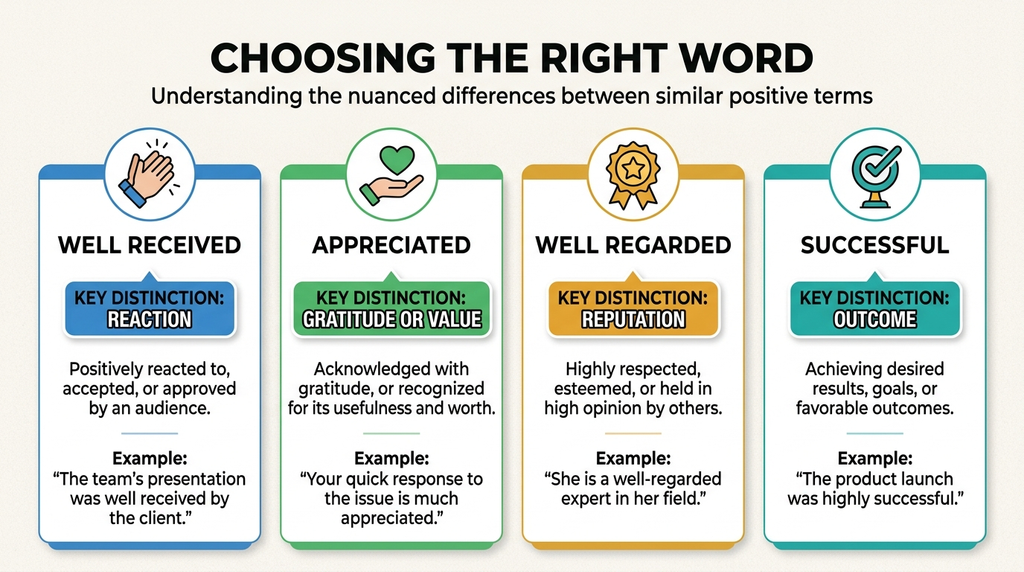
The best synonym depends on whether you mean approval, appreciation, acceptance, popularity, or simply successful delivery.
| Word or phrase | Meaning and nuance | Example |
|---|---|---|
| Welcomed | Received with pleasure or approval | “The new policy was welcomed by staff.” |
| Well regarded | Considered worthy of respect or admiration | “She is well regarded in her field.” |
| Well received | Met with a favorable reaction | “Her presentation was well received.” |
| Appreciated | Recognized as valuable or helpful | “Your assistance was appreciated.” |
| Praised | Explicitly commended or complimented | “The speaker was praised for her clarity.” |
| Accepted | Approved, admitted, or agreed to | “The proposal was accepted.” |
| Popular | Liked by many people | “The series is popular with teenagers.” |
| Successful | Achieved a desired result | “The launch was successful.” |
| Well liked | Viewed with affection or approval | “The teacher is well liked by students.” |
| Acknowledged | Recognized or confirmed as received | “The email was acknowledged.” |
Well received vs. welcomed
Welcomed emphasizes that something was greeted with approval, interest, or pleasure. Well received often summarizes the overall response after an event, announcement, or piece of work has been presented.
- “The proposal was welcomed by the committee.” — The committee greeted it positively.
- “The proposal was well received by the committee.” — The committee’s overall reaction was favorable.
The meanings overlap considerably, and both are correct in many contexts.
Well received vs. appreciated
Appreciated places more emphasis on recognizing value or feeling gratitude. Well received focuses on the reaction to something.
- “Your email was well received.” — It produced a favorable response.
- “Your email was appreciated.” — The recipient valued it or was grateful for it.
A message can be appreciated without generating a broader favorable reaction, and an idea can be well received without inspiring personal gratitude.
Well received vs. well regarded
Well regarded usually describes an established reputation. Well received often refers to a response to a specific event, product, work, or communication.
- “The author is well regarded by critics.” — The author has a positive reputation.
- “The author’s latest book was well received by critics.” — Critics reacted favorably to that particular book.
Well received vs. successful
A favorable reception can contribute to success, but the terms are not interchangeable.
- “The event was well received.” — Attendees reacted positively.
- “The event was successful.” — The event achieved its objectives.
An event might receive positive feedback but fail to meet its attendance or financial targets.
Well received vs. received well
Both constructions are grammatical.
- “The announcement was well received by employees.”
- “Employees received the announcement well.”
The passive form was well received is especially common in formal and professional writing. The active form received it well is also natural, particularly in ordinary conversation.
Register and Regional Notes
Is “well received” formal or informal?
The expression is neutral to formal. It is common in:
- Business emails and reports
- Academic writing
- Journalism and reviews
- Meeting summaries
- Public relations
- Everyday conversation
In professional contexts, it can sound polished and objective. In casual conversation, simpler expressions such as people liked it or everyone responded positively may feel more natural.
Is it British or American English?
Well received is standard in both British and American English. The meaning is substantially the same in both varieties, and neither variety has an exclusive claim to the expression.
Is it an idiom?
It is best understood as a conventional expression with a fairly transparent meaning, rather than an opaque idiom. The word well describes the favorable manner of reception, while received refers to how something is taken or responded to.
What does “the expression meaning to be well received by an audience” mean?
It means that an audience responds favorably to a performance, speech, presentation, creative work, or message. The response may be shown through applause, positive feedback, favorable reviews, engagement, or other indicators.
However, the phrase itself does not specify the evidence for that reaction. A writer should provide additional details if the distinction matters.
Pronunciation
The expression is pronounced with the ordinary English pronunciation of well followed by received. The main stress falls on the second syllable of received.
In connected speech, the two words are usually spoken as a single natural phrase rather than as separate, strongly emphasized units.
Common Mistakes
1. Confusing “well received” with “well-recieved”
The correct spelling is well received or well-received, depending on the grammatical position.
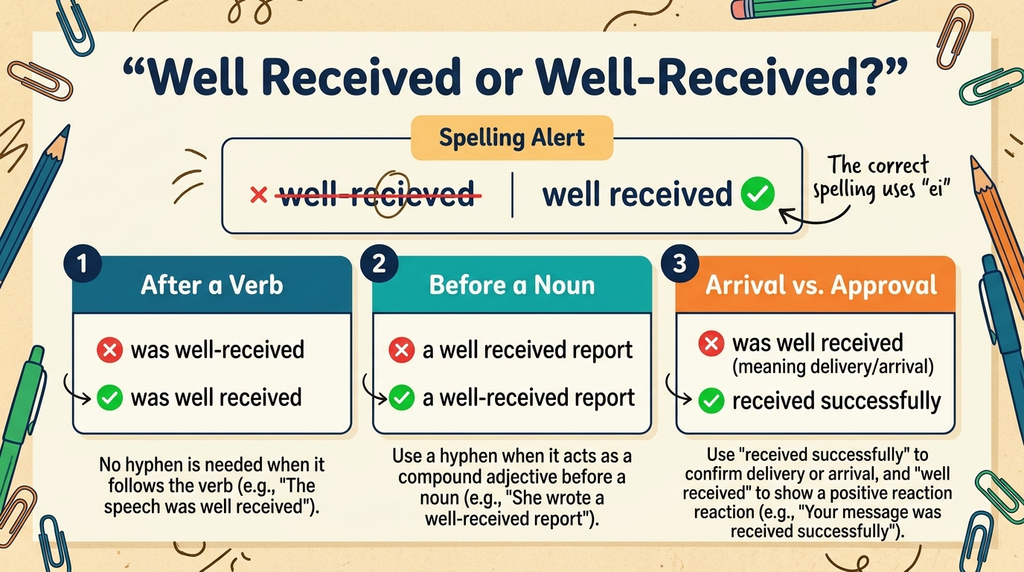
Well-recieved, well recieved, and well reveived are misspellings. The word received follows the familiar spelling pattern in which i comes before e after c.
Incorrect: “The proposal was well recieved.”
Correct: “The proposal was well received.”
2. Forgetting the hyphen before a noun
When the phrase directly modifies a noun, a hyphen is generally preferred.
- Before a noun: “It was a well-received presentation.”
- After a linking verb: “The presentation was well received.”
The hyphen helps readers recognize the two words as a single compound modifier. Other editorial styles may vary in some compounds, but this distinction is a reliable general rule.
3. Using “well received” when you only mean delivered
Well received usually communicates a favorable response, not merely successful delivery.
Ambiguous: “Your email was well received.”
Clearer if you mean delivery: “Your email was received successfully.”
Clearer if you mean acknowledgment: “I received your email and will review it shortly.”
4. Treating “well received” as proof of approval
A positive response does not necessarily indicate a formal decision.
For example, “The application was well received by the committee” does not necessarily mean the application was approved.
If a formal decision has been made, write approved, accepted, or rejected as appropriate.
5. Saying “well received email reply” without a clear relationship
The phrase well received email reply can be unclear because it does not show whether the reply itself was well received or whether it is a reply acknowledging receipt.
For a response confirming receipt, write:
“Thank you for your email. I confirm that I have received it.”
For a response describing a favorable reaction, write:
“Thank you for sharing your feedback. Your comments were well received by the team.”
6. Using an unnatural active construction
The sentence “The audience well received the presentation” is understandable, but many speakers find the following alternatives more natural:
- “The audience received the presentation well.”
- “The presentation was well received by the audience.”
The passive form is particularly convenient when the presentation, rather than the audience, is the focus.
FAQs
What does “well received” mean?
It means welcomed, accepted, or reacted to positively. It is often used to describe reactions to emails, ideas, speeches, presentations, proposals, performances, and products.
Is “well received” one word or two?
It is written as two words when used after a verb: “The report was well received.” When it appears before a noun as a compound adjective, it is generally hyphenated: “a well-received report.”
Is it “well received” or “well-received”?
Both forms are correct. Use well received in a construction such as “The film was well received.” Use well-received before a noun, as in “a well-received film.”
Is “well recieved” correct?
No. Recieved is a misspelling. The correct form is received. Therefore, write well received or well-received, depending on the sentence.
What is a synonym for “well received”?
Common alternatives include welcomed, appreciated, positively received, and favorably received. Praised is appropriate when people explicitly express approval, while accepted is more suitable when a decision has been made to agree to something.
What is the difference between “well received” and “received well”?
Both express a favorable reception. “The proposal was well received” is a common passive construction in professional writing. “The committee received the proposal well” is an active alternative.
How do you reply to an email with “well received”?
If you want to confirm receipt, a concise reply is usually best:
Thank you for your email. I have received it and will review the details shortly.
Best regards,
[Your Name]
If you want a very short acknowledgment, “Received, thank you” is also suitable. In formal correspondence, “I confirm receipt of your email” is more explicit.
What is a well-received email reply?
It can mean either a reply that the recipient responds to positively or, less precisely, a reply that confirms a message has arrived. To avoid ambiguity, use a positively received reply for a favorable reaction or an acknowledgment email for confirmation of receipt.
How do you respond when someone says “well received”?
The best response depends on the context.
- If they mean they have received your message, you can say, “Thank you for confirming.”
- If they mean your work was received positively, you can say, “Thank you for the feedback. I’m glad it was helpful.”
- If they are simply acknowledging receipt, no further response may be necessary.
What does “was it well received?” mean?
It asks whether people reacted positively to something.
Example: “Was the presentation well received?” means “Did the audience respond favorably to the presentation?”
Is “well received” positive or negative?
It is normally positive. The phrase communicates a favorable reception. A negative reaction is more naturally described as poorly received or not well received.
What does “receiving well” mean?
Receiving well is the continuous form of receive well. It can describe how a person or group is responding to something.
Example: “The community is receiving the new initiative well.”
However, the initiative is being well received is often more natural in formal writing.
What does “well delivered” mean?
Well delivered means presented, performed, communicated, or carried out effectively. For example, “The speech was well delivered” describes the speaker’s execution. “The speech was well received” describes the audience’s reaction. A speech can be well delivered without being well received, and vice versa.
What does “best received” mean?
Best received is the superlative form used when comparing reactions to multiple options or items.
Example: “Of the three proposals, the second was best received by the committee.”
The phrase identifies the option that attracted the most favorable response in the comparison. It does not necessarily mean that the option was formally approved or ultimately selected.
Is “well received” appropriate in formal writing?
Yes. It is widely used in professional, academic, journalistic, and administrative writing. When precision is important, specify who received something and what evidence supports the description.
What is the origin of “well received”?
The phrase combines the ordinary adverb well with the past participle received, from receive. Its meaning follows the established use of receive to describe how something is accepted or responded to. No specialized origin is necessary to explain its modern usage.
Summary
Well received means welcomed, accepted, or met with a favorable response. It is a versatile expression used to describe reactions to messages, proposals, presentations, products, performances, and other forms of communication.
Remember these essential distinctions:
- Well received: “The presentation was well received.”
- Well-received: “It was a well-received presentation.”
- Received successfully: The item arrived, without necessarily implying approval.
- Well regarded: Someone or something has a positive reputation.
- Well delivered: Something was presented or performed effectively.
For clear, natural writing, use well received when describing a favorable reaction, add a hyphen when it precedes a noun as a compound modifier, and choose a more precise expression when you mean delivery, acknowledgment, appreciation, or formal approval.