
Stay Gold Meaning: Definition, Usage, and What “Stay Golden” Really Means
Quick Meaning
“Stay gold” means to remain good, genuine, hopeful, innocent, or true to yourself, especially when life becomes difficult or changes you. It is an encouraging expression that tells someone to preserve the qualities that make them special.
The phrase is strongly associated with The Outsiders, where Johnny tells Ponyboy to “stay gold.” In that literary context, gold represents innocence, beauty, goodness, and the ability to appreciate meaningful things before hardship takes those qualities away.
In everyday English, stay gold is usually figurative rather than literal. Someone saying “Stay gold” is not normally talking about the metal gold. They are expressing something closer to:
- Keep your good heart.
- Stay genuine.
- Don’t let the world make you bitter.
- Hold on to your kindness and optimism.
- Remain the person you are at your best.
“Stay golden” has essentially the same meaning, although golden can sound slightly warmer, more poetic, or more expressive.

Definitions
1. Stay gold: remain good and genuine
The most common modern interpretation of stay gold is to remain a good, sincere, kind, or authentic person despite pressure or difficult experiences.
For example:
“You’ve been through a lot, but stay gold.”
Here, the speaker is encouraging the listener not to become cynical or lose their kindness.
This is especially common in sentimental messages, social-media captions, personal letters, graduation messages, and conversations about personal growth.
2. Stay gold: preserve innocence or youthful wonder
The expression can also refer to holding on to innocence, wonder, beauty, or an ability to see the good in life.
This sense is particularly important when stay gold is used as a literary reference to The Outsiders.
A person might say:
“She never lost her sense of wonder. She really stayed gold.”
The meaning is not simply “she remained nice.” It suggests that she preserved something precious about herself as she grew older.
3. Stay gold: don’t let hardship change your core character
Another useful interpretation is remain yourself even when circumstances become difficult.
In this sense, “gold” represents an inner quality that should be protected.
“The job may get stressful, but stay gold.”
The speaker means that the person should not allow stress, disappointment, or other people’s behavior to destroy their integrity.
4. Stay golden
Stay golden is a close equivalent of stay gold.
It can mean:
- remain positive
- remain kind
- keep your authentic personality
- preserve your good qualities
- continue to shine or do well
The difference is mostly stylistic. Stay gold has a stronger literary and cultural association, while stay golden can sound more naturally poetic or motivational in ordinary writing.

Part of Speech
Stay gold is best understood as a verb phrase, specifically an imperative construction.
The verb is stay, while gold functions as a subject complement after the linking verb.
Compare:
Stay calm.
Stay strong.
Stay kind.
Stay gold.
The grammatical structure is similar. Stay means “continue to be,” while the word following it describes the state or quality the person should maintain.
In stay gold, however, gold is highly figurative. It does not literally mean that a person should become made of gold.
What about “golden”?
In stay golden, golden is an adjective:
Stay golden.
Grammatically, this follows the same broad pattern as:
Stay positive.
Stay hopeful.
Stay honest.
The difference is that golden carries a broader range of associations, including goodness, success, beauty, warmth, and something especially valuable.
How “Stay Gold” Is Used
The expression is normally used as a direct encouragement.
It works particularly well when someone is going through change, pressure, disappointment, or uncertainty.
As encouragement
“Whatever happens next, stay gold.”
This tells someone to preserve their positive qualities.
As a farewell
“Take care, stay gold.”
Here, it functions almost like a warm personal blessing.
As a compliment
“You always make people feel welcome. Stay gold.”
The speaker is recognizing someone’s character and encouraging them not to lose it.
In captions
“Growing up without losing yourself. Stay gold.”
Social-media users often use the expression as a short statement about authenticity, personal growth, friendship, or nostalgia.
In sentimental writing
“Years may change our lives, but I hope you stay gold.”
This version emphasizes continuity of character.
As a literary reference
If someone says “Stay gold, Ponyboy,” the expression carries a much more specific meaning connected with The Outsiders.
That reference matters because readers familiar with the novel may understand more than the ordinary dictionary-style definition.

“Stay Gold” and The Outsiders
One of the most important meanings of stay gold comes from S. E. Hinton’s novel The Outsiders.
In the story, Johnny tells Ponyboy to “stay gold.” The phrase connects to Robert Frost’s poem “Nothing Gold Can Stay,” which Ponyboy has discussed earlier in the story.
Here, “gold” is associated with a fragile form of beauty, innocence, goodness, and purity. Johnny’s message is essentially a wish that Ponyboy will preserve those qualities even though he is growing up in a difficult environment.
What does Johnny mean by “stay gold, Ponyboy”?
Johnny means that Ponyboy should hold on to his goodness, sensitivity, innocence, and ability to appreciate beauty.
It is not simply “be happy.”
Johnny recognizes that Ponyboy is capable of seeing beauty and meaning in the world. His message encourages Ponyboy not to lose that part of himself as he experiences violence, grief, conflict, and adulthood.
This is why the phrase can feel much deeper than an ordinary motivational slogan.
What does “Nothing Gold Can Stay” mean?
Robert Frost’s “Nothing Gold Can Stay” explores the temporary nature of beauty and perfection.
The central idea is that beautiful or ideal moments do not last forever. Nature changes, innocence fades, and early forms of beauty eventually give way to something else.
In The Outsiders, that idea becomes part of Johnny’s message to Ponyboy.
Johnny cannot prevent change. Instead, he encourages Ponyboy to preserve his inner goodness even while change is unavoidable.
Is “stay gold” a quote from Robert Frost?
Not originally.
“Stay gold” is strongly associated with The Outsiders, while “Nothing Gold Can Stay” is the title and central phrase of Frost’s poem. Hinton’s novel connects the two ideas.
That distinction is important because the expressions are often treated as though they came from the same source.
“Stay Gold” vs. “Nothing Gold Can Stay”
These expressions are related, but they do different jobs.
| Expression | Basic idea |
|---|---|
| Stay gold | Preserve your goodness, innocence, beauty, or authenticity |
| Nothing Gold Can Stay | Beautiful or perfect things are temporary |
| Stay golden | Remain positive, admirable, warm, or true to yourself |
There is an interesting contrast between the first two.
“Nothing Gold Can Stay” emphasizes the fact that change and loss are unavoidable.
“Stay gold” turns that idea into encouragement: even if the world changes, try to preserve what is best within you.
Common Collocations
Because stay gold is a short phrase rather than a conventional vocabulary word, its collocations are somewhat flexible.
Common combinations include:
- stay gold, my friend
- stay gold forever
- always stay gold
- keep shining and stay gold
- stay gold, Ponyboy
- stay gold quote
- stay golden
- stay gold message
- stay gold attitude
- stay gold mentality
- stay gold spirit
Some combinations are more natural than others.
For example:
“Always stay gold.”
sounds natural as an inspirational message.
But:
“I stayed gold at the office.”
sounds unusual unless the writer is deliberately being poetic.
This difference illustrates an important point: stay gold is not a normal replacement for ordinary adjectives such as good, honest, or successful. Its figurative meaning depends heavily on context.
Examples of “Stay Gold”
Friendly
“No matter where life takes you, stay gold.”
Meaning: Don’t lose your good qualities.
Romantic
“You have such a beautiful heart. Stay gold.”
Meaning: Preserve the kindness and warmth that make you special.
Encouraging
“Things may be difficult right now, but stay gold.”
Meaning: Don’t allow hardship to change your character for the worse.
Nostalgic
“We may grow older, but I hope we always stay gold.”
Meaning: Preserve the friendship and qualities associated with your younger years.
Literary
“Johnny’s request that Ponyboy stay gold is about much more than simply being nice.”
Meaning: The phrase represents innocence, goodness, sensitivity, and an appreciation of beauty.
Social-media caption
“Growing, learning, changing—but still staying gold.”
Meaning: Personal growth does not have to mean losing your identity.

Pronunciation
Stay gold is pronounced naturally as two words, with the main stress falling on gold.
The phrase is straightforward for most English learners because both words are common.
The pronunciation is the same whether stay gold is being used literally or figuratively.
The phrase stay golden adds the adjective ending -en, creating a three-syllable expression.
Synonyms and Near-Synonyms
There is no single perfect synonym for stay gold because its meaning combines several ideas.
Depending on the context, these expressions may come close:
Stay true to yourself
This is probably the closest everyday equivalent when stay gold means preserving one’s identity.
“Stay true to yourself even when people pressure you to change.”
Stay kind
This works when the focus is specifically on kindness.
“The world can be difficult, but stay kind.”
However, stay kind is narrower than stay gold.
Stay genuine
This emphasizes authenticity.
“Don’t pretend to be someone else. Stay genuine.”
Keep your innocence
This is closer to the literary meaning associated with The Outsiders, although it can sound more specific and sometimes more childish.
Keep your light
This is a poetic near-synonym meaning to preserve one’s optimism or positive spirit.
Stay positive
This focuses on attitude rather than character.
Keep shining
This emphasizes confidence, optimism, or personal brilliance.
Remain true
This is more formal and can refer to principles, identity, or loyalty.
The key difference is that stay gold can combine kindness + authenticity + innocence + hope + beauty depending on context. That is why replacing it mechanically with one synonym can weaken its meaning.
“Stay Gold” vs. “Stay Golden”
These phrases overlap substantially.
Stay gold tends to feel:
- concise
- literary
- nostalgic
- symbolic
- emotionally intimate
Stay golden tends to feel:
- warm
- poetic
- motivational
- expressive
- slightly more conversational in some contexts
For example:
“Stay gold, my friend.”
has a compact, almost literary quality.
“Keep smiling and stay golden.”
sounds more like a general motivational message.
Neither is universally “more correct.” The choice depends on the tone you want.
“Stay Gold” vs. “Stay Good”
These are not identical.
Stay good usually means continue behaving well or remain morally good.
Stay gold can suggest something deeper: preserve a special quality that is valuable, genuine, beautiful, or innocent.
Compare:
“Stay good while I’m gone.”
This sounds like ordinary advice about behavior.
“Stay gold while I’m gone.”
This sounds emotional, personal, and symbolic.
“Stay Gold” vs. “Stay True to Yourself”
Stay true to yourself is clearer and more direct.
Stay gold is more figurative.
If your audience may not know the expression, “stay true to yourself” communicates the idea more immediately. If you want a poetic or literary effect, stay gold has more emotional texture.
“Stay Gold” vs. “Keep Shining”
These can overlap in inspirational writing, but they emphasize different things.
Keep shining often suggests confidence, success, positivity, or personal brilliance.
Stay gold more strongly suggests preserving something already valuable inside you.
Someone can “keep shining” by becoming more confident. Someone can “stay gold” by refusing to lose their kindness or authenticity.
“I Want Gold But the A Is Silent” Meaning
The phrase “I want gold but the A is silent” is a playful internet-style expression rather than a standard English idiom.
Its joke depends on the idea of removing or silencing a letter from a word to create another meaning. Because versions of this joke circulate in memes and social posts, the exact intended punchline can depend on the surrounding context.
It should therefore not be treated as a dictionary definition of stay gold.
If you encounter this wording online, look at the complete post or conversation before assigning it a specific meaning.
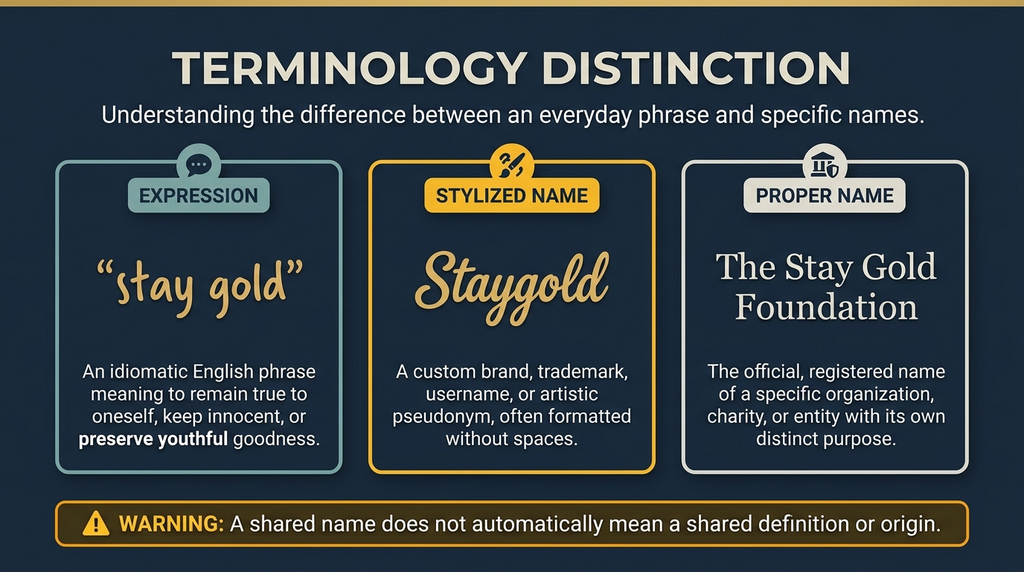
“Staygold” and “Stay Gold”
Staygold written as one word is usually a stylized form, username, brand name, project name, title, or compound branding rather than the standard grammatical form of the expression.
In ordinary English writing, use:
Stay gold.
not:
Staygold.
A company, organization, social account, or creative project may intentionally use Staygold as its proper name. That is a naming choice, not evidence that the standard phrase has changed spelling.
The Stay Gold Foundation
The Stay Gold Foundation should be treated as a proper name, not as another dictionary meaning of stay gold.
An organization using that name may draw on the positive associations of the phrase, but its specific mission, activities, and identity must be established from the organization itself.
This distinction matters for vocabulary research:
- stay gold = an English expression
- staygold = potentially a stylized name
- The Stay Gold Foundation = a proper organizational name
One should not assume that every organization, business, foundation, or project containing “Stay Gold” has the same meaning or origin.
Register and Regional Notes
Stay gold is generally informal to neutral in register, but it has a distinctly poetic and literary flavor.
It is comfortable in:
- personal messages
- social media
- captions
- inspirational writing
- friendship messages
- farewell messages
- literary discussion
- youth-oriented communication
It is less appropriate in highly technical or formal professional writing unless the phrase is being discussed or deliberately used for rhetorical effect.
For example:
“Please remain compliant with the applicable requirements.”
would be appropriate in a formal policy document.
“Please stay gold.”
would sound inappropriate unless the document intentionally uses an informal, motivational voice.
There is no major British-versus-American difference in the core meaning. The expression is widely understandable in English-speaking contexts, although its literary association with The Outsiders may be especially recognizable to people familiar with American literature and popular culture.
Common Mistakes
Mistake 1: Assuming “gold” is literal
In most uses, gold is metaphorical.
“Stay gold” does not normally mean “remain golden-colored.”
Mistake 2: Treating it as exactly the same as “stay good”
The expressions overlap, but stay gold has additional associations with authenticity, innocence, beauty, and preserving one’s best qualities.
Mistake 3: Assuming “stay golden” is a completely different expression
It usually isn’t. Stay golden is a close variation with substantially overlapping meaning.
Mistake 4: Assuming “stay gold” came from the Frost poem
The connection is real, but the distinction matters. “Nothing Gold Can Stay” is Frost’s poem, while “stay gold” became especially famous through The Outsiders and its use of Frost’s imagery.
Mistake 5: Capitalizing it automatically
In ordinary sentences, write:
I hope you stay gold.
Capitalize Stay Gold when it is part of a title, named work, brand, organization, or other proper name.
Mistake 6: Using it in every context where “remain good” would work
Because it is figurative and emotionally marked, it can sound unnatural in purely factual situations.
“The machine stayed gold during testing.”
This would normally sound confusing unless “gold” has a special technical or contextual meaning.
FAQs
What does “stay gold” mean?
Stay gold means to remain good, genuine, kind, hopeful, or true to yourself despite changes and difficulties. It can also suggest preserving innocence or a sense of wonder.
What does “stay golden” mean?
Stay golden generally means to remain positive, admirable, warm, genuine, or successful. It is closely related to stay gold but can sound slightly more poetic or motivational.
What does Johnny mean by “stay gold, Ponyboy”?
Johnny is encouraging Ponyboy to preserve his goodness, innocence, sensitivity, and ability to appreciate beauty even as he experiences hardship and grows older.
What does “Nothing Gold Can Stay” mean?
It expresses the idea that beautiful, perfect, or innocent states are temporary. In The Outsiders, this idea becomes closely connected with Johnny’s wish that Ponyboy preserve his inner goodness.
Is “stay gold” a compliment?
It can be. When someone tells you “stay gold,” they are often complimenting your character while encouraging you not to lose the qualities they admire.
Can I say “stay gold” to a friend?
Yes. It is especially natural in a warm, sentimental, encouraging, or farewell message.
For example:
“Thanks for always being there. Stay gold, my friend.”
Is “stay gold” grammatically correct?
Yes. It is an imperative verb phrase. Stay functions as a linking verb, while gold functions as a complement describing the state the person is encouraged to remain in.
Is “stay golden” grammatically correct?
Yes. Golden is an adjective, and the construction follows the same basic pattern as “stay calm,” “stay strong,” or “stay positive.”
What is the meaning of “stay gold” in Hindi?
Depending on context, stay gold can be expressed in Hindi as “अच्छे और सच्चे बने रहो,” “अपनी अच्छाई बनाए रखो,” or “जैसे हो, वैसे ही अच्छे बने रहो।”
There is no single Hindi translation that captures every shade of the English phrase. In a literary context, it may also carry the idea of preserving मासूमियत, अच्छाई, और दिल की सच्चाई.
Is “stay gold” romantic?
It can be romantic, but it is not inherently romantic. It can be used between partners, friends, family members, or anyone offering heartfelt encouragement.
What is the difference between “stay gold” and “keep shining”?
Stay gold emphasizes preserving one’s inner goodness or authenticity. Keep shining more often emphasizes continuing to be confident, positive, successful, or inspirational.
What is the difference between “stay gold” and “stay true”?
Stay true means remain loyal to your values, identity, or principles. Stay gold is broader and more poetic, potentially including goodness, innocence, kindness, beauty, and authenticity.
Does “stay gold” mean “never change”?
Not exactly. The expression does not necessarily oppose personal growth. It usually means that while you change and mature, you should preserve the qualities that make you genuinely good.
Can “stay gold” be used professionally?
It can be used in an informal workplace message, but it is not ideal for formal business, legal, academic, or technical writing unless a deliberately personal tone is intended.
Summary
Stay gold is a figurative English expression meaning remain good, genuine, hopeful, kind, or true to yourself, especially when life becomes difficult or changes you.
Its most famous literary association comes from The Outsiders, where Johnny tells Ponyboy to “stay gold.” The phrase connects to Robert Frost’s “Nothing Gold Can Stay,” giving it additional associations with innocence, beauty, youth, and the temporary nature of ideal things.
In everyday use, stay gold can function as an affectionate encouragement, farewell, compliment, or motivational message. Stay golden is a close variation with a similar meaning.
The most important distinction is that gold is symbolic in this expression. It represents something precious within a person—not simply wealth, color, or the physical metal.
If someone tells you “stay gold,” the simplest interpretation is:
Keep the best parts of yourself, even when life gives you reasons to lose them.