Choose or Chose: What Is the Difference?
Quick Answer
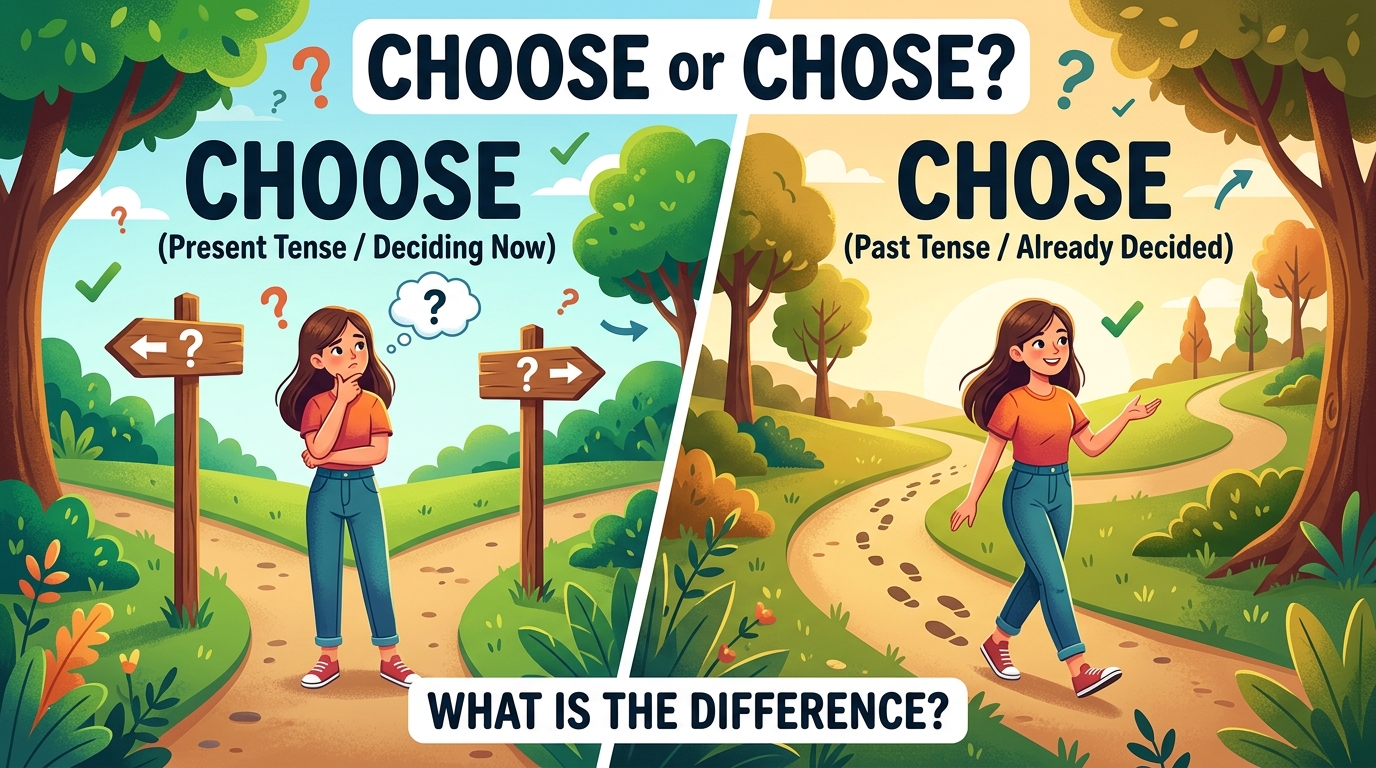
Choose and chose are two forms of the same verb, but they are used at different times.
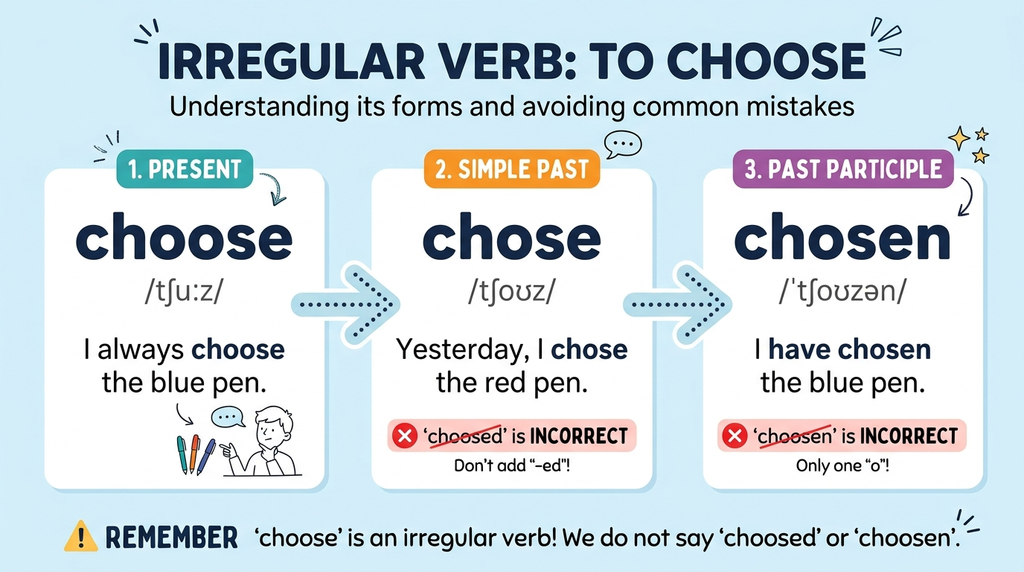
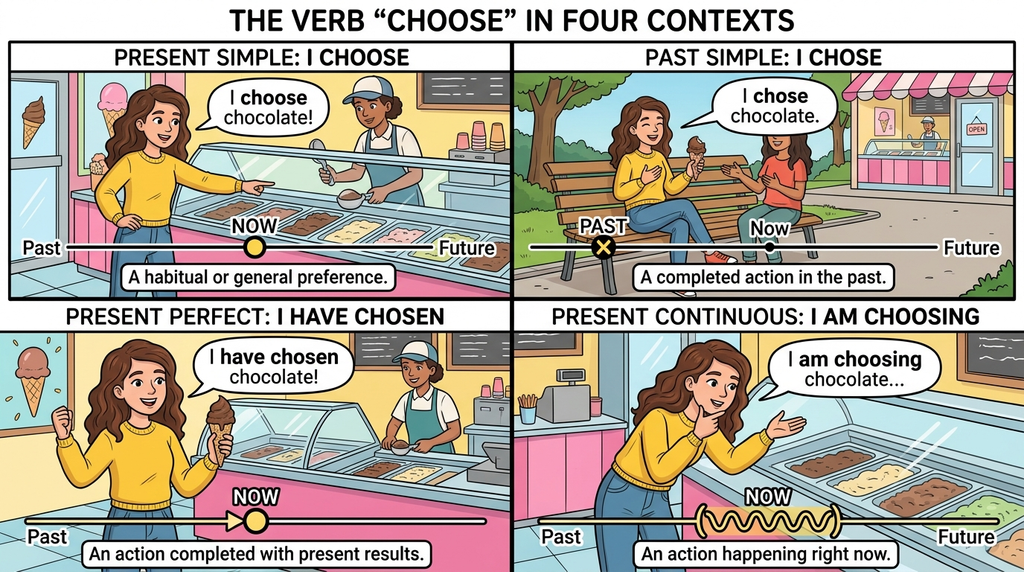
- Choose is the present-tense form: I choose the blue shirt.
- Chose is the simple past form: I chose the blue shirt yesterday.
- Chosen is the past participle: I have chosen the blue shirt.
So, choose = present, chose = past, and chosen = past participle.
The spelling can be confusing because choose and chose look similar but are pronounced differently. Choose rhymes with shoes, while chose rhymes with goes.
The incorrect form choosed is not standard English. Likewise, choosen is incorrect; the correct past participle is chosen.
At-a-Glance Table
| Form | Grammar | Main use | Example |
|---|---|---|---|
| choose | Present/base form | Present choices, general actions, infinitives | I choose tea every morning. |
| chooses | Third-person singular present | He, she, it | She chooses carefully. |
| chose | Simple past | A completed choice in the past | She chose tea yesterday. |
| chosen | Past participle | Perfect tenses and passive constructions | She has chosen tea. |
| choosing | Present participle/gerund | Ongoing action or noun-like use | He is choosing a gift. |
The central distinction is therefore grammatical rather than a difference in meaning. Choose, chose, and chosen all relate to making a decision or selecting something. The form changes according to the grammatical construction and time being expressed.
Choose vs. Chose: The Detailed Difference
What Does “Choose” Mean?
Choose means to decide which person, thing, option, or course of action you want from two or more possibilities.
It is the base form of the verb and is also used for the present tense.
For example:
I usually choose the window seat.
This describes a regular or current preference. It does not tell us that the choice happened at a particular completed point in the past.
Choose is also required after modal verbs and in infinitives:
- I choose carefully.
- She will choose tomorrow.
- You should choose wisely.
- They might choose the cheaper option.
- He wants to choose his own schedule.
Notice that forms such as will chose and should chose are incorrect because modal verbs are followed by the base form choose.
What Does “Chose” Mean?
Chose is the simple past form of choose.
Use it when the act of choosing happened in the past and is being presented as a completed event.
- I chose the red jacket yesterday.
- We chose a different restaurant last night.
- She chose to remain silent.
- They chose the smaller apartment in June.
The important point is not simply that the sentence contains a past-time expression. Chose is used because the choosing itself is presented as a completed past event.
Compare:
I choose the red jacket every winter.
This describes a repeated or habitual action.
I chose the red jacket yesterday.
This describes one completed choice in the past.
What About “Chosen”?
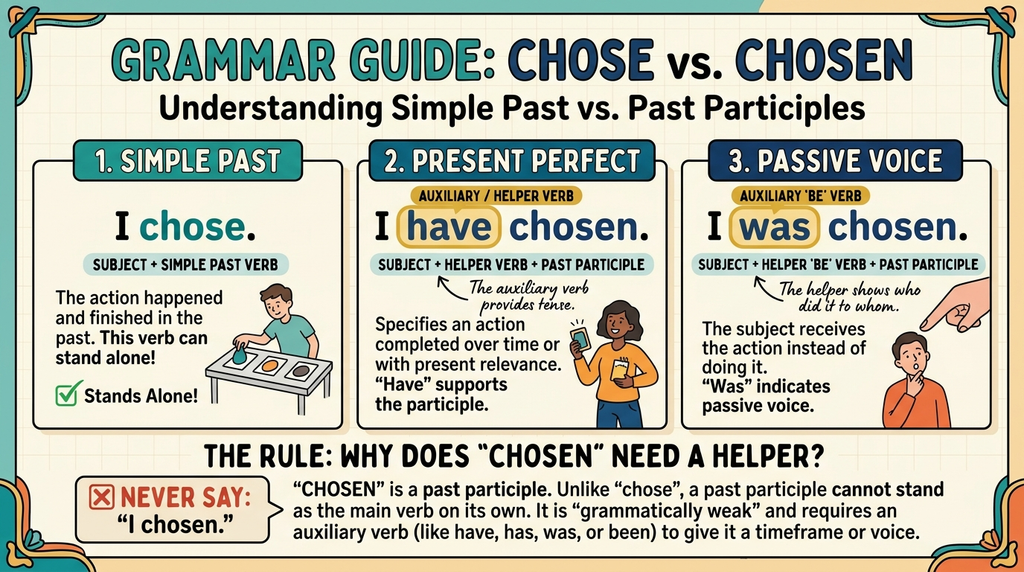
Chosen is not interchangeable with chose.
It is the past participle of choose, so it normally appears with an auxiliary verb such as have, has, or had, or in a passive construction with be.
- I have chosen a new laptop.
- She had chosen her university before the deadline.
- They have chosen three finalists.
- He was chosen for the position.
You cannot normally say:
I chosen the blue one yesterday.
The correct form is:
I chose the blue one yesterday.
Likewise:
I have chose the blue one.
is incorrect.
The correct sentence is:
I have chosen the blue one.
Choose, Choses, Chose, Chosen, and Choosing
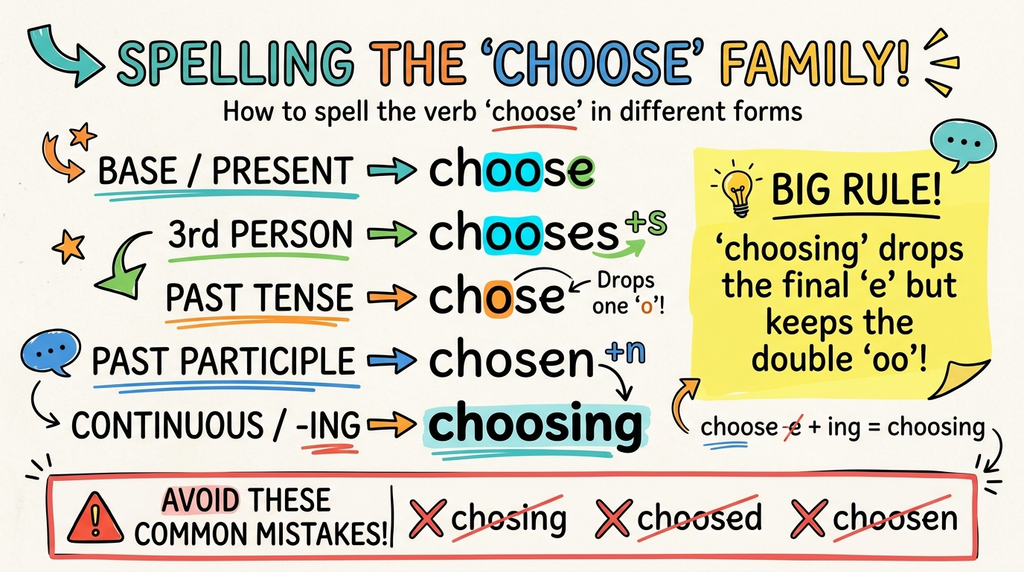
A useful way to understand the entire verb family is to see all its main forms together.
Choose
Choose is the base form and present form used with I, you, we, and they.
- I choose the music.
- You choose the destination.
- We choose our seats online.
- They choose carefully.
It is also the form used after to in an infinitive:
- I want to choose.
- She needs to choose.
- They agreed to choose later.
Chooses
Chooses is the third-person singular present form, used with he, she, it, or a singular noun.
- He chooses his words carefully.
- Maria chooses the healthiest option.
- The customer chooses a delivery time.
A common spelling mistake is choses.
She choses the blue dress.
This is incorrect.
She chooses the blue dress.
This is correct.
The -s in chooses is pronounced as a separate syllable: roughly CHOO-ziz.
Chose
Chose is the simple past form.
- I chose the earlier train.
- She chose a different approach.
- We chose not to respond.
It is used with all subjects:
- I chose
- you chose
- he chose
- she chose
- we chose
- they chose
Unlike the present tense, there is no -s variation in the simple past.
Chosen
Chosen is the past participle.
- I have chosen.
- She has chosen.
- They had chosen.
- He was chosen.
The form remains chosen, not choosed or choosen.
Choosing
Choosing is the present participle and gerund form.
- She is choosing a dress.
- They are choosing between two plans.
- Choosing the right tool can save time.
The correct spelling is choosing, with the final e of choose removed before -ing.
choose → choosing
Not:
chosing
The spelling chosing is incorrect in standard English.
When to Use Choose
Use choose when the grammar calls for the base or present form.
For present habits and repeated decisions
- I choose fruit instead of dessert most days.
- We usually choose the quietest table.
- They choose different routes depending on traffic.
After modal verbs
After can, could, may, might, must, should, will, would, and similar modal verbs, use choose, not chose.
- You should choose one option.
- We can choose later.
- She will choose tomorrow.
- They might choose the larger room.
Not:
She will chose tomorrow.
Correct:
She will choose tomorrow.
After “to”
The infinitive uses to choose.
- I need to choose soon.
- He decided to choose the safer route.
- We hope to choose a date this week.
In general statements
- Everyone has the right to choose.
- People often choose what feels familiar.
- Consumers choose products for many different reasons.
When to Use Chose
Use chose when the choice itself occurred in the simple past.
With finished past events
- I chose the black shoes yesterday.
- She chose the final design last Friday.
- We chose that hotel during our trip.
With past-time expressions
Words and phrases such as yesterday, last week, last year, two days ago, in 2024, earlier that morning, and similar expressions often signal a completed past event.
- They chose the venue last month.
- He chose that answer two minutes ago.
- I chose the blue folder earlier.
The time expression itself does not mechanically determine the verb. Rather, it helps establish the sentence’s time frame.
In past storytelling
- She looked at both options and chose the simpler one.
- He considered leaving but chose to stay.
- We discussed several possibilities before we chose a final plan.
When to Use Chosen
Use chosen when the sentence requires a past participle.
Present perfect
Use has/have + chosen.
- I have chosen my seat.
- She has chosen a new career path.
- We have chosen three candidates.
Past perfect
Use had + chosen.
- By noon, they had chosen a winner.
- She had already chosen her topic before class began.
Passive voice
Use a form of be + chosen.
- She was chosen for the scholarship.
- The finalists were chosen by the panel.
- He has been chosen as team captain.
This is why chose and chosen cannot simply replace each other.
Examples by Context
Everyday decisions
Present:
I choose coffee when I need to stay focused.
Past:
I chose coffee this morning.
Perfect:
I have chosen coffee every morning this week.
These sentences differ in grammatical structure and time perspective, even though they describe the same general act of selecting coffee.
Food and restaurants
- We usually choose a table outside.
- We chose the vegetarian menu last night.
- They have chosen their meals already.
- She is choosing a dessert.
Education
- Students choose their subjects before the new term.
- He chose mathematics as his major.
- She has chosen a research topic.
- They are choosing between two courses.
Work and business
- Managers choose strategies based on available information.
- The company chose a new supplier last year.
- The board has chosen a new chairperson.
- The team is choosing between two proposals.
Relationships and personal decisions
- People choose relationships for many different reasons.
- She chose to forgive him.
- He has chosen to move forward.
- They are choosing what matters most to them.
Technology
- Users choose their privacy settings.
- I chose the annual subscription.
- She has chosen a different device.
- We are choosing between two software options.
Choose or Chose in Questions
Questions often cause confusion because auxiliary verbs can change which form you need.
Present questions
Use do/does + choose.
- Do you choose your meals in advance?
- Does she choose the final design?
- Why do they choose that route?
Not:
Did you chose the blue one?
Past questions
Use did + choose, not did + chose.
- Did you choose the blue one?
- Did she choose the earlier flight?
- Why did they choose that option?
This is one of the most important rules to remember.
The past tense is already expressed by did, so the main verb returns to its base form:
Did + choose
not:
Did + chose
Compare:
She chose the blue one.
but:
Did she choose the blue one?
Negative past sentences
The same principle applies with did not.
I did not choose that option.
Not:
I did not chose that option.
The auxiliary did carries the past tense.
Choose vs. Chose Pronunciation
The pronunciation difference is important because the spelling alone does not make the distinction obvious.
Choose
Choose is pronounced approximately /tʃuːz/.
It rhymes with words such as:
- shoes
- blues
- news
The vowel sound is the long oo sound.
Chose
Chose is pronounced approximately /tʃoʊz/ in standard American English.
It rhymes closely with:
- goes
- knows
- shows
The vowel sound is different from the one in choose.
Chosen
Chosen is approximately /ˈtʃoʊzən/ in American English.
The first syllable sounds like chose, followed by an unstressed second syllable.
Pronunciation can therefore provide a useful memory aid:
choose → sounds like shoes
chose → sounds like goes
British English uses different phonetic details for some vowel sounds, but the fundamental distinction between choose and chose remains.
Common Mistakes
“Choosed” instead of “Chose”
Choosed is not the standard past tense of choose.
Incorrect:
I choosed the cheaper option.
Correct:
I chose the cheaper option.
“Choosen” instead of “Chosen”
Choosen is also incorrect.
Incorrect:
She has choosen the winner.
Correct:
She has chosen the winner.
“Did chose” instead of “Did choose”
Incorrect:
Did you chose this one?
Correct:
Did you choose this one?
Because did already marks the past tense, the main verb uses the base form.
“Will chose” instead of “Will choose”
Incorrect:
We will chose tomorrow.
Correct:
We will choose tomorrow.
Modal verbs such as will require the base form.
“To chose” instead of “To choose”
Incorrect:
I need to chose a topic.
Correct:
I need to choose a topic.
The infinitive uses to choose.
“Choses” instead of “Chooses”
Incorrect:
She choses the best option.
Correct:
She chooses the best option.
The third-person singular present form is chooses.
“Chosing” instead of “Choosing”
Incorrect:
We are chosing a new name.
Correct:
We are choosing a new name.
The correct spelling is choosing.

A Fast Decision Rule
When you are unsure whether to write choose or chose, ask:
Is the choosing happening now, regularly, or in a construction that requires the base verb?
Use choose.
Did the choosing happen as a completed event in the past?
Use chose.
Does the sentence contain have, has, had, or a passive construction requiring a past participle?
Use chosen.
For example:
I choose the blue one.
Present.
I chose the blue one yesterday.
Simple past.
I have chosen the blue one.
Present perfect.
I was chosen for the position.
Passive construction.
A Practical Proofreading Test
If you’re editing your own sentence, look at the words immediately before the verb.
If you see “did”
Use choose:
Did you choose?
If you see “will,” “can,” “should,” or another modal
Use choose:
She will choose.
If you see “to”
Usually use choose:
We decided to choose.
If you see “have,” “has,” or “had”
Use chosen:
They have chosen.
If the sentence simply describes a completed past choice
Use chose:
They chose yesterday.
This test is particularly useful because many errors occur when writers focus on the meaning of the verb but overlook the grammatical structure surrounding it.
“I Choose” or “I Chose”?
Both can be correct, but they communicate different time relationships.
I choose means that the choice is present, habitual, general, or otherwise expressed in the present.
I choose the vegetarian option whenever I eat here.
I chose means that the choice happened in the past.
I chose the vegetarian option when I visited yesterday.
Compare:
I choose to work from home on Fridays.
This describes a regular decision.
I chose to work from home last Friday.
This describes a specific past decision.
The same distinction applies to we choose/we chose, they choose/they chose, and other subjects.
“Choose or Chosen?”
This is a different question from choose or chose.
Use choose as the base/present form:
I need to choose.
Use chosen as a past participle:
I have chosen.
The word chosen cannot normally stand alone as the simple past.
Incorrect:
Yesterday, I chosen the red one.
Correct:
Yesterday, I chose the red one.
But:
I have chosen the red one.
is correct.
“Chose or Chosen?”
Use chose for simple past:
She chose the blue dress.
Use chosen with perfect constructions or passive structures:
She has chosen the blue dress.
She was chosen for the role.
A useful test is to ask whether an auxiliary is doing grammatical work.
If you have has/have/had, you generally need chosen.
If you are simply describing a completed past action without that auxiliary, chose is normally correct.
Formal, Casual, British, and American Usage
There is no major British-versus-American difference in the basic forms choose, chose, chosen, chooses, and choosing.
Both major varieties of English use the same standard verb forms.
Differences may appear in pronunciation, particularly in the vowel sounds associated with chose, but not in the fundamental grammar.
The words are also neutral in register. Choose and chose are perfectly natural in casual conversation, professional writing, academic prose, journalism, and formal communication.
For example:
- Casual: I chose the blue one.
- Professional: The committee chose the final proposal.
- Academic: Participants chose one of four responses.
- Formal: The panel has chosen a new chair.
There is no need to replace these forms with more formal alternatives merely because the writing is professional.
Why “Choose” and “Chose” Are Easy to Confuse
The forms are visually similar, but English does not form the past tense simply by adding -ed here.
The verb is irregular:
choose → chose → chosen
This is why choosed is not correct.
The spelling also creates a pronunciation trap. The oo in choose represents a different vowel sound from the o in chose.
Learning the entire family together is more effective than memorizing isolated spellings.
Memory Trick
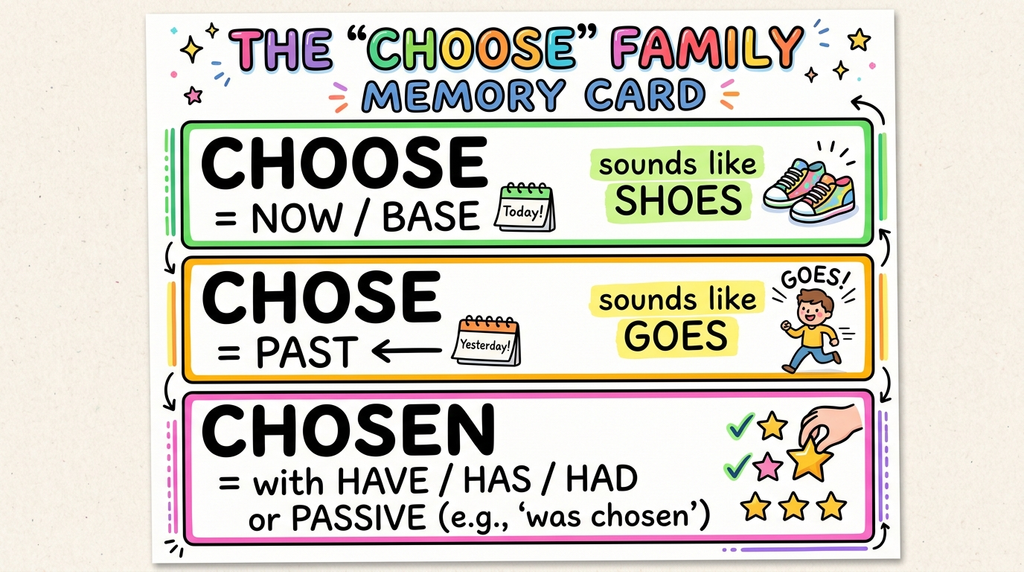
A simple way to remember the forms is:
Choose = shoes
Both have the long oo sound.
Chose = goes
Both have the long o sound in common standard pronunciations.
Then remember the grammar:
choose → present/base
chose → past
chosen → have/has/had or passive
You can also remember the sequence as:
Today: choose → Yesterday: chose → Already selected: chosen
This is not a complete grammar rule by itself, but it is an effective learning shortcut.
FAQs
Is “choosed” a word?
Choosed is not the standard simple past form of choose. The correct past form is chose.
I chose the blue option.
Is “choosen” correct spelling?
No. Choosen is an incorrect spelling. The correct past participle is chosen.
She has chosen a new topic.
What is the difference between choose and chose?
Choose is the base/present form, while chose is the simple past form.
I choose carefully.
I chose carefully yesterday.
What is the difference between chose and chosen?
Chose is simple past. Chosen is the past participle.
She chose the winner.
She has chosen the winner.
Do you say “I choose” or “I chose”?
Either can be correct depending on the intended time.
I choose tea every morning.
I chose tea this morning.
Is it “did choose” or “did chose”?
It is did choose.
Did you choose this option?
The auxiliary did carries the past tense.
Is it “will choose” or “will chose”?
It is will choose.
We will choose tomorrow.
A modal verb such as will takes the base form.
How do you spell “choose”?
The correct spelling is choose: c-h-o-o-s-e.
How do you spell “chose”?
The correct spelling is chose: c-h-o-s-e.
How do you spell “choosing”?
The correct spelling is choosing: c-h-o-o-s-i-n-g.
The spelling chosing is incorrect.
Is “choses” correct?
Choses is incorrect when you mean the third-person singular form of choose. The correct spelling is chooses.
She chooses carefully.
Is “choose” pronounced like “chose”?
No. Choose and chose have different vowel sounds.
Choose is approximately /tʃuːz/, while chose is approximately /tʃoʊz/ in American English.
Can “chosen” be used without “have,” “has,” or “had”?
Yes, especially in passive constructions.
She was chosen as captain.
So the useful rule is not “chosen always needs have/has/had.” Rather, chosen is a past participle that can appear in perfect constructions or passive structures.
What is the correct verb sequence: choose, chose, or chosen?
The standard principal forms are:
choose — chose — chosen
The related forms include chooses and choosing.
Final Takeaway
The difference between choose and chose is mainly grammatical:
- Choose = base/present form
I choose the blue one. - Chooses = third-person singular present
She chooses the blue one. - Chose = simple past
She chose the blue one yesterday. - Chosen = past participle
She has chosen the blue one. - Choosing = present participle/gerund
She is choosing the blue one.
Never use choosed as the standard past tense, and do not confuse chosen with the simple past.
For a quick proofreading decision, remember:
choose now, chose before, chosen with a helping verb or passive structure.
And for spelling and pronunciation:
choose sounds like shoes, while chose sounds like goes.