If There Is Any vs If There Are Any: What’s the Difference?
Quick Answer
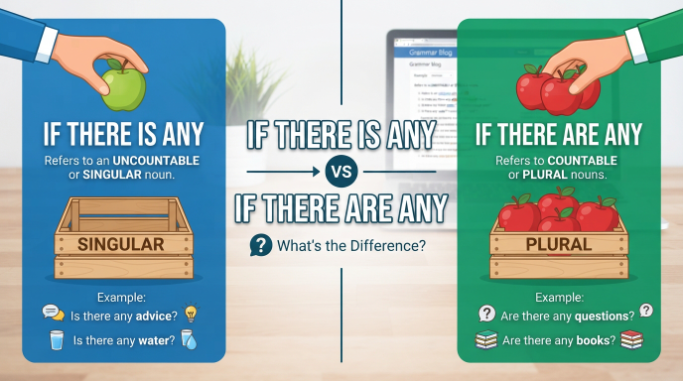
“If there is any” and “if there are any” are both correct, but they are used with different kinds of nouns.
- Use “if there is any” with an uncountable noun or with a singular noun when the meaning calls for singular agreement.
- Let me know if there is any confusion.
- Check if there is any water left.
- Use “if there are any” with plural countable nouns.
- Let me know if there are any questions.
- Check if there are any errors in the report.
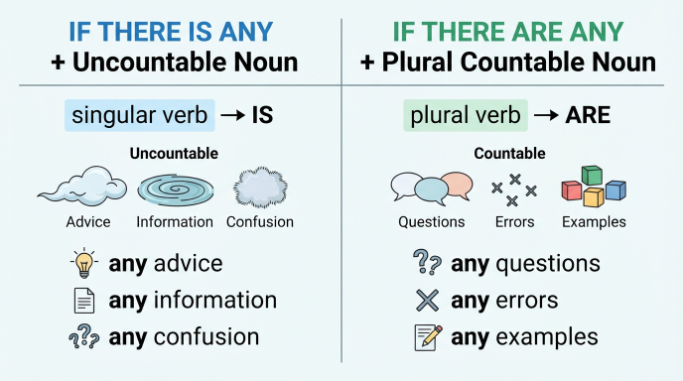
The easiest test is to look at the noun after any. If it is something you normally count as individual items—questions, problems, mistakes, examples—use there are. If it is uncountable—information, advice, confusion, water—use there is.
At-a-Glance Table
| Expression | Use it with | Example | Why |
|---|---|---|---|
| if there is any | Uncountable nouns | Tell me if there is any information missing. | “Information” is uncountable |
| if there are any | Plural countable nouns | Tell me if there are any errors. | “Errors” is plural and countable |
| if there is a/an | Singular countable nouns | Tell me if there is a problem. | “Problem” is singular |
| if there are no | Plural countable nouns | Tell me if there are no available seats. | “Seats” is plural |
| if there is no | Singular or uncountable nouns | Tell me if there is no evidence. | “Evidence” is normally uncountable |
| if any | Concise phrase when the noun is understood | Contact me if any arise. | The omitted noun is understood from context |
The important point is that “any” does not determine whether the verb should be singular or plural. The noun does.
The Detailed Difference
“If there is any”
“If there is any” uses the singular form there is. It commonly appears before an uncountable noun.
Uncountable nouns refer to things that are generally treated as a substance, concept, category, or mass rather than as separate individual units.
Examples include:
- information
- advice
- help
- confusion
- evidence
- damage
- traffic
- furniture
- equipment
- water
- time
- money
So these sentences are natural:
Please tell me if there is any additional information.
Let me know if there is any confusion.
Check whether there is any damage to the package.
You would not normally say “there are any information” or “there are any advice” in standard English because information and advice are not normally plural countable nouns.
“If there are any”
“If there are any” uses the plural form there are. It is normally followed by a plural countable noun.
Examples:
Let me know if there are any questions.
Check whether there are any mistakes.
Tell us if there are any changes to the schedule.
Here, questions, mistakes, and changes are all things that can be counted individually:
- one question → two questions
- one mistake → two mistakes
- one change → two changes
Therefore, there are agrees with the plural noun.
Why “Any” Does Not Decide the Verb
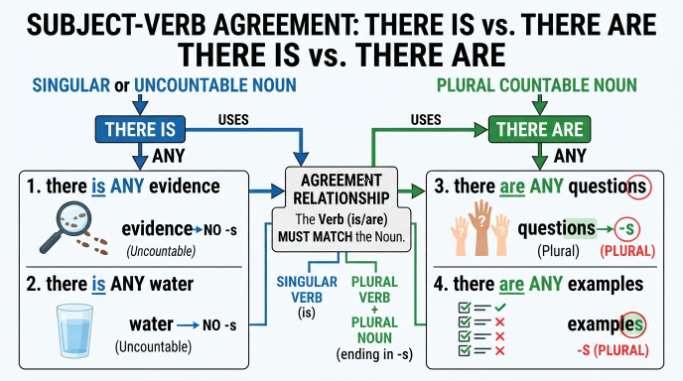
A common mistake is to think that any means “more than one,” so it must require are.
That is not how English grammar works.
Any can occur with both uncountable nouns and plural countable nouns:
- any water
- any information
- any advice
- any questions
- any problems
- any examples
Compare:
Is there any water in the bottle?
Are there any bottles in the cupboard?
The difference comes from water versus bottles, not from any.
This is why both expressions are grammatical:
If there is any information you need, let me know.
If there are any questions, let me know.
When to Use “If There Is Any”
Use “if there is any” when the noun that follows is normally uncountable.
Information
Correct:
Please contact me if there is any additional information.
Not standard:
Please contact me if there are any additional information.
If you want to count individual pieces of information, you can change the noun:
Let me know if there are any additional details.
Advice
Correct:
Tell me if there is any advice you would like to add.
For individual pieces, English commonly uses pieces of advice:
Let me know if there are any additional pieces of advice.
Help
Ask me if there is any help you need.
More naturally in many contexts:
Let me know if there is anything I can help with.
Confusion
Tell me if there is any confusion about the instructions.
Evidence
The investigators checked whether there was any evidence of damage.
Evidence is normally treated as an uncountable noun in standard English.
Time
Let me know if there is any time available this afternoon.
Money
Check if there is any money left in the account.
The noun determines the construction.
When to Use “If There Are Any”
Use “if there are any” when the following noun is plural and countable.
Questions
Please ask if there are any questions.
Problems
Tell the technician if there are any problems with the device.
Errors
Check if there are any errors before submitting the document.
Examples
Let me know if there are any examples that you would like me to explain.
Differences
See if there are any differences between the two versions.
Changes
Please tell me if there are any changes to the schedule.
Alternatives
Let me know if there are any alternatives.
All of these nouns can be counted, so the plural verb are is appropriate.
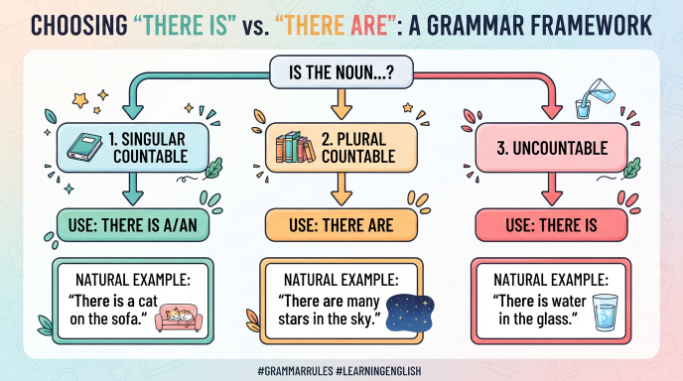
A Third Pattern: “If There Is a” and “If There Are”
The distinction becomes clearer if you compare any with a/an.
With a singular countable noun:
If there is a problem, call me.
With a plural countable noun:
If there are any problems, call me.
With an uncountable noun:
If there is any trouble, call me.
Notice that problem is singular in the first sentence, problems is plural in the second, and trouble is uncountable in the third.
The underlying rule is therefore broader than the phrase “if there is any vs if there are any.”
It is really about number and countability.
Examples by Context
In emails and workplace communication
Both forms are common in professional writing.
Please let me know if there is any additional information required.
Please let me know if there are any questions about the proposal.
Tell me if there is any confusion regarding the deadline.
Let me know if there are any concerns before we proceed.
In workplace English, these constructions are useful because they make requests sound open rather than assuming that a problem exists.
In customer service
Please contact us if there is any problem with your order.
Please contact us if there are any problems with the delivery.
Both can be correct. The choice depends on whether you are talking about a problem as a general possibility or multiple possible problems.
In academic writing
The researcher should report if there is any evidence supporting the claim.
The researcher should report if there are any significant differences between the groups.
The paper should acknowledge if there is any uncertainty in the data.
The discussion should explain if there are any limitations.
In everyday conversation
Let me know if there is any food left.
Let me know if there are any sandwiches left.
The first uses an uncountable noun, while the second uses a plural countable noun.
With questions
This is one of the most common contexts:
Let me know if there are any questions.
Because questions is plural, are is required.
However:
Let me know if there is any confusion.
Because confusion is uncountable, is is appropriate.
With examples
Let me know if there are any examples you want to discuss.
But:
Let me know if there is any evidence for that interpretation.
The distinction remains consistent even when the sentences become longer.

“If There Is Any” Can Also Appear With Singular Countable Nouns in Certain Structures
There is an important nuance here.
The simple rule “there is any + uncountable noun” is useful, but it is not the whole story.
In some structures, any can modify a singular countable noun, particularly when the meaning is close to “any one” or when the noun is being considered as a possible instance.
For example:
If there is any person who can solve this problem, it is Maya.
Here, person is singular and countable, and there is any person is grammatical, although this wording is more formal or literary than everyday conversation.
A more natural everyday version might be:
If there is anyone who can solve this problem, it is Maya.
Similarly:
If there is any chance of rain, we should postpone the event.
Here chance is singular and countable.
You could also say:
If there are any chances of rain…
but that changes the meaning and is generally less natural when referring to the possibility of rain as a general condition.
So the practical rule should be:
“There is” agrees with a singular or uncountable noun; “there are” agrees with a plural noun.
That is more accurate than treating any itself as the deciding factor.
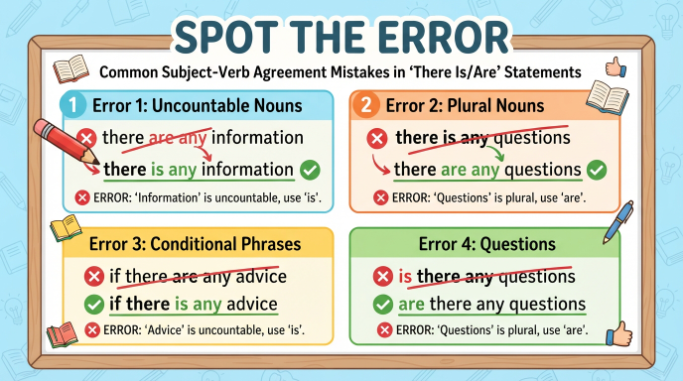
Common Mistakes
Mistake 1: “If there are any information”
Incorrect:
Let me know if there are any information.
Correct:
Let me know if there is any information.
Information is normally uncountable.
If you want a plural countable noun, use:
Let me know if there are any details.
Mistake 2: “If there is any questions”
Incorrect:
Tell me if there is any questions.
Correct:
Tell me if there are any questions.
Questions is a plural countable noun.
Mistake 3: Thinking “any” always requires “are”
Incorrect reasoning:
“Any” means multiple things, so I should use “are.”
The problem is that any also works with uncountable nouns:
any water
any advice
any information
Therefore:
if there is any water
is correct.
Mistake 4: Using “there” as though it were the subject
In existential constructions, there introduces the existence of something. The following noun determines the grammatical number:
There is a problem.
There are problems.
There is some information.
There are several pieces of information.
This is why the noun matters so much.
Mistake 5: Confusing “if there is any” with “is there any”
These constructions have different grammatical jobs.
Is there any coffee left?
This is a question.
Let me know if there is any coffee left.
This is a conditional clause embedded in a larger sentence.
Both can refer to the same situation, but their word order differs.
“If There Any” and “If Theres”: Why They Are Different
Searches such as “if there any,” “if theres,” and “if there’s” often arise from informal typing or uncertainty about contractions.
“If there any”
“If there any” is generally incomplete when there is intended to introduce an existential construction.
You normally need a verb:
If there is any problem, let me know.
If there are any problems, let me know.
In casual speech, contractions can change the surface form:
If there’s any problem, let me know.
But you still have the verb is in contracted form.
“If theres”
“Theres” without an apostrophe is not the standard spelling of the contraction.
Correct:
there’s
Incorrect in standard writing:
theres
There’s can mean there is:
There’s a problem.
There’s some information missing.
When used in an if-clause:
If there’s any problem, call me.
This is the contracted form of:
If there is any problem, call me.
“If there’s any” vs “if there are any”
Both can be correct:
If there’s any confusion, ask me.
If there are any questions, ask me.
The first uses there’s = there is with uncountable confusion. The second uses there are with plural questions.
“Is There Any” vs “Are There Any”
These are the question forms corresponding to the same noun distinction.
Use “Is there any…?” with an uncountable noun or a singular noun:
Is there any water left?
Is there any information available?
Is there a problem?
Use “Are there any…?” with plural countable nouns:
Are there any questions?
Are there any seats available?
Are there any examples of this usage?
This explains searches such as “is there any difference” and “are there any examples.”
Correct:
Is there any difference between these sentences?
Because difference is singular.
Correct:
Are there any differences between these sentences?
Because differences is plural.
Correct:
Are there any examples that illustrate the rule?
Because examples is plural.

“If Any” Without “There Is” or “There Are”
Sometimes you do not need either expression.
For example:
If any problems arise, contact support.
If any questions remain, let me know.
If any are available, choose the larger ones.
Here if any works because the noun or verb construction makes the meaning clear.
Compare:
If there are any questions, let me know.
and:
If any questions remain, let me know.
Both are grammatical, but the second is more compact.
You can even omit the noun when it is already understood:
There may be some errors. If any are found, correct them.
Here any refers back to errors.
This style is especially common in formal instructions and edited prose.
Formal vs Casual Usage
The grammar does not fundamentally change between formal and informal English, but contractions and phrasing do.
Formal:
Please let me know if there is any additional information.
More conversational:
Let me know if there’s any more information.
Formal:
Please advise us if there are any questions.
Conversational:
Let me know if there are any questions.
Both are grammatically sound.
“There’s” in informal speech
There’s is extremely common in spoken English and informal writing.
If there’s any problem, call me.
It is also common with plural nouns in informal speech:
There’s a few things we need to discuss.
However, traditional formal grammar recommends:
There are a few things we need to discuss.
The plural noun things calls for are in standard formal usage.
This is an example where actual spoken usage can differ from the conservative grammatical standard. In careful writing, use there are with plural countable nouns.
British vs American English
There is no major British-American difference in the core rule.
Both varieties generally use:
If there is any information…
and:
If there are any questions…
The distinction between singular/uncountable and plural countable nouns applies in both varieties.
Differences may sometimes appear in broader questions of collective nouns, informal speech, or regional preferences, but those do not change the central rule discussed here.
A Fast Decision Rule
When you are unsure, use this three-step test:
Step 1: Find the noun
Look at what comes after any.
any information
any questions
any examples
Step 2: Ask whether you can count it
Can you naturally say:
one question, two questions?
Yes → plural questions can take there are.
Can you naturally say:
one information, two informations?
No, not in standard English → information takes there is.
Step 3: Choose the verb
Singular or uncountable → there is
Plural countable → there are
So:
If there is any information…
If there are any questions…
The Practical Proofreading Test
Replace any temporarily with a form that makes the noun easier to see.
For example:
If there is any information…
Think:
There is some information.
That sounds correct.
Now:
If there are any questions…
Think:
There are some questions.
That also sounds correct.
This test is particularly useful when a sentence contains a lot of words between the introductory phrase and the noun.
For example:
Please let me know if there are any additional questions about the revised policy.
Ignore the extra words:
There are questions.
The plural noun makes are correct.
Similarly:
Please let me know if there is any additional information about the revised policy.
Reduce it to:
There is information.
That tells you is is correct.
Memory Trick
Remember:
IS → one or uncountable
ARE → more than one
So:
- there is any advice
- there is any information
- there is any confusion
- there are any questions
- there are any examples
- there are any problems
A useful mental shortcut is:
Count the noun, not “any.”
If the noun is plural, use are. If it is singular or uncountable, use is.
More Natural Examples
Here are additional examples across different situations:
Let me know if there is any reason to delay the meeting.
Let me know if there are any reasons to reconsider the schedule.
Check whether there is any milk in the refrigerator.
Check whether there are any bottles in the refrigerator.
Tell me if there is any damage to the equipment.
Tell me if there are any damaged parts.
Please ask if there is any additional funding available.
Please ask if there are any additional funding sources available.
Let me know if there is any uncertainty about the instructions.
Let me know if there are any unclear instructions.
See whether there is any evidence of a problem.
See whether there are any signs of a problem.
Tell me if there is any space left.
Tell me if there are any seats left.
Notice how changing the noun can change the verb:
There is any evidence.
There are any signs.
There is any confusion.
There are any questions.
The principle stays the same.
FAQs
Is “if there is any” correct?
Yes. It is correct when followed by an appropriate singular or uncountable noun.
Let me know if there is any information missing.
Tell me if there is any problem.
Is “if there are any” correct?
Yes. Use it with a plural countable noun.
Let me know if there are any questions.
Tell me if there are any problems.
Should I say “if there is any questions” or “if there are any questions”?
Use “if there are any questions.” Questions is a plural countable noun.
Should I say “if there is any information” or “if there are any information”?
Use “if there is any information.” Information is normally uncountable in standard English.
Is “if there’s any” correct?
Yes. There’s is the contraction of there is.
If there’s any confusion, let me know.
In formal writing, you may prefer the full there is.
Is “if theres any” correct?
No. In standard writing, the contraction is spelled there’s, with an apostrophe.
What is the difference between “is there any” and “are there any”?
Is there any normally goes with an uncountable or singular noun:
Is there any evidence?
Are there any goes with a plural countable noun:
Are there any examples?
Is there any difference between “if there is any” and “if there are any”?
Yes. The difference is grammatical agreement with the noun that follows any. There is goes with singular or uncountable nouns, while there are goes with plural countable nouns.
Are there any examples of both forms?
Yes:
If there is any uncertainty, ask for clarification.
If there are any questions, ask for clarification.
If there is any water left, put it in the refrigerator.
If there are any bottles left, put them in the refrigerator.
Can “any” be used with a singular countable noun?
Yes. Any can modify a singular countable noun when the meaning calls for it:
If there is any chance of rain, bring an umbrella.
So the simplified rule should not be treated as an absolute ban on any + singular countable noun.
Is “if there are” always followed by a plural noun?
In standard existential constructions, there are normally introduces a plural noun phrase:
If there are any problems…
If there are several options…
The noun phrase, rather than the word any, controls the number.
Final Takeaway
The choice between “if there is any” and “if there are any” is primarily a matter of noun number and countability.
Use:
If there is any + singular/uncountable noun
If there is any information…
If there is any confusion…
If there is any chance…
Use:
If there are any + plural countable noun
If there are any questions…
If there are any problems…
If there are any examples…
The most reliable proofreading question is simple:
What noun does “there is/are” introduce?
If it is singular or uncountable, choose is. If it is plural, choose are.
And remember that any itself does not control the verb. The noun does.