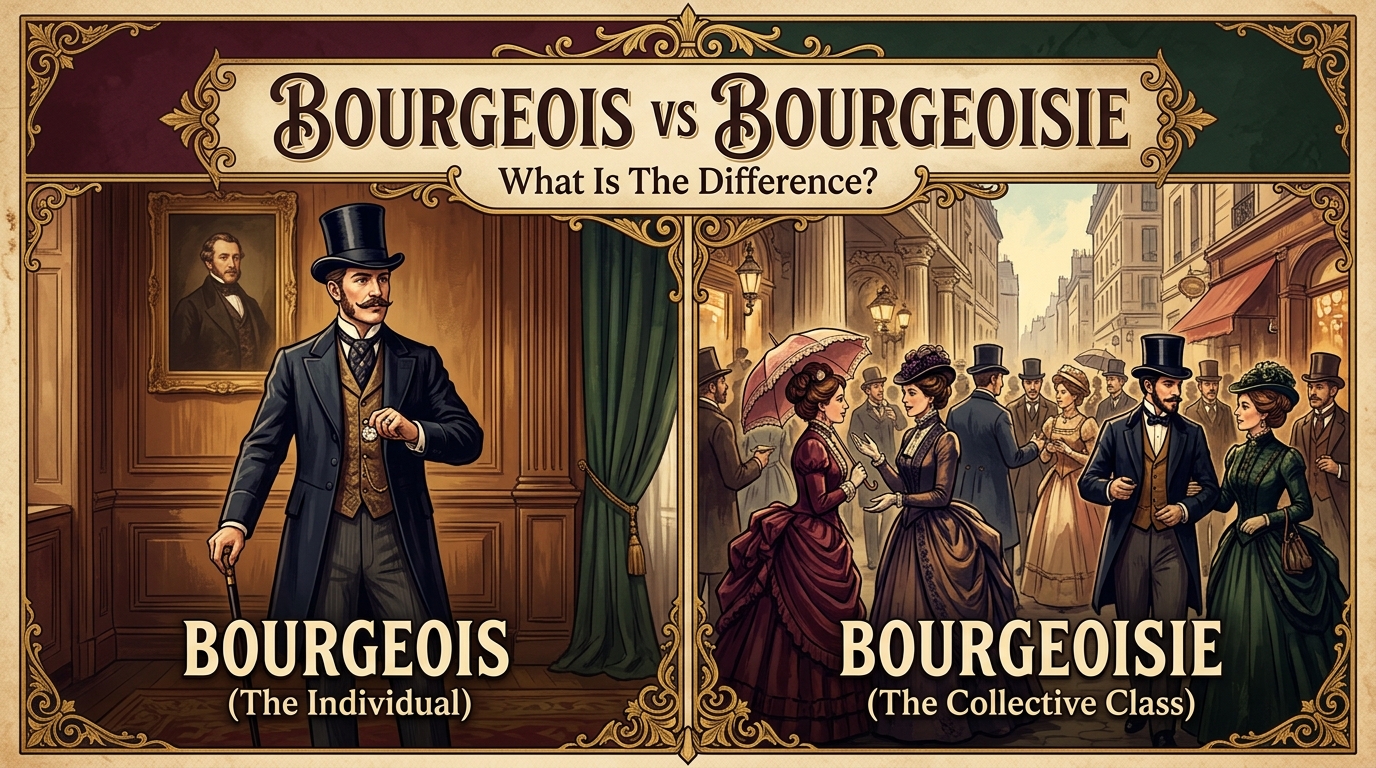
Bourgeois vs Bourgeoisie: What Is the Difference?
Quick Answer
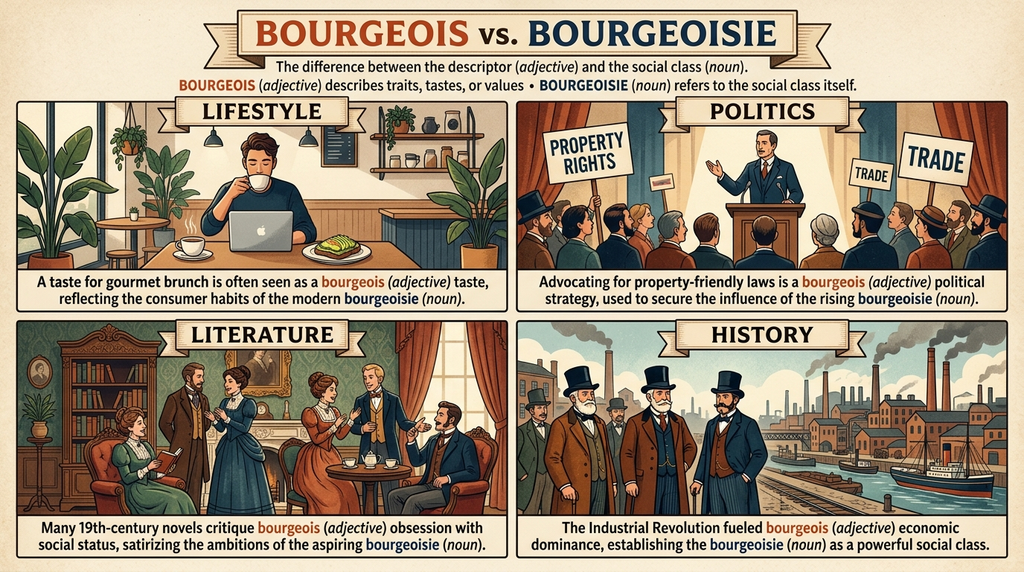
Bourgeois and bourgeoisie are related words, but they are not interchangeable.
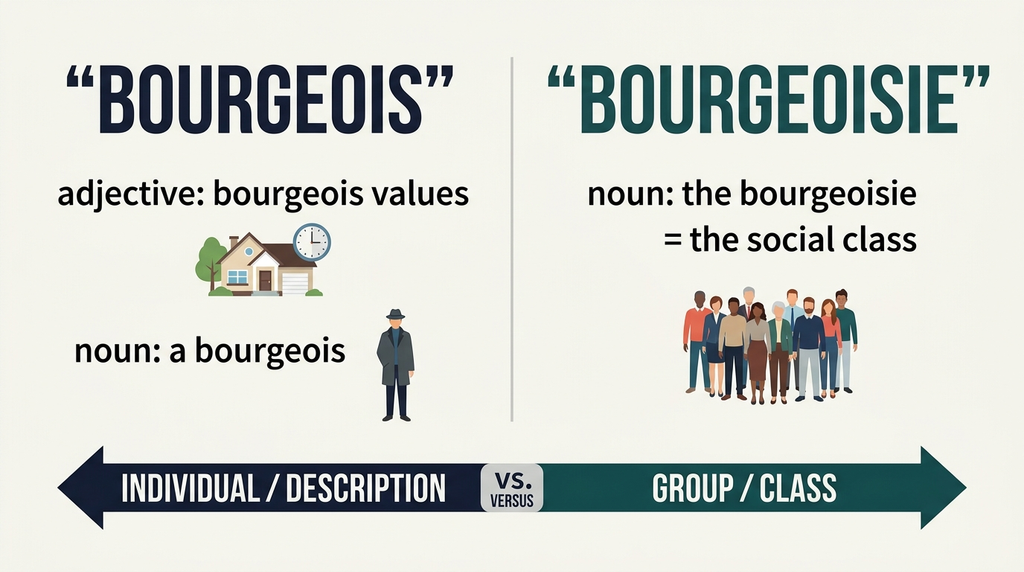
- Bourgeois is usually an adjective meaning associated with the middle class, especially its conventional, materialistic, or status-conscious values. It can also be a noun referring to an individual member of the bourgeois class.
- Bourgeoisie is a noun referring to the middle-class social group as a whole, particularly in historical, political, economic, or Marxist discussion.
The simplest distinction is:
bourgeois = a person or an adjective
bourgeoisie = the social class or group
For example:
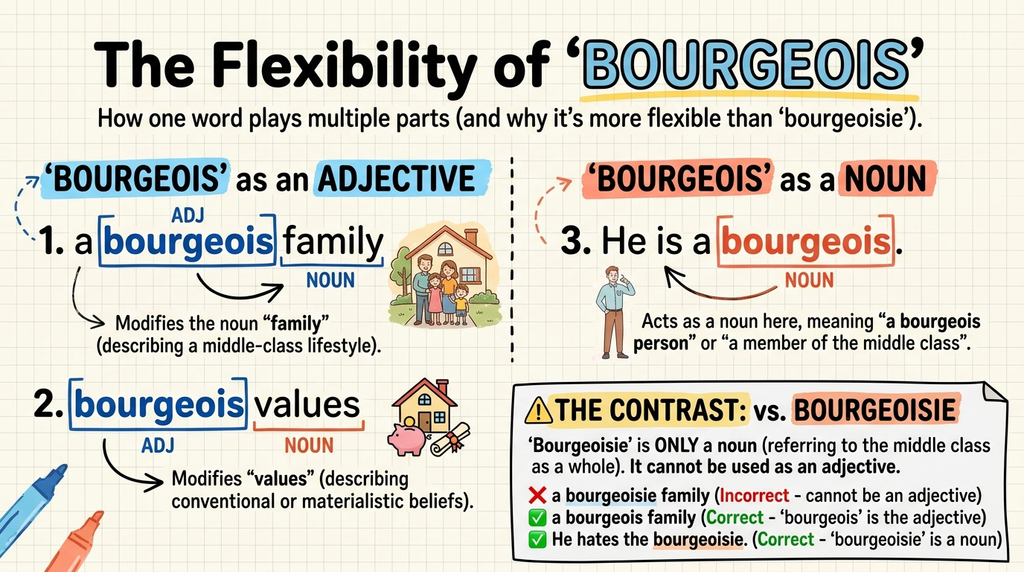
- She comes from a bourgeois family. → bourgeois describes the family.
- The bourgeoisie gained economic influence during the period. → bourgeoisie names the social class.
- He is bourgeois in his tastes. → bourgeois describes his tastes or outlook.
- The bourgeoisie supported the new commercial system. → bourgeoisie refers to the group collectively.
At-a-Glance Table
| Feature | Bourgeois | Bourgeoisie |
|---|---|---|
| Basic meaning | Middle-class; associated with middle-class attitudes or lifestyle | The middle-class social group |
| Part of speech | Adjective; sometimes noun | Noun |
| Refers to | A quality, characteristic, person, or type | A class or collective group |
| Example | “They have bourgeois tastes.” | “The bourgeoisie became economically powerful.” |
| Can modify a noun? | Yes | No |
| Can refer to an individual? | Yes, as a noun | Not normally |
| Can refer to a group? | Sometimes, depending on construction | Yes |
| Typical register | General, cultural, social, political | More formal, historical, economic, political |
| Common in Marxist writing? | Yes | Very common |
| Plural form | bourgeois / bourgeois people | bourgeoisie is normally treated as a collective noun |
| Pronunciation | Commonly /ˈbʊəʒwɑː/ in British English and /bʊrˈʒwɑː/ in many American contexts | Commonly /ˌbʊəʒwɑːˈziː/ in British English and /ˌbʊrʒwɑːˈziː/ in many American contexts |
The key grammatical clue is particularly useful: bourgeois can describe something, while bourgeoisie names the class itself.
You can say:
bourgeois lifestyle
but not:
bourgeoisie lifestyle
If you want the adjective, use bourgeois:
bourgeois lifestyle
If you want the name of the social class, use bourgeoisie:
the bourgeoisie
What Does Bourgeois Mean?
Bourgeois can function as an adjective or, less commonly, as a noun.
As an adjective, it describes something associated with the middle class or with attitudes traditionally associated with the middle class. Depending on context, the word can be neutral, descriptive, critical, or even mildly dismissive.
For example:
She grew up in a comfortable bourgeois household.
Here, bourgeois describes the household. It suggests a middle-class social and economic setting.
But the word can carry a more critical meaning:
His rejection of risk was criticized as bourgeois.
In this sentence, the speaker is not simply saying that the person is middle class. The word may suggest conventionality, materialism, respectability, or an attachment to established social values.
That distinction matters because bourgeois does not always simply mean “middle-class.” In contemporary English, its connotations depend heavily on context.
Bourgeois as an adjective
The adjective can modify many different nouns:
- bourgeois family
- bourgeois lifestyle
- bourgeois values
- bourgeois culture
- bourgeois society
- bourgeois morality
- bourgeois attitudes
- bourgeois tastes
- bourgeois neighborhood
- bourgeois sensibilities
For example:
The novel portrays a bourgeois family struggling with social expectations.
Here, bourgeois tells us what kind of family is being discussed.
Bourgeois as a noun
Bourgeois can also be used as a noun for an individual member of the bourgeois class:
He was a bourgeois who benefited from the new commercial economy.
The plural can be bourgeois or, depending on the construction and style, bourgeois people:
The revolution challenged the interests of the bourgeois.
In ordinary modern English, however, writers often choose a clearer expression such as middle-class person, bourgeois individual, or member of the bourgeoisie, depending on what they mean.
What Does Bourgeoisie Mean?
Bourgeoisie is a noun referring to the bourgeois social class, particularly when that class is viewed collectively.
It is especially common in discussions of:
- social class
- economic history
- capitalism
- industrialization
- political theory
- Marxism
- European history
- class conflict
For example:
The bourgeoisie accumulated considerable economic power during industrialization.
Here, bourgeoisie refers to a social group, not to one person.
Another example:
The relationship between the working class and the bourgeoisie became a central subject of political debate.
The word identifies one class in relation to another.
Is bourgeoisie singular or plural?
This is one reason learners sometimes find bourgeoisie confusing.
Although bourgeoisie refers to many people, it is generally used as a collective noun for the class as a whole.
You normally say:
The bourgeoisie was becoming more influential.
when treating the class as a unified social group.
You may also encounter plural-style agreement in some varieties or contexts, particularly where the individual members are being emphasized:
The bourgeoisie were divided over the proposal.
This is more likely in British English, where collective nouns can take either singular or plural agreement depending on whether the group is viewed as a unit or as individuals.
For formal writing, consistency and context are more important than mechanically assuming that bourgeoisie must always take one particular verb form.
Bourgeois vs Bourgeoisie: The Detailed Difference
The easiest way to understand the relationship is to think of bourgeois as the descriptive or individual term and bourgeoisie as the collective class term.
Compare:
bourgeois values
and:
the bourgeoisie
In the first sentence, bourgeois functions like an adjective. It tells us what kind of values are being discussed.
In the second, bourgeoisie is the name of the group.
Another useful comparison is:
a bourgeois
versus:
the bourgeoisie
The first can identify an individual member of the class. The second identifies the class collectively.
Bourgeois describes; bourgeoisie identifies
This is not an absolute rule for every possible sentence, but it is an excellent practical rule.
If you can naturally replace the word with “middle-class” or “associated with the middle class,” you probably need bourgeois:
bourgeois culture
middle-class culture
bourgeois attitudes
middle-class attitudes
If you are naming the social class itself, bourgeoisie is usually appropriate:
the bourgeoisie
the growing bourgeoisie
members of the bourgeoisie
A useful grammatical test
Ask:
“Am I describing something, or am I naming the group?”
If you are describing:
bourgeois
If you are naming the group:
bourgeoisie
This distinction solves most cases.
When to Use Bourgeois
Use bourgeois when the word modifies another noun:
The restaurant has a distinctly bourgeois atmosphere.
Her parents had fairly bourgeois expectations.
The film satirizes bourgeois society.
They rejected what they regarded as bourgeois conventions.
It can also stand as a noun when referring to an individual:
The protagonist is presented as a bourgeois rather than an aristocrat.
However, this noun use is relatively specialized and can sound theoretical or historical outside contexts where social class is already being discussed.
Bourgeois does not always mean “wealthy”
This is an important nuance.
A person can be wealthy without being described as bourgeois, and someone can be bourgeois without being extremely rich.
The word is fundamentally about social class, social position, culture, attitudes, or values, depending on context.
For example:
The family was wealthy but deliberately rejected bourgeois conventions.
This sentence makes sense because wealth and bourgeois identity are not identical concepts.
Similarly:
She lives a modest but distinctly bourgeois lifestyle.
Here, bourgeois refers more to social habits, expectations, and cultural orientation than to extreme wealth.
When to Use Bourgeoisie
Use bourgeoisie when you are referring to the social class collectively.
Typical constructions include:
the bourgeoisie
the rising bourgeoisie
the urban bourgeoisie
the European bourgeoisie
the industrial bourgeoisie
members of the bourgeoisie
the interests of the bourgeoisie
For example:
The expanding bourgeoisie played an important role in the development of commercial cities.
Here, the subject is an entire social group.
Another example:
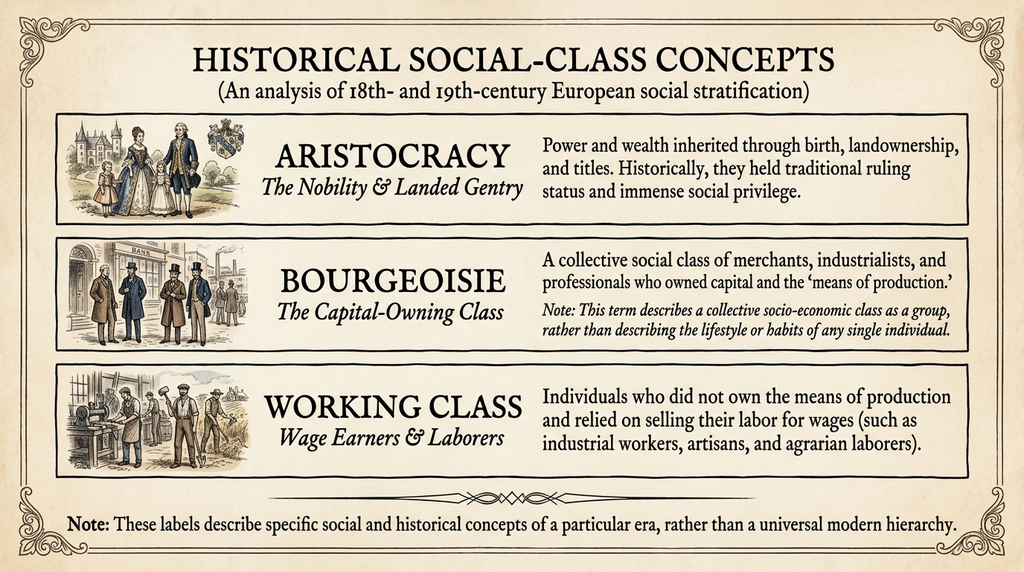
The author examines tensions between the aristocracy, the bourgeoisie, and the working class.
Because all three terms refer to broad social groups, bourgeoisie is the natural choice.
Bourgeois vs Bourgeoisie in Different Contexts
Everyday lifestyle
In everyday discussion, bourgeois is more likely.
They have fairly bourgeois tastes.
His idea of success is quite bourgeois.
She dislikes the bourgeois emphasis on status and possessions.
Using bourgeoisie here would usually be unnecessarily formal unless you are specifically discussing the social class.
History
Both words can occur in historical writing, but they perform different jobs.
The bourgeoisie expanded its economic influence.
The merchants developed a bourgeois identity.
The first sentence names the class. The second uses an adjective to characterize an identity.
Political theory
Both terms are particularly common in political and economic theory.
Marxist theory distinguishes the bourgeoisie from the proletariat.
Here, bourgeoisie is the name of a class.
But:
The text criticizes bourgeois property relations.
Here, bourgeois is an adjective modifying property relations.
Art, literature, and culture
Bourgeois often appears as a cultural adjective:
The novel mocks bourgeois respectability.
The painting depicts bourgeois domestic life.
Bourgeoisie is appropriate when the class itself is the subject:
The novel follows members of the provincial bourgeoisie.
Social criticism
Bourgeois can have a negative or ironic tone:
He considered the desire for a large house hopelessly bourgeois.
This does not necessarily mean “bad.” The speaker is using the word to characterize a particular set of social values.
Bourgeois vs Aristocracy
Bourgeois and aristocratic are not synonyms.
The aristocracy traditionally refers to a hereditary or socially privileged upper class, particularly one historically associated with titles, inherited status, land, or noble lineage.
The bourgeoisie, by contrast, traditionally refers to a class associated with commerce, property, urban economic activity, and the middle class, although the exact definition varies across historical contexts and theoretical traditions.
So:
The aristocracy and the bourgeoisie occupied different social positions.
is perfectly natural.
The adjective forms are:
aristocratic society
and:
bourgeois society
The distinction is not simply rich versus poor. Social class has historically involved status, occupation, property, political power, education, family background, and cultural identity as well as income.
Can someone be both bourgeois and aristocratic?
In historical or sociological analysis, categories can overlap in complicated ways, especially during periods when social classes were changing.
A wealthy bourgeois family might acquire aristocratic status through marriage, titles, political connections, or other historical developments. Therefore, it is safer not to treat these categories as universally rigid boxes.
Examples by Context
Family and lifestyle
They were raised in a comfortable bourgeois household.
Her parents had fairly bourgeois expectations about education and career.
The documentary examines bourgeois family life in the nineteenth century.
Politics and economics
The bourgeoisie became an influential economic force.
The reform challenged the interests of the bourgeoisie.
The essay examines bourgeois attitudes toward private property.
Literature
The novel satirizes bourgeois respectability.
Several characters belong to the local bourgeoisie.
The author presents bourgeois ambition as both admirable and destructive.
Art and culture
The gallery explores bourgeois tastes in nineteenth-century Europe.
The collection reflects the interests of the urban bourgeoisie.
Personal description
He considers himself decidedly bourgeois.
She rejected what she saw as bourgeois notions of success.
Calling someone bourgeois can be descriptive, humorous, ironic, or critical depending on context.
Common Mistakes
Mistake 1: Using bourgeoisie as an adjective
Incorrect:
They have a bourgeoisie lifestyle.
Better:
They have a bourgeois lifestyle.
Why?
Bourgeois is the adjective. Bourgeoisie is the noun naming the class.
Mistake 2: Using bourgeois when you mean the whole class
Less precise:
The bourgeois became economically powerful.
Possible in a specialized context, but often unclear.
Better:
The bourgeoisie became economically powerful.
Why?
The sentence is discussing the social class collectively, so bourgeoisie makes the intended meaning explicit.
Mistake 3: Treating bourgeoisie as a person
Incorrect:
She is a bourgeoisie.
Better:
She is bourgeois.
Or, if you want the social-class noun:
She is a member of the bourgeoisie.
Why?
Bourgeoisie names the group, not normally an individual member.
Mistake 4: Assuming bourgeois always means rich
Not necessarily.
Bourgeois can concern middle-class identity, values, habits, culture, social position, or attitudes. It does not automatically mean wealthy, upper-class, or aristocratic.
Mistake 5: Assuming bourgeois is always an insult
It can be critical, but it is not inherently insulting.
Compare:
The museum presents bourgeois domestic interiors from the period.
This is relatively neutral.
But:
His obsession with status is painfully bourgeois.
This is clearly more critical or dismissive.
Context determines the tone.
Mistake 6: Confusing bourgeoisie with bourgeoisies
In standard usage, bourgeoisie is normally treated as the established noun for the class and is not ordinarily pluralized simply to refer to its members.
Instead of:
different bourgeoisies
a writer will often say:
different bourgeois groups
or:
different bourgeois classes
when several historically distinct groups need to be distinguished.
In specialized academic writing, unusual plural uses can occur, but they should not be adopted casually.
Bourgeois and Bourgeoisie: Pronunciation
The two words look similar because they are closely related, but their endings are different.
Bourgeois is commonly pronounced approximately like “boor-ZHWAH”, although the exact vowel quality varies by accent.
Bourgeoisie adds an ending with a final “zee” sound, approximately “boor-ZHWAH-zee.”
The French origin of the vocabulary also explains why the spelling does not behave like an ordinary English word.
For learners, the most useful distinction is not to pronounce the two words as if bourgeoisie were simply a plural spelling of bourgeois. They are separate lexical forms with different grammatical roles.

Formal vs Casual Usage
Bourgeois is flexible enough to appear in general writing, cultural criticism, journalism, literature, and casual conversation.
For example:
That restaurant feels a little bourgeois.
This sounds natural in informal conversation, although the precise implication depends on the speaker.
Bourgeoisie, on the other hand, has a more academic, historical, political, or sociological flavor.
The bourgeoisie emerged as an influential social class.
This sounds completely natural in an academic history essay but would be unusual in a casual conversation about someone’s weekend.
In ordinary modern conversation, middle class, middle-class people, or wealthy professionals may communicate the intended idea more directly.
Therefore, choosing between these terms is not only a matter of grammar. Register matters too.
British vs American Usage
There is no major British-American distinction in the basic meanings of bourgeois and bourgeoisie. Both varieties use the words in broadly the same ways.
There can, however, be differences in:
- pronunciation
- collective-noun agreement
- stylistic preference
- how common the words are in everyday writing
British English is particularly comfortable with collective nouns taking either singular or plural verb agreement depending on whether the group is viewed as a unit or as individuals. Thus, constructions such as:
The bourgeoisie was divided.
and:
The bourgeoisie were divided.
may both be encountered, with the choice reflecting the writer’s interpretation and broader grammatical style.
American English more often favors singular agreement with collective nouns when the group is treated as a single entity, although actual usage varies.
The safest approach is to consider bourgeoisie a collective noun and choose the verb according to the meaning and the variety of English you are writing in.
What Is the Antonym for Bourgeois?
There is no single antonym for bourgeois that works in every context.
The appropriate opposite depends on what bourgeois means in the sentence.
If bourgeois means middle-class, a broad socioeconomic contrast might be:
working-class
If it is being contrasted with hereditary upper-class status:
aristocratic
If it is being used in a Marxist framework, the relevant contrast may be:
proletarian
or:
working-class
These words are not interchangeable in every context.
For example:
bourgeois and proletarian
belongs naturally to Marxist or class-theoretical discussion.
Meanwhile:
bourgeois and aristocratic
focuses on different social classes or status traditions.
And:
bourgeois and working-class
can be useful in ordinary socioeconomic discussion.
The right antonym therefore depends on the conceptual framework, not merely on the dictionary definition.
Is “Bourgeois and Bourgeoisie” Correct?
Yes, both words can appear in the same sentence because they perform different grammatical functions.
For example:
The book examines bourgeois values among members of the bourgeoisie.
Here:
- bourgeois = adjective describing values
- bourgeoisie = noun naming the social class
Another example:
Bourgeois culture developed alongside the growing economic power of the bourgeoisie.
Again, the adjective describes culture, while the noun identifies the class.
This is one of the clearest ways to see the relationship between the two words.
Bourgeois Meaning in Telugu
For Telugu learners, bourgeois does not have one perfect one-word translation in every context.
Depending on context, it may be explained using ideas such as:
- మధ్యతరగతికి చెందిన — belonging to the middle class
- మధ్యతరగతి — middle class
- మధ్యతరగతి విలువలకు సంబంధించిన — related to middle-class values
- మధ్యతరగతి జీవనశైలికి సంబంధించిన — related to a middle-class lifestyle
For example:
bourgeois lifestyle
can be understood as a middle-class lifestyle, although the English word may carry cultural or critical implications that a simple translation does not fully capture.
Bourgeoisie, meanwhile, refers to the middle-class social group or class as a whole, so its Telugu explanation needs to preserve the collective social-class meaning rather than treating it as an adjective.
Translation should therefore follow the sentence rather than relying on a single fixed equivalent.
A Fast Decision Rule
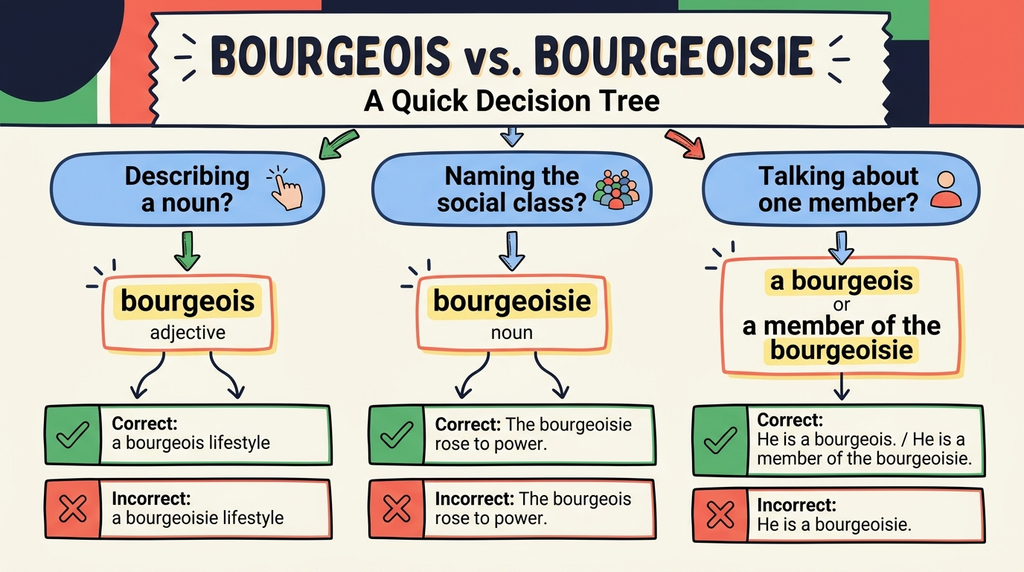
When choosing between bourgeois and bourgeoisie, use this three-step test:
1. Is it describing a noun?
Use bourgeois.
bourgeois culture
bourgeois family
bourgeois values
2. Is it naming the social class as a group?
Use bourgeoisie.
the bourgeoisie
members of the bourgeoisie
the interests of the bourgeoisie
3. Are you referring to one individual?
Use bourgeois as a noun if the specialized context supports it, or use the clearer phrase member of the bourgeoisie.
He was a bourgeois.
or:
He was a member of the bourgeoisie.
For general readers, the second version is often clearer.
The Practical Proofreading Test
Try replacing the word with one of these phrases:
- middle-class
- associated with the middle class
- a member of the middle class
- the middle-class social group
If the sentence needs an adjective, bourgeois is likely correct:
bourgeois culture
→ middle-class culture
If the sentence needs the name of a social group, bourgeoisie is likely correct:
the bourgeoisie
→ the middle-class social group
A second useful test is grammatical:
Can I put this word directly before a noun?
If yes, bourgeois can often work:
bourgeois tastes
You cannot normally do the same with bourgeoisie:
❌ bourgeoisie tastes
Instead:
✓ bourgeois tastes
or:
✓ the tastes of the bourgeoisie
FAQs
Is bourgeois the same as bourgeoisie?
No. Bourgeois can be an adjective meaning associated with the middle class and can also be a noun for an individual member of that class. Bourgeoisie is the noun for the social class collectively.
Which is correct: bourgeois or bourgeoisie?
Both are correct, but they are used differently. Choose bourgeois when you are describing something or, in specialized usage, referring to an individual. Choose bourgeoisie when naming the social class as a group.
Is bourgeoisie a plural of bourgeois?
No. Bourgeoisie is not simply the plural form of bourgeois. The two words have different grammatical functions and meanings.
Can I say “bourgeoisie people”?
It is generally unnecessary and awkward. Bourgeoisie already names the social class. Better choices include bourgeois people, members of the bourgeoisie, or middle-class people, depending on the intended meaning.
Is “bourgeois lifestyle” correct?
Yes. Bourgeois lifestyle is grammatically correct because bourgeois is functioning as an adjective modifying lifestyle.
Is “bourgeoisie lifestyle” correct?
No, not in standard English. Bourgeoisie is a noun, so it does not normally function as an adjective before lifestyle. Say bourgeois lifestyle or the lifestyle of the bourgeoisie.
What does bourgeois mean?
It generally means associated with the middle class or with values, attitudes, tastes, or lifestyles traditionally associated with that class. Depending on context, it can be neutral, descriptive, ironic, or critical.
What does bourgeoisie mean?
Bourgeoisie refers to the bourgeois social class considered collectively. It is especially common in historical, economic, political, sociological, and Marxist discussions.
Is bourgeois an insult?
Not necessarily. The word can be neutral or descriptive, but it is often used critically to suggest conventional, materialistic, status-conscious, or socially conservative attitudes. Context determines its tone.
What is the difference between bourgeoisie and aristocracy?
The bourgeoisie traditionally refers to a middle class associated with commerce, property, and economic activity, while the aristocracy traditionally refers to a hereditary or socially privileged upper class. Historical boundaries between classes can be complicated, so the terms should not be treated as universal modern categories.
What is the antonym of bourgeois?
There is no single universal antonym. Depending on context, possible contrasts include working-class, proletarian, or aristocratic. The correct choice depends on whether you are discussing economics, Marxist theory, or social status.
What is the easiest way to remember bourgeois vs bourgeoisie?
Remember:
bourgeois describes; bourgeoisie names the class.
So:
bourgeois values
but:
the bourgeoisie
That distinction will correctly handle most everyday cases.
Final Takeaway
The difference between bourgeois vs bourgeoisie is mainly a difference in grammatical function and social reference.
Bourgeois is generally an adjective meaning associated with the middle class or its values, tastes, culture, or lifestyle. It can also function as a noun for an individual member of the bourgeois class.
Bourgeoisie is a noun referring to the bourgeois social class collectively.
The most useful rule is:
Use bourgeois to describe; use bourgeoisie to name the class.
So write:
bourgeois lifestyle
bourgeois attitudes
bourgeois culture
but:
the bourgeoisie
members of the bourgeoisie
the interests of the bourgeoisie
Once you identify whether the sentence needs a descriptor or the name of a social group, the choice becomes much easier.