Wracking My Brain or Racking My Brain: Which Is Correct?
Quick Answer
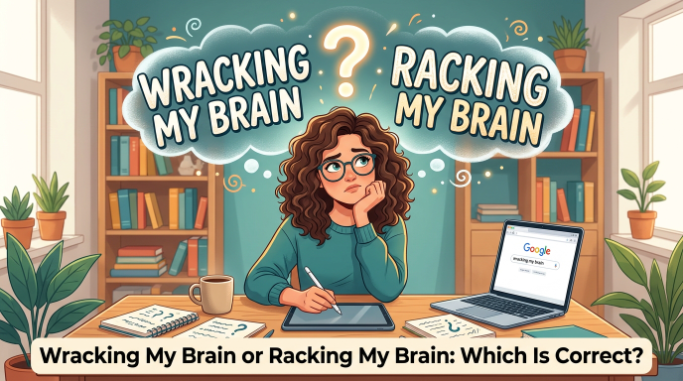
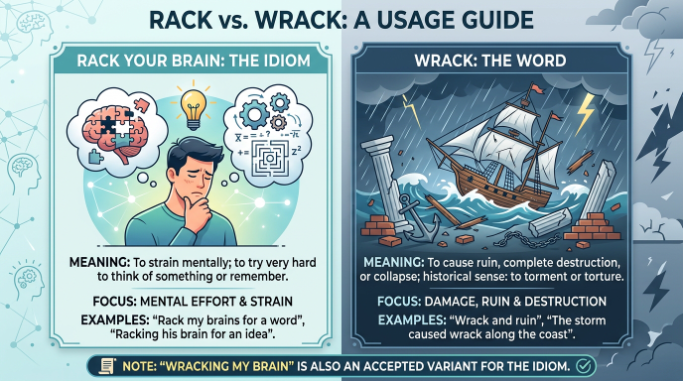
Both “wracking my brain” and “racking my brain” are used, but “racking my brain” is generally the preferred and more widely accepted modern form.
If you mean thinking very hard to remember, solve, or understand something, write:
“I’ve been racking my brain trying to remember her name.”
However, “wracking my brain” is also an established variant and appears in respected writing. The overlap exists because rack and wrack have historically become entangled in English usage.
The safest choice for most modern writing—especially formal, academic, professional, and edited English—is racking my brain.
Fast decision rule
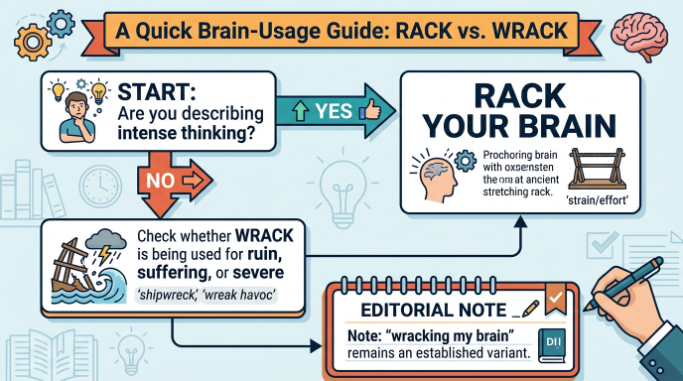
- Trying hard to think or remember? → rack your brain
- Describing destruction, ruin, or severe damage? → wrack
- Not sure which form an editor expects? → use rack your brain
At-a-Glance Table
| Form | Main meaning | Typical modern use | Example |
|---|---|---|---|
| rack my brain | Think extremely hard | Preferred form of the idiom | “I racked my brain for the answer.” |
| racking my brain | Thinking extremely hard right now or over time | Most common modern phrasing | “I’ve been racking my brain all morning.” |
| racked my brain | Thought extremely hard in the past | Standard past-tense idiom | “She racked her brain for a solution.” |
| wrack | Cause ruin, destruction, or severe suffering | Used in other expressions and as a variant in the brain idiom | “The storm left the coast wracked by damage.” |
| wracking my brain | Thinking intensely | Accepted variant, but less consistently preferred | “He was wracking his brain for an explanation.” |
| wracked my brain | Thought extremely hard | Variant spelling | “I wracked my brain trying to remember.” |
The Detailed Difference Between “Wracking” and “Racking”
The confusion between wracking my brain or racking my brain exists because rack and wrack overlap historically and have influenced one another over time.
In modern English, the idiom traditionally understood as “rack your brain” means:
to think very hard about something
When you rack your brain, you mentally search for an answer, memory, idea, or solution.
For example:
- I’m racking my brain trying to remember where I parked.
- We racked our brains for a cheaper solution.
- She spent the evening racking her brain over the problem.
The form “wracking my brain” developed as a common variant and is now widely encountered. Many dictionaries and style discussions recognize that actual usage is not a perfectly simple binary.
That means calling “wracking my brain” completely wrong would be too absolute.
Still, if your goal is to choose the form least likely to be questioned in modern edited English, “racking my brain” is usually the safer choice.
What Does “Racking My Brain” Mean?
The meaning of racking my brain is simple: making a strong mental effort to remember, understand, invent, or solve something.
You might rack your brain when:
- trying to remember someone’s name
- solving a difficult problem
- thinking of an idea
- searching your memory
- trying to explain something confusing
- looking for the right answer
For example:
I’ve been racking my brain, but I still can’t remember the password hint.
The speaker is not physically doing anything to their brain. The expression is idiomatic and describes intense mental effort.
Define “racking my brain”
Racking my brain means thinking very hard or searching your memory intensely for an answer or idea.
What does “rack your brain” mean?
Rack your brain is the base form of the expression.
Examples:
- Rack your brain and see if you remember his address.
- Don’t rack your brain over something you cannot control.
The form changes depending on grammar:
- rack my brain
- racking my brain
- racked my brain
- racks his brain

When Should You Use “Racking My Brain”?
Use racking my brain when you are describing an ongoing process of intense thinking.
Present continuous
I’m racking my brain to think of a better title.
The action is happening now.
Present perfect continuous
I’ve been racking my brain trying to remember what she said.
This means the mental effort started earlier and has continued until now.
The phrase “I’ve been racking my brain” is especially natural when someone has spent time unsuccessfully trying to remember or solve something.
For example:
I’ve been racking my brain all day, but the answer still hasn’t come to me.
Why “racking” works
The verb is rack, and racking is its present participle.
Just as:
- think → thinking
- solve → solving
- rack → racking
So racking my brain follows normal English verb grammar.
When Should You Use “Racked My Brain”?
Use racked my brain when the intense thinking happened in the past.
Examples:
- I racked my brain for an excuse.
- She racked her brain trying to remember the date.
- We racked our brains for a way out.
- He racked his brain but found no answer.
The phrase “racked his brain” therefore means that he made a strong mental effort to think of something.
Racked her brain meaning
Racked her brain means she thought very hard about something.
Example:
She racked her brain for a reason why the meeting had been canceled.
Racked our brains
Because the expression can refer to more than one person, English also uses:
We racked our brains for a solution.
And in ongoing situations:
We were racking our brains trying to fix the problem.
Is “Wracking My Brain” Wrong?
Not necessarily.
This is where the issue requires more nuance than a simple “right versus wrong” answer.
Wracking my brain is a recognized and established variant. It appears frequently in published writing and has been used for a long time.
Examples include:
- I was wracking my brain for the missing detail.
- He spent hours wracking his brain over the mystery.
- She wracked her brain trying to remember the conversation.
So if you write “wracking my brain,” many readers will understand it immediately, and it cannot simply be dismissed as meaningless nonsense.
However, because rack your brain remains the form many editors and style-conscious writers prefer, racking my brain is generally the better default choice.
The practical answer
If you are writing:
- a school assignment
- a professional email
- an academic paper
- website content
- formal copy
- carefully edited writing
Choose racking my brain.
If you encounter wracking my brain in published writing, do not automatically assume the writer made a spelling mistake.

Wrack vs. Rack: The Broader Difference
Outside the brain idiom, rack and wrack have different associations.
Rack
Rack has several meanings.
It can refer to:
- a framework for holding things
- a storage structure
- placing something on a rack
- arranging objects on a rack
- an idiomatic expression involving mental effort
Examples:
- Put the plates on the drying rack.
- The bicycles were locked to the rack.
- I had to rack my brain for the answer.
Wrack
Wrack is traditionally associated with:
- destruction
- ruin
- severe damage
- intense suffering or distress in certain expressions
A familiar example is:
The country was wracked by conflict.
Here, wracked suggests being severely affected, damaged, or devastated.
This is different from the mental-search meaning of rack your brain.
Why do people confuse them?
Because English usage has allowed wrack and rack to overlap in some expressions over time.
That overlap is why you may see:
- racked with pain
- wracked with pain
and similarly:
- racking my brain
- wracking my brain
Language history and modern usage do not always produce perfectly separated categories.
“Racking My Brains” or “Racking My Brain”?
The traditional idiom is most commonly:
rack your brain
with brain singular.
Examples:
- I’m racking my brain.
- She’s racking her brain.
- They were racking their brains.
When the subject is plural, the possessive and noun can naturally become plural:
We were racking our brains for ideas.
They were racking their brains trying to solve the puzzle.
Therefore, forms such as racking our brains and racking your brains are completely natural.
Racking your brains meaning
Racking your brains means thinking very hard, usually collectively or intensely, to find an answer or idea.
Example:
You can keep racking your brains, but the clue may not be enough to solve the puzzle.
“Wrack My Brain” or “Rack My Brain”?
If you are choosing the preferred modern form, write:
rack my brain
Examples:
- I need to rack my brain for ideas.
- Don’t rack your brain too much over it.
The alternative wrack my brain exists in usage, but rack my brain is generally the safer editorial choice.
The same principle applies to:
- rack your brain
- rack my brain
- racking my brain
- racked my brain
- racking his brain
Natural Examples by Context
Trying to remember something
I’m racking my brain, but I cannot remember where we first met.
Solving a problem
The engineers were racking their brains for a way to reduce costs.
Looking for an idea
She racked her brain for a creative birthday message.
Searching your memory
He racked his brain to remember the name of the restaurant.
Working together
We spent the afternoon racking our brains for a solution.
Continuing mental effort
I’ve been racking my brain about what to do next.
After unsuccessful thinking
I racked my brain, but nothing useful came to mind.
Using the accepted variant
He was wracking his brain over the final question.
The meaning remains clear, but racking his brain would usually be the safer choice in heavily edited prose.

Common Mistakes
Mistake 1: Assuming “wracking my brain” is always wrong
Overly simplistic:
❌ “Wracking my brain is incorrect English.”
A better explanation is:
“Racking my brain is generally the preferred modern form, while wracking my brain is an established variant.”
Why this matters: English usage is often more complicated than a single correct spelling versus a completely impossible one.
Mistake 2: Using the wrong tense
❌ Yesterday, I racking my brain for the answer.
✅ Yesterday, I racked my brain for the answer.
Why: Yesterday places the action in the past, so racked is needed.
Mistake 3: Forgetting the helping verb
❌ I racking my brain right now.
✅ I am racking my brain right now.
Why: The -ing form needs an appropriate auxiliary verb in this sentence.
Mistake 4: Confusing “racking” with “racking up”
The phrase racking my brain has nothing to do with racking up.
Compare:
- I’m racking my brain for the answer.
- The company is racking up significant expenses.
In rack up, the meaning is to accumulate.
So the search phrase “wracking up or racking up” represents a different spelling question from the brain idiom.
Mistake 5: Treating “nerve-racking” exactly like the brain idiom
The spelling nerve-racking is traditionally common and widely preferred for something that causes intense stress or anxiety.
Example:
Waiting for the results was nerve-racking.
You may also encounter nerve-wracking, which reflects the same historical overlap between rack and wrack.
However, the phrase nerve-racking should not be used as proof that every expression involving mental strain must use one spelling or the other. Each established expression has its own usage history and editorial conventions.
A Simple Memory Trick
Use this practical association:
Rack = search or strain mentally in “rack your brain.”
Think of your mind as being pushed into intense effort while you search for an answer.
So remember:
When you are trying hard to THINK → RACK your brain.
For broader meanings involving devastation or severe suffering, think:
WRACK = ruin or severely affect.
This is a useful memory aid, not a claim that the two words never overlap.

A Practical Proofreading Test
When editing your sentence, ask these questions.
Step 1: Am I talking about intense thinking?
If yes, racking my brain is usually your safest choice.
I’m trying to remember the answer.
→ I’m racking my brain.
Step 2: Is the action happening now?
Use:
racking
Example:
She is racking her brain for an answer.
Step 3: Did the action happen in the past?
Use:
racked
Example:
She racked her brain for an answer.
Step 4: Am I writing “wracking” because I mean destruction or severe damage?
If yes, wrack may be the appropriate word.
Example:
The disaster left the region wracked by grief.
Step 5: Is this specifically the familiar thinking idiom?
Choose:
rack your brain
This simple test will prevent most errors involving racked or wracked, racking or wracking, and rack vs. wrack.
Formal, Casual, and Regional Usage Notes
Formal writing
For formal and carefully edited writing, racking my brain is generally the safest choice.
Example:
The researchers spent months racking their brains for an explanation.
Casual conversation
In speech, nobody can hear whether you mean racking or wracking because they are pronounced the same in normal usage.
That means the spelling question mainly matters in writing.
American and British English
Both British and American English recognize the long-standing overlap between rack and wrack in expressions involving suffering and mental strain.
However, racking your brain is widely treated as the preferred standard form in contemporary edited English on both sides of the Atlantic.
You may encounter wracking your brain in British and American writing, so the variation is not limited neatly to one dialect.
Pronunciation
Rack and wrack are pronounced the same:
/ræk/
Therefore:
- racking
- wracking
also sound the same in ordinary speech.
The difference is primarily spelling and usage, not pronunciation.
“Brain-Racking,” “Brain Wracking,” and Similar Forms
You may encounter expressions such as:
- brain-racking
- brain wracking
- mind-racking
- wracking my mind
These are much less standardized than the familiar idiom racking my brain.
If you mean thinking very hard, the most natural and established expression is usually:
racking my brain
Instead of:
I’m doing some brain-racking thinking.
A more natural sentence would be:
I’m racking my brain trying to solve it.
Similarly, wracking my mind may be understandable, but it is less idiomatic than racking my brain.
The key principle is that English often favors established phrases rather than allowing every word in an idiom to be freely substituted.
Racking vs. Wracking: The Best Editorial Choice
If you are deciding between wracking vs. racking in the expression about intense thinking, use this hierarchy:
Best default
Racking my brain
Accepted variant
Wracking my brain
Avoid when possible
Inventing less established variations such as brain wracking when the standard idiom racking my brain expresses the idea more naturally.
This distinction is especially useful for writers, students, editors, and anyone preparing polished content.
FAQs
Is it “wracking my brain” or “racking my brain”?
Both forms are used, but racking my brain is generally the preferred modern form when you mean thinking very hard.
Is “wracking my brain” grammatically correct?
Yes, wracking my brain is an established variant in English usage. However, racking my brain is usually the safer choice for formal or carefully edited writing.
What does “I’ve been racking my brain” mean?
It means you have been thinking very hard, usually for some time, trying to remember or solve something.
Example:
I’ve been racking my brain trying to remember his phone number.
Is it “racked my brain” or “wracked my brain”?
Racked my brain is generally the preferred past-tense form of the idiom. Wracked my brain is an established variant.
What does “racked my brain” mean?
Racked my brain means thought very hard about something in the past.
Example:
I racked my brain but could not remember the answer.
Should I say “rack your brain” or “wrack your brain”?
Choose rack your brain as the preferred modern form.
Is “racking your brains” correct?
Yes. Racking your brains is natural, particularly when referring to multiple people or emphasizing collective mental effort.
Example:
The team was racking their brains for a solution.
Is it “nerve-racking” or “nerve-wracking”?
Nerve-racking is the traditional and widely preferred spelling. Nerve-wracking is also encountered because of the historical overlap between rack and wrack.
Is “racking up” related to “racking my brain”?
No. Rack up usually means accumulate, while rack your brain means think very hard.
Can I use “wracking my mind” instead?
People may understand it, but racking my brain is the more natural and established idiom when you mean intense mental effort.
Final Takeaway
When choosing between wracking my brain or racking my brain, the clearest practical answer is:
Use “racking my brain” when you mean thinking very hard.
For example:
I’ve been racking my brain trying to remember the answer.
Wracking my brain is not simply an invented modern error—it is an established variant—but racking my brain remains the safest and most widely preferred choice for polished contemporary writing.
Remember the quick rule:
Thinking hard? → Rack your brain.
Destruction or severe suffering? → Wrack may be appropriate.
And when the historical overlap creates uncertainty, choose the form that best fits the established modern idiom rather than assuming English always follows a perfectly simple spelling rule.