Wether or Weather or Whether: Meaning, Differences, Spelling, and Examples
Quick Answer
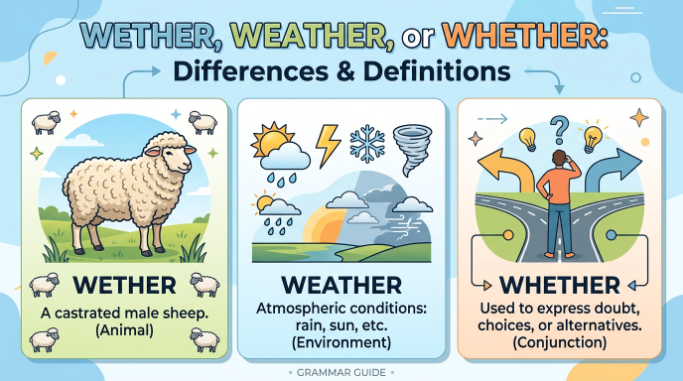
Weather, whether, and wether are three different English words.
- Weather = the conditions of the atmosphere, such as rain, wind, heat, or snow. It can also be a verb meaning to endure or survive something.
- Whether = a conjunction used when discussing alternatives, possibilities, or uncertainty. It commonly appears in phrases such as “whether or not” and “whether you agree.”
- Wether = a noun meaning a castrated male sheep, especially a ram. It is a legitimate English word, but it is much less common than weather or whether.
So, if you are writing “I don’t know whether it will rain,” the correct word is whether, not weather or wether.
If you are talking about rain, sunshine, temperature, storms, or atmospheric conditions, use weather.
If you mean a castrated male sheep, use wether.
At-a-Glance Table
| Word | Part of speech | Main meaning | Typical example | Pronunciation |
|---|---|---|---|---|
| weather | Noun, verb | Atmospheric conditions; to endure | “The weather is cold today.” | Usually like WEH-thər |
| whether | Conjunction | Introduces alternatives, possibilities, or uncertainty | “I don’t know whether she’ll come.” | Usually like WEH-thər |
| wether | Noun | A castrated male sheep | “The farmer sold a wether.” | Usually like WEH-thər |
The most important point is that weather, whether, and wether can sound alike or nearly alike in many varieties of English, but their meanings and grammatical roles are different.
That makes this primarily a spelling-and-usage problem, not a pronunciation problem.
What Is the Difference Between Wether, Weather, and Whether?
The simplest distinction is:
Weather → atmosphere
Whether → alternatives or uncertainty
Wether → sheep
Consider these three sentences:
- The weather is getting colder.
- I don’t know whether it will snow.
- The wether was grazing in the field.
The words may sound similar, but replacing one with another changes the meaning—or makes the sentence incorrect.
Weather
Weather is most commonly a noun referring to atmospheric conditions at a particular time and place.
It includes things such as:
- rain
- snow
- wind
- sunshine
- clouds
- humidity
- temperature
- storms
- fog
Examples:
- “The weather is beautiful today.”
- “We stayed inside because of the bad weather.”
- “What will the weather be like tomorrow?”
- “The mountain weather can change quickly.”
Weather can also be a verb. In this sense, it means to withstand, survive, or come through something difficult.
Examples:
- “The old building has weathered many storms.”
- “The company weathered the financial crisis.”
- “She weathered a difficult period and continued working.”
So weather has two important grammatical uses: noun and verb.
Whether
Whether is a conjunction used to introduce alternatives, possibilities, or uncertainty.
It frequently appears when someone is unsure about two or more possibilities.
Examples:
- “I don’t know whether he is coming.”
- “Tell me whether you want tea or coffee.”
- “We need to decide whether to leave now.”
- “She asked whether the meeting had started.”
A particularly common construction is:
whether … or …
For example:
- “I can’t decide whether to stay or leave.”
- “We need to determine whether the plan will work or fail.”
- “He hasn’t decided whether he wants the blue one or the black one.”
Another very common expression is:
whether or not
Examples:
- “I’ll go whether or not you come.”
- “She will finish the project whether or not she receives help.”
- “We have to make a decision whether or not everyone agrees.”
Wether
Wether is a real English word. It is not simply a misspelling of weather or whether.
A wether is a castrated male sheep.
The word is mainly encountered in agricultural, farming, livestock, historical, or specialized contexts.
Examples:
- “The farmer selected a young wether for the flock.”
- “The wether was calm around the other sheep.”
- “The shepherd separated the wether from the breeding rams.”
Because wether is relatively uncommon in everyday English, people frequently encounter it only when reading about sheep or livestock.

When to Use Weather
Use weather when you are talking about atmospheric conditions.
A useful substitution test is:
Can I replace the word with “rain, sunshine, temperature, wind, or atmospheric conditions”?
If yes, you probably need weather.
For example:
- “The weather is terrible.”
- “The weather forecast says it will rain.”
- “Cold weather can damage some plants.”
- “The aircraft was delayed because of severe weather.”
Here, whether would be incorrect:
- ❌ “The whether is terrible.”
- ❌ “The whether forecast says it will rain.”
The correct spelling is:
- ✅ “The weather is terrible.”
- ✅ “The weather forecast says it will rain.”
Weather as a Verb
The verb weather has a different meaning.
To weather something means to survive or endure it.
For example:
- “The bridge has weathered decades of heavy use.”
- “They weathered the crisis successfully.”
- “The team weathered several difficult setbacks.”
This use can sometimes confuse learners because the word is no longer describing rain or sunshine.
Compare:
“The house survived the storm.”
with:
“The house weathered the storm.”
In the second sentence, weathered means survived or endured.
When to Use Whether
Use whether when a sentence involves choice, alternatives, uncertainty, or two possible outcomes.
A useful test is:
Could the sentence involve “if,” “which of two possibilities,” or “whether A or B”?
If so, whether may be the correct choice.
Examples:
- “I don’t know whether she is available.”
- “They are deciding whether to move.”
- “He asked whether we needed help.”
- “We must determine whether the information is accurate.”
Whether With “Or”
The pattern whether … or … is especially clear.
- “I don’t know whether to call or wait.”
- “She couldn’t decide whether to laugh or cry.”
- “They need to determine whether the machine is working or broken.”
Whether or Not
Whether or not means that something applies regardless of the outcome.
- “I’ll attend whether or not you are there.”
- “We must finish the work whether or not it rains.”
- “She intends to continue whether or not people approve.”
Notice the interesting example:
“We must finish the work whether or not it rains.”
The word whether introduces the possibility, while rains refers to the weather.
That is why a sentence can contain both whether and weather-related language without the words being interchangeable.
“Whether It Be” vs “Weather It Be”
One of the most common spelling mistakes involves the expression:
whether it be
For example:
- “Choose one, whether it be large or small.”
- “The rule applies, whether it be summer or winter.”
Here, whether is correct.
Weather it be is normally a spelling error when the intended meaning is “whether it be.”
The construction whether it be is relatively formal or literary. In ordinary modern writing, whether it is is often more natural:
- Formal: “Whether it be true or false, we must investigate.”
- More everyday: “Whether it is true or false, we must investigate.”
Whether vs If
One reason whether can be confusing is that it sometimes overlaps with if.
Compare:
- “I don’t know whether he will come.”
- “I don’t know if he will come.”
Both can be acceptable in ordinary English, depending on context and style.
However, whether is especially useful when there are explicit alternatives:
- “I don’t know whether he will come or stay home.”
It is also preferred or required in some constructions where if would be awkward or change the intended structure.
For example:
- “We need to decide whether to continue.”
- “It depends on whether they agree.”
A useful practical rule is that whether is the safer choice when you are clearly presenting alternatives or using a formal construction.

Examples by Context
Everyday Conversation
- “Do you know whether Sam is coming?”
- “The weather looks awful today.”
- “I can’t decide whether to order lunch.”
- “The weather should improve by evening.”
School and Academic Writing
- “The researchers examined whether the treatment affected the results.”
- “The study considers whether the two methods produce different outcomes.”
- “Extreme weather can influence agricultural production.”
In formal writing, whether is often useful because it clearly introduces a research question or alternative.
Business Writing
- “Management must determine whether the proposal is financially viable.”
- “The company successfully weathered the downturn.”
- “Severe weather disrupted transportation.”
Farming and Agriculture
This is where wether is most likely to appear.
- “The flock included several young wethers.”
- “The farmer separated the wether from the breeding animals.”
- “The wether was approximately two years old.”
If you are not discussing sheep or livestock, you probably do not need wether.
Weather Reports
Use weather:
- “The weather will remain cloudy.”
- “Severe weather is expected overnight.”
- “The weather forecast calls for strong winds.”
Never use whether merely because it sounds the same.
Common Mistakes and Corrections
“Weather or not”
When you mean “regardless of whether something happens,” the correct expression is:
- ❌ “Weather or not you agree…”
- ✅ “Whether or not you agree…”
But there is one important edge case.
Weather or not could theoretically be meaningful if you deliberately meant something related to weather. For example, a sentence might play on the two words in a joke or headline.
In normal prose, however, whether or not is the expression you want.
“Wether or not”
Usually incorrect:
- ❌ “Wether or not she comes…”
- ✅ “Whether or not she comes…”
“Whether forecast”
Incorrect when discussing atmospheric conditions:
- ❌ “The whether forecast is sunny.”
- ✅ “The weather forecast is sunny.”
“Wether forecast”
Also incorrect in ordinary weather reporting:
- ❌ “Check the wether forecast.”
- ✅ “Check the weather forecast.”
“Weather I should go”
If the sentence means “if I should go” or “whether I should go,” use whether:
- ❌ “I don’t know weather I should go.”
- ❌ “I don’t know wether I should go.”
- ✅ “I don’t know whether I should go.”
“Whether is cold today”
If you are describing atmospheric conditions:
- ❌ “Whether is cold today.”
- ✅ “Weather is cold today.”
More naturally:
- ✅ “The weather is cold today.”
“Weather it be this or that”
When you mean alternatives, the correct form is:
- ❌ “Weather it be this or that…”
- ✅ “Whether it be this or that…”
The phrase is built around whether, because it introduces alternatives.

How to Remember the Difference Between Weather and Whether
The fastest memory trick is:
Weather = atmosphere
Think:
WEATHER → WIND, RAIN, SUN
If you can associate the sentence with clouds, rain, temperature, storms, or atmospheric conditions, choose weather.
Whether = choices
Think:
WHETHER → WHICH ONE?
If the sentence involves alternatives or uncertainty, choose whether.
For example:
“I don’t know whether to stay or leave.”
There are two possibilities: stay or leave.
Wether = sheep
Think:
WETHER → WETHER IS A SHEEP WORD
A wether is a castrated male sheep.
This is the least common of the three words, so if you are not writing about livestock, wether is unlikely to be the word you need.
The 5-Second Proofreading Test
When you see wether, weather, or whether, stop and ask:
1. Am I talking about rain, wind, temperature, or atmospheric conditions?
→ weather
2. Am I expressing uncertainty or presenting alternatives?
→ whether
3. Am I specifically talking about a castrated male sheep?
→ wether
If none of those tests seems to work, read the entire sentence again rather than choosing based only on pronunciation.
A Quick Replacement Test
Try these substitutions:
Weather → “atmospheric conditions”
“The weather is unpredictable.”
“The atmospheric conditions are unpredictable.”
The meaning remains broadly intact.
Whether → “if” or “which possibility”
“I don’t know whether she is ready.”
“I don’t know if she is ready.”
The basic meaning remains intact.
Wether → “castrated male sheep”
“The wether was grazing.”
“The castrated male sheep was grazing.”
If the replacement makes sense, you have likely found the correct word.
Pronunciation: Are Weather, Whether, and Wether Homophones?
In many accents, weather, whether, and wether are pronounced the same or almost the same.
They are commonly represented approximately as:
WEH-thər
The exact pronunciation can vary by accent.
This is why listening alone is not a reliable way to distinguish them. The spelling and context do the important work.
How to Pronounce Wether
Wether is generally pronounced like weather in standard English pronunciation.
That means you should not normally pronounce wether as if it were “wee-ther” or “wet-her” with two clearly separated syllables.
Are Weather and Whether Homophones?
For many speakers, yes. Weather and whether are homophones or near-homophones: they sound alike or extremely similar while having different meanings and spellings.
Wether also commonly shares the same pronunciation.
This makes weather, whether, and wether an excellent example of why English spelling cannot always be predicted from sound.

Formal, Casual, British, and American Usage
There is no major British-versus-American spelling difference that turns weather into whether or vice versa.
The three words retain their basic meanings in both British and American English.
The more relevant differences concern style and construction, particularly the use of whether.
For example:
- “I don’t know whether he’ll come.”
- “I don’t know if he’ll come.”
Both forms are widely encountered.
In formal writing, whether can be preferable when alternatives are explicit:
“The committee must decide whether to approve or reject the proposal.”
In casual conversation, speakers may often use if:
“I don’t know if he’s coming.”
Neither pattern should be treated as a simple British/American spelling distinction.
“Whether It Be”
The expression whether it be has a formal, traditional, or literary flavor.
For example:
“Whether it be a minor error or a major failure, the procedure must be followed.”
In contemporary everyday English, whether it is may sound more natural:
“Whether it is a minor error or a major failure, the procedure must be followed.”
The choice here is primarily about style and register, not different meanings of weather and whether.
Is “Wether” a Word?
Yes.
Wether is a genuine English word.
Its principal modern dictionary meaning is a castrated male sheep.
Therefore, saying that wether is “just a misspelling” would be inaccurate.
The important distinction is that being a real word does not mean it is the right word in every sentence.
For example:
“The wether is cloudy.”
This is grammatically possible as a sequence of words, but it does not express the normal intended meaning of a weather report. If you mean atmospheric conditions, the correct sentence is:
“The weather is cloudy.”
Likewise:
“I don’t know wether she will come.”
is incorrect if the intended word is whether.
“Wether” Definition and Meaning in English
Wether: a castrated male sheep.
Plural:
wethers
Example:
“Several wethers were grazing near the fence.”
Because this is a specialized livestock term, it is much less common in general conversation than weather and whether.
This explains why searches such as “what does wether mean,” “wether define,” “wether definition,” “wether means,” “what is wether,” and “wether meaning in English” often lead to confusion: the word exists, but it has a specialized meaning.
Why “Wethier,” “Wethear,” “Wheter,” and Similar Forms Are Wrong
Forms such as:
- wethier
- whethear
- whetehr
- wheather
- wheter
- wheither
- whethr
- wthether
- whehter
- whetere
- whethere
- weither
are generally misspellings or typing errors when the intended word is weather or whether.
English spelling errors often occur because the sounds are similar and because whether contains an extra h after the w.
The three standard spellings to remember are:
WEATHER
WHETHER
WETHER
There is no standard fourth spelling that combines them.
Weather Has Two Main Meanings
It is useful to remember that weather itself has more than one grammatical use.
Weather as a Noun
It describes atmospheric conditions.
“The weather is warm.”
Weather as a Verb
It means to endure or survive.
“The company weathered the crisis.”
This explains why weather can appear in sentences that have nothing directly to do with rain.
For example:
“She weathered the criticism.”
Here, weathered does not mean “experienced rain.” It means endured or survived the criticism.
Whether Has Several Common Sentence Patterns
Learning the patterns is often more useful than memorizing a dictionary definition.
Whether + Clause
“I don’t know whether he agrees.”
Whether + To-Infinitive
“She hasn’t decided whether to stay.”
Whether + A or B
“We must choose whether to travel by train or by bus.”
Whether or Not
“I’ll finish it whether or not you help.”
Whether … or …
“Whether you win or lose, you should learn from the experience.”
These patterns provide a strong clue that whether is the appropriate spelling.
Weather, Whether, or Wether: Side-by-Side Examples
| Sentence | Correct word | Why |
|---|---|---|
| “The ___ is unusually warm.” | weather | Atmospheric conditions |
| “I don’t know ___ she agrees.” | whether | Uncertainty |
| “The farmer raised a ___.” | wether | Castrated male sheep |
| “Check the ___ before leaving.” | weather | Atmospheric conditions |
| “We must decide ___ to continue.” | whether | Choice |
| “The ___ was grazing with the flock.” | wether | Sheep |
| “They ___ed the difficult period.” | weathered | Endured/survived |
| “I’ll go ___ or not she comes.” | whether | Alternative/condition |
| “The ___ forecast predicts rain.” | weather | Atmospheric forecast |
| “The farmer counted six ___s.” | wethers | Male sheep |

Common Questions About Weather, Whether, and Wether
Is “wether” a word?
Yes. Wether is a standard English noun referring to a castrated male sheep.
What does wether mean?
Wether means a castrated male sheep, particularly a ram or male sheep that has been castrated.
Is wether the same as weather?
No. Wether refers to a type of sheep, while weather refers primarily to atmospheric conditions and can also mean to endure something.
Is wether the same as whether?
No. Whether is a conjunction used for alternatives, possibilities, and uncertainty. Wether is a noun referring to a castrated male sheep.
What is the difference between weather and whether?
Weather concerns atmospheric conditions or, as a verb, enduring something. Whether introduces alternatives or uncertainty.
Compare:
“The weather is changing.”
and:
“I don’t know whether it will change.”
How do you spell weather?
The spelling for atmospheric conditions is:
W-E-A-T-H-E-R — weather
How do you spell whether?
The spelling used for alternatives or uncertainty is:
W-H-E-T-H-E-R — whether
How do you spell “whether or not”?
The correct spelling is:
whether or not
Not:
- weather or not
- wether or not
- wheather or not
unless weather or wether is intentionally being used for a different meaning.
Is “weather or not” ever correct?
It can be grammatically meaningful only in a special context where weather itself is the intended noun or verb. But if you mean the common expression meaning “regardless of whether,” use whether or not.
What does “whether it be” mean?
Whether it be introduces alternatives and has a formal or literary tone. It can usually be understood as roughly “whether it is” in such constructions.
What is the difference between “weather” and “whether” in grammar?
Weather is normally a noun or verb. Whether is a conjunction. Their grammatical functions are therefore fundamentally different even when their pronunciation is similar.
Are weather and whether homophones?
For many English speakers, yes. They are pronounced the same or nearly the same. Accent differences can affect the exact realization.
How do you pronounce wether?
Wether is generally pronounced like weather in English.
What is another spelling for weather?
There is no alternative standard spelling of weather meaning atmospheric conditions. Wether and whether are separate words with different meanings.
Can whether and if mean the same thing?
Sometimes. In sentences expressing uncertainty, whether and if can overlap:
“I don’t know whether he is ready.”
“I don’t know if he is ready.”
However, whether is particularly useful when alternatives are explicit or in constructions such as whether to, whether or not, and whether A or B.
Final Takeaway
The difference between wether, weather, and whether becomes straightforward once you focus on meaning rather than sound:
- Weather = atmospheric conditions, or to endure something.
- Whether = alternatives, possibilities, or uncertainty.
- Wether = a castrated male sheep.
The quickest memory aid is:
Weather = wind and rain.
Whether = which possibility?
Wether = sheep.
When proofreading, don’t ask “Which spelling sounds right?” Ask “What does this word mean in this sentence?”
If the sentence is about rain, sunshine, temperature, wind, or storms, choose weather.
If it involves a choice, possibility, uncertainty, or “whether or not,” choose whether.
If it specifically identifies a castrated male sheep, choose wether.
That meaning-first approach is the most reliable way to distinguish weather vs whether, wether vs weather, and whether vs wether—including phrases such as “whether it be,” “whether or not,” and “weather or not.”
Relevant Internal-Link Suggestions
- Weather vs Climate: What Is the Difference?
- Common English Homophones and How to Use Them
- If vs Whether: Grammar Rules and Examples
- Affect vs Effect: Meaning, Grammar, and Examples
- Their, There, and They’re: Complete Usage Guide
- Then vs Than: Difference and Examples
- Your vs You’re: Correct Usage Explained
- Its vs It’s: Spelling and Grammar Guide
- There vs Their vs They’re: Common English Mistakes
- English Spelling Mistakes: Common Words People Get Wrong