Fiancé vs Fiancée: What Is the Difference?
Quick Answer
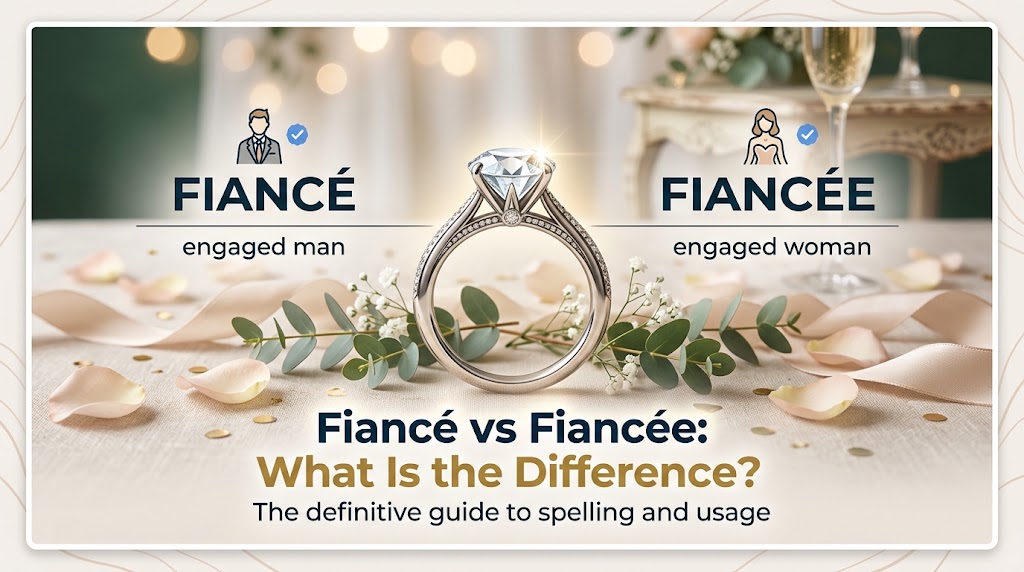
Fiancé and fiancée both mean a person who is engaged to be married, but traditionally they differ by gender:
- Fiancé = a man who is engaged to be married.
- Fiancée = a woman who is engaged to be married.
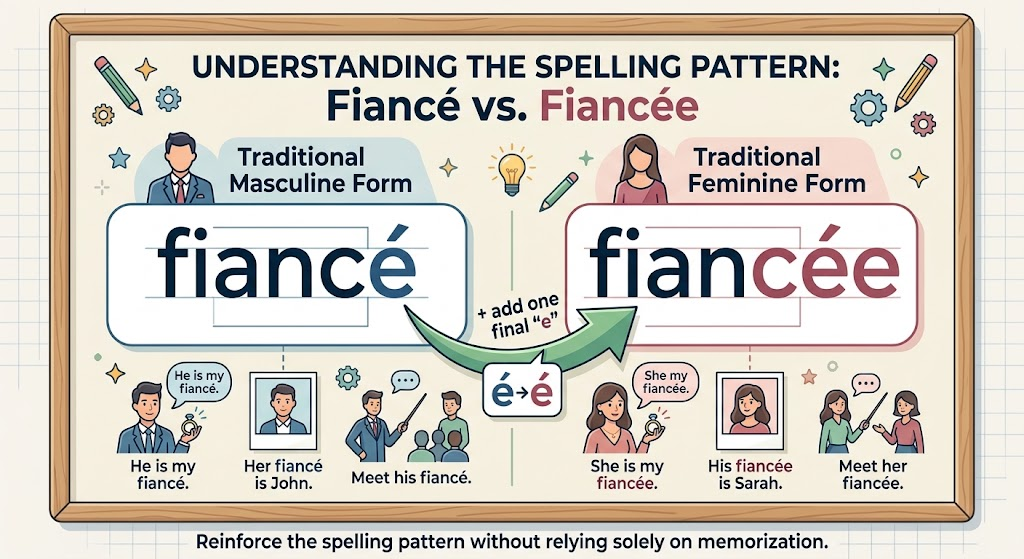
The spelling difference is simple: fiancé ends with é, while fiancée ends with ée.
So, if you are writing about an engaged woman, the traditional spelling is fiancée. If you are writing about an engaged man, use fiancé.
The words are French loanwords used in English, and the accent marks are often retained in careful or formal writing. In informal English, you may also encounter fiance and fiancee without accents.
| Form | Traditional gender | Meaning | Example |
|---|---|---|---|
| fiancé | Male | A man who is engaged to be married | “Her fiancé proposed in June.” |
| fiancée | Female | A woman who is engaged to be married | “His fiancée starts work next week.” |
| fiance | Usually male | Unaccented spelling of fiancé | “I met her fiance yesterday.” |
| fiancee | Usually female | Unaccented spelling of fiancée | “His fiancee lives nearby.” |
| fiancés | Usually male or mixed plural | More than one fiancé | “The two fiancés compared notes.” |
| fiancées | Female plural | More than one fiancée | “The fiancées attended together.” |
The Detailed Difference Between Fiancé and Fiancée
The difference between fiancé and fiancée is primarily grammatical and lexical rather than a difference in the relationship itself.
Both words describe someone who has agreed to marry another person. The distinction comes from the traditional French gender system retained in these English loanwords.
Fiancé traditionally refers to a male person who is engaged.
Daniel is my fiancé.
Here, Daniel is the man who is engaged to the speaker.
Fiancée traditionally refers to a female person who is engaged.
Maria is my fiancée.
Here, Maria is the woman who is engaged to the speaker.
The underlying relationship is identical. Both people are engaged; the traditional spelling simply identifies the person’s gender.
Fiancé: The Male Form
Use fiancé when referring to a man who is engaged to be married.
Examples:
- My fiancé is choosing the wedding venue.
- Her fiancé sent the invitations yesterday.
- I introduced my fiancé to my colleagues.
- His fiancé is moving to London after the wedding.
The final é is part of the conventional spelling.
Fiancée: The Female Form
Use fiancée when referring to a woman who is engaged to be married.
Examples:
- My fiancée is studying for her final exam.
- His fiancée organized the ceremony.
- I met her fiancée at the family dinner. (Incorrect if “her” refers to the woman being engaged; see the pronoun test below.)
- Her fiancée works in the same office.
The feminine form has an additional e at the end:
fiancé → fiancée
That extra e is the feature most learners need to remember.
Is Fiancé Gender Neutral?
Traditionally, fiancé is not gender-neutral in English when the French distinction is preserved.
In standard traditional usage:
- fiancé → male
- fiancée → female
However, actual English usage is more complicated because English increasingly uses gender-neutral language and many speakers are unfamiliar with the original French distinction.
Some writers use fiancé as a general term for an engaged person, while others use fiancée only for women. This means you may encounter fiancé being used without an intended gender distinction.
If gender neutrality is important, the clearest alternatives are:
- my partner
- my future spouse
- the person I am engaged to
- my future husband/wife, where applicable
There is therefore a distinction between traditional correctness and contemporary usage. If you are specifically being tested on the conventional difference between the two words, fiancé = male and fiancée = female remains the expected answer.
Is Fiancée Always Female?
Traditionally, yes.
Fiancée is the feminine form, so conventional usage applies it to a woman who is engaged to be married.
For example:
Her fiancée arrived at the restaurant at seven.
If the engaged person is a man, the traditional form is:
Her fiancé arrived at the restaurant at seven.
If you do not know or do not wish to specify the person’s gender, partner or another gender-neutral expression may be clearer.
Fiancé vs Fiancée: Why Is There an Extra E?
The extra e is not merely an arbitrary English spelling trick.
The words come from French, where grammatical gender affects certain forms. English borrowed the terms while retaining the traditional distinction in spelling.
You do not need to know French grammar to use the English words correctly, though. For practical English writing, the easiest rule is:
Man → fiancé
Woman → fiancée
Do not add an extra e simply because the person is engaged. The spelling depends on the traditional gender distinction.
Fiancé vs Fiancée With and Without Accent Marks
You will see both accented and unaccented versions:
- fiancé
- fiance
- fiancée
- fiancee
The accented forms are the conventional spellings:
fiancé and fiancée
The unaccented versions commonly appear when people are typing without easy access to accented characters, in plain-text environments, or in systems that do not handle diacritics conveniently.
For polished English prose, especially formal or edited writing, fiancé and fiancée are preferable.
Fiancé With an Accent
The standard accented form is:
fiancé
The final character is é, not an ordinary e.
Fiancée With an Accent
The standard accented form is:
fiancée
Notice that the word ends in ée.
That gives you this useful visual distinction:
fiancé → é
fiancée → ée

When to Use Fiancé
Use fiancé when the engaged person is a man and you are following the traditional gendered distinction.
Examples:
My fiancé has already booked the photographer.
Sarah’s fiancé is from Manchester.
I spoke with your fiancé yesterday.
Her fiancé proposed during their holiday.
The groom thanked his fiancé for organizing the reception.
The key question is not whether the person is getting married soon. The key question is who is engaged and, under traditional usage, whether that person is male.
When to Use Fiancée
Use fiancée when the engaged person is a woman.
Examples:
My fiancée loves classical music.
James introduced his fiancée to his parents.
Her fiancée will join us for dinner.
The bride-to-be invited her fiancée’s family to the celebration.
His fiancée accepted the proposal immediately.
Again, the word describes the engaged person, not the person they are engaged to.
That distinction prevents many mistakes.
The Pronoun Test: A Simple Way to Choose
One of the fastest ways to decide between fiancé and fiancée is to replace the word with he or she.
If the sentence would refer to he, use fiancé.
My fiancé is arriving tonight.
He is arriving tonight.
If the sentence would refer to she, use fiancée.
My fiancée is arriving tonight.
She is arriving tonight.
This test is particularly useful when possessive pronouns make the sentence confusing.
Compare:
Emma’s fiancé called.
He called → fiancé.
Emma’s fiancée called.
She called → fiancée.
The possessive word Emma’s does not determine the spelling. The gender of the engaged person does.
Natural Examples in Different Contexts
Everyday Conversation
I’m meeting my fiancé after work.
My fiancée is running late.
Have you met her fiancé?
His fiancée is coming to the party.
Wedding Planning
The bride and her fiancé chose a spring wedding.
The groom and his fiancée are finalizing the guest list.
The couple asked their families to meet.
Workplace Writing
I will be taking Friday off because my fiancée and I are getting married.
My fiancé will relocate with me after the wedding.
In professional contexts, you may also prefer partner if the gender distinction is irrelevant.
Family Conversations
Your sister’s fiancé seems very kind.
Our son’s fiancée is visiting this weekend.
Her fiancé met the entire family yesterday.
Social Media
Can’t wait to marry my fiancé!
Life with my fiancée gets better every day.
For casual posts, people frequently omit accent marks, particularly when typing quickly.
Fiancé vs Fiancée Pronunciation
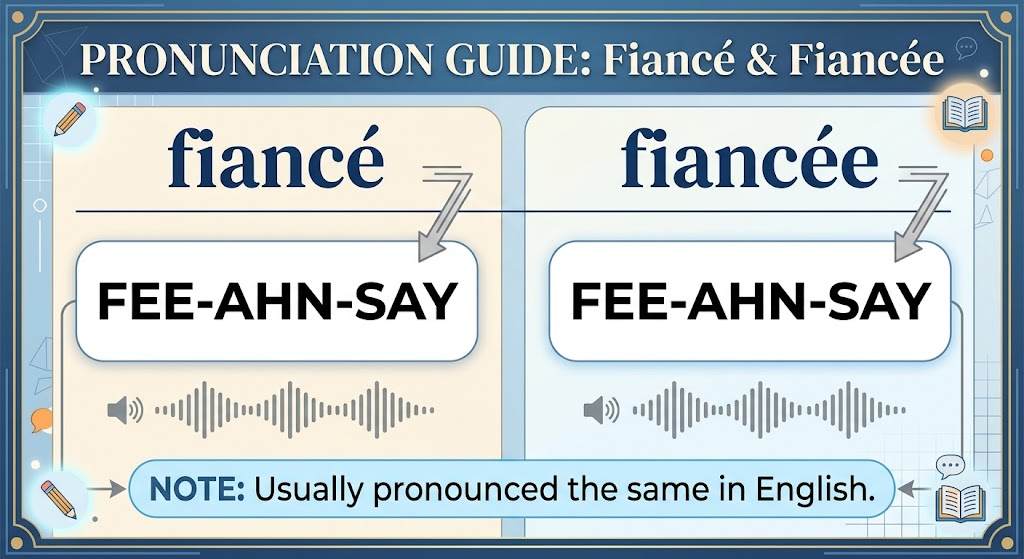
In English, fiancé and fiancée are generally pronounced the same way.
A common pronunciation is approximately:
fee-AHN-say
The final é sound is similar to the vowel sound in the final syllable of café for many English speakers.
The extra written e in fiancée does not normally create a different pronunciation in English.
So:
- fiancé → approximately “fee-AHN-say”
- fiancée → approximately “fee-AHN-say”
The distinction is primarily visible in writing.
Regional accents can produce small differences in vowel quality, stress, or the first syllable, but there is generally no reliable pronunciation difference between the two forms.
Fiancé or Fiancee in British and American English
The traditional distinction between fiancé and fiancée is recognized in both British and American English.
There is no basic British-versus-American rule that reverses the gender distinction.
The bigger variation concerns accent marks and individual usage.
You may see:
- fiancé / fiancée in edited prose
- fiance / fiancee in informal digital writing
- fiancé used more broadly by some speakers
British and American publications may differ in editorial preferences regarding foreign-language accents, but the safest polished spellings remain fiancé and fiancée when you intend the traditional distinction.
Fiancé vs Fiancée in Formal and Casual Writing
In formal writing, preserve the conventional spellings when practical:
The applicant’s fiancé will accompany her to the ceremony.
The speaker’s fiancée attended the reception.
In casual writing, accents may be dropped:
My fiance is picking me up.
My fiancee starts her new job Monday.
Removing the accent does not necessarily mean the writer has confused the two words. It may simply reflect typing conventions.
However, if you are writing an article, academic assignment, professional document, or carefully edited publication, fiancé and fiancée are the better choices.
Common Spelling Mistakes
“Finace” Is Incorrect
A frequent typo is:
My finace is coming tonight.
The correct spelling is:
My fiancé is coming tonight.
The letters a and n appear in the sequence fiancé, not finace.
“Fianceé” Is Usually the Wrong Order
Another common error is:
fianceé
The conventional spelling is:
fiancée
The accented é comes before the final e:
fiancé + e = fiancée
“Fiancee” Is Not a Separate Meaning
The unaccented fiancee is generally just an unaccented rendering of fiancée. The extra final e still distinguishes the traditional feminine form from fiance.
“Fiancé” Does Not Mean Husband
A fiancé is an engaged person, not necessarily a married person.
My fiancé is arriving tonight.
This tells us that the couple is engaged. It does not mean they are already married.
After the wedding, husband or wife may become appropriate, depending on the relationship.
“Fiancée” Does Not Mean Wife
Similarly, fiancée means an engaged woman, not a married woman.
His fiancée attended the ceremony.
This indicates an engagement, although the context could describe events immediately before the wedding.
“Fiancé” Does Not Mean Boyfriend
A boyfriend may not be engaged to the speaker. A fiancé specifically refers to someone who is engaged to be married.
Compare:
Alex is my boyfriend.
with:
Alex is my fiancé.
The second statement communicates a more specific relationship status.

Fiancé or Fiancée: A Fast Decision Rule
Use this three-second test:
Step 1: Who is the engaged person?
Step 2: Is that person male or female, if you are using the traditional distinction?
Step 3: Choose the spelling.
- Engaged man → fiancé
- Engaged woman → fiancée
- Gender does not need to be specified → partner or another neutral expression
A compact memory formula is:
One final E = fiancé
Two final E letters = fiancée
More precisely, when written without the accent:
- fiance → one final e
- fiancee → two final e letters
With accents:
- fiancé → é
- fiancée → ée
A Practical Proofreading Test
When proofreading, temporarily replace the word with engaged man or engaged woman.
For example:
My ______ is arriving at six.
If you mean:
My engaged man is arriving at six.
then the traditional form is fiancé.
If you mean:
My engaged woman is arriving at six.
then the traditional form is fiancée.
An even more natural test is the pronoun substitution:
he → fiancé
she → fiancée
This works because the traditional spelling difference corresponds to the masculine/feminine distinction.
What Is the Plural of Fiancé?
The traditional plural of fiancé is:
fiancés
Example:
The two fiancés met for dinner.
The plural of fiancée is:
fiancées
Example:
Several fiancées attended the bridal workshop.
Without accent marks, you may see:
- fiances
- fiancees
These forms preserve the spelling distinction but omit the diacritics.
For mixed groups, context matters. English can also avoid the issue entirely by saying engaged couples, engaged partners, or people who are engaged.
What About “Fiancé” as a Gender-Neutral Word?
This is one of the genuine edge cases.
English is not French, and borrowed words do not always preserve every feature of their original language. Some English speakers use fiancé more broadly as a general term for an engaged partner, regardless of gender.
That usage exists, but it does not erase the traditional distinction.
If your goal is:
- traditional usage → fiancé for a man, fiancée for a woman
- maximum clarity → use fiancé/fiancée according to the person’s gender
- gender-neutral wording → use partner or future spouse
There is no need to force a gendered loanword when gender is irrelevant to the sentence.
Can Fiancé Refer to a Woman?
In contemporary English, you may encounter fiancé used for women, especially in informal writing or among speakers who treat the word as gender-neutral.
That does not make fiancée meaningless.
If an editor asks for the traditional distinction, the expected answer remains:
fiancé = male
fiancée = female
For formal writing where the distinction is useful, following the conventional forms is the clearest approach.
Can Fiancée Refer to a Man?
Under traditional usage, fiancée refers to a woman.
Using fiancée for a man conflicts with the conventional gender distinction retained in English.
If you want a gender-neutral term, fiancé is sometimes used broadly in contemporary English, but partner is less ambiguous.
Fiancé vs Fiancée: Context Can Matter More Than the Word
Consider:
Taylor’s fiancé arrived at the airport.
The word fiancé conventionally tells the reader that Taylor’s engaged partner is male.
Now consider:
Taylor’s partner arrived at the airport.
This tells us nothing about the partner’s gender.
This difference can be useful. Choose the form that communicates exactly what you intend rather than automatically choosing the spelling based on the gender of the person speaking.
For example, a woman can have a fiancé, and a man can have a fiancée.
The gender of the speaker does not determine the word.
The Speaker’s Gender Does Not Decide the Spelling
This is a particularly important point.
A woman may say:
My fiancé is a doctor.
because her engaged partner is a man.
A man may say:
My fiancée is a doctor.
because his engaged partner is a woman.
Therefore, do not use fiancée simply because a woman is saying the sentence. The word describes the engaged partner, not the speaker.
“Fiancé Meaning Wife” and Similar Confusions
Searches sometimes ask whether fiancé means wife or whether fiancée means husband.
Neither does.
The basic meanings are:
- fiancé = an engaged man
- fiancée = an engaged woman
- husband = a married man
- wife = a married woman
The relationship status changes from engagement to marriage, so the terms are not interchangeable.
Fiancé vs Fiancée in Irish English and Other Varieties
The words are established English loanwords and are widely recognizable across English-speaking regions.
Regional differences are more likely to involve pronunciation, whether accents are retained in everyday writing, and whether speakers maintain the traditional gender distinction than a completely different definition.
If you are writing for an international English audience, fiancé and fiancée are the safest conventional forms.
Frequently Asked Questions
What is the correct spelling for fiancé?
The traditional spelling is fiancé, with an accented é at the end.
What is the female spelling of fiancé?
The traditional feminine form is fiancée, spelled with an additional final e: fiancée.
Is fiancé male or female?
Traditionally, fiancé refers to a male person who is engaged to be married.
Is fiancée male or female?
Traditionally, fiancée refers to a female person who is engaged to be married.
Is fiancé gender neutral?
Traditionally, no. It is the masculine form. However, some contemporary English speakers use fiancé more broadly as a gender-neutral term. Partner is clearer when gender neutrality is important.
What is the difference between fiancé and fiancée?
The traditional difference is gender: fiancé refers to an engaged man, while fiancée refers to an engaged woman.
How do you spell fiancé?
Spell it fiancé in the conventional accented form.
How do you spell fiancée for a woman?
Spell it fiancée. Without the accent, it is fiancee.
Does fiancé have one or two e’s?
In the unaccented spelling fiance, there is one final e. The conventional accented form is fiancé, ending in é.
Does fiancée have two e’s?
The unaccented spelling fiancee has two final e letters. The conventional accented spelling is fiancée, ending in ée.
Are fiancé and fiancée pronounced differently?
Usually not in English. They are generally pronounced essentially the same way, approximately fee-AHN-say.
Can I write fiance without the accent?
Yes. Fiance is commonly encountered as an unaccented form, especially in informal or plain-text writing. In polished writing, fiancé is preferable.
Can I write fiancee without the accent?
Yes. Fiancee is a common unaccented rendering of fiancée. In edited prose, fiancée is the conventional spelling.
What is the plural of fiancé?
The traditional plural is fiancés.
What is the plural of fiancée?
The traditional plural is fiancées.
What is the opposite of fiancé?
There is no true grammatical “opposite.” Depending on what you mean, possible contrasts include fiancée as the traditional feminine counterpart or husband/wife when contrasting engagement with marriage.
Is fiancé a French word?
Yes. Fiancé and fiancée are French-derived terms that English has adopted as loanwords.
Which is correct: fiancé or fiancee?
Both can be correct depending on the intended person and spelling convention. Fiancé is the traditional masculine form; fiancée is the traditional feminine form. The unaccented fiancee represents the latter without the accent.
Which is correct: fiancée or fiancé for a woman?
For a woman, the traditional form is fiancée.
Which is correct: fiancé or fiancée for a man?
For a man, the traditional form is fiancé.
Is “finace” correct?
No. Finace is a common misspelling. The correct forms are fiancé and fiancée.
What does fiancé and fiancée mean?
Both refer to someone who is engaged to be married. Traditionally, fiancé is masculine and fiancée is feminine.

Final Takeaway
The traditional distinction is straightforward:
Fiancé = an engaged man
Fiancée = an engaged woman
The spelling clue is equally useful:
fiancé → final é
fiancée → final ée
Both words normally have the same pronunciation in English, so the difference is primarily visible in writing. The accent marks are conventional in polished English, while fiance and fiancee are also widely encountered without diacritics.
If gender is irrelevant or you want explicitly gender-neutral language, partner or future spouse may be clearer.
The best proofreading rule is simple: look at the person being described, not the person speaking. If that person is traditionally described as male, choose fiancé; if female, choose fiancée.
Relevant Internal-Link Suggestions
- Fiancé vs Fiancée Pronunciation Guide — link from the pronunciation section to a dedicated explanation of stress and vowel sounds.
- Boyfriend vs Fiancé — useful for readers confusing relationship status with engagement.
- Husband vs Fiancé — useful for distinguishing engagement from marriage.
- Fiancée Meaning and Examples — a focused guide for readers specifically searching for the feminine form.
- Commonly Confused English Words — a broader educational hub for spelling and word-choice questions.
- Gender-Neutral Relationship Terms in English — useful for readers interested in contemporary alternatives such as partner and future spouse.