Hasn’t vs Haven’t: What’s the Difference and When to Use Each?
Quick Answer
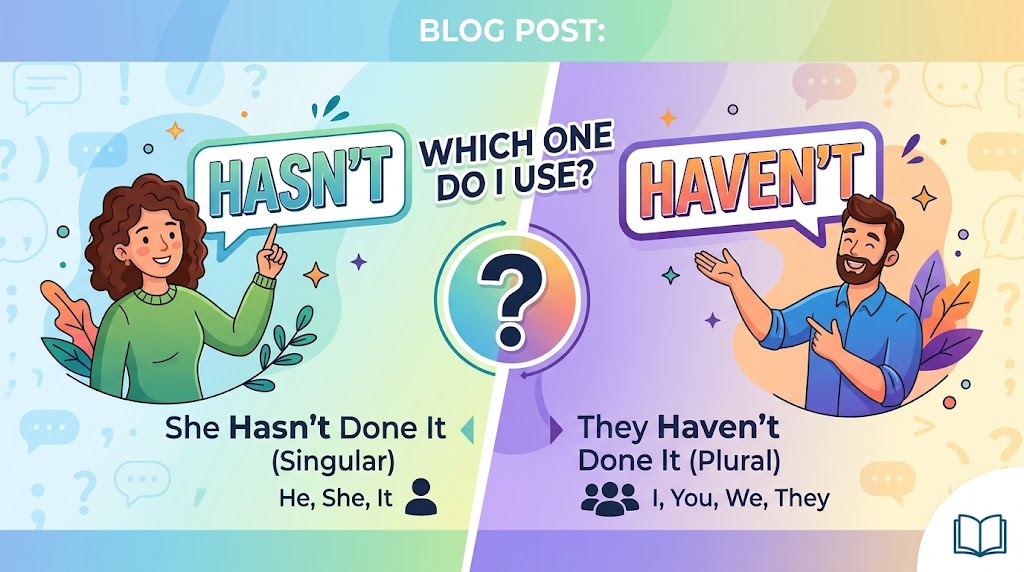
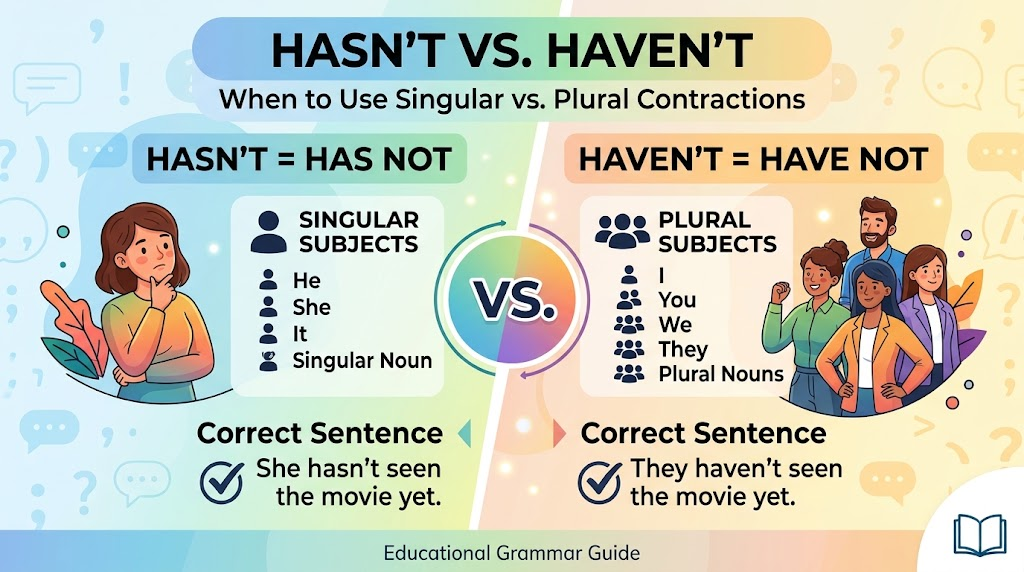
The difference between hasn’t and haven’t is simple: the correct choice depends on the subject.
- Hasn’t means has not and is generally used with he, she, it, and singular nouns.
- Haven’t means have not and is used with I, you, we, they, and plural nouns.
For example:
- She hasn’t finished her work. ✅
- He hasn’t called me. ✅
- It hasn’t stopped raining. ✅
- I haven’t finished my work. ✅
- We haven’t received the email. ✅
- They haven’t arrived yet. ✅
The quickest way to decide is to expand the contraction. If has not sounds correct, use hasn’t. If have not sounds correct, use haven’t.
Hasn’t vs Haven’t at a Glance
| Feature | Hasn’t | Haven’t |
|---|---|---|
| Full form | Has not | Have not |
| Base auxiliary | Has | Have |
| Common subjects | He, she, it | I, you, we, they |
| Noun agreement | Singular nouns | Plural nouns |
| Example | She hasn’t arrived. | They haven’t arrived. |
| Standard spelling | hasn’t | haven’t |
| Typical use | Negative present perfect and related structures | Negative present perfect and related structures |
| Formal alternative | has not | have not |
Both hasn’t and haven’t are contractions. They are not different parts of speech with unrelated meanings. The real grammatical difference comes from the forms has and have.
The Detailed Difference Between Hasn’t and Haven’t
Hasn’t is the contracted form of has not.
Haven’t is the contracted form of have not.
In many sentences, has and have function as auxiliary verbs that help form the present perfect.
The basic patterns are:
Subject + has + past participle
Subject + have + past participle
To make these structures negative, add not:
- She has not finished.
- She hasn’t finished.
- They have not finished.
- They haven’t finished.
The past participle does not determine whether you use hasn’t or haven’t. The subject determines the correct form.
Compare:
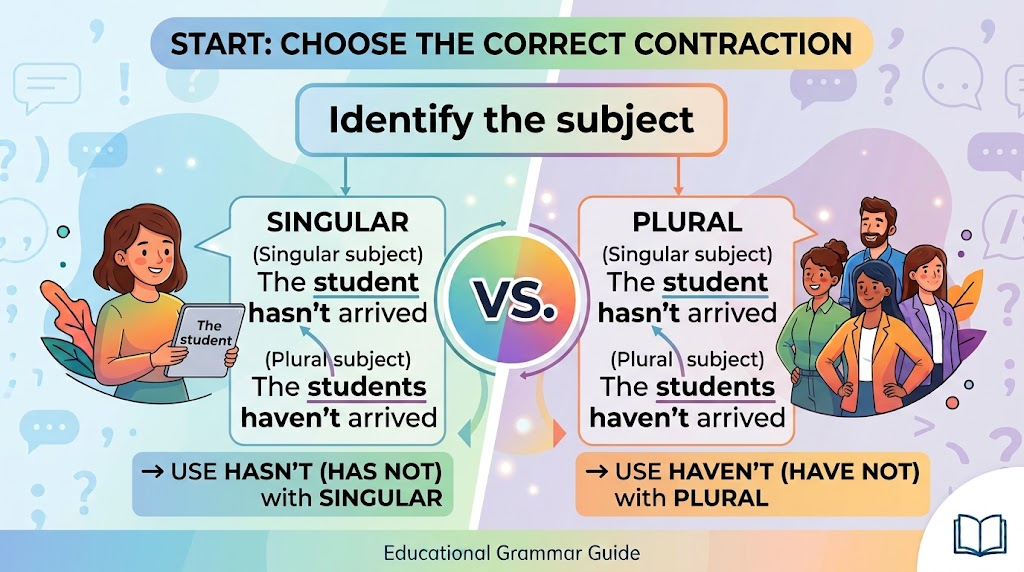
- My sister hasn’t eaten yet.
- My sisters haven’t eaten yet.
The verb form changes because sister is singular while sisters is plural.
This is the central grammar rule behind hasn’t vs haven’t, hasnt or havent, and haven’t or hasn’t.
When to Use Hasn’t
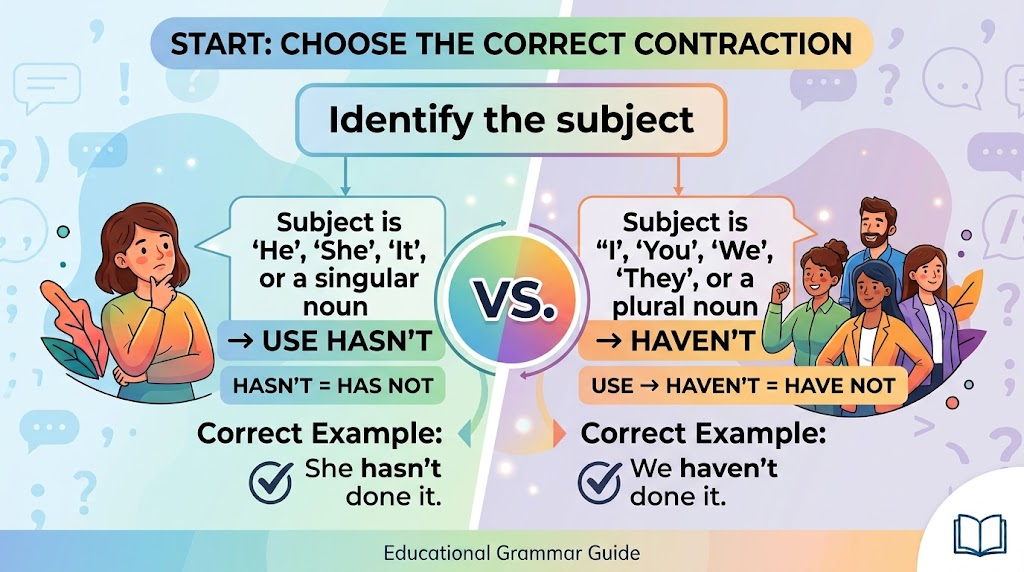
Use hasn’t when the subject takes has.
With He
- He hasn’t answered my question.
- He hasn’t been feeling well today.
- No, he hasn’t finished yet.
The phrase “no, he hasn’t” is a correct short answer when responding to a question using has.
For example:
Has he arrived?
No, he hasn’t.
With She
- She hasn’t called since Monday.
- She hasn’t posted in a while.
- She hasn’t tried the new software yet.
- No, she hasn’t seen it.
For example:
Has she replied to your message?
No, she hasn’t.
The phrase “no she hasn’t” is common in informal writing, although punctuation usually makes the meaning clearer:
No, she hasn’t.
With It
Use hasn’t with it:
- It hasn’t started yet.
- It hasn’t worked properly all week.
- It hasn’t stopped snowing.
This explains why “it hasn’t” is correct while “it haven’t” is not standard English.
With Singular Nouns
Singular nouns normally take hasn’t:
- The manager hasn’t approved the request.
- My phone hasn’t charged properly.
- The movie hasn’t started yet.
- The company hasn’t released its statement.
A useful comparison is:
- The student hasn’t arrived. Singular
- The students haven’t arrived. Plural
When to Use Haven’t
Use haven’t when the subject takes have.
With I
- I haven’t finished the book yet.
- I haven’t tried that before.
- I haven’t had lunch.
- I haven’t been there in years.
The phrase “I haven’t” is correct.
Incorrect:
- I hasn’t finished. ❌
Correct:
- I haven’t finished. ✅
With You
Use haven’t with you, whether you are speaking to one person or more than one person.
- You haven’t answered the question.
- You haven’t seen the final version yet.
This remains true because modern standard English uses have with you.
With We
- We haven’t made a decision yet.
- We haven’t received the documents.
- We haven’t had any difficulties so far.
- We haven’t been informed about the change.
The spelling “we havent” is incorrect because the apostrophe is missing.
The correct form is:
We haven’t
With They
- They haven’t arrived yet.
- They haven’t tried the new feature.
- They haven’t contacted us.
- They haven’t been told about the schedule change.
The phrase “they haven’t” is correct because they takes have.
With Plural Nouns
Plural nouns take haven’t:
- The children haven’t gone to bed yet.
- My friends haven’t replied.
- The files haven’t uploaded successfully.
- The teachers haven’t announced the results.
Examples of Hasn’t and Haven’t by Context
Talking About Something That Has Not Happened Yet
Both contractions are frequently used when something has not happened up to the present moment.
- She hasn’t arrived yet.
- They haven’t arrived yet.
- The package hasn’t arrived.
- We haven’t received the package.
The meaning often involves an expectation that something may happen later.
Talking About Experience
- He hasn’t visited Japan before.
- I haven’t visited Japan before.
- She hasn’t tried skiing.
- We haven’t tried skiing.
The subject determines hasn’t or haven’t, while the rest of the present perfect structure remains similar.
Talking About Recent Actions
- She hasn’t called me today.
- I haven’t called her today.
- The team hasn’t announced the result.
- The players haven’t announced their plans.
Talking About Ongoing Situations
- It hasn’t improved.
- Things haven’t improved.
- He hasn’t been working recently.
- We haven’t been working together for long.
With Been
Many learners search for phrases such as “haven’t been” or “hasn’t been.”
Both are correct, depending on the subject:
- She hasn’t been home all day.
- I haven’t been home all day.
- The computer hasn’t been working.
- The computers haven’t been working.
With Had
Both forms can also appear before had in present perfect structures:
- She hasn’t had time to call.
- I haven’t had time to call.
- They haven’t had any problems.
The phrase “haven’t had” is completely normal. The first have is an auxiliary verb, while had is the past participle of have.
For example:
I haven’t had breakfast.
This means I have not had breakfast.
Hasn’t vs Haven’t With Short Answers
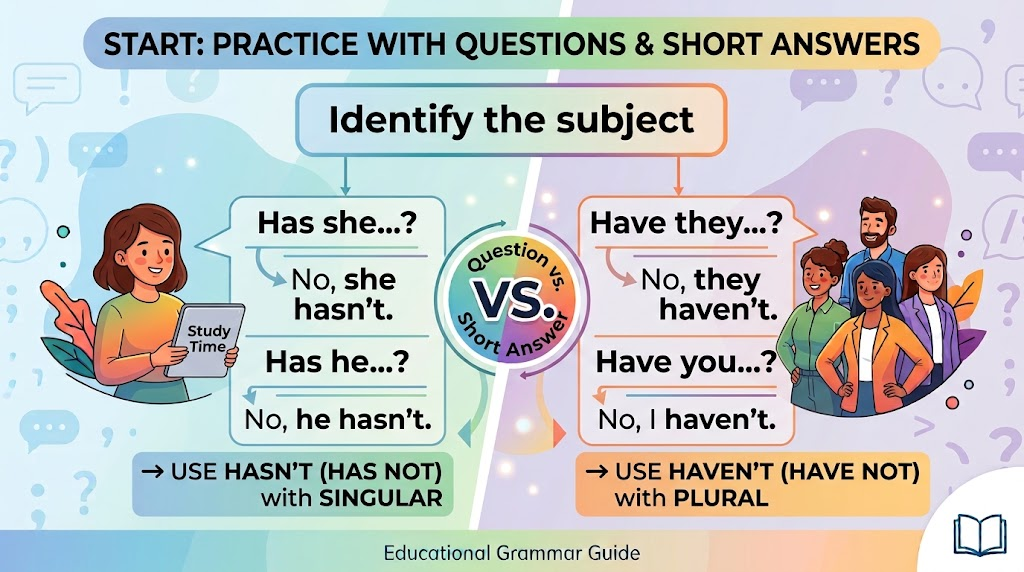
Short answers follow the same subject–auxiliary agreement rules.
Has she arrived?
Yes, she has.
No, she hasn’t.
Has he finished?
Yes, he has.
No, he hasn’t.
Have they arrived?
Yes, they have.
No, they haven’t.
Have you finished?
Yes, I have.
No, I haven’t.
This is why phrases such as “no, I haven’t,” “no, she hasn’t,” and “no, he hasn’t” are correct.
Common Mistakes: Hasn’t, Haven’t, Hasnt, and Havent
Mistake 1: Using Hasn’t With I
Incorrect:
I hasn’t finished yet. ❌
Correct:
I haven’t finished yet. ✅
Why? I takes have, not has.
Mistake 2: Using Haven’t With She
Incorrect:
She haven’t finished yet. ❌
Correct:
She hasn’t finished yet. ✅
Why? She takes has in the present perfect.
Mistake 3: Writing Hasnt or Havent Without an Apostrophe
Incorrect in standard English:
- hasnt ❌
- havent ❌
- we havent ❌
- i havent ❌
Correct:
- hasn’t ✅
- haven’t ✅
- we haven’t ✅
- I haven’t ✅
The apostrophe replaces omitted letters.
has not → hasn’t
have not → haven’t
Mistake 4: Writing Havn’t
A common spelling question is “havn’t or haven’t?”
The correct spelling is:
haven’t ✅
These are incorrect:
- havn’t ❌
- havnt ❌
- have’nt ❌
- hav’nt ❌
- hasen’t ❌
The apostrophe belongs between the n and t because the contraction removes letters from not.
Mistake 5: Saying “I Haven’t Try”
Incorrect:
I haven’t try it. ❌
Correct:
I haven’t tried it. ✅
After has/have in the present perfect, English normally uses the past participle.
- haven’t tried
- hasn’t finished
- haven’t seen
- hasn’t gone
This is why searches such as “I haven’t try” usually involve a second grammar problem beyond the choice between hasn’t and haven’t.
Mistake 6: Confusing Didn’t and Haven’t
Compare:
I didn’t call her yesterday.
I haven’t called her yet.
Both sentences are negative, but they are not interchangeable.
Didn’t is generally used with the simple past and often refers to a finished past time.
Haven’t forms the present perfect and connects the past action or lack of action to the present.
This distinction matters when deciding between didn’t or haven’t.
Mistake 7: Using “Haven’t” When the Sentence Needs “Hasn’t”
Incorrect:
There haven’t been a problem. ❌
Correct:
There hasn’t been a problem. ✅
Here, a problem is singular.
But:
There haven’t been any problems. ✅
The noun phrase after there helps determine whether a singular or plural form is appropriate.
This is one of the useful edge cases in the hasn’t vs haven’t discussion.
How to Spell Hasn’t and Haven’t Correctly
If you are wondering how to spell haven’t, the standard spelling is:
h-a-v-e-n-‘ -t
→ haven’t
If you are wondering how to spell hasn’t, the standard spelling is:
h-a-s-n-‘ -t
→ hasn’t
The full forms are:
- has not
- have not
Avoid spellings such as:
- hasnt
- havent
- havnt
- havn’t
- have’nt
- hasen’t
These may appear in informal typing, search queries, or unedited messages, but they are not standard spellings.
Pronunciation of Hasn’t and Haven’t
In ordinary speech:
- hasn’t is commonly pronounced approximately HAZ-ənt
- haven’t is commonly pronounced approximately HAV-ənt
Pronunciation varies somewhat according to accent and speaking speed, but the spelling distinction remains the same.
The important pronunciation point is that contractions are natural in spoken English. Native speakers commonly use:
- She hasn’t…
- I haven’t…
- They haven’t…
In careful speech, speakers may choose the full forms has not and have not for emphasis.
For example:
She hasn’t called me. Neutral statement.
She has not called me. More formal or potentially more emphatic.
A Fast Decision Rule for Hasn’t vs Haven’t
Use this quick checklist.
Step 1: Find the subject
Ask: Who or what is the sentence talking about?
Step 2: Replace the contraction
Would you say has not or have not?
Step 3: Match the subject
Use hasn’t with:
- he
- she
- it
- singular nouns
Use haven’t with:
- I
- you
- we
- they
- plural nouns
Step 4: Check the verb form
In present perfect sentences, the next verb usually needs to be a past participle.
Correct:
- She hasn’t gone.
- I haven’t gone.
- They haven’t tried it.
Incorrect:
- She hasn’t go.
- I haven’t try.
- They haven’t went.
A Practical Proofreading Test
When proofreading, temporarily expand the contraction.
Take this sentence:
She hasn’t completed the form.
Expand it:
She has not completed the form.
That works, so hasn’t is correct.
Now consider:
We haven’t completed the form.
Expand it:
We have not completed the form.
That works, so haven’t is correct.
This expansion test is one of the easiest ways to catch mistakes.
Ask yourself:
Would I naturally write has not or have not here?
Your answer usually gives you the correct contraction.

An Easy Memory Trick for Hasn’t vs Haven’t
A useful memory pattern is:
HE, SHE, IT → HAS
Therefore:
HE, SHE, IT → HASN’T
Then remember:
I, YOU, WE, THEY → HAVE
Therefore:
I, YOU, WE, THEY → HAVEN’T
You can also remember the familiar pairs:
- She has → She hasn’t
- He has → He hasn’t
- I have → I haven’t
- They have → They haven’t
The contraction simply follows the same grammar as the full form.
Formal vs Casual Usage
Hasn’t and haven’t are standard English contractions. They are not incorrect or automatically too informal.
They are common in:
- everyday conversation
- emails
- articles
- blogs
- journalism
- general business communication
- fiction
Examples:
- We haven’t received your request yet.
- The company hasn’t announced a decision.
In highly formal, legal, academic, or deliberately emphatic writing, some writers prefer the full forms:
- We have not received your request.
- The company has not announced a decision.
The choice is often one of register and style, not grammar.
A contraction can sound more natural and conversational, while the full form may sound more formal or emphatic.
British English vs American English
The basic distinction between hasn’t and haven’t is the same in British and American English.
However, related present perfect usage can sometimes differ.
British English often uses the present perfect in situations where American English may also accept the simple past.
For example, British English commonly says:
I haven’t eaten yet.
American English also commonly says this.
But in some contexts, American English is more comfortable with a simple past form where British English strongly favors the present perfect.
The rule for choosing hasn’t or haven’t, however, does not change:
- She hasn’t…
- I haven’t…
- They haven’t…
Another related difference involves gotten.
American English commonly uses gotten as the past participle of get in many contexts:
I haven’t gotten the email yet.
British English more commonly uses:
I haven’t got the email yet.
However, British usage varies by meaning and context, and got can have several functions. The important point is that both dialects still use haven’t because the subject is I.
Similarly:
- She hasn’t gotten the email yet. Common in American English.
- She hasn’t got the email yet. Common in British English.
The choice between got and gotten is separate from the hasn’t vs haven’t rule.
Hasn’t and Haven’t With “Got”
The phrase haven’t got can confuse learners because have may carry different meanings in different structures.
For possession, British English commonly uses:
I haven’t got any money with me.
American English may also use this, although:
I don’t have any money with me.
is also very common.
With a singular third-person subject:
She hasn’t got any money with her.
The grammar remains consistent:
- I haven’t got
- You haven’t got
- We haven’t got
- They haven’t got
- He hasn’t got
- She hasn’t got
Important Edge Cases
“Everyone” and Other Indefinite Pronouns
Words such as everyone, someone, and nobody are generally grammatically singular.
Therefore:
Everyone hasn’t received the email.
can be grammatically formed with hasn’t, but it may create a meaning problem.
It can suggest that not everyone received the email, rather than that nobody received it.
For clarity, you might write:
- Not everyone has received the email.
- Nobody has received the email yet.
This is a good example of why grammatical correctness alone does not always produce the clearest sentence.
Collective Nouns
Collective nouns can vary between British and American usage.
For example:
The team hasn’t made its decision. Common when the team is treated as one unit.
In British English, collective nouns may sometimes be treated as plural when emphasizing individual members:
The team haven’t agreed on their positions.
This is more common in British usage than in American English.
Therefore, the choice can occasionally depend on whether the collective noun is treated as singular or plural.
“There Hasn’t” vs “There Haven’t”
Use singular agreement with a singular noun:
There hasn’t been a response.
Use plural agreement with plural nouns:
There haven’t been any responses.
This explains why searches such as “there hasn’t” can involve agreement with the noun that follows the existential structure.
Questions With Who
Questions with who can require attention to what who refers to.
Who hasn’t completed the form?
This treats who as the subject and normally uses a singular form in standard constructions.
But if the question structure changes:
Who haven’t you invited?
the subject is you, so haven’t is used.
This is why questions resembling “who haven’t or hasn’t?” cannot always be answered by looking at the word who alone. You must identify the actual grammatical subject and sentence structure.
Frequently Asked Questions
What does hasn’t mean?
Hasn’t means has not.
Example:
She hasn’t arrived yet.
This means:
She has not arrived yet.
What does haven’t mean?
Haven’t means have not.
Example:
I haven’t finished yet.
This means:
I have not finished yet.
Is it “hasn’t or haven’t” with I?
Use haven’t.
I haven’t finished. ✅
Never use I hasn’t in standard English.
Is it “hasn’t or haven’t” with she?
Use hasn’t.
She hasn’t finished. ✅
Not:
She haven’t finished. ❌
Is “they haven’t” correct?
Yes.
They haven’t arrived yet.
Because they takes have.
Is “you haven’t” correct?
Yes.
You haven’t told me yet.
Both singular and plural you take have.
How do you spell haven’t?
The correct spelling is haven’t.
It is the contraction of have not.
How do you spell hasn’t?
The correct spelling is hasn’t.
It is the contraction of has not.
Is “havn’t” correct?
No. The correct spelling is haven’t.
havn’t is not standard English spelling.
Is “hasnt” correct?
No, not in standard edited English. The correct spelling is hasn’t, with an apostrophe.
Can I use hasn’t and haven’t in formal writing?
Yes, in many forms of standard writing. However, some highly formal styles prefer has not and have not.
The decision is usually about tone and style rather than correctness.
Is “I haven’t try” correct?
No.
Use:
I haven’t tried.
The present perfect requires the appropriate past participle.
What is the difference between “I didn’t” and “I haven’t”?
I didn’t usually refers to a completed past situation:
I didn’t call yesterday.
I haven’t connects the situation to the present:
I haven’t called yet.
The correct choice depends on the time reference and meaning.
Final Takeaway
The difference between hasn’t vs haven’t comes down primarily to subject–verb agreement.
Use hasn’t when the subject takes has:
- he hasn’t
- she hasn’t
- it hasn’t
- the student hasn’t
Use haven’t when the subject takes have:
- I haven’t
- you haven’t
- we haven’t
- they haven’t
- the students haven’t
Remember the simplest proofreading test: expand the contraction.
If has not works, use hasn’t.
If have not works, use haven’t.
Then check the rest of the sentence, especially the verb that follows. In present perfect structures, you usually need a past participle, which is why “I haven’t tried” is correct but “I haven’t try” is not.
Once you identify the subject and understand the difference between has and have, choosing between hasn’t and haven’t becomes straightforward in most situations.