Better Understand vs Understand Better: What Is the Difference?
Quick Answer
“Better understand” and “understand better” are both grammatically correct, but they place the emphasis differently.
- Better understand is the more common choice when better modifies the degree or quality of understanding. It is especially natural before an object: I want to better understand the problem.
- Understand better is also correct, particularly when better comes after the verb, often with an object or comparison: I understand the problem better now.
- In many sentences, the two forms communicate essentially the same idea: to understand something more clearly, accurately, or completely.
The easiest rule is this:
Before an object, “better understand” is often the smoother choice. After an object or at the end of the clause, “understand better” is often natural.
For example:
- I want to better understand your point.
- I understand your point better now.
Neither form is inherently wrong. The best choice depends on sentence structure, emphasis, and style.

At-a-Glance Table
| Feature | Better understand | Understand better |
|---|---|---|
| Basic meaning | Understand more clearly or completely | Understand more clearly or completely |
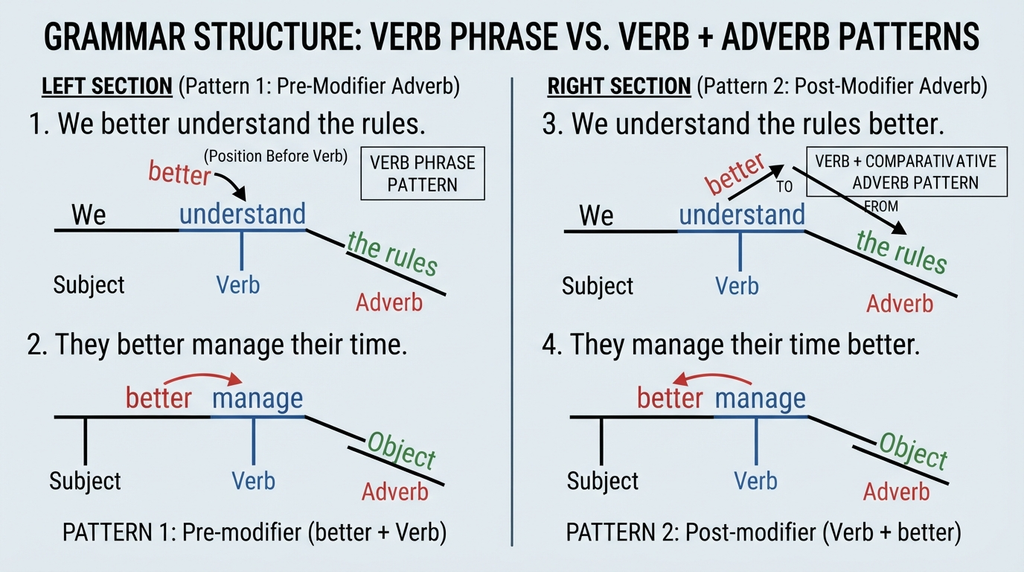
| Grammar | Verb phrase | Verb + adverb |
| Common pattern | better understand + object | understand + object + better |
| Example | I want to better understand the rules. | I understand the rules better now. |
| Correct? | Yes | Yes |
| Common in formal writing | Yes | Yes |
| Common in everyday English | Very common | Very common |
| Main emphasis | Improved understanding as the goal | The resulting degree of understanding |
| British vs American English | Both varieties use it | Both varieties use it |
| Usually interchangeable? | Often | Often, but sentence structure can favor one |
Better Understand vs Understand Better: The Detailed Difference
The word better is a comparative form of well when it describes how successfully an action is performed. In these expressions, it means to a greater degree or with greater clarity than before, or than another level of understanding.
The central difference is not meaning but position and sentence structure.
“Better understand”
In better understand, better comes before the main verb understand. This construction is particularly common when understand is followed by an object.
Examples:
- I want to better understand the situation.
- This example will help you better understand the difference.
- We need to better understand what caused the error.
- She is trying to better understand her customers.
- Reading the background information helped me better understand the issue.
Here, better understand functions naturally as a unit meaning understand more fully or clearly.
The construction is especially useful after verbs such as:
- want
- need
- help
- try
- hope
- seek
- aim
For example:
We need to better understand the customer’s concern.
The sentence presents improved understanding as something the speakers need to achieve.
“Understand better”
In understand better, better follows understand. This arrangement is particularly natural when the sentence describes someone’s current or improved level of understanding.
Examples:
- I understand the topic better now.
- She understands him better than I do.
- After the explanation, they understood the instructions better.
- I understand why you were upset much better now.
- He understands the process better after working with the team.
Here, better tells us how well the person understands something.
Compare:
I want to better understand the process.
with:
I understand the process better now.
The first describes a goal. The second describes an improved result or state.
When to Use “Better Understand”
Use better understand when you are talking about gaining, improving, or developing understanding.
After “want”
I want to better understand how this system works.
This is one of the most natural contexts for the construction.
After “need”
We need to better understand the customer’s expectations.
The sentence presents understanding as a necessary objective.
After “help”
The diagram helps students better understand the concept.
This construction is particularly common in educational and explanatory writing.
After “try”
She is trying to better understand why the results changed.
The phrase emphasizes an effort to achieve greater understanding.
With “to”
The researcher collected more data to better understand the pattern.
Here, to better understand expresses purpose: the additional data was collected in order to understand the pattern more fully.
This pattern is extremely common in academic, technical, professional, and general explanatory writing.
With an indirect question
The interview helped us better understand what happened.
The construction works naturally before clauses beginning with what, why, how, when, and whether.
Examples:
- We need to better understand why the software failed.
- The survey helps us better understand how readers behave.
- She wants to better understand whether the change was necessary.
When to Use “Understand Better”
Use understand better when you are describing an improved level of understanding, particularly when the sentence contains words such as now, after, than, or much.
With “now”
I understand the instructions better now.
The word now makes the change in understanding especially clear.
With a comparison
I understand this explanation better than the first one.
Here, better explicitly compares two levels of understanding.
With “much,” “far,” or “a little”
Comparative forms can be strengthened or softened:
- I understand it much better now.
- She understands the situation far better than I do.
- I understand the process a little better after seeing the example.
After gaining new information
After reading the report, I understand the decision better.
The sentence focuses on the improved understanding that resulted from the new information.
Examples by Context
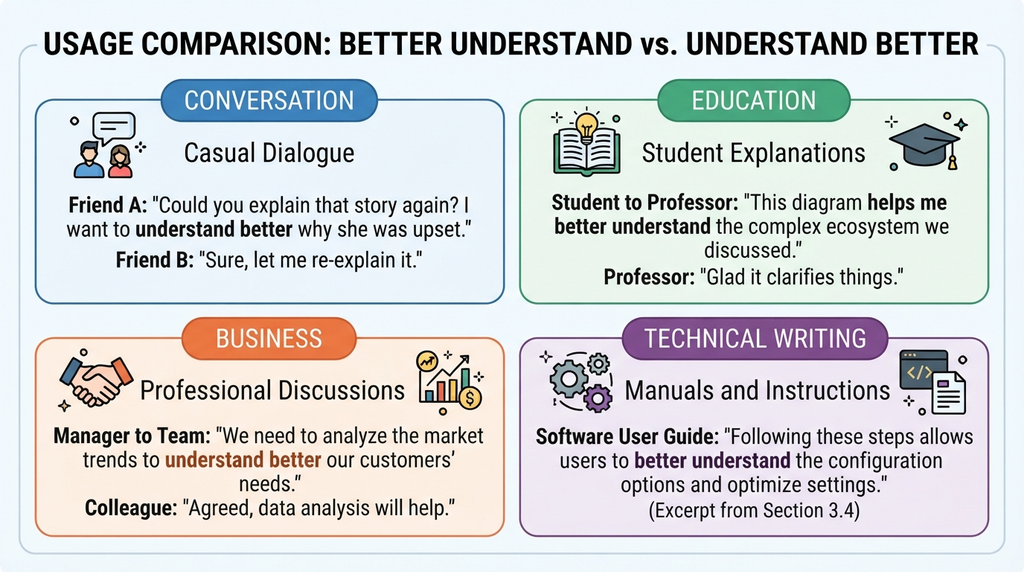
Everyday conversation
Both forms sound natural in ordinary speech.
I want to better understand what you mean.
I understand what you mean better now.
If you are asking someone for clarification, understand better can sound especially natural:
Can you explain that so I can understand it better?
This is a very common conversational pattern.
Education
Teachers and students use both constructions frequently.
The experiment helps students better understand chemical reactions.
After the experiment, students understand the reaction better.
The first focuses on the educational purpose. The second focuses on the learning outcome.
Business writing
We conducted interviews to better understand customer needs.
This construction is concise and natural in reports, presentations, and research writing.
You could also write:
The interviews gave us a better understanding of customer needs.
That version changes the grammar from a verb phrase to a noun phrase, but the basic idea remains similar.
Academic writing
Further research is needed to better understand the relationship between the two variables.
This is a common academic structure because it describes the purpose of future research.
Another possibility is:
The relationship between the variables is now better understood.
This is a passive construction and shifts attention away from the researchers.
Technical writing
The following diagram will help you better understand the data flow.
This is often clearer than using a complicated noun phrase such as facilitate an improved understanding of the data flow.
Good technical writing usually favors the simpler construction when it communicates the idea precisely.
“To Better Understand” vs “To Understand Better”
Both forms are grammatical:
I read the article to better understand the issue.
I read the article to understand the issue better.
The difference is mainly one of word placement and style, not meaning.
To better understand is compact and very common in formal, academic, professional, and explanatory prose.
To understand better can sound more conversational and may be especially natural when the object is followed by better:
I read the article to understand the issue better.
Neither sentence needs to be “corrected.”
However, avoid assuming that better understand must always be used simply because it sounds more formal. English allows both patterns.
“I Understand Better” vs “I Better Understand”
These forms deserve special attention.
I understand better now.
This is completely natural.
I better understand the issue now.
This is also grammatical, although the word order may feel more formal or deliberate to some speakers.
When an object follows understand, both are possible:
I better understand the issue now.
I understand the issue better now.
The second version often sounds more conversational because English frequently places comparative adverbs after the verb or its object.
But there is no rule saying that “I better understand” is incorrect.
“You Better Understand” Has Two Different Interpretations
The phrase you better understand can cause confusion because it may belong to two different grammatical patterns.
“You better understand the situation”
In a formal grammatical interpretation, this can mean:
You understand the situation better.
However, this wording is less common in everyday speech than you understand the situation better.
“You better understand!”
In informal American English, “you better…” can be a shortened form of “you had better…”:
You better understand what I’m saying.
Depending on context, this may mean something closer to:
You had better understand what I’m saying.
That construction can sound forceful, warning-like, or threatening depending on the situation.
The important point is that “better” does not always mean “more clearly” in this pattern.
Compare:
You understand the instructions better now.
This describes improved comprehension.
You better understand the instructions.
This can be interpreted as an informal “you had better understand” construction, with an implied warning or strong expectation.
Context and intonation matter greatly.

Better Understanding: The Noun Form
Better understanding is different grammatically because understanding functions as a noun rather than the main verb.
Compare:
I want to better understand the issue.
and:
I want a better understanding of the issue.
The first uses understand as a verb.
The second uses understanding as a noun.
Both can be correct, but their structures differ.
Verb structure
The meeting helped us better understand the problem.
Noun structure
The meeting gave us a better understanding of the problem.
The noun phrase a better understanding is particularly useful when understanding is treated as a thing, level, or state that someone can possess or develop.
Common patterns include:
- a better understanding of
- gain a better understanding of
- develop a better understanding of
- provide a better understanding of
- lead to a better understanding of
For example:
The workshop gave employees a better understanding of the new procedure.
Understanding Words Better
The phrase understanding words better is grammatically possible, but its meaning depends on context.
Reading regularly can help children understand words better.
Here, the meaning is that children become better at comprehending vocabulary.
You can also say:
Reading regularly can help children better understand unfamiliar words.
The second version places the improvement directly before the verb and sounds particularly natural in explanatory prose.
If you mean learning vocabulary itself, alternatives may be more precise:
Reading regularly can help children learn new words.
Reading in context can help children understand unfamiliar vocabulary.
The choice should reflect whether you mean comprehension, vocabulary acquisition, or both.
Better Understand Meaning in Hindi
The expression better understand generally means:
बेहतर समझना, अधिक अच्छी तरह समझना, or और अच्छी तरह समझना.
For example:
I want to better understand this topic.
A natural Hindi rendering is:
मैं इस विषय को बेहतर समझना चाहता हूँ।
Similarly:
This example will help you better understand the concept.
can be translated naturally as:
यह उदाहरण आपको इस अवधारणा को बेहतर समझने में मदद करेगा।
The exact Hindi translation can change according to context. बेहतर समझना is not necessarily the only possible translation.
“Understand You Better” Meaning in Hindi
Understand you better generally means आपको बेहतर समझना or आपको और अच्छी तरह समझना.
For example:
I want to understand you better.
can mean:
मैं आपको बेहतर समझना चाहता हूँ।
The intended meaning is usually that the speaker wants to understand the other person’s thoughts, feelings, personality, intentions, or perspective more fully.
Compare:
I want to better understand you.
and:
I want to understand you better.
Both can mean essentially the same thing.
However, understand you better may sound especially natural in personal conversation.
Is “More Understand” Correct?
Usually, no.
When you mean understand to a greater degree, English normally uses better, not more, with understand.
Incorrect or unnatural:
I want to more understand the problem.
Natural:
I want to better understand the problem.
Also natural:
I want to understand the problem better.
The reason is that better is the established comparative form associated with well in this use.
You can use more with related nouns or adjectives:
I want to learn more about the problem.
I want a more complete understanding of the problem.
But more understand is not the normal construction.

Synonyms for “Better Understand”
There is no single synonym that works perfectly in every sentence because better understand can express several related ideas.
Depending on context, alternatives include:
- understand more clearly
- understand more fully
- gain insight into
- gain a clearer understanding of
- grasp more clearly
- comprehend more fully
- learn more about
- get a clearer picture of
- develop a deeper understanding of
Examples:
The report helped us better understand the issue.
Could become:
The report helped us understand the issue more clearly.
Or:
The report gave us a clearer understanding of the issue.
These are not always exact substitutes. Grasp can imply successful comprehension, while learn more about can mean acquiring additional information rather than simply improving comprehension.
Another Word for “Better Understand”
If you need a shorter or more precise alternative, choose according to the intended meaning.
For clearer comprehension:
understand more clearly
For deeper comprehension:
understand more fully
For insight:
gain insight into
For a general overview:
get a clearer picture of
For learning additional information:
learn more about
For strong comprehension:
grasp
For example:
The guide helped me better understand the process.
could become:
The guide helped me understand the process more clearly.
Or:
The guide gave me a clearer picture of the process.
The best alternative depends on what kind of improvement you mean.
Common Mistakes
Mistake 1: Treating “understand better” as incorrect
❌ “Understand better” is wrong.
✅ I understand the process better now.
There is nothing grammatically wrong with understand better.
Mistake 2: Treating “better understand” as incorrect
❌ You must always say “understand better.”
✅ This example will help you better understand the rule.
Better understand is a standard and widely used construction.
Mistake 3: Using “more understand”
❌ I want to more understand this subject.
✅ I want to better understand this subject.
✅ I want to understand this subject better.
Mistake 4: Assuming formal means correct
Some writers believe better understand is always more sophisticated than understand better.
That is not a reliable grammar rule.
Compare:
I understand the issue better now.
This is perfectly professional.
There is no need to replace it with:
I better understand the issue now.
simply to make the sentence sound formal.
Mistake 5: Confusing “better understanding” with a verb
The lecture gave me a better understanding of the topic.
Here, understanding is a noun.
But:
The lecture helped me better understand the topic.
Here, understand is a verb.
The two structures should not be analyzed as if they were identical.
Mistake 6: Ignoring context in “you better understand”
You better understand this.
This may be interpreted as an informal version of “you had better understand this,” rather than simply meaning “you understand this better.”
If you want to describe improved comprehension, use a clearer sentence:
You understand this better now.
Or:
You now understand this more clearly.
A Practical Memory Trick
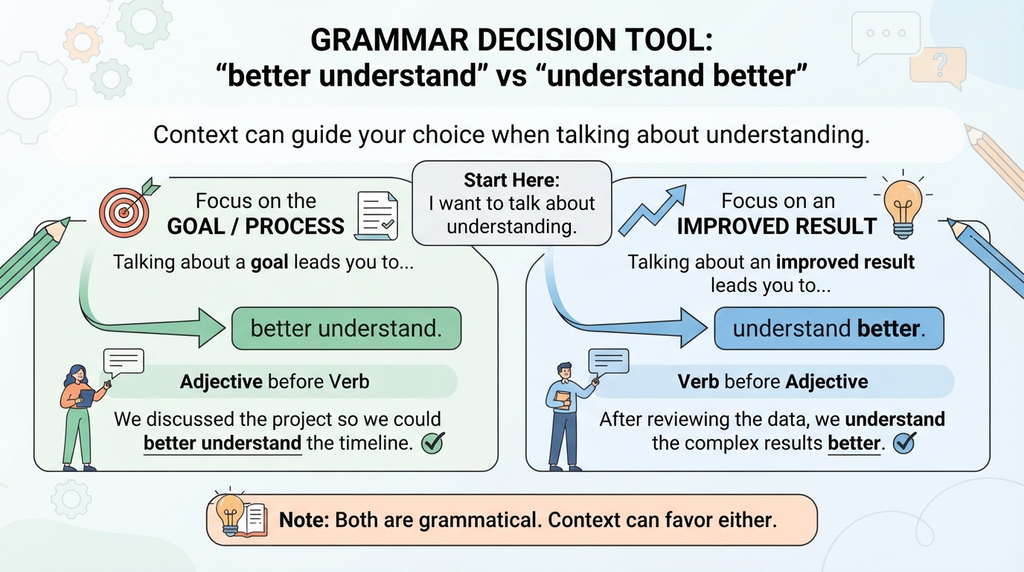
Think of better understand as a goal and understand better as a result.
Goal
I want to better understand the issue.
You are trying to improve your understanding.
Result
I understand the issue better now.
Your understanding has improved.
This is not an absolute grammar rule. It is a useful memory aid that works in many common sentences.
A second quick test is to look at the position of the object.
better understand + object
I want to better understand the instructions.
versus:
understand + object + better
I understand the instructions better now.
If both versions sound natural, choose the one that best fits the surrounding sentence and desired rhythm.
Formal vs Casual and Regional Notes
There is no major British-versus-American difference that makes one expression correct in one variety and incorrect in the other. Both better understand and understand better occur in British and American English.
Differences are more likely to involve sentence rhythm, context, emphasis, and individual style.
Formal and academic writing
Better understand is particularly common in purpose statements:
The study was designed to better understand consumer behavior.
It is concise and widely accepted.
However, some editors prefer:
The study was designed to understand consumer behavior better.
or:
The study was designed to gain a better understanding of consumer behavior.
The choice may depend on house style rather than grammar.
Casual conversation
Understand better is extremely natural:
I understand what you’re saying better now.
You will also hear:
I want to better understand what you mean.
Both belong to normal contemporary English.
Register and style
Neither expression is inherently informal.
The noun phrase a better understanding can sometimes sound more formal or institutional:
The report provides a better understanding of the underlying causes.
Meanwhile:
The report helps us better understand the underlying causes.
is more direct and verb-centered.
Good editing should therefore consider clarity and sentence flow, not simply whether one form looks more formal.
Shorter and Easier to Understand
The expression shorter and easier to understand is itself useful when discussing clear writing.
For example:
Can you make this explanation shorter and easier to understand?
Here, easier to understand is a normal infinitive construction. It does not mean the same thing as better understand.
Compare:
I want to better understand the explanation.
The speaker wants their own comprehension to improve.
I want the explanation to be easier to understand.
The speaker wants the explanation itself to become clearer.
That distinction is important in editing.
You can also say:
Please rewrite this so it is shorter and easier to understand.
This focuses on the quality of the writing, not the reader’s existing level of understanding.
Proofreading Test
When deciding between better understand and understand better, ask three questions:
- Am I describing a goal or purpose?
Try better understand: We need to better understand the issue. - Am I describing an improved result or comparison?
Try understand better: I understand the issue better now. - Would moving “better” change the meaning?
If not, choose the position that produces the clearest and most natural sentence.
Then check whether you accidentally wrote more understand. If so, replace it with better understand or understand better, depending on the sentence.
FAQs
Is “better understand” grammatically correct?
Yes. Better understand is a grammatical and widely used construction meaning to understand something more clearly, fully, or accurately.
Is “understand better” grammatically correct?
Yes. Understand better is also grammatical. It commonly describes an improved level of understanding: I understand the topic better now.
Which is more correct: “better understand” or “understand better”?
Neither is universally more correct. Both are grammatical. The surrounding sentence determines which placement sounds more natural.
Is “to better understand” correct?
Yes. To better understand is a common infinitive construction expressing purpose or an intended improvement in understanding.
We need more information to better understand the problem.
Is “to understand better” correct?
Yes.
We need more information to understand the problem better.
This sentence means essentially the same thing as the example above.
Should I say “I better understand” or “I understand better”?
Both can be grammatical.
I better understand the problem now.
I understand the problem better now.
The second often sounds more conversational, while the first can place greater emphasis on the improvement in understanding. Neither should automatically be labeled wrong.
What does “better understand” mean in Hindi?
Better understand generally means बेहतर समझना, और अच्छी तरह समझना, or अधिक अच्छी तरह समझना, depending on context.
What does “understand you better” mean in Hindi?
Understand you better generally means आपको बेहतर समझना or आपको और अच्छी तरह समझना.
Is “more understand” correct English?
Generally, no, when you mean “understand to a greater degree.” Use better understand or understand better instead.
What is another word for “better understand”?
Depending on context, you can use understand more clearly, understand more fully, gain insight into, grasp more clearly, get a clearer picture of, or develop a deeper understanding of.
Is “better understanding” the same as “better understand”?
No. Better understand contains the verb understand. A better understanding contains understanding as a noun.
I want to better understand the topic.
I want a better understanding of the topic.
Is “you better understand” the same as “you understand better”?
Not necessarily. You understand better normally describes improved comprehension. You better understand can also be interpreted as an informal version of you had better understand, which expresses a strong expectation or warning.
Final Takeaway
Better understand and understand better are both correct English.
Use better understand naturally when talking about the goal or process of gaining clearer comprehension:
I want to better understand the issue.
Use understand better naturally when describing an improved result, especially with now, than, much, or similar words:
I understand the issue better now.
When both work, do not waste time searching for a universal “correct” form. Check the sentence’s structure, meaning, rhythm, and register.
The most useful distinction to remember is:
Goal → better understand
Improved result → understand better
And when you need the noun form, use a better understanding:
The explanation gave me a better understanding of the issue.