Deactivate vs Inactivate: Meaning, Differences, and Correct Usage
Quick Answer
Deactivate and inactivate both mean to make something inactive, but they are not equally natural in every context.
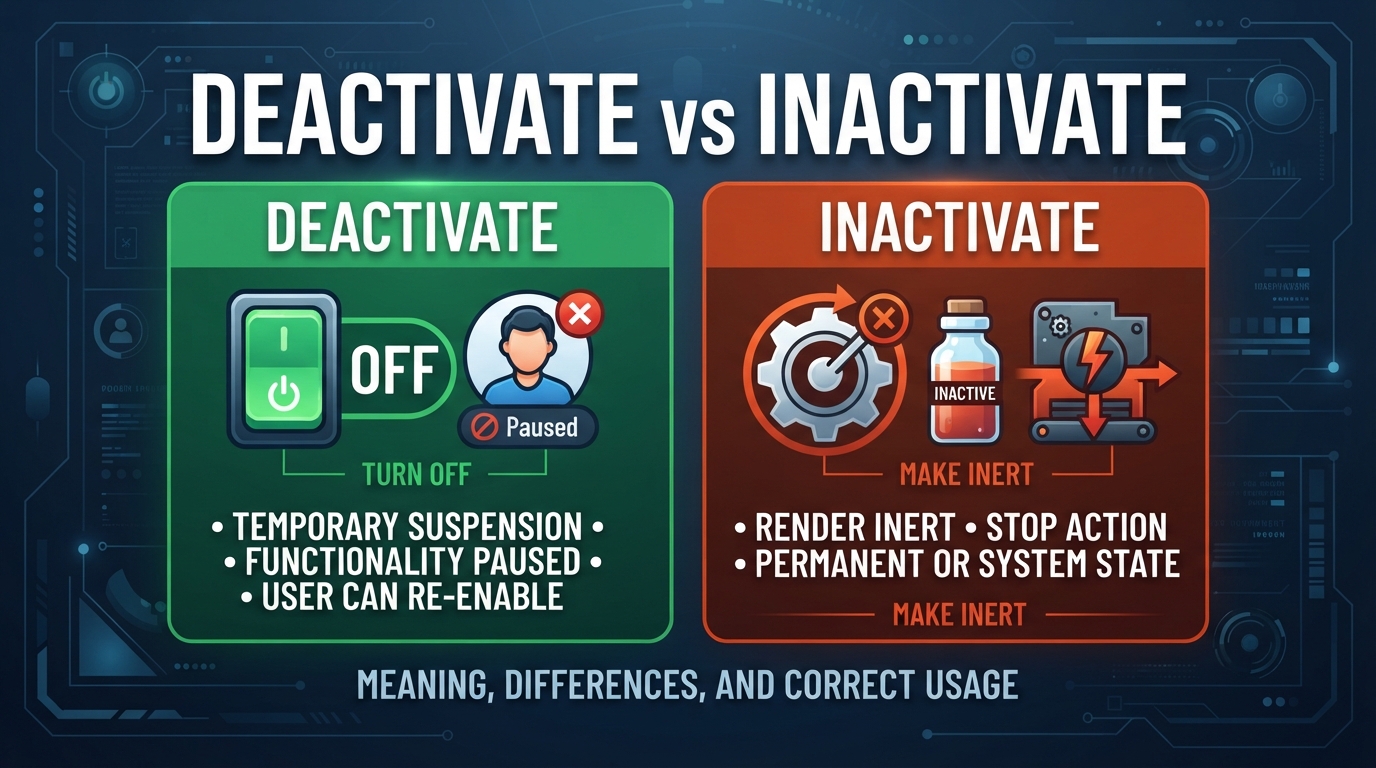
Deactivate is the more common and general word. It is especially natural when you mean to turn off, disable, or stop something from functioning, such as an account, device, feature, service, or system.
Inactivate also means to make something inactive or no longer active, but it is more specialized. It appears frequently in scientific, medical, biological, technical, and institutional contexts, where something is rendered inactive without necessarily suggesting an ordinary “turn-off” action.
For example:
- Deactivate your account before deleting the app.
- The treatment can inactivate the virus.
- The administrator deactivated the security feature.
- Heat inactivates certain enzymes.
A useful rule is:
Use “deactivate” for ordinary disabling or turning off; use “inactivate” when the context specifically describes rendering something biologically, chemically, technically, or functionally inactive.
The two words can overlap, so the choice is sometimes a matter of context and register rather than strict grammatical correctness.

At-a-Glance Table
| Point | Deactivate | Inactivate |
|---|---|---|
| Basic meaning | Make something inactive, disabled, or nonoperational | Make something inactive or no longer active |
| Part of speech | Verb | Verb |
| Commonness | Very common | Less common |
| Everyday use | Very natural | Often sounds unusual |
| Accounts | Deactivate an account | Usually not preferred |
| Devices/features | Deactivate a feature | Possible but uncommon |
| Software/security | Deactivate a setting | Possible in specialized contexts |
| Viruses/pathogens | Possible | Especially common |
| Enzymes/proteins | Possible | Especially common |
| Biological processes | Less typical | Common |
| Scientific writing | Common | Often preferred where technical precision matters |
| Formality | Neutral | Often technical or specialized |
| “Turn off” sense | Strong | Weaker |
| “Render inactive” sense | Strong | Strong |
| Passive form | deactivated | inactivated |
| Noun | deactivation | inactivation |
Deactivate vs Inactivate: The Detailed Difference
The central difference is not that one word is “correct” and the other is “incorrect.” Both are established English verbs.
The difference is primarily how the inactivity is understood and what kind of thing is being made inactive.
What does “deactivate” mean?
Deactivate means to cause something to stop being active, operational, enabled, or available for use.
It commonly describes a deliberate action performed by a person, organization, system, or mechanism.
Examples include:
- deactivate an account
- deactivate a credit card
- deactivate a phone
- deactivate a security alarm
- deactivate a feature
- deactivate a user profile
- deactivate a notification
- deactivate a system
The word often suggests a reversible or administrative action. If you deactivate an account, for instance, the account may remain in the system even though it is no longer active.
The company deactivated the old user accounts.
This sentence naturally describes an administrative decision that changes the status of the accounts.
What does “inactivate” mean?
Inactivate means to make something inactive or to cause it to lose its activity or functional effect.
The word is especially useful when “active” has a technical meaning.
For example:
The researchers used heat to inactivate the enzyme.
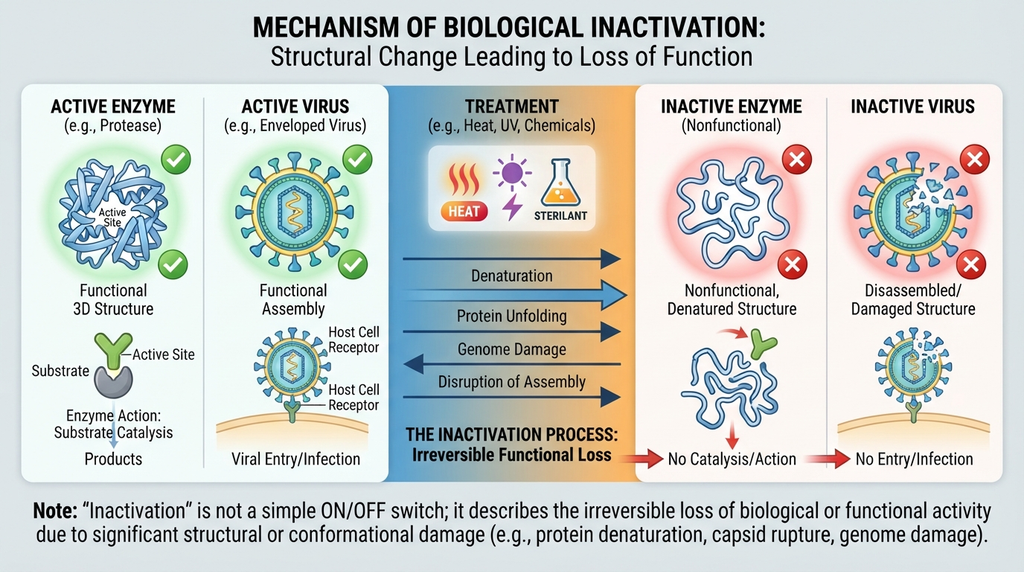
Here, “inactivate” does not simply mean someone pressed an off button. The enzyme has been rendered unable to perform its normal function.
Similarly:
The treatment may inactivate the virus.
The focus is on the biological activity of the virus being eliminated or suppressed.
That is why inactivate is particularly common in scientific and technical writing.
Is “Inactivate” a Real Word?
Yes. Inactivate is a standard English verb.
Its forms include:
- inactivate — base form
- inactivates — third-person singular present
- inactivated — past tense and past participle
- inactivating — present participle/gerund
- inactivation — noun
Examples:
The chemical can inactivate the bacteria.
The chemical inactivates the bacteria.
The bacteria were inactivated by the treatment.
Researchers are studying methods of inactivating the pathogen.
The process causes viral inactivation.
The word is therefore not an incorrect alternative created by analogy with “inactive.” It has a legitimate role in English, although its distribution is narrower than that of deactivate.
Inactivate vs Deactivate in Everyday English
For ordinary objects, accounts, settings, and services, deactivate is generally the more natural choice.
Compare:
Deactivate your account before changing your email address.
with:
Inactivate your account before changing your email address.
The second sentence is understandable, but it sounds unnecessarily technical or unusual in ordinary consumer communication.
Likewise:
Deactivate the alarm.
is much more natural than:
Inactivate the alarm.
And:
The administrator deactivated the user’s account.
is the normal choice in a software context.
Why does “deactivate” work better here?
Because these examples involve an enabled/disabled status. Something has been deliberately switched from an active state to an inactive one.
Modern interfaces commonly use language such as:
- Activate
- Deactivate
- Enable
- Disable
- Turn on
- Turn off
“Inactivate” does not normally belong to this everyday interface vocabulary.
When to Use “Deactivate”
Use deactivate when you are talking about deliberately disabling something or taking it out of active operation.
Accounts and profiles
This is one of the clearest uses.
I decided to deactivate my social media account.
You can deactivate your profile temporarily.
The administrator deactivated the former employee’s account.
Here, deactivate is the natural choice because an account has an active/inactive status.
Devices and systems
Please deactivate the device before removing the battery.
The technician deactivated the alarm system.
The software automatically deactivates the feature when the battery is low.
These sentences describe operational controls.
Features and settings
Deactivate location sharing when you do not need it.
The update deactivated an outdated feature.
You can deactivate automatic notifications in the settings.
Again, the meaning is essentially disable.
Cards, services, and access
The bank deactivated the old card.
The company deactivated his access badge.
The service was deactivated after the subscription ended.
These are all ordinary administrative or operational uses.

When to Use “Inactivate”
Use inactivate when the focus is on rendering something inactive, especially when the thing has a technical, biological, chemical, or functional activity.
Biological substances
The treatment inactivates the virus.
Researchers developed a method to inactivate the pathogen.
The process can inactivate certain enzymes.
These sentences focus on the loss of biological activity.
Chemical and biochemical contexts
The compound may inactivate the enzyme.
Heat can inactivate some proteins.
The researchers measured the rate of enzyme inactivation.
In these contexts, “inactivate” is often more precise than “deactivate.”
Technical or specialized processes
“Inactivate” can also appear outside biology when the writer is discussing a technical state of activity rather than an ordinary user-controlled switch.
The process inactivates the reactive component.
The safety mechanism inactivates the system under certain conditions.
Even here, however, deactivate may be preferable if the intended meaning is simply “turn off” or “disable.”
Deactivate or Inactivate: Context Matters
Some nouns can reasonably take either verb.
For example:
The procedure deactivated the system.
The procedure inactivated the system.
Both are grammatically possible, but they can create slightly different impressions.
Deactivated emphasizes the system being turned off, disabled, or removed from operation.
Inactivated emphasizes the system being rendered inactive.
The difference becomes clearer when the object is biological:
The treatment inactivated the virus.
This is highly natural because viral activity is the relevant concept.
By contrast:
The technician deactivated the virus.
This sounds odd because a virus is not normally treated like an account, device, or software feature with a user-controlled “deactivate” command.
This illustrates an important principle: verb choice depends partly on what “active” means for the noun being modified.
Inactivated vs Deactivated
The past forms follow the same basic distinction.
“Inactivated” meaning
Inactivated means made inactive or rendered unable to perform its normal activity or function.
For example:
The vaccine contains inactivated viral material.
The enzyme was inactivated during the experiment.
The researchers examined the inactivated cells.
The word is especially common when activity has been removed through a scientific or technical process.
“Deactivated” meaning
Deactivated means made inactive, disabled, or switched out of an active state.
For example:
Her account was deactivated.
The security system was deactivated.
The old feature was deactivated after the update.
The word frequently implies an operational or administrative change.
A useful comparison
The account was deactivated.
The account is no longer active as an account.
The enzyme was inactivated.
The enzyme is no longer biologically active.
Both sentences describe inactivity, but the type of inactivity is different.

Inactivation vs Deactivation
The nouns inactivation and deactivation follow the same distinction.
Deactivation generally refers to the act or process of disabling something or changing it from an active state to an inactive one.
Account deactivation prevents other users from viewing the profile.
The system includes automatic deactivation after a period of inactivity.
Inactivation generally refers to the process of making something inactive, particularly in scientific or technical contexts.
Viral inactivation is an important part of the manufacturing process.
The study investigated enzyme inactivation.
Neither noun is restricted to only one field, but their typical contexts differ.
Inactivation vs deactivation in scientific writing
Scientific writers often choose inactivation because it describes the loss of biological or functional activity.
For example:
The experiment measured thermal inactivation of the enzyme.
Using “deactivation” here would not necessarily make the sentence grammatically impossible, but it could make the terminology less precise or less conventional for the field.
Deactivation in technology
Technology documentation frequently favors deactivation when describing a feature, account, service, or control.
Account deactivation is reversible for 30 days.
The application supports automatic deactivation.
In these cases, the concept is administrative or operational rather than biological.
“Unactivate” vs “Deactivate”
Another word that sometimes causes confusion is unactivate.
Although unactivate can be encountered and its meaning is understandable, deactivate is the standard and much more natural choice in ordinary modern English.
Prefer:
Deactivate the account.
rather than:
Unactivate the account.
Similarly:
The administrator deactivated the feature.
is preferable to:
The administrator unactivated the feature.
There is usually no reason to replace the established verb deactivate with “unactivate.”
If you want a simple everyday verb, disable is also often excellent:
Disable notifications.
Disable the feature.
Disable the account.
However, “disable” and “deactivate” are not universally interchangeable. Product documentation may distinguish between a feature that is disabled and an account that is deactivated.
Activation and Deactivation
The relationship between activation and deactivation is especially straightforward.
Activation means the process of making something active, operational, or enabled.
Deactivation means the process of making it inactive, disabled, or no longer operational.
For example:
Account activation is required before you can sign in.
Account deactivation removes the account from active use.
This pairing is extremely common in administrative, technical, and commercial contexts.
The corresponding pair activation/inactivation is also possible, but it is more likely to occur when “activity” has a specialized scientific or functional meaning.
For example:
Enzyme activation increases catalytic activity.
Enzyme inactivation reduces or eliminates catalytic activity.
Here, inactivation is more natural than “deactivation” because the subject is biochemical activity.
Examples by Context
Social media and online accounts
Natural:
I deactivated my account for a few weeks.
The platform deactivated the account after repeated violations.
Less natural:
I inactivated my social media account for a few weeks.
“Inactivate” is understandable, but deactivate is the normal choice for an account.
Mobile phones and apps
Natural:
Deactivate the old notification setting.
The app automatically deactivates background activity when battery levels are low.
“Deactivate” fits the interface and operational meaning.
Security systems
Natural:
Deactivate the alarm before entering the maintenance area.
The access card was deactivated.
Again, the concept is disabling a system or access mechanism.
Biology
Natural:
The treatment inactivated the virus.
Heat inactivated the enzyme.
Here, inactivate is strongly associated with the scientific meaning of removing biological activity.
Medicine and laboratory research
The researchers tested whether the compound could inactivate the pathogen.
The sample contained inactivated organisms.
The study examined the mechanism of cellular inactivation.
These uses sound natural because “activity” is a technical property being altered.
Industrial or technical processes
Either word may be possible depending on the intended meaning.
The operator deactivated the machine.
This suggests a deliberate operational action.
The process inactivated the reactive material.
This focuses on the material losing its functional activity.
Organizations and memberships
The administrator deactivated the membership.
This is generally more natural than:
The administrator inactivated the membership.
The first sounds like an account or administrative status change.
Common Mistakes
Mistake 1: Assuming “inactivate” is incorrect
Incorrect assumption:
“Inactivate” isn’t a real English word.
Correction:
“Inactivate” is a standard English verb, particularly common in scientific and technical contexts.
The issue is not whether the word exists. The issue is whether it is the most natural word for the particular context.
Mistake 2: Using “inactivate” for every account or setting
I inactivated my Instagram account.
This is understandable, but deactivated is the normal choice in everyday technology language.
Better:
I deactivated my account.
Mistake 3: Using “deactivate” automatically in scientific contexts
The chemical deactivated the enzyme.
This may be understandable, but if the intended meaning is that the enzyme lost its biological activity, inactivated is often the more precise choice.
Better:
The chemical inactivated the enzyme.
Mistake 4: Treating the two words as perfect synonyms
They overlap, but context determines which one sounds idiomatic.
Compare:
The administrator deactivated the account.
The treatment inactivated the virus.
Replacing each verb with the other makes the sentences less natural.
Mistake 5: Confusing “inactive” with “deactivated”
Something can be inactive without having been deactivated.
For example:
The account has been inactive for six months.
This merely describes its status.
By contrast:
The administrator deactivated the account.
This tells us that an action changed the account’s status.
Similarly:
The enzyme is inactive.
describes its condition, while:
The treatment inactivated the enzyme.
describes a process that caused the loss of activity.
Mistake 6: Assuming “inactivated” always means permanently destroyed
It does not necessarily mean destroyed.
“Inactivated” generally means that something has been rendered inactive or has lost its relevant activity. The underlying object or substance may still physically exist.
That distinction matters in scientific writing.

A Fast Decision Rule
When deciding between deactivate and inactivate, ask:
1. Am I talking about turning something off or disabling access?
Use deactivate.
Deactivate the account.
Deactivate the alarm.
Deactivate the feature.
2. Am I talking about removing biological or specialized functional activity?
Use inactivate.
Inactivate the virus.
Inactivate the enzyme.
Inactivate the pathogen.
3. Is the context technical enough that “inactive” describes a measurable property?
Inactivate may be the better choice.
4. Is this ordinary consumer, administrative, or software language?
Deactivate is usually the safer choice.
The Practical Proofreading Test
Try replacing the verb with disable or render inactive.
If disable sounds natural, deactivate is often a good choice:
Deactivate the account.
→ Disable the account.
→ Both sound natural.
If render inactive better captures the meaning, inactivate may be preferable:
Inactivate the enzyme.
→ Render the enzyme inactive.
→ This preserves the intended scientific meaning.
The test is not absolute, but it is useful when editing.
A second test is to ask:
Could a user normally click a button or change a setting to do this?
If yes, deactivate will often be the natural verb.
If the action is instead a chemical, biological, physical, or functional process, inactivate becomes more likely.
Formal vs Casual and Regional Notes
Neither word is simply “formal English” versus “informal English.”
The important difference is register and domain.
Deactivate is common across casual, professional, administrative, and technical English.
Inactivate is less common in everyday conversation but perfectly appropriate in scientific, medical, biological, laboratory, and specialized technical writing.
For example, a scientist might naturally write:
The procedure inactivates the enzyme.
A customer-support representative would normally write:
Please deactivate your account.
This does not mean that scientists never use “deactivate” or that customer-support teams can never use “inactivate.” Rather, different professional communities develop preferred collocations.
British vs American English
There is no major British-American spelling distinction between deactivate and inactivate.
Both forms occur in both varieties of English.
The bigger issue is field-specific usage, not national dialect.
You may therefore encounter:
- deactivate in British English
- deactivate in American English
- inactivate in British English
- inactivate in American English
The surrounding noun and professional context matter much more than whether the writer is British or American.
Pronunciation
Deactivate is commonly pronounced:
dee-AK-tuh-vayt
IPA: /ˌdiːˈæktɪveɪt/
Inactivate is commonly pronounced:
in-AK-tuh-vayt
IPA: /ɪnˈæktɪveɪt/
The main stress falls on the syllable associated with act in both words.
The related nouns are:
- deactivation — /ˌdiːæk.tɪˈveɪ.ʃən/
- inactivation — /ɪnˌæk.tɪˈveɪ.ʃən/
Pronunciation is rarely the source of confusion here; the main challenge is choosing the appropriate word for the context.
Grammar and Word Forms
Both words function as regular verbs.
Deactivate
| Form | Example |
|---|---|
| Base | deactivate |
| Third-person singular | deactivates |
| Past | deactivated |
| Past participle | deactivated |
| -ing form | deactivating |
| Noun | deactivation |
Examples:
Please deactivate the account.
The system deactivates the feature automatically.
The account was deactivated yesterday.
The administrator is deactivating unused profiles.
The company announced the deactivation of the service.
Inactivate
| Form | Example |
|---|---|
| Base | inactivate |
| Third-person singular | inactivates |
| Past | inactivated |
| Past participle | inactivated |
| -ing form | inactivating |
| Noun | inactivation |
Examples:
The treatment can inactivate the virus.
Heat inactivates the enzyme.
The virus was inactivated during processing.
Researchers are studying methods of inactivating the pathogen.
The process causes rapid inactivation.
What Does “Deactivating” Mean?
Deactivating is the present participle or gerund form of deactivate.
It means turning something off, disabling it, or causing it to stop being active.
For example:
I am deactivating the account.
Deactivating notifications can reduce interruptions.
The system is deactivating the connection automatically.
The meaning depends on the object, but the central idea remains a transition from active to inactive.
What Does “Inactivating” Mean?
Inactivating is the present participle or gerund form of inactivate.
It means making something inactive or causing it to lose its activity.
For example:
The researchers are studying methods of inactivating the virus.
The chemical is effective at inactivating the enzyme.
Here, the word naturally emphasizes the process by which activity is removed.
What Does “Inactivation” Mean?
Inactivation is the noun form of inactivate.
It means the process or result of making something inactive.
Examples:
Viral inactivation is an important stage of the process.
The researchers observed rapid enzyme inactivation.
The study investigated the inactivation of the pathogen.
It is especially useful when discussing an inactive state or loss of activity as a technical phenomenon.
What About “Inactivations”?
The plural inactivations is grammatically possible, although it is much less common than the singular noun inactivation.
It can be used when referring to multiple instances, events, or mechanisms of inactivation.
For example:
The researchers compared several independent enzyme inactivations.
In ordinary writing, however, the singular is usually enough:
The researchers studied enzyme inactivation.
Do not use the plural merely because a process happens repeatedly.
Edge Cases: When Both Words Work
There are situations where both verbs are defensible.
Consider:
The safety mechanism deactivated the machine.
This emphasizes the machine being switched out of operation.
Now consider:
The safety mechanism inactivated the machine.
This is possible, but it gives the sentence a more technical “rendered inactive” flavor.
Likewise:
The software deactivated the component.
is natural in technology writing.
The software inactivated the component.
could also be appropriate if the writer is describing a technical state rather than a conventional software control.
In such cases, collocation and professional convention should guide the final choice.
If your field has an established technical term, follow the terminology normally used by specialists.
A Simple Memory Trick
Remember:
DEACTIVATE = DISABLE
Think:
Deactivate the account.
Deactivate the alarm.
Deactivate the feature.
For inactivate, think:
INACTIVATE = RENDER INACTIVE
Think:
Inactivate the virus.
Inactivate the enzyme.
Inactivate the pathogen.
The prefix does not create a universal grammar rule. This is simply a practical memory aid based on common usage.
Quick Comparison Examples
| Sentence | Best choice | Why |
|---|---|---|
| Please ___ your account. | deactivate | Administrative status |
| ___ the alarm before maintenance. | deactivate | Turn off/disable |
| The treatment ___ the virus. | inactivated | Biological activity |
| Heat ___ the enzyme. | inactivates | Loss of biochemical activity |
| The company announced account ___. | deactivation | Administrative process |
| The study examined viral ___. | inactivation | Scientific process |
| The administrator ___ the old profile. | deactivated | Software/account context |
| The chemical ___ the protein. | inactivated | Scientific context |
FAQs
Is “inactivate” the same as “deactivate”?
They overlap in meaning because both can describe making something inactive. However, deactivate is broader and more common for disabling accounts, devices, features, systems, and services, while inactivate is particularly common when describing biological or specialized functional activity.
Is it “inactivate or deactivate”?
Both are valid words. The better choice depends on context. For an account or feature, choose deactivate. For an enzyme, virus, pathogen, or similar biological entity, inactivate is often more natural.
Is “inactivate” correct English?
Yes. Inactivate is a standard English verb. It is especially common in scientific, medical, biological, and technical writing.
What does “inactivated” mean?
Inactivated means made inactive or caused to lose its relevant activity or function. In scientific contexts, it often describes something that has lost biological activity while still physically existing.
What is the difference between inactivation and deactivation?
Inactivation usually emphasizes the loss or removal of activity, particularly in scientific or technical contexts. Deactivation usually emphasizes disabling something or changing its operational status.
Is “unactivate” correct?
“Unactivate” can be understood and does occur, but it is much less natural than deactivate in standard contemporary usage. In most ordinary contexts, use deactivate instead.
Is “deactivate” more common than “inactivate”?
Yes. Deactivate is considerably more common in general English because it applies naturally to everyday things such as accounts, systems, features, devices, and services. Inactivate has a more specialized distribution.
Can you deactivate a virus?
The sentence is grammatically possible, but inactivate a virus is generally the more natural scientific expression when the intended meaning is to eliminate or suppress its biological activity.
Can you inactivate an account?
It is understandable, but deactivate an account is the standard everyday expression. “Inactivate” would usually sound unnecessarily technical.
Does “deactivate” mean permanently delete?
No. Deactivation and deletion are not necessarily the same. A deactivated account or service may remain stored in a system and may sometimes be reactivated.
Does “inactivated” mean destroyed?
Not necessarily. Something that has been inactivated may still physically exist; its relevant activity or function has simply been reduced, stopped, or eliminated.
Final Takeaway
Deactivate vs inactivate is mainly a question of context rather than correctness.
Use deactivate when you mean disable, turn off, or change an account, feature, device, service, or system from active to inactive.
Use inactivate when you mean render something inactive, especially when discussing viruses, enzymes, proteins, pathogens, biological processes, or other specialized forms of activity.
The quickest rule is:
Accounts, devices, features, and systems → deactivate.
Viruses, enzymes, pathogens, and biological activity → inactivate.
When both are technically possible, choose the verb that matches the terminology and register of your field. Good editing is not simply about finding a dictionary synonym; it is about choosing the word that native speakers in that context would naturally expect.