On a Call vs In a Call: Which Is Correct?
Quick Answer
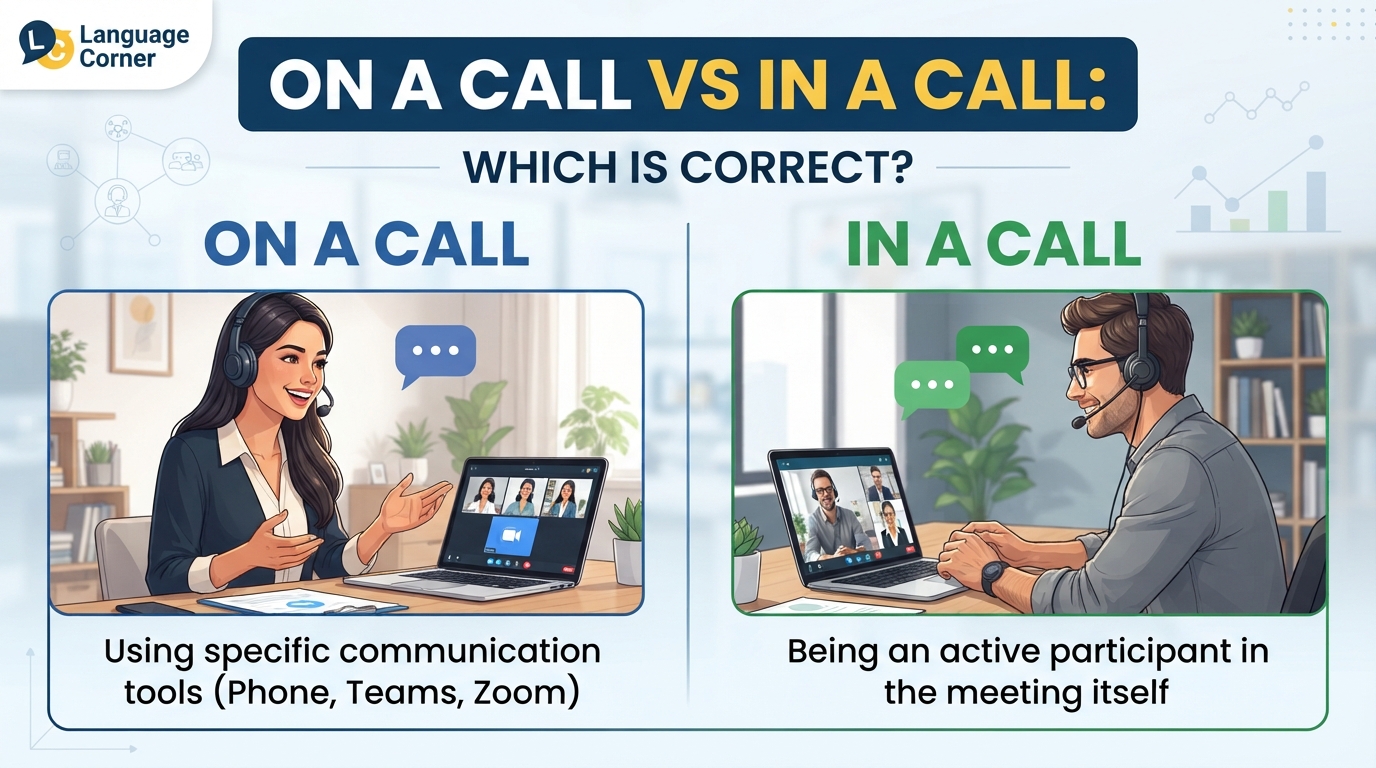
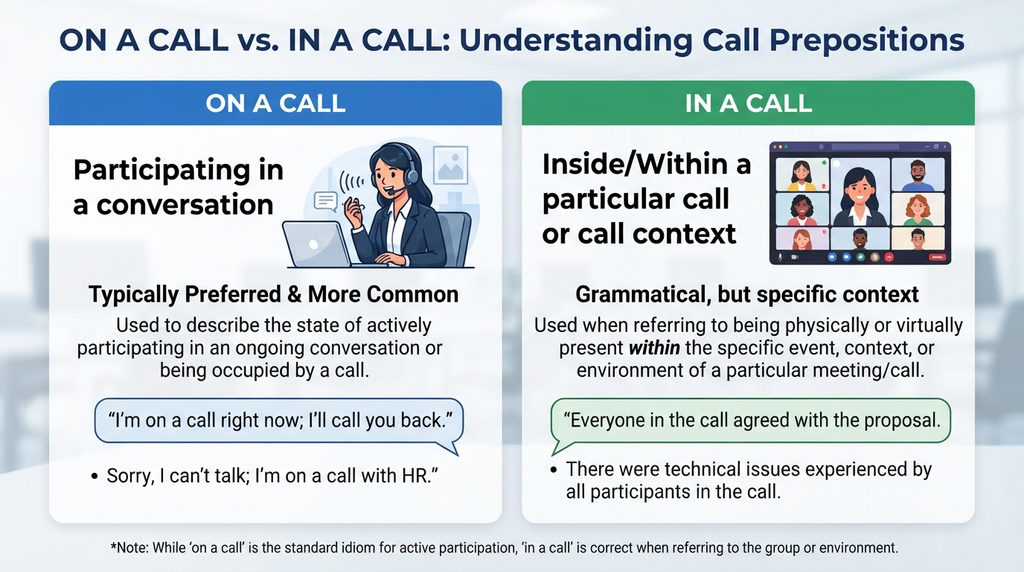
“On a call” is the natural and standard expression when you mean that someone is participating in a telephone, mobile, video, or online conversation.
- I’m on a call. — Natural and very common.
- She’s on a call with her manager. — Natural.
- Can I call you later? I’m on a call right now. — Natural.
- We discussed the issue on a call. — Natural.
“In a call” is also grammatical, but it has a different focus. It usually refers to being inside or participating in a particular call as an event, especially in technical, business, or organizational contexts.
- I’m in a call with the client. — Possible, especially in workplace or international English, but generally less idiomatic than “I’m on a call with the client.”
- Everyone in the call agreed. — Possible, with emphasis on the participants in a particular call.
- The recording is available in the call history. — Here, “in” describes location within a system or collection rather than participation.
So, for everyday English, use on a call when you mean “talking by phone or video.”
Usage Table
| Expression | Typical meaning | Naturalness | Example |
|---|---|---|---|
| on a call | Participating in a phone/video/online conversation | Very natural | I’m on a call right now. |
| on the call | Participating in a specific call already identified | Very natural | Tom is on the call with us. |
| in a call | Within or participating in a particular call/event | Grammatical, but less idiomatic for everyday speech | Several issues came up in the call. |
| in the call | Within a particular call, often emphasizing the event or its content | Natural in some contexts | We discussed this in the call. |
| on a phone call | Participating in a telephone conversation | Very natural | She’s on a phone call. |
| in a phone call | During/within a telephone conversation | Usually unnatural for participation | Say “during the phone call” instead. |
| on call | Available to respond when needed | Very natural | The doctor is on call tonight. |
| on-call | Adjectival form before a noun | Standard | She is the on-call engineer. |
| via a call | By means of a call | Formal/neutral | We confirmed the details via a call. |
| taking a call | Answering or handling a telephone call | Very natural | I’m taking a call from a customer. |
The important distinction is that on a call describes your participation in a communication activity, while in the call can emphasize the particular event, its contents, or the people who are part of it.
The Meaning Behind “On a Call”
The preposition on has a long-established association with communication systems and communication activities.
English uses on in several expressions where a person is actively connected to or engaged with a communication medium:
- on the phone
- on the telephone
- on a call
- on the line
- on a video call
- on Zoom
- on a conference call
- on the radio
This does not mean that the person is literally physically sitting “on” a telephone or call. The construction is idiomatic. On signals participation in or active connection to the communication activity.
That is why I’m on a call sounds completely ordinary.
Compare:
I’m on a call with Sarah.
The sentence tells us what the speaker is doing: participating in a conversation.
By contrast:
There were three major decisions in the call.
Here, in presents the call as an event or container of information. The decisions occurred within that particular call.

“On a Call” vs “In a Call”
The easiest way to understand the difference is to ask what you are describing.
If you are describing what someone is currently doing, on a call is usually the right choice.
I can’t talk right now. I’m on a call.
She’s on a call with a customer.
He’s been on a call for an hour.
If you are describing what happened during a particular call, in the call or, often more naturally, during the call, may work.
We discussed the budget during the call.
Several concerns were raised in the call.
Everyone in the call heard the announcement.
There is an important stylistic point here: when in means “during,” during the call is often clearer and more idiomatic in polished English.
Instead of:
We discussed the problem in the call.
you can usually write:
We discussed the problem during the call.
However, in the call becomes more natural when the call is being treated as a specific event or communication record:
The customer mentioned the issue in the call.
This usage is particularly common in workplace and technology-related communication.
Common Patterns With “On a Call”
I’m on a call
This is the most useful everyday pattern.
Sorry, I can’t talk. I’m on a call.
I’ll message you when I’m off the call.
She’s on a call at the moment.
The expression works for ordinary phone conversations, business calls, conference calls, video meetings, and online meetings.
On a call with someone
Use with to identify the other participant or participants.
I’m on a call with my manager.
She was on a call with the client.
We’re on a call with the development team.
This is one of the most common workplace constructions.
On the call
Use the when both speaker and listener understand which particular call is being discussed.
Is James on the call?
Everyone on the call needs to stay until the end.
I’ll explain that on the call tomorrow.
Compare:
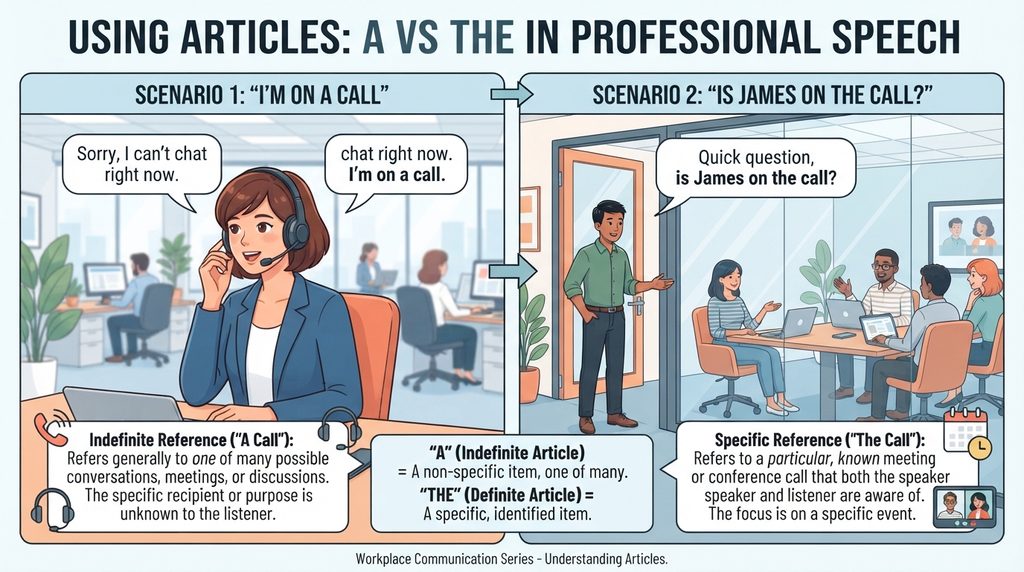
I’m on a call.
This means some call is taking place.
I’m on the call.
This normally refers to a particular call already known from context.
On another call
If someone is already speaking with somebody else, on another call is the natural expression.
Sorry, she’s on another call right now.
I’ll ask him to call you back; he’s on another call.
The manager is currently on another call.
In another call is possible in contexts where you are referring to a different call as an event, but it is not the normal way to tell someone that a person is currently unavailable because they are speaking on the telephone.
“On a Phone Call” and “On the Phone”
Both are natural:
I’m on a phone call right now.
I’m on the phone right now.
The shorter on the phone is extremely common in everyday English.
Can you talk?
Sorry, I’m on the phone.
On a call is especially common in modern workplace English because the call may be a phone call, video call, conference call, or online meeting.
So:
I’m on the phone.
emphasizes the telephone medium, while:
I’m on a call.
can describe a broader range of communication.
“In phone” or “on phone”?
The usual construction is on the phone, not in the phone.
She’s on the phone with her mother.
I was on the phone all morning.
“On phone” without the article is possible in some varieties of English, particularly in informal or regional usage, but on the phone is the standard form in broadly international standard English.
“In the Call” vs “On the Call”
These two expressions can overlap, but they do not always perform the same grammatical job.
On the call
On the call normally means participating in the call.
Sarah is on the call.
Everyone on the call can hear you.
Who else is on the call?
This is the preferred choice when referring to participants.
In the call
In the call often focuses on the content or circumstances of a particular call.
The issue was mentioned in the call.
There was a misunderstanding in the call.
The customer explained the problem in the call.
However, these sentences can often be improved by using during the call:
The issue was mentioned during the call.
There was a misunderstanding during the call.
The customer explained the problem during the call.
When referring specifically to participants, on the call is generally clearer:
Everyone on the call agreed.
rather than:
Everyone in the call agreed.
The second is understandable and used by some speakers, but the first is more idiomatic for general professional English.
“In a Call” vs “On a Call”
The indefinite versions show the same distinction.
I’m on a call.
This means I am currently participating in a call.
I heard that in a call last week.
This means the information was heard during a particular call.
A useful substitution is:
If you can replace the phrase with “participating in a conversation,” use “on a call.”
I’m on a call.
→ I’m participating in a conversation.
If you can replace it with “during the call,” “in the call” may be possible.
We discussed it in the call.
→ We discussed it during the call.
But when “during the call” sounds more natural, prefer it in polished writing.
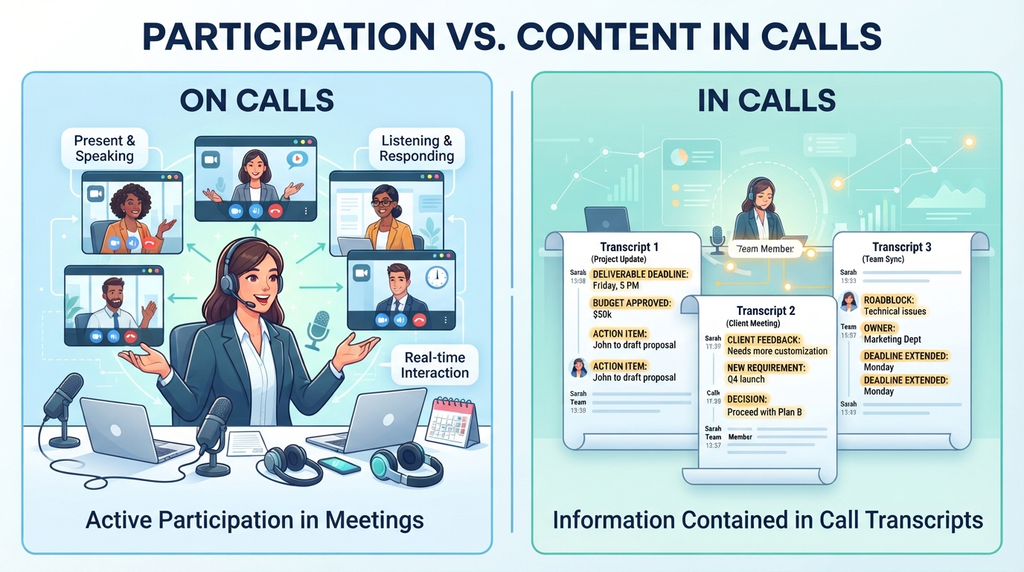
“On Calls” and “In Calls”
Plural forms introduce another useful distinction.
On calls
On calls generally means participating in multiple calls.
I spend most of my day on calls.
Customer-service staff may be on calls for several hours.
We have three people on calls this afternoon.
The phrase can also occur in expressions such as:
We discussed the issue on calls with several clients.
However, this can sound less precise than:
We discussed the issue during calls with several clients.
In calls
In calls can refer to multiple particular calls or to events occurring within calls.
The problem came up in several calls.
We noticed the same pattern in calls with customers.
This is especially natural when analyzing recorded calls, customer interactions, interviews, or meeting data.
Compare:
Our sales representatives are on calls all morning.
versus:
The same complaint appeared in calls with customers.
The first describes participation. The second describes the content of multiple calls.
“On Call” vs “On a Call”
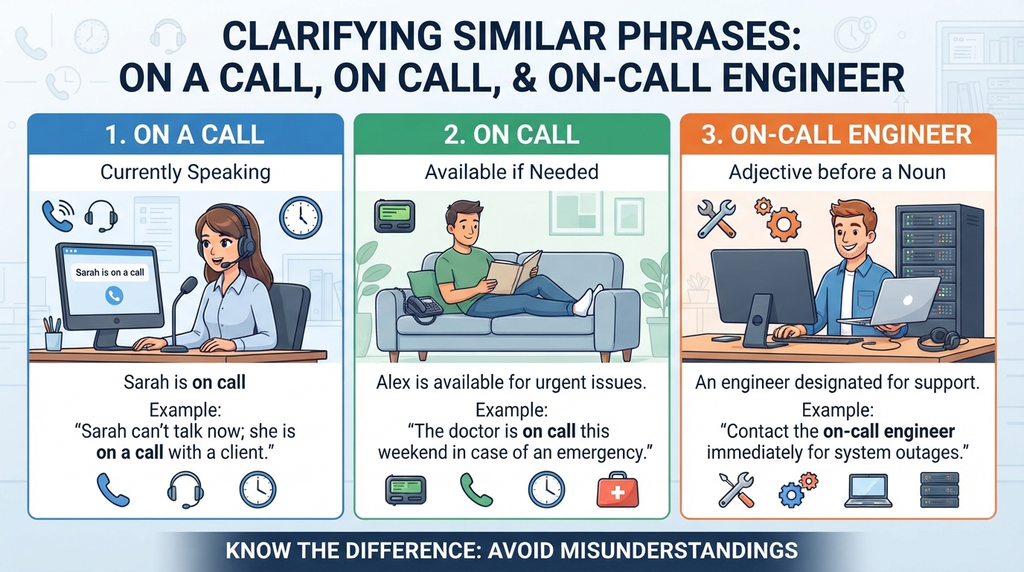
These expressions look similar but have completely different meanings.
On a call
On a call means participating in a call.
I’m on a call with the client.
On call
On call means available to respond to an emergency, request, or problem when needed.
The doctor is on call tonight.
An engineer is on call this weekend.
Who is on call after midnight?
A person who is on call does not necessarily have to be talking to anyone.
A person who is on a call is actually participating in a conversation.
Is “on call” hyphenated?
Usually:
- on call — when used as a predicate or ordinary phrase
- on-call — when used as a compound adjective before a noun
Examples:
The technician is on call tonight.
We need an on-call technician.
She works an on-call shift.
The same distinction explains oncall vs on-call: oncall as one word is generally not the standard spelling for this ordinary adjective or phrase.
“Via a Call” and “Via Telephone Call”
Via a call means by means of a call. It is grammatically correct, but it is more formal and less conversational than on a call.
We confirmed the appointment via a call.
The details were explained via a call.
In everyday conversation, you might simply say:
We confirmed it on the phone.
or:
We confirmed it during a call.
Via telephone call is also grammatically possible but sounds formal and somewhat bureaucratic.
The applicant was contacted via telephone call.
In ordinary professional writing, by phone, by telephone, or during a phone call will often sound smoother.
“Taking a Call”
Taking a call has a different meaning from being on a call.
To take a call usually means to answer or handle a telephone call.
I’m taking a call from a customer.
Can you take this call?
She had to step out to take a call.
Once the person answers, they are on the call or on the phone.
A useful sequence is:
take a call → be on the call → end the call
For example:
I need to take a call.
I’m on the call now.
I’ll call you back when the call ends.
Formal vs Casual English
In casual conversation, on a call is overwhelmingly useful.
Sorry, I’m on a call.
Can I call you later? I’m on a call.
He’s on another call.
In professional communication, the same expressions remain natural.
I’m currently on a call with a client and will respond afterward.
Several team members are already on the call.
In formal reports, during the call is often preferable when describing events or information:
During the call, the parties discussed the proposed schedule.
This is usually more polished than:
In the call, the parties discussed the proposed schedule.
Formal writing also commonly uses during the telephone conversation, during the meeting, or by telephone, depending on context.
Regional Variation
English usage varies somewhat across regions and professional communities.
On a call is broadly understood and highly established in international English, particularly in business and technology contexts.
In a call is also used, especially among speakers who conceptualize an online meeting or conference as a bounded event or room. Workplace technology can reinforce this pattern because interfaces often refer to people being “in a meeting,” “in a session,” or “in a call.”
That does not make in a call the best universal replacement for on a call.
For international professional writing, on a call is generally the safer choice when your intended meaning is simply participating in a telephone or online conversation.
The same principle applies to expressions such as on the call, on another call, and on a conference call.
Common Mistakes
Mistake: “I am in a call” when you mean “I am currently speaking”
❌ I’m in a call right now.
✅ I’m on a call right now.
The first may be heard and understood, particularly in some workplace varieties, but the second is the more idiomatic general-English choice.
Mistake: “Everyone in the call” for participants
Less natural: Everyone in the call agreed.
More natural: Everyone on the call agreed.
If you mean the people participating, on the call is the clearer choice.
Mistake: “We discussed it on the call” when referring to a specific event
This sentence is actually correct:
We discussed it on the call.
It is particularly natural in workplace speech.
You can also say:
We discussed it during the call.
The difference is mainly one of framing and style, not grammatical correctness.
Mistake: “In the phone”
❌ She’s in the phone.
✅ She’s on the phone.
Mistake: “Oncall”
❌ The nurse is oncall tonight.
✅ The nurse is on call tonight.
Before a noun:
✅ the on-call nurse
Mistake: Confusing “on call” with “on a call”
The engineer is on call.
The engineer is available if needed.
The engineer is on a call.
The engineer is currently participating in a conversation.
These are not interchangeable.
Practical Substitution Test
When you are unsure whether to use on or in, test the intended meaning.
Test 1: “Am I participating right now?”
If yes, choose on a call.
I’m ___ a call.
→ I’m on a call.
She is ___ another call.
→ She is on another call.
Test 2: “Am I talking about the participants?”
If yes, on the call is normally the best choice.
Who is ___ the call?
→ Who is on the call?
Everyone ___ the call heard it.
→ Everyone on the call heard it.
Test 3: “Am I talking about something that happened during a particular call?”
Try during the call.
We discussed the issue ___.
→ We discussed the issue during the call.
If in the call is also used in your context, it may be grammatical, but during the call is often the clearer choice in careful writing.
Test 4: “Do I mean available if needed?”
Then use on call, not on a call.
The doctor is on call tonight.
Test 5: “Am I describing a method?”
Use via a call, by phone, or by telephone as appropriate.
We confirmed the details by phone.
We confirmed the details via a call.
Sentence Pair Comparison
| Less preferred or different | Better choice | Why |
|---|---|---|
| I’m in a call right now. | I’m on a call right now. | Current participation |
| She is in another call. | She is on another call. | Current participation |
| Who is in the call? | Who is on the call? | Asking about participants |
| We discussed it in the call. | We discussed it during the call. | “During” clearly expresses time |
| Everyone in the call agreed. | Everyone on the call agreed. | Participants |
| She’s in the phone. | She’s on the phone. | Established communication expression |
| He’s oncall tonight. | He’s on call tonight. | Availability |
| He’s an on call engineer. | He’s an on-call engineer. | Compound adjective |
Memory and Decision Test
Remember the basic mental picture:
ON = connected/participating
on the phone
on a call
on the line
on a video call
on a conference call
IN = within something
in the conversation
in the meeting
in the recording
in the transcript
in the call history
This is not an absolute rule for every expression in English. Prepositions are strongly influenced by established collocations. Nevertheless, it provides a useful semantic explanation for why on a call is the normal choice for current participation.
A final three-question test is usually enough:
Are you currently talking? → on a call.
Are you identifying participants? → on the call.
Are you describing something that happened during the event? → during the call (and sometimes in the call, depending on context).
FAQs
Is it “on a call” or “in a call”?
On a call is the standard and most natural choice when you mean that someone is currently participating in a phone, video, or online conversation.
I’m on a call right now.
In a call can be grammatical when referring to something within a particular call, but it is usually not the first choice for everyday statements about participation.
Is it “in the call” or “on the call”?
Usually on the call when you mean someone is participating.
Everyone on the call agreed.
Use in the call when you are focusing on something occurring within a particular call, although during the call is often more natural.
We discussed the problem during the call.
What does “on a call” mean?
On a call means participating in a telephone, video, conference, or online conversation.
I can’t talk because I’m on a call.
What does “on the call” mean?
On the call means participating in a specific call that is already known from context.
Is Maria on the call?
Is “on a phone call” correct?
Yes. On a phone call is completely natural.
She is on a phone call with her sister.
You can also simply say on the phone.
Is “in a phone call” correct?
It can occur, but it is not the normal expression for saying that someone is participating in a telephone conversation. On a phone call or during a phone call is generally better.
Is “via a call” correct?
Yes. Via a call means by means of a call. It is more formal than everyday expressions such as on the phone or during a call.
Is “via telephone call” correct?
Yes, but it sounds formal or bureaucratic. Depending on context, by telephone, by phone, or during a telephone call may sound more natural.
What is the difference between “on call” and “on a call”?
On call means available to respond when needed.
On a call means currently participating in a conversation.
The doctor is on call tonight.
The doctor is on a call with a patient.
Is “on call” hyphenated?
Usually, on call is written as two words when it functions as a phrase:
She is on call tonight.
Use on-call as a compound modifier before a noun:
an on-call doctor
Is “oncall” or “on-call” correct?
Oncall is generally not the standard spelling for this expression. Use on call as a phrase and on-call as a compound adjective before a noun.
What does “being on call” mean?
Being on call means being available to respond to a request, emergency, or problem during a specified period.
The technician is on call this weekend.
It does not necessarily mean the person is currently talking to someone.
Is “taking a call” the same as “being on a call”?
No.
Taking a call usually means answering or handling a telephone call.
Being on a call means participating in the call.
I need to take a call.
I’m on the call now.
Should I say “on another call” or “in another call”?
For someone who is currently speaking with somebody else, use on another call.
Sorry, she’s on another call.
In another call can be grammatical when referring to something occurring within a different call, but it is not the normal expression for temporary telephone unavailability.
What does “in call” mean?
In call is not normally the standard everyday phrase for being on the telephone. In particular contexts, it can occur as technical, workplace, or system-related language, but general English normally uses on a call.
What does “incall” mean in slang?
Incall can have specialized meanings in different online or commercial contexts, including slang uses unrelated to ordinary telephone English. It should not be confused with the standard expression in a call. The meaning depends heavily on context.
What is the meaning of “on a call” in Telugu?
In ordinary usage, on a call means that someone is currently speaking or participating in a phone or online conversation. In Telugu, the idea can naturally be expressed as కాల్లో మాట్లాడుతున్నాను (“I’m talking on a call”) or, depending on context, కాల్లో ఉన్నాను (“I’m on a call”).
Is “our call” correct?
Yes. Our call means a call involving the speaker and another person or group.
Thanks for joining our call.
We discussed this during our call yesterday.
Here, our identifies ownership or association with the particular call.
Summary
For the ordinary question “on a call vs in a call,” choose on a call when you mean that someone is currently participating in a phone, video, or online conversation.
I’m on a call.
She’s on another call.
Everyone is on the call.
He’s on the phone.
Use in the call or in a call only when the context genuinely treats the call as a particular event or container for information. In careful writing, during the call is often the clearest alternative.
The most useful distinction is:
on a call = participating in the communication
on the call = participating in a specific communication
during/in the call = something happens within that communication
on call = available if needed
Once you separate these meanings, the choice becomes much easier than memorizing isolated prepositions.