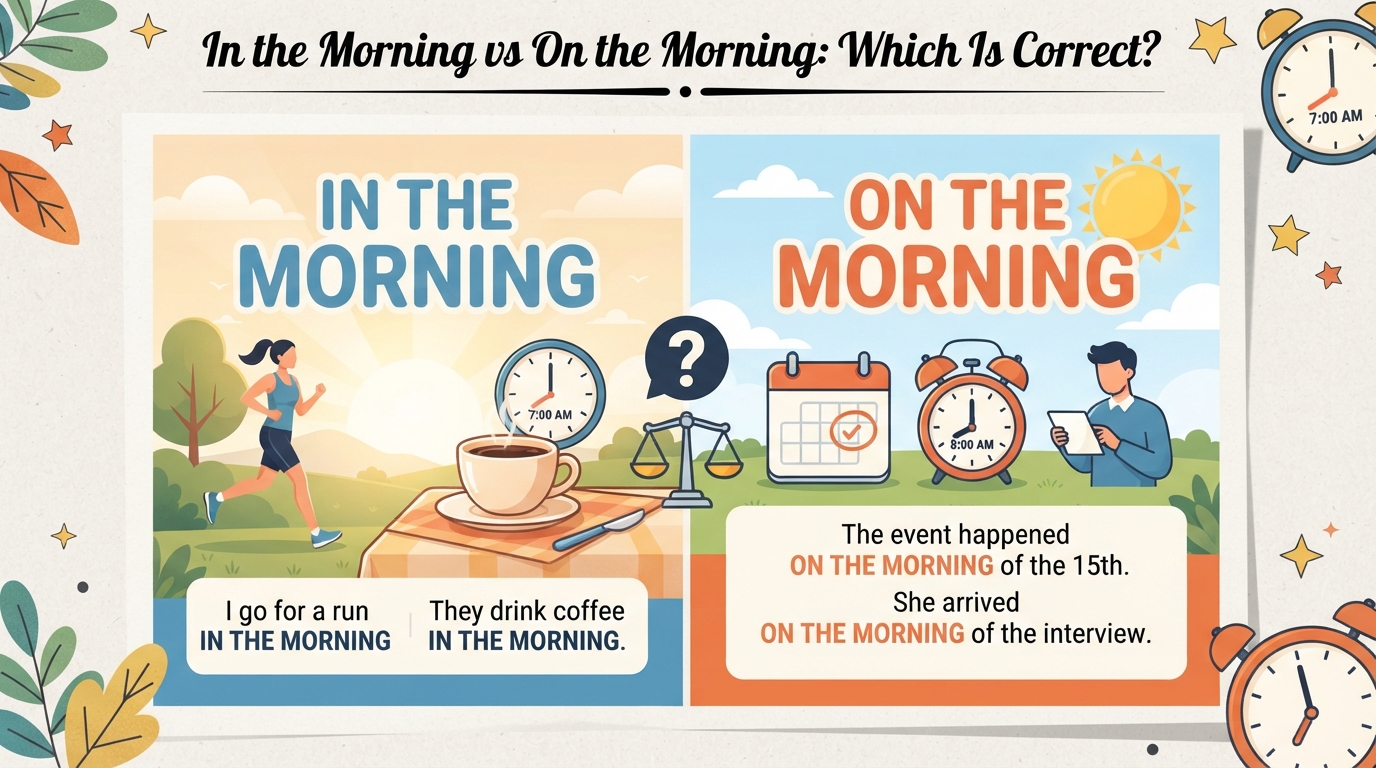
In the Morning vs On the Morning: Which Is Correct?
Quick Answer
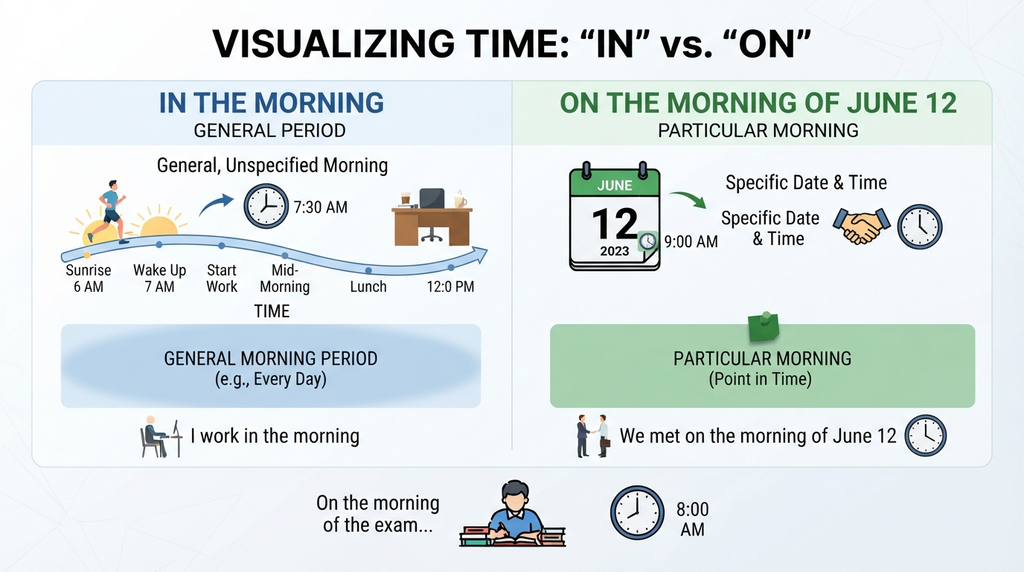
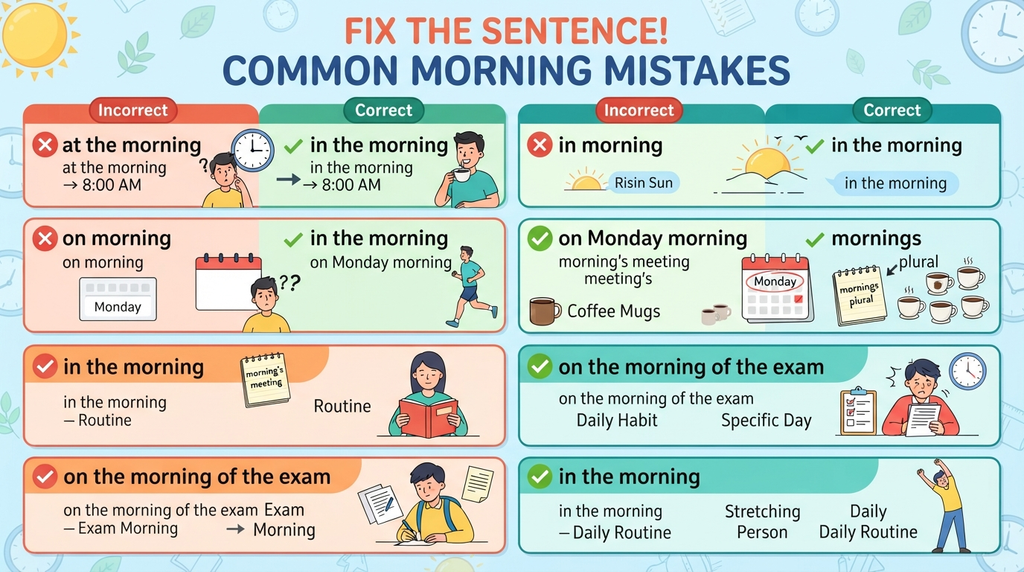
Use “in the morning” for a general time of day. Use “on the morning of” when you mean a particular morning connected to a specific day or event.
- in the morning = generally during the morning
I usually exercise in the morning. - on the morning of + specific day/event = during one particular morning
We left on the morning of June 12. - on the morning + of… is normally followed by a specific date, day, or event:
On the morning of the wedding, it rained. - at the morning is generally incorrect in standard English.
- on morning is generally incorrect in standard English.
- in morning is usually incomplete or nonstandard in ordinary English; use in the morning.
The key distinction is not simply that in goes with “morning” and on does not. The preposition reflects how you are conceptualizing the time: a period of the day versus a particular morning associated with a specific day or event.
Usage Table
| Expression | Standard? | Typical meaning | Example |
|---|---|---|---|
| in the morning | Yes | General morning time | I read in the morning. |
| on the morning of Monday | Yes | A particular Monday morning | She called on the morning of Monday, May 4. |
| on the morning of the meeting | Yes | A particular morning associated with an event | He arrived early on the morning of the meeting. |
| on the morning | Usually incomplete | Needs a specific reference in most contexts | On the morning of the interview, I was nervous. |
| in a morning | Grammatical, but less common | Within one morning / during a morning | The entire task can be completed in a morning. |
| on a morning | Grammatical | On one particular, often unspecified morning | On a morning like this, I prefer to stay home. |
| in the mornings | Yes | Habitually during mornings | I walk in the mornings. |
| at the morning | Generally no | Not normal standard English | Use in the morning. |
| at morning | Generally no | Not normal standard English | Use in the morning. |
| in morning | Usually no in ordinary prose | Missing article in standard usage | Use in the morning. |
| on morning | Usually no | Missing necessary construction | Use in the morning or on the morning of…. |
The Meaning and Relationship Behind the Prepositions
English prepositions often reflect how we mentally structure time.
With in, English commonly treats a period as something that contains an activity:
- in the morning
- in the afternoon
- in the evening
- in the summer
- in January
- in 2026
The activity happens within that period.
Compare:
I answer emails in the morning.
The speaker is not identifying one particular morning. “Morning” functions as a general part of the daily schedule.
With on, English commonly identifies a particular day or date:
- on Monday
- on Friday
- on June 12
- on my birthday
- on Christmas Day
When you say:
on the morning of June 12
the word morning is attached to a particular date. You are effectively identifying the morning belonging to that day.
The same pattern appears with events:
on the morning of the wedding
on the morning of the interview
on the morning of the election
on the morning of the accident
So on the morning of is not really competing directly with ordinary in the morning. The two constructions usually serve different purposes.

Common Patterns With “In the Morning”
General routines
Use in the morning when talking about habits, routines, preferences, or typical activities.
I drink coffee in the morning.
She goes for a walk in the morning.
We normally have meetings in the morning.
Do you study in the morning or at night?
He is more productive in the morning.
This is by far the normal construction for general statements.
Future plans
You can also use in the morning when the particular date is already clear from context.
I’ll call you in the morning.
Let’s discuss it in the morning.
I’ll send the report in the morning.
Here, the listener normally understands which morning you mean from the conversational context.
Past events
The same construction works for past events:
I saw her in the morning.
We left in the morning.
He called me in the morning.
If you want to identify the exact day, add the day or date:
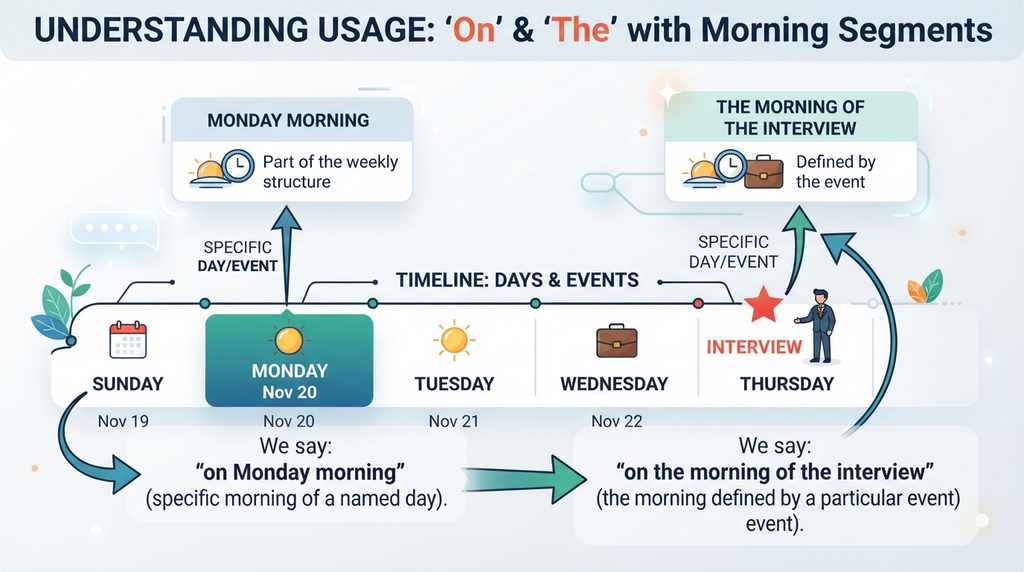
We left on Monday morning.
We left on the morning of Monday, June 12.
The addition of a specific day changes the construction naturally.
“On the Morning of” for Specific Days and Events
On the morning of is especially useful when the morning itself is connected to a specific reference point.
Specific dates
On the morning of June 12, the temperature dropped sharply.
The package arrived on the morning of October 3.
They left on the morning of December 24.
Specific days
On the morning of Monday, we reviewed the final documents.
On the morning of Friday, the office reopened.
In everyday English, on Monday morning is often more natural than on the morning of Monday:
We met on Monday morning.
The longer construction is useful when the date or event is being presented as a distinct chronological reference.
Specific events
On the morning of the wedding, everyone was busy.
On the morning of the interview, I reviewed my notes.
On the morning of the exam, she woke up early.
On the morning of the meeting, the manager sent an update.
Here, the morning is definite because the following phrase tells us exactly which morning.
In the Morning vs On the Morning: Sentence Pairs
Small changes in context can make the preferred construction obvious.
General habit vs specific event
I exercise in the morning.
This describes a routine.
I exercised on the morning of the race.
This identifies one particular morning.
General time vs particular date
We arrived in the morning.
The exact morning is not emphasized.
We arrived on the morning of July 8.
The date identifies the particular morning.
General preference vs historical sequence
She likes to read in the morning.
A general preference.
On the morning of the announcement, she read the statement aloud.
A particular event in a sequence.
Context can make “in the morning” specific enough
I’ll see you in the morning.
This can refer to tomorrow morning even though no date is mentioned.
So it would be wrong to claim that in the morning always means a general morning. Context can make it refer to a specific upcoming or previously understood morning.
The important distinction is that in the morning focuses on the time period, while on the morning of… explicitly identifies a particular morning.
“On a Morning” vs “In a Morning”
These are both possible, but they mean different things.
On a morning
On a morning presents one morning as a particular occasion.
On a quiet morning, I like to walk by the river.
On a morning like this, coffee is essential.
On a cold winter morning, the streets were almost empty.
It often sounds descriptive or literary because the writer is presenting a particular morning as a scene.
In a morning
In a morning commonly emphasizes what can happen within the duration of one morning.
We can finish the work in a morning.
She learned the basic procedure in a morning.
This construction is less common than in the morning, because the meaning is different.
Compare:
I work in the morning.
This means during morning hours.
I can finish the work in a morning.
This means within the span of one morning.
That distinction is important when deciding between on a morning or in a morning.
“In the Mornings”
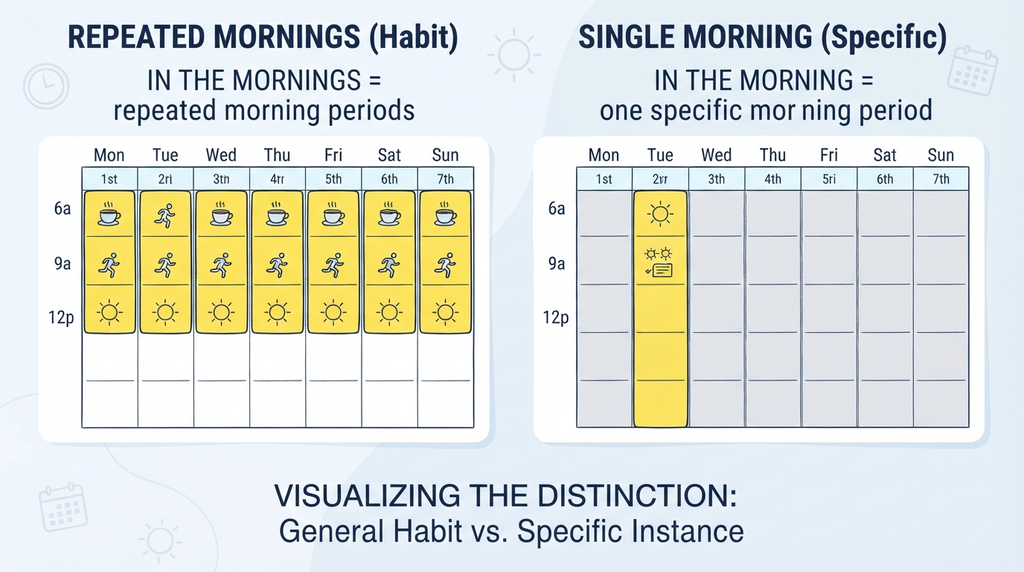
Use in the mornings when talking about repeated morning periods, especially habits.
I exercise in the mornings.
She works best in the mornings.
We usually open early in the mornings.
Both in the morning and in the mornings are natural.
Compare:
I usually run in the morning.
I usually run in the mornings.
The first can sound like a general routine involving the morning as a time category. The second makes the repeated nature of the habit slightly more explicit.
The choice often depends on style and context rather than a major difference in meaning.
Common Time Expressions With Morning
Several related expressions are worth separating.
In the morning
I work in the morning.
Early in the morning
We left early in the morning.
This is one of the most natural ways to express an early time.
In the early morning
The birds are particularly active in the early morning.
This is grammatical and natural, especially in descriptive or formal writing.
In an early morning
This is grammatical when an early morning is treated as a particular type or instance of morning:
In an early morning of the previous century, the town was still quiet.
However, it is much less common in ordinary conversation than:
Early one morning…
or:
One early morning…
On an early morning
This can also occur when the writer treats a particular early morning as a scene:
On an early morning in May, the hikers began their climb.
Here, on works because the phrase presents a particular morning.
Early morning
When used as a noun modifier, no preposition is necessary:
an early morning flight
an early morning meeting
early morning traffic
This is different from saying:
I arrived early in the morning.
“In Morning” and “On Morning”
Learners sometimes encounter phrases such as in morning or on morning, particularly in informal messages, learner English, headlines, or language influenced by another language.
In standard everyday English, the usual construction is:
in the morning
not:
in morning
Similarly, use:
on Monday morning
or:
on the morning of Monday
rather than:
on morning
The article the is an important part of the ordinary expression in the morning.
There are contexts where morning appears without an article, but those are different grammatical structures:
Morning!
Good morning.
Morning coffee is ready.
Monday morning traffic was heavy.
These do not make in morning standard.
“At the Morning” vs “In the Morning”
For ordinary time expressions, at the morning is not the normal choice.
Use:
I woke up in the morning.
We met in the morning.
She works in the morning.
English uses at with certain points or fixed time expressions:
- at 8:00
- at noon
- at midnight
- at night
- at dawn
Notice the useful contrast:
in the morning
but:
at night
This is one reason learners may incorrectly transfer at night to at morning. English does not normally use that parallel construction.

Everyday, Professional, Email, and Formal Examples
Everyday conversation
What are you doing in the morning?
I’ll call you in the morning.
Do you feel more energetic in the morning?
We can meet on Saturday morning.
The first three are general or contextually understood. The last identifies a particular day.
Professional communication
The team will meet in the morning to review the proposal.
Please send the revised document in the morning.
The inspection took place on the morning of May 14.
The client contacted us on the morning of the launch.
For business writing, on the morning of + date/event is especially useful when establishing a precise chronology.
Natural:
I’ll send you the final version in the morning.
Natural:
We received your message on Monday morning.
More formal:
The documents were received on the morning of September 8.
Less natural:
I’ll send you the final version at the morning.
Formal and academic writing
Formal writing often needs precise chronological references:
On the morning of April 15, the committee convened.
The researchers collected the samples in the morning.
On the morning of the experiment, all equipment was inspected.
The choice depends on whether the writer needs general temporal information or a particular chronological reference.
Regional Variation
The core distinction is broadly shared across major varieties of standard English, including British and American English:
in the morning
is standard in both.
on Monday morning
is standard in both.
on the morning of the event
is standard in both.
There can be stylistic differences in how frequently speakers use certain longer constructions, particularly in formal narrative writing. But there is no major British-versus-American rule that changes in the morning into on the morning.
Some regional varieties and learner varieties may omit articles or use prepositions differently. Such forms can occur in real-world communication without being the preferred form in edited standard English.
Common Mistakes
Mistake 1: Using “at the morning”
❌ I will call you at the morning.
✅ I will call you in the morning.
Mistake 2: Saying “on morning”
❌ We met on morning.
✅ We met in the morning.
Or, if a particular day is intended:
✅ We met on Monday morning.
Mistake 3: Omitting “the”
❌ I usually study in morning.
✅ I usually study in the morning.
Mistake 4: Using “on” for every specific morning
Specificity alone does not automatically require on.
I’ll see you in the morning.
This can refer to one particular morning when the context makes it clear.
On becomes especially natural when the morning is explicitly linked to a day or event:
on Monday morning
on the morning of the exam
on the morning of June 12
Mistake 5: Treating “in a morning” and “in the morning” as interchangeable
I work in the morning.
This means during morning hours.
I can finish it in a morning.
This means within one morning.
They are grammatically and semantically different.
Mistake 6: Confusing “morning” and “morning’s”
The plural is:
mornings
The possessive singular is:
morning’s
Examples:
I enjoy quiet mornings.
The morning’s silence was peaceful.
Do not use an apostrophe simply to make a plural.
So:
❌ I love peaceful morning’s.
✅ I love peaceful mornings.
Memory and Decision Test
When choosing between in, on, and at, ask what kind of time reference you are making.
Test 1: Is it a general part of the day?
Use in.
I exercise in the morning.
She studies in the afternoon.
We relax in the evening.
Test 2: Is it a particular day?
Use on.
on Monday
on Friday morning
on June 12
Test 3: Is it a particular morning identified by a date or event?
Use:
on the morning of…
Examples:
on the morning of the exam
on the morning of June 12
on the morning of the wedding
Test 4: Are you talking about something completed within one morning?
Use in a morning when that is the intended meaning.
We finished the project in a morning.
Test 5: Are you talking about a habitual pattern?
Use in the morning or in the mornings.
I read in the morning.
I read in the mornings.
A useful shortcut is:
general period → in
specific day → on
specific morning of a day/event → on the morning of
point/fixed expression such as night → at
FAQs
Is it “in the morning” or “on the morning”?
Usually, in the morning.
Use on the morning when it forms part of a construction identifying a particular morning, especially on the morning of + date/event.
Is “on the morning of” correct?
Yes. It is a standard construction for identifying a particular morning.
On the morning of the interview, I arrived early.
Can I say “on Monday morning”?
Yes. In fact, this is usually more natural than on the morning of Monday in everyday English.
We met on Monday morning.
Is “at morning” correct?
Not normally in standard modern English. Use in the morning.
Is “in morning” correct?
Not normally in standard English when you mean the ordinary time expression. Use in the morning.
Is “on morning” correct?
Not normally. Say in the morning, on Monday morning, or on the morning of the event, depending on your meaning.
Should I say “in the mornings” or “in the morning”?
Both are correct.
I exercise in the morning.
I exercise in the mornings.
The second makes the repeated nature of the routine more explicit.
Is “on a morning” correct?
Yes. It normally presents one particular morning as an occasion or scene.
On a quiet morning, the city feels completely different.
Is “in a morning” correct?
Yes, but it has a different meaning. It commonly means within the duration of one morning.
We completed the task in a morning.
What is the difference between “early morning” and “early in the morning”?
Both are correct, but they serve different grammatical roles.
early morning traffic — early morning modifies traffic.
We left early in the morning — early in the morning is a time expression.
Is “in the morning in the evening” correct?
It depends on the sentence. When contrasting two times, English normally uses parallel expressions:
We work in the morning and in the evening.
You can also say:
We work in the morning and evening.
The first version is slightly more explicit and symmetrical.
Is “mornings like this” or “mornings like these” correct?
Both can be correct, but they point to different numbers.
Mornings like this are rare.
= mornings resembling the kind of morning happening now.
Mornings like these are rare.
= several mornings of the type being discussed or indicated.
Is “this mornings” correct?
No. Use:
this morning
For example:
I spoke to her this morning.
The possessive morning’s is different:
This morning’s meeting was productive.
Summary
The most useful distinction is simple:
“In the morning” is the standard expression for talking about morning as a time period, whether the reference is general or understood from context.
“On the morning of…” identifies a particular morning by connecting it to a specific date or event.
Compare:
I usually work in the morning.
I worked on the morning of the conference.
And when a weekday is named, use the very natural:
on Monday morning
rather than trying to force every morning expression into in.
Finally, avoid at morning, at the morning, on morning, and ordinary in morning in standard English. When in doubt, ask whether you are describing a period of the day or identifying a particular day/morning. That semantic distinction will usually give you the right construction.