Ask a Question vs Pose a Question: What’s the Difference?
Quick Answer
“Ask a question” and “pose a question” are both correct, and they usually mean the same basic thing: to put a question into words and seek an answer.
The main difference is register and emphasis:
- Ask a question is the normal, everyday expression. It works naturally in conversation, emails, classrooms, interviews, and most kinds of writing.
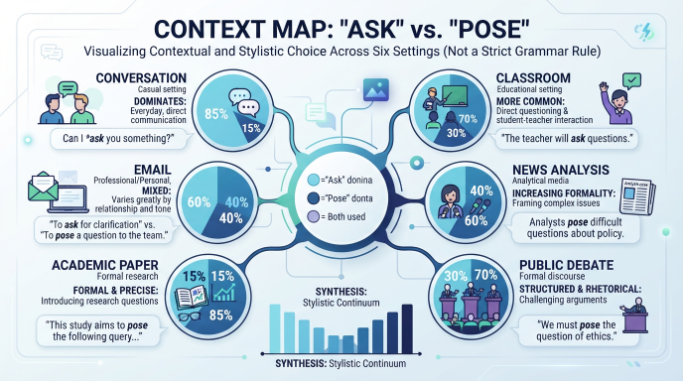
- Pose a question is more formal and deliberate. It is especially common in academic, professional, journalistic, analytical, and literary writing.
- Pose can suggest that a question is being presented for consideration, not necessarily asked directly of a particular person.
- Ask is more natural when someone is directly seeking information from another person.
So, in most casual situations, choose ask a question. In formal or analytical writing, pose a question may sound more precise or polished.

At-a-Glance Table
| Feature | Ask a question | Pose a question |
|---|---|---|
| Basic meaning | Put a question to someone | Put or present a question for consideration |
| Part of speech | Ask is a verb | Pose is a verb |
| Typical register | Neutral, everyday | More formal or deliberate |
| Direct conversation | Very natural | Correct but less conversational |
| Academic writing | Natural | Especially common |
| Business writing | Natural | Common in formal analysis |
| Journalism | Common | Common |
| Asking someone for information | Usually preferred | Possible, but can sound formal |
| Presenting an issue for discussion | Natural | Often especially suitable |
| British English | Common | Common |
| American English | Common | Common |
| Meaning difference | Usually focuses on obtaining an answer | Often emphasizes presenting the question |
| Example | “Can I ask you a question?” | “The study poses an important question.” |
The expressions are therefore not opposites. They overlap considerably, but they can create different impressions depending on the context.
Ask a Question vs Pose a Question: The Detailed Difference
What does “ask a question” mean?
Ask a question means to put a question to someone because you want information, clarification, an opinion, or an answer.
For example:
“May I ask you a question?”
“She asked the teacher a difficult question.”
“I need to ask you something.”
The verb ask is one of the most ordinary and flexible verbs in English. It can be used with a direct object:
“He asked a question.”
It can also be followed by a person:
“He asked Maria a question.”
Or by a question clause:
“She asked whether the report was finished.”
The expression does not imply that the question is formal, sophisticated, difficult, or carefully constructed. It simply describes the act of asking.
What does “pose a question” mean?
Pose a question also means to put forward a question, but pose often carries the additional sense of presenting something for thought, discussion, investigation, or consideration.
For example:
“The discovery poses an important question.”
Here, the writer is not necessarily saying that the discovery literally spoke to someone and requested an answer. Instead, the discovery raises an issue that requires consideration.
Likewise:
“The researcher posed a question about the reliability of the data.”
This sounds more deliberate and formal than:
“The researcher asked a question about the reliability of the data.”
Both are grammatical. The choice depends on the writer’s intended emphasis.
Why does “pose” sound more formal?
In this expression, pose is associated with the idea of putting something before an audience or presenting it for consideration.
That makes it particularly useful in contexts such as:
- academic research
- essays
- journalism
- business analysis
- public debate
- philosophy
- scientific discussion
- formal presentations
Compare:
“I want to ask you a question.”
with:
“This finding poses an important question about the reliability of the current model.”
The first sentence sounds like ordinary communication. The second frames the question as an intellectual or analytical issue.

Is “Pose a Question” Grammatically Correct?
Yes. Pose a question is a standard grammatical construction.
The structure is:
subject + pose + a/the + question
Examples:
- “The professor posed a question.”
- “The article poses an interesting question.”
- “The report posed several questions.”
- “She posed the question carefully.”
- “The evidence poses a serious question about the conclusion.”
The verb pose is transitive here, meaning that it normally takes a direct object.
The object can be singular:
“He posed a question.”
or plural:
“He posed several questions.”
You can also use the when the question has already been identified or is understood from context:
“The committee posed the question to the panel.”
“Pose the Question” vs “Pose a Question”
The difference between a and the follows the ordinary English distinction between indefinite and definite articles.
“Pose a question”
Use a question when introducing one question without assuming that the reader already knows which question you mean.
“The researcher posed a question about consumer behavior.”
This introduces the question as new information.
“Pose the question”
Use the question when referring to a specific question already mentioned, established, or understood.
“The researchers discussed the problem for several hours before posing the question to the panel.”
Here, the question identifies a particular question.
Another example:
“The article begins by posing a question and later answers the question.”
The first reference is a question because it is being introduced. The later reference is the question because the reader now knows which one is meant.
“The Question Was Posed” Meaning
“The question was posed” is the passive form of “someone posed the question.”
For example:
“The question was posed during the final part of the interview.”
This means that someone presented or asked the question, but the sentence does not identify who did it.
Active:
“The journalist posed the question.”
Passive:
“The question was posed by the journalist.”
The passive construction is particularly common in formal writing when the person asking the question is unimportant or already obvious.
“Posed a Question” vs “Asked a Question”
Both are correct.
Compare:
“The student asked a question.”
“The student posed a question.”
The first is more neutral and conversational. The second gives the act a more formal or deliberate tone.
This does not mean that “pose” always refers to a more intelligent or difficult question. A simple question can be posed:
“The moderator posed a simple question to the audience.”
And a complicated question can be asked:
“The researcher asked a highly technical question.”
The distinction is primarily about presentation and register, not the intellectual quality of the question.
When to Use “Ask a Question”
Use ask a question when the main idea is that someone wants an answer or information.
In everyday conversation
“Can I ask you a question?”
“I wanted to ask you something.”
“She asked me a question about my job.”
These are the most natural choices in ordinary speech.
In classrooms
“Students should feel comfortable asking questions.”
“I asked my professor a question after class.”
Although “pose questions” is possible in academic contexts, ask questions is usually more natural when describing an actual student seeking clarification.
In interviews
“The interviewer asked several questions.”
“I have one more question to ask.”
Again, ask emphasizes the communicative act.
In emails
“I’d like to ask a question about the deadline.”
This sounds natural and professional without being unnecessarily formal.
When to Use “Pose a Question”
Use pose a question when the question itself is being presented as an issue for consideration, analysis, or discussion.
Academic writing
“The results pose an important question about the reliability of the experiment.”
Here, the results themselves cannot literally speak. They raise an issue that researchers need to consider.
Analytical writing
“The decision poses a difficult question for policymakers.”
This emphasizes the problem created by the decision.
Journalism
“The investigation poses new questions about how the funds were allocated.”
The focus is on the questions raised by the investigation.
Presentations and debates
“Let me pose a question to the audience.”
This is formal but completely natural. The speaker is deliberately putting a question before the audience.
Philosophical discussion
“The thought experiment poses a fundamental question about personal identity.”
Here, pose works particularly well because the question is an intellectual problem rather than merely a request for information.
Examples by Context
Everyday conversation
Natural:
“Can I ask you a question?”
Possible but more formal:
“Can I pose a question?”
If you are talking to a friend, ask is usually the natural choice.
Professional email
“I’d like to ask a question about the revised schedule.”
This is straightforward and professional.
A more formal analytical context could use:
“The revised schedule poses a question about how the remaining work will be allocated.”
Notice that the second sentence changes the meaning slightly. The schedule itself creates an issue; nobody is necessarily directly requesting information.
Academic writing
Both forms work:
“The study asks an important question about memory.”
“The study poses an important question about memory.”
The second is often more polished when the study raises an issue for investigation.
Research
“The researchers asked participants several questions.”
Here, asked is clearly preferable because the researchers actually presented questions to participants.
But:
“The findings pose several questions about the long-term effects.”
Here, pose is appropriate because the findings raise issues requiring further investigation.
This is one of the clearest practical distinctions between the two verbs.
Journalism
“The reporter asked the minister a question.”
The reporter is directly seeking an answer.
But:
“The minister’s response poses another question.”
The response creates a new issue for consideration.
Public speaking
“I’d like to ask you a question.”
Neutral and conversational.
“Let me pose a question to the audience.”
More formal, deliberate, and rhetorical.
Essay writing
“This raises an important question.”
“This poses an important question.”
Both are acceptable. Raises a question is also extremely natural and often avoids unnecessary formality.
“Pose an Issue” vs “Pose a Question”
The verb pose is not limited to questions.
You can say:
“The proposal poses a significant problem.”
“The new regulation poses a challenge for small businesses.”
“The change poses a risk to the existing system.”
In these constructions, pose means something like present, create, or put forward as a problem, challenge, risk, or issue.
Therefore:
“The discovery poses a question.”
means that the discovery presents an issue requiring consideration.
This is closely related to:
“The discovery raises a question.”
Both are natural, although raise a question is generally more common in ordinary prose.
“Posing a Question” Meaning
Posing a question is the -ing form of pose a question.
It can function in several ways.
As part of a continuous construction
“She is posing a question to the panel.”
This describes an action happening now or around the current time.
As a participial phrase
“By posing a question about the evidence, the writer encourages readers to reconsider the conclusion.”
Here, posing introduces the action that helps produce the main effect.
As a gerund
“Posing questions can encourage deeper discussion.”
Here, posing questions acts as the subject of the sentence.
The phrase posing questions meaning therefore simply refers to the meaning of asking or presenting questions for consideration, often with a formal or deliberate tone.
“Posed as a Question” Is Different
Be careful with posed as a question.
The expression can mean that something was formulated or presented in the form of a question.
For example:
“The criticism was posed as a question.”
This does not necessarily mean someone genuinely wanted an answer. The speaker may have expressed a criticism indirectly by wording it as a question.
Compare:
“She asked whether the plan was realistic.”
with:
“Her criticism was posed as a question: Was the plan really realistic?”
The second sentence focuses on how the statement was presented.
“The Questions Posed” Meaning
“The questions posed” means the questions that were presented, raised, or asked.
For example:
“The questions posed by the study deserve further investigation.”
This means:
“The questions raised or presented by the study deserve further investigation.”
Another example:
“The questions posed during the interview were difficult.”
Here, posed simply means asked.
The construction is especially common in formal writing because it allows the writer to compress information:
“The questions posed by the researchers…”
instead of:
“The questions that the researchers asked…”
Both are grammatically correct.
“Question Posed” Meaning
Question posed is simply a noun phrase containing a past participle.
For example:
“The question posed by the committee was controversial.”
The phrase means:
“The question that the committee presented or asked…”
You may also see it in headlines, academic writing, and formal prose:
“The question posed is whether the policy can be implemented.”
Here, posed modifies question.
“Question Pose” and “Question Posing”
The natural English expression is question posing when you need a noun phrase describing the activity of posing questions.
For example:
“Effective question posing can improve classroom discussion.”
However, question pose is generally not the normal noun expression for this idea.
You would usually write:
- question posing
- posing questions
- the posing of questions
- asking questions
rather than question pose.
The phrase question pose may occur in specialized terminology or unusual contexts, but it should not be treated as the standard equivalent of question posing.
Common Mistakes
Mistake 1: Thinking “pose a question” is more grammatically correct
It is not.
Both are grammatical:
“She asked a question.”
“She posed a question.”
The difference is primarily style, register, and emphasis.
Mistake 2: Using “pose” in every formal sentence
Formal writing does not require replacing every instance of ask with pose.
Awkward:
“The customer posed a question about the shipping date.”
Possible, but unnecessarily formal.
More natural:
“The customer asked a question about the shipping date.”
Mistake 3: Assuming “pose” means “ask difficult questions”
There is no such grammatical rule.
“The child posed a simple question.”
is perfectly correct.
Likewise:
“The professor asked a difficult question.”
is perfectly correct.
The difficulty of the question does not determine the verb.
Mistake 4: Confusing “pose” with “raise”
These expressions overlap:
“The evidence raises a question.”
“The evidence poses a question.”
Both can mean that the evidence creates an issue for consideration.
But raise a question is often more idiomatic in general prose, while pose a question can sound more deliberate or formal.
Mistake 5: Writing “pose question” without an article
In ordinary singular usage, you normally need an article or another determiner:
“She posed a question.”
“She posed the question.”
“She posed several questions.”
Not:
“She posed question.”
A singular count noun such as question normally requires an appropriate determiner.
Mistake 6: Confusing “posed” with “postured”
The word pose has several meanings.
As a verb, it can mean:
- to present a question or problem
- to create a risk or challenge
- to assume a particular physical position
- to pretend or present oneself in a particular way
For example:
“The proposal poses a serious risk.”
and:
“She posed for a photograph.”
These are different meanings of the same verb.

A Fast Decision Rule
Use this simple test:
Are you directly seeking information from someone?
→ Use ask.
“I need to ask my manager a question.”
Are you presenting a question, problem, or issue for consideration?
→ Pose may be the better stylistic choice.
“The results pose an important question about the method.”
Are you writing ordinary conversation?
→ Ask is usually more natural.
Are you writing formal analytical prose?
→ Pose is often appropriate, though ask remains correct.
The Practical Proofreading Test
When editing a sentence, replace pose with ask.
If the sentence describes someone directly seeking an answer, ask will often be the more natural choice:
“The interviewer asked the candidate about her experience.”
If the sentence describes a situation creating an intellectual problem or issue, pose may be more effective:
“The findings pose a difficult question about the reliability of the test.”
Another useful substitution is raise:
“The findings raise a difficult question about the reliability of the test.”
If raise works naturally, pose may also work, particularly in formal writing.
Formal vs Casual Usage
There is no strict British-versus-American rule separating ask and pose.
Both expressions are established in British English and American English.
The important distinction is generally register, not geography.
Casual English
Prefer:
“Can I ask you something?”
“I want to ask a question.”
“She asked me why I was late.”
These sound natural and unmarked.
Formal English
Both remain possible:
“The researcher asked participants whether they agreed.”
“The researcher posed a question concerning the reliability of the results.”
The second sentence has a more formal and analytical feel.
British and American English
British and American speakers both use ask a question and pose a question. Neither expression is exclusively British or American.
Pronunciation also does not create a meaningful distinction here:
- ask: /ɑːsk/ in many British varieties and /æsk/ in most American varieties
- pose: /pəʊz/ in many British varieties and /poʊz/ in American English
The pronunciation differences reflect normal regional vowel differences, not different meanings of the expressions.

Can You “Pose a Question to” Someone?
Yes.
The construction pose a question to someone is grammatical.
“The journalist posed a question to the minister.”
“The professor posed a question to the class.”
“She posed a difficult question to the panel.”
This structure is especially natural when the question is being formally presented to an audience, panel, speaker, or group.
You can also say:
“The journalist asked the minister a question.”
The ask construction is more neutral.
Can “Pose” Be Used Without “A Question”?
Yes. The verb pose can take many different objects.
“The storm poses a serious threat.”
“The proposal poses a challenge.”
“The decision poses a problem.”
“The evidence poses an interesting question.”
In each case, pose conveys the idea that something presents or creates a particular issue, difficulty, risk, or question.
This is why pose can be particularly useful in analytical writing.
“Pose a Question” in Crossword Clues
If you encounter “pose a question” as a crossword clue, the expected answer depends on the number of letters and the particular puzzle.
Common synonyms include:
- ask
- query
- inquire
- raise
- put
The exact answer cannot be determined from the clue alone because crossword construction depends on the required letter count and crossing letters.
For ordinary vocabulary purposes, however, ask is the most direct synonym of pose a question.
More Natural Examples
Direct questions
“Can I ask you a quick question?”
“She asked her brother where he had parked.”
“The customer asked whether the product was still available.”
“The interviewer asked three follow-up questions.”
Formal or analytical questions
“The discovery poses an important question about the origins of the material.”
“The report poses several questions about the effectiveness of the program.”
“The new evidence poses a challenge to the existing explanation.”
“The article poses the question of whether the policy can be sustained.”
Mixed contexts
“The professor posed a question to the class.”
“Several students asked questions after the lecture.”
“The results pose questions that future researchers will need to investigate.”
“A reporter asked the mayor a question about the decision.”
These examples demonstrate why the distinction is not simply informal = ask and formal = pose. Context and meaning both matter.
FAQs
Is it better to say “ask a question” or “pose a question”?
Neither is universally better. Ask a question is the standard neutral expression and is usually preferable in everyday communication. Pose a question is especially useful when a question is being deliberately presented for discussion, analysis, or consideration.
Is “pose a question” formal?
Usually, yes. It tends to sound more formal, deliberate, or analytical than ask a question, although it is not restricted to formal writing.
Does “pose a question” mean the same as “ask a question”?
They overlap strongly. Both can mean putting a question to someone. Pose can additionally emphasize presenting the question as an issue for consideration.
Is “posed the question” correct?
Yes.
“The researcher posed the question to the panel.”
It means that the researcher presented or asked the specific question.
What does “the question was posed” mean?
It is the passive form of “someone posed the question.” It means that the question was presented or asked, without necessarily identifying who asked it.
What does “posing a question” mean?
It means asking or presenting a question, often with an implication that the question is being deliberately put forward for consideration.
Is “pose question” correct?
Not normally when question is a singular count noun used without a determiner.
Use:
“pose a question”
or:
“pose the question”
or:
“pose several questions.”
Can I say “pose a question to someone”?
Yes. It is completely grammatical:
“She posed a question to the speaker.”
Is “ask a question” more common?
In ordinary English, yes. Ask is the basic, everyday verb for requesting information or putting a question to someone. Pose is more specialized in tone and is common in formal and analytical contexts.
Is “raise a question” the same as “pose a question”?
They can be very close in meaning.
“The findings raise an important question.”
“The findings pose an important question.”
Both can mean that the findings create an issue requiring consideration. Raise is particularly natural in general analytical prose.
Does “pose” mean “ask” in every context?
No. Pose has several meanings. It can mean to present a question or problem, but it can also refer to adopting a physical position or pretending to be something.
Is there a British or American difference?
Not in the basic usage. Ask a question and pose a question are used in both British and American English. Differences are mainly related to register and pronunciation rather than grammatical correctness.
Final Takeaway
Ask a question is the standard, neutral choice when someone is directly seeking information or an answer.
Pose a question is equally grammatical but often sounds more formal and deliberate. It is particularly useful when a person, study, discovery, argument, or situation presents a question for consideration.
A simple rule is:
Directly seeking an answer? Ask.
Presenting an issue for thought or analysis? Pose.
When both options are grammatically possible, choose based on the tone and emphasis you want—not because one is universally “correct” and the other is not.