Whoever or Whomever: What’s the Difference?
Quick Answer
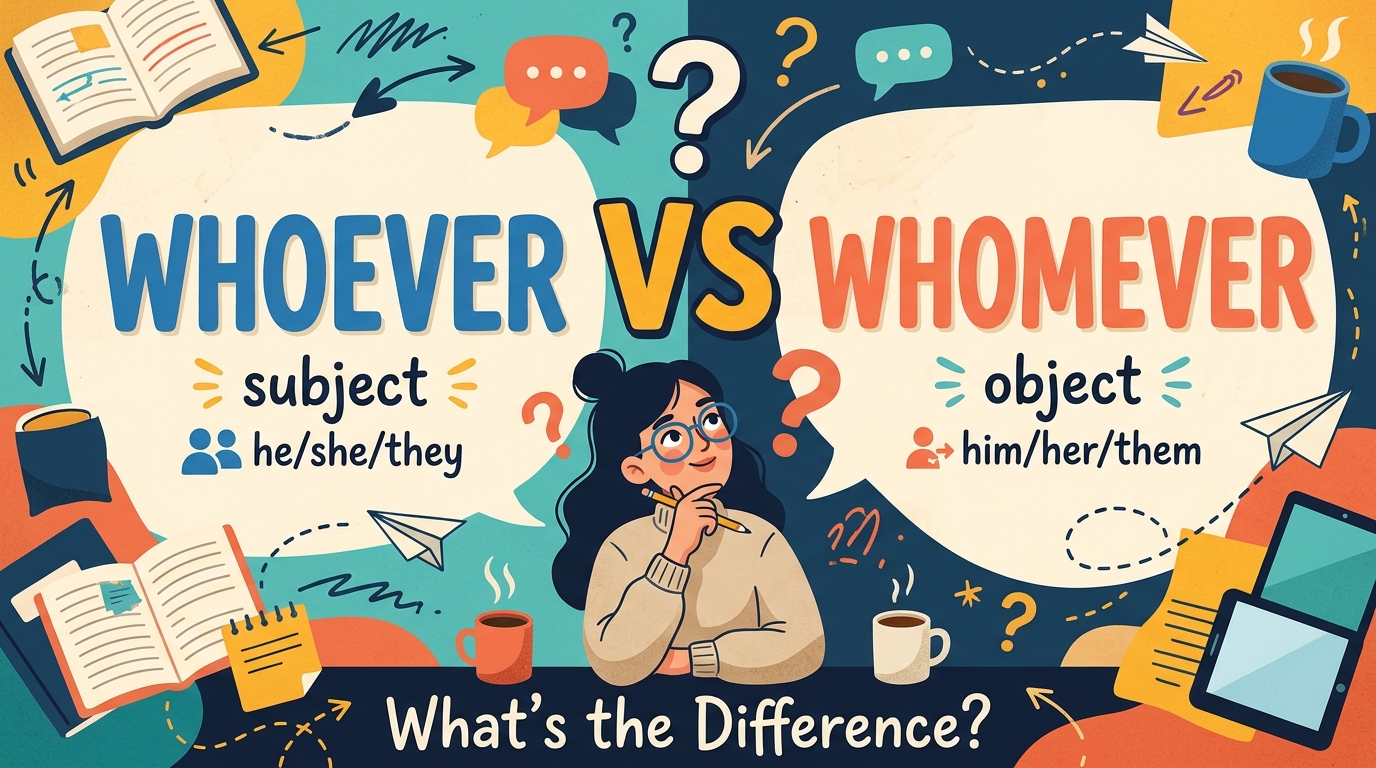
Whoever and whomever both refer to an unspecified person, but they serve different grammatical roles in a sentence.
- Whoever is used when the person performs an action (the subject).
- Whomever is used when the person receives an action or functions as an object (the object).
Examples:
- Whoever finishes first can leave. (The person performs the action of finishing.)
- You may invite whomever you like. (The person is the object of the verb invite.)
The most reliable way to choose between them is to examine the grammatical role of the person inside the relevant clause, rather than automatically choosing the word that sounds more formal.
In everyday English, whoever is common in both conversation and writing, while whomever is less frequent and often sounds formal. In some sentences, the correct choice depends on the structure of a clause embedded inside a larger sentence.
At-a-Glance Table
| Feature | Whoever | Whomever |
|---|---|---|
| Basic meaning | Any person who; the person who | Any person whom; the person whom |
| Grammatical role | Subject | Object |
| Used as the subject of a verb | Yes | No, not in standard edited English |
| Used as the object of a verb | No, not in standard edited English | Yes |
| Used after a preposition | Usually not when the pronoun is the preposition’s object | Yes, in formal standard usage |
| Example | Whoever arrives first wins. | Give it to whomever you choose. |
| Register | Everyday, formal, and informal English | More formal and less common |
| Common mistake | Using it automatically because it sounds natural | Using it automatically because it sounds sophisticated |
Important: The correct choice depends on the role the pronoun plays in its own clause. A sentence can contain both a subject and an object, so the grammatical structure matters more than the overall sentence.
Detailed Difference Between Whoever and Whomever
1. What Does Whoever Mean?
Whoever is an indefinite relative pronoun that generally means “any person who” or “the person who.” It can introduce a clause identifying a person without specifying who that person is.
Examples:
- Whoever arrives early can choose a seat.
- Whoever broke the window should tell the teacher.
- I will support whoever takes responsibility.
- Whoever you invite must follow the rules.
- Whoever wins the competition will receive a certificate.
In the first two examples, whoever is the subject of its clause: whoever arrives and whoever broke the window.
In the fourth example, whoever is the object of invite within the clause “whoever you invite.” Although the pronoun functions as an object in that clause, whoever is traditionally preferred in standard English when the entire embedded clause is functioning as the object of a larger verb.
This is a key distinction: the grammatical role of the whole clause can affect which form is appropriate.
2. What Does Whomever Mean?
Whomever is the object form corresponding to whoever. It means “any person whom” or “the person whom.”
Use it when the pronoun itself functions as an object within its clause, especially in formal writing.
Examples:
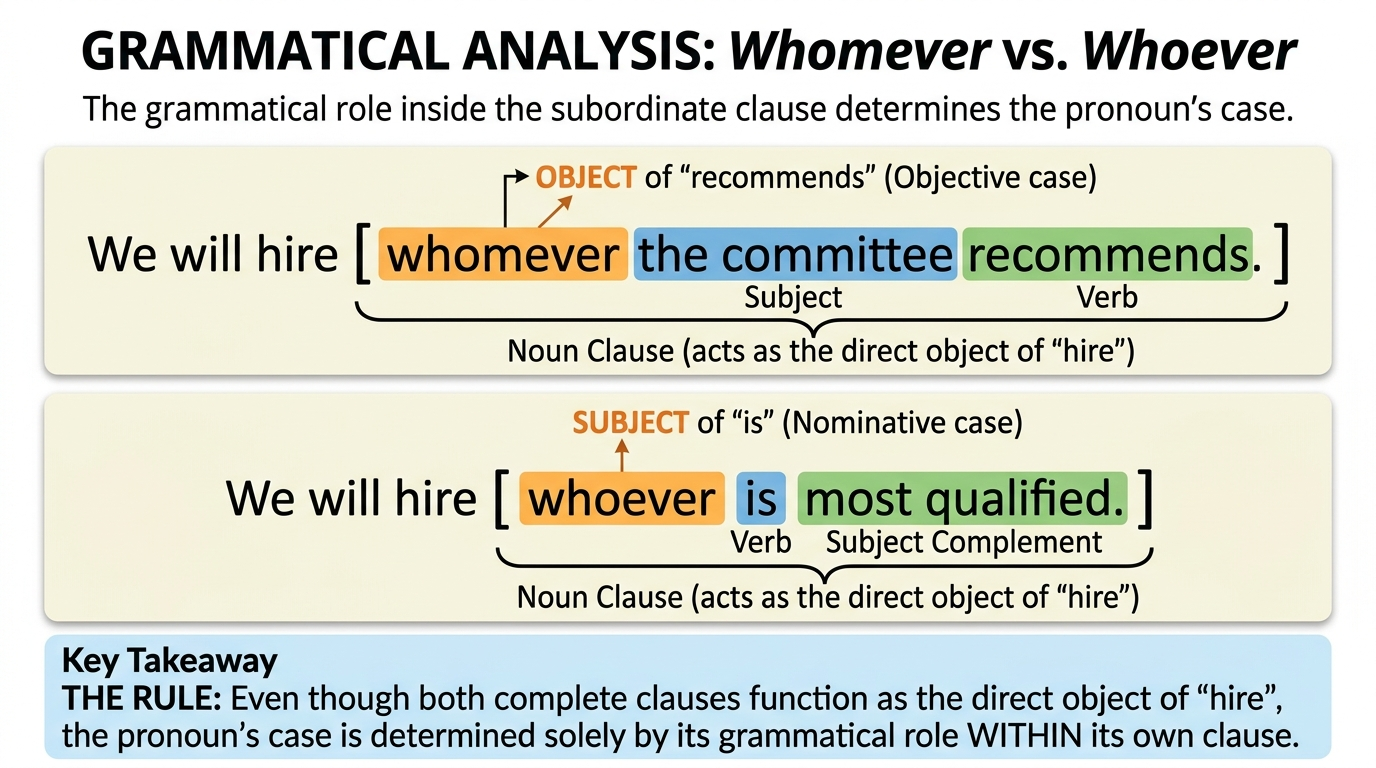
- We will hire whomever the committee recommends.
- Please send the documents to whomever you trust.
- She can consult whomever she considers qualified.
- The manager will interview whomever the department selects.
- You may nominate whomever you believe deserves recognition.
The underlying grammatical roles explain the traditional choice:
- The committee recommends whomever.
- You trust whomever.
- The department selects whomever.
In each embedded clause, the pronoun receives the action of a verb or serves as its object.
However, there is an important complication: the pronoun can be the subject of a clause that functions as the object of a larger verb. In that situation, whoever is normally the traditional choice.
3. Is Whomever a Word?
Yes. Whomever is a standard English word, not a misspelling or an invented form.
It is the objective form of whoever, just as whom is the objective form of who. It appears in dictionaries and is used in formal writing, professional correspondence, academic prose, and carefully edited English.
For example:
- You may speak to whomever you wish.
- We will follow whomever the board appoints.
- The invitation is open to whomever the organizers select.
Although the word is grammatically valid, it is less common in everyday conversation. Many speakers prefer whoever in situations where formal grammar traditionally calls for whomever.
That preference does not make whomever incorrect or obsolete. It simply means that actual usage is often less formal than traditional grammatical prescriptions.
4. Is Whoever a Word?
Yes. Whoever is also a standard English word. It is used to refer to an unspecified person or any person meeting a particular condition.
Examples:
- Whoever needs help should ask.
- Whoever called left no message.
- I will listen to whoever wants to explain.
- Whoever is responsible must report the problem.
The spelling is whoever, not whover, who ever in ordinary indefinite-pronoun usage, or whomever when the subject form is required.
The phrase who ever can occur when ever is a separate word used for emphasis or surprise, as in “Who ever told you that?” In modern usage, however, whoever is normally written as one word when it means “any person who.”
When to Use Whoever
Use whoever when the pronoun acts as the subject of its own clause. A useful way to check is to identify who performs the action of the verb.
When the Person Performs an Action
Examples:
- Whoever calls first will get a response.
- Whoever designed this website did an excellent job.
- Whoever arrives after noon must sign in.
- Whoever knows the answer should raise a hand.
- Whoever wants to participate may register.
In each example, whoever is doing something: calling, designing, arriving, knowing, or wanting.
When the Pronoun Is the Subject of an Embedded Clause
An embedded clause is a smaller clause that functions as part of a larger sentence.
Examples:
- Give the award to whoever wins.
- I will support whoever is elected.
- We can work with whoever has the necessary experience.
- She will recommend whoever performs best.
- They will hire whoever meets the requirements.
Consider “I will support whoever is elected.”
The whole phrase “whoever is elected” is the object of support, but whoever is the subject of the embedded clause “whoever is elected.” That is why whoever is the traditional grammatical choice.
This is one of the most useful distinctions to learn when deciding between the two words.
When the Person Is Identified by a Description or Condition
Use whoever when the clause describes a person by what they do, believe, or are.
Examples:
- Whoever needs a copy can download one.
- Whoever is available should attend the meeting.
- Whoever believes the proposal is workable may vote for it.
- Whoever has the original receipt should bring it.
- Whoever becomes team leader will organize the schedule.
The pronoun does not identify a particular individual in advance. It refers to any person who meets the stated condition.
When to Use Whomever
Use whomever when the pronoun itself is the object of a verb or preposition within its clause, especially in formal, edited English.
When the Person Receives the Action of a Verb
Examples:
- Invite whomever you prefer.
- We will interview whomever the panel recommends.
- She congratulated whomever the judges selected.
- The school will recognize whomever the principal nominates.
- You can consult whomever you consider reliable.
To check the grammar, simplify the relevant clause:
- You prefer him.
- The panel recommends him.
- The judges selected him.
- The principal nominates him.
Because him is the objective form, the traditional grammatical choice is whomever.
When the Pronoun Follows a Preposition
A preposition such as to, for, with, from, or by can take an object.
Examples:
- Send the invitation to whomever you choose.
- She will collaborate with whomever the director appoints.
- The package is intended for whomever the recipient names.
- We will accept applications from whomever the committee approves.
- The decision was made by whomever the board authorized.
In these examples, whomever is the object of the preposition within its clause or construction.
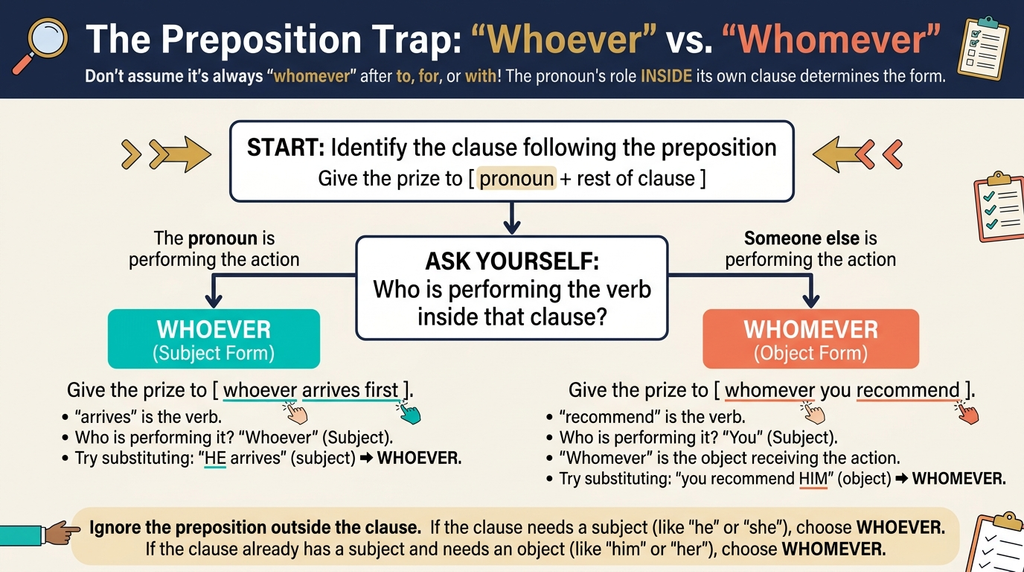
However, a preposition does not automatically require whomever. The structure of the clause still matters.
For example:
– The position will go to whoever performs best.
Here, whoever is the subject of “whoever performs best.” The fact that the complete clause follows to does not change the pronoun’s role inside that clause.
To Whoever or To Whomever?
Both forms can be correct, depending on the grammatical role of the pronoun.
The traditional rule favors to whomever when the pronoun is the object of the preposition to. But to whoever is appropriate when whoever is the subject of a clause that follows the preposition.
| Sentence | Traditional choice | Why |
|---|---|---|
| Give the package to whomever you select. | Whomever | The pronoun is the object of select. |
| Give the package to whoever answers the door. | Whoever | The pronoun is the subject of answers. |
| Send the invitation to whomever the manager recommends. | Whomever | The pronoun is the object of recommends. |
| Send the invitation to whoever is available. | Whoever | The pronoun is the subject of is. |
| Forward the message to whomever you think appropriate. | Whomever | The pronoun is the object of think appropriate in the intended construction. |
The last example is more complex and can be rephrased for clarity: “Forward the message to the person you think is appropriate” or “Forward the message to whomever you consider appropriate.”
The practical lesson is that the word immediately before the pronoun does not determine the answer by itself.
Is It “Thank You to Whomever” or “Thank You to Whoever”?
The correct choice depends on what follows.
– “Thank you to whomever you asked to help.” The pronoun is the object of asked.
– “Thank you to whoever helped us.” The pronoun is the subject of helped.
Both sentences are grammatically defensible in traditional standard English.
If you want a simpler construction, you can write “Thank you to everyone who helped us.” That wording avoids the issue entirely.
“Whoever Assumes” or “Whomever Assumes”?
When the pronoun is the subject of assumes, use whoever assumes.
Correct examples:
- Whoever assumes responsibility must complete the report.
- Whoever assumes the role will receive additional training.
- Whoever assumes the costs should keep the receipts.
- Whoever assumes the task must follow the agreed procedure.
Incorrect in standard edited English:
– Whomever assumes responsibility must complete the report.
Why? Because the person is performing the action of assuming responsibility. The pronoun is the subject of assumes, so the subject form whoever is required.
Compare that with:
– We will support whomever the director appoints.
Here, the director appoints the person, so the pronoun is the object of appoints.
“I Depend on Whoever” or “I Depend on Whomever”?
This is a particularly useful example because the preposition on can mislead writers.
Consider these two sentences:
- I depend on whoever understands the process.
- I depend on whomever the manager recommends.
Both are traditionally correct.
In the first sentence, “whoever understands the process” is a clause following on. Inside that clause, whoever is the subject of understands.
In the second sentence, whomever is the object of recommends. The manager recommends the person, making the objective form appropriate.
Compare the clauses:
| Clause | Subject or object? | Choice |
|---|---|---|
| Whoever understands the process | Subject of understands | Whoever |
| Whomever the manager recommends | Object of recommends | Whomever |
| Whoever is available | Subject of is | Whoever |
| Whomever the manager trusts | Object of trusts | Whomever |
Do not automatically choose whomever merely because depend on contains a preposition. Look inside the following clause.
Whoever or Whomever: Examples by Context
Everyday Conversation
In conversation, whoever is common and often sounds more natural.
- Whoever gets there first can save us a seat.
- Give the spare key to whoever is home.
- I will ask whoever knows the answer.
- Whoever wants the last slice can have it.
- You can invite whoever you want.
In the last two examples, many speakers use whoever even in contexts where formal grammatical analysis may favor whomever. In relaxed conversation, the distinction is often less strictly observed.
For polished formal writing, examine the clause carefully.
Business and Professional Writing
Use the traditional distinction when writing reports, policies, proposals, and professional correspondence.
- Whoever leads the project must submit a weekly update.
- The company will consult whomever the legal team recommends.
- Whoever approves the request must document the decision.
- The award will be presented to whoever achieves the highest score.
- The committee may contact whomever it considers suitable.
These examples illustrate why a sentence-level check is more reliable than choosing based on tone.
Academic Writing
Academic writing benefits from grammatical precision, especially when a sentence contains several clauses.
- Whoever conducts the experiment must record the results.
- The researcher interviewed whomever the study coordinator selected.
- The grant will be awarded to whoever meets the eligibility criteria.
- The panel will consult whomever it considers an appropriate specialist.
- Whoever interprets the data must explain the methodology.
In formal prose, avoid using whomever simply to make a sentence sound more scholarly. Correct grammatical function is what matters.
Emails and Messages
The same distinction applies in emails, but a simpler sentence may sometimes be clearer.
Examples:
- Please forward this to whoever handles scheduling.
- We will respond to whomever the department assigns to the case.
- Whoever is available can join the call.
- I am grateful to whoever helped organize the event.
- Please contact whomever you believe can resolve the issue.
If the recipient is already known, using a name, job title, or phrase such as “the person responsible” can make the message more direct.
Questions and Conditional Sentences
Examples:
- Whoever finishes the task first should notify the group.
- I will speak with whoever is in charge.
- Whomever you choose will receive an invitation.
- Whoever assumes the position must complete the training.
- We will follow whomever the committee appoints.
Remember that a question mark or conditional meaning does not determine the choice. The grammatical role does.

Whoever vs. Whomever: Common Mistakes
Mistake 1: Using Whomever Whenever the Sentence Sounds Formal
Incorrect: Whomever arrives first should open the office.
Correct: Whoever arrives first should open the office.
Why: The person performs the action of arriving. The pronoun is the subject of arrives.
Mistake 2: Assuming a Preposition Always Requires Whomever
Incorrect: Give the badge to whomever is waiting outside.
Traditional standard form: Give the badge to whoever is waiting outside.
Why: Whoever is the subject of the embedded clause “whoever is waiting outside.” The preposition to precedes the entire clause, not an object-form pronoun standing alone.
Mistake 3: Using Whoever as the Object in Formal Writing
Less preferred in traditional formal grammar: Invite whoever you prefer.
Traditional formal choice: Invite whomever you prefer.
Why: The pronoun is the object of prefer. In everyday speech, however, whoever is widespread, so the first sentence is not necessarily perceived as an error in casual usage.
Mistake 4: Confusing the Whole Clause With the Pronoun’s Role
Incorrect: I will help whomever needs assistance.
Traditional standard form: I will help whoever needs assistance.
Why: The whole clause “whoever needs assistance” is the object of help, but the pronoun is the subject of needs.
This is the central difficulty of the whoever–whomever distinction.
Mistake 5: Treating Whomever as a More Correct Version of Whoever
Incorrect reasoning: “Whomever sounds more formal, so I should use it in professional writing.”
Better approach: Determine whether the pronoun is a subject or an object first. Choose the form that matches its grammatical role.
Mistake 6: Confusing Whoever With Who Ever
Use whoever when you mean “any person who.”
- Whoever left this notebook should collect it.
- Whoever wants to volunteer may sign up.
Use who ever when ever is a separate emphatic word, often expressing surprise or disbelief.
- Who ever suggested that idea?
- Who ever could have predicted this result?
In many everyday contexts, punctuation and intonation help distinguish the emphatic phrase from the indefinite pronoun.
Mistake 7: Misspelling the Words
Correct spellings:
- Whoever
- Whomever
- Whomsoever
Common misspellings include whover and whomeverr. The word whoever is normally one word when used as an indefinite relative pronoun.
The Memory Trick: He or Him?
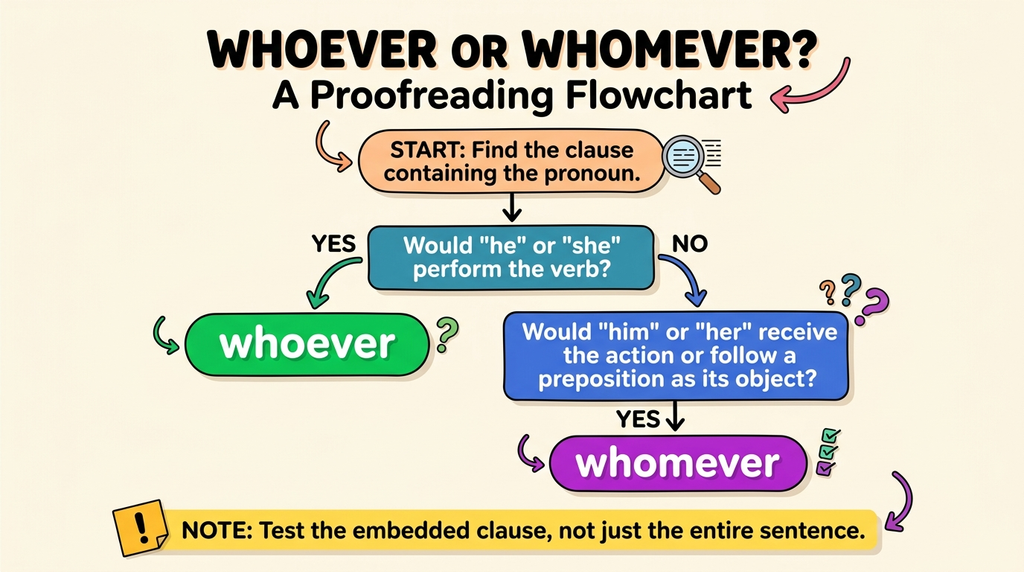
The simplest traditional test is to replace the pronoun with he or him, or with she or her.
- If the subject form works, choose whoever.
- If the object form works, choose whomever.
For example:
Sentence: Whoever/whomever calls first will receive a reply.
Test: “He calls first.”
Because he works, choose whoever.
Sentence: We will invite whoever/whomever the coach selects.
Test: “The coach selects him.”
Because him works as the object of selects, choose whomever in traditional formal English.
Sentence: Give the prize to whoever/whomever wins.
Test: “He wins.”
Because he is the subject of wins, choose whoever.
The test must be applied to the relevant clause, not to the entire sentence as a whole.
A Practical Proofreading Test
When editing a sentence, follow these steps.
- Find the clause. Identify the verb directly associated with the person represented by whoever or whomever.
- Identify the role. Ask whether the person performs the action or receives it.
- Use the pronoun test. Try he/she for a subject and him/her for an object.
- Check the larger structure. A clause can function as the object of a verb or preposition even when its own subject is whoever.
- Consider the register. In formal edited English, preserve the traditional subject–object distinction. In casual conversation, recognize that whoever is often used more broadly.
Try the following examples.
| Sentence | Correct choice | Explanation |
|---|---|---|
| ___ arrives first should sign in. | Whoever | Subject of arrives. |
| Hire ___ the manager recommends. | Whomever | Object of recommends. |
| Send the file to ___ is available. | Whoever | Subject of is available. |
| Consult ___ you trust. | Whomever | Object of trust. |
| ___ assumes responsibility must sign the form. | Whoever | Subject of assumes. |
| The award belongs to ___ the panel selects. | Whomever | Object of selects. |
The rule becomes much easier once you stop treating the two words as alternatives chosen by sound and start identifying their roles within their clauses.
Whomsoever vs. Whomever vs. Whoever
These three forms are related, but they differ in frequency and register.
Whoever
The ordinary modern form meaning “any person who.”
Example: Whoever completes the assignment may leave.
Whomever
The objective form of whoever, traditionally used when the pronoun is an object.
Example: Give the certificate to whomever the director names.
Whomsoever
A more formal, literary, or legal-sounding variant of whomever. It is used much less often in ordinary modern English.
Example: The rule applies to whomsoever the authority designates.
In most contemporary writing, whomever is preferable to whomsoever when an objective form is needed. Whomsoever can sound archaic or unnecessarily elaborate.
Whomsoever vs. Whoever
- Whoever signs the document must provide identification.
- The document must be given to whomsoever the authority designates.
The first sentence uses the subject form. The second uses an object form after to, although a more natural modern version would be “The document must be given to whomever the authority designates.”
Do not use whomsoever simply because the sentence is legal or formal. Clarity remains the priority.
What Does Whomever’s Mean?
Whomever’s is a possessive form built from whomever, although it is relatively uncommon and can sound awkward.
For example:
– Whomever’s name appears on the list must confirm attendance.
This sentence is possible, but many writers would prefer a clearer alternative:
– The person whose name appears on the list must confirm attendance.
The distinction between whomever’s and whoever’s follows the same underlying subject–object principle, but possessive constructions can make the sentence harder to analyze. In most practical writing, rephrasing is the simplest solution.
Formal vs. Casual English: American and British Usage
The traditional distinction between whoever and whomever is taught in both American and British English. There is no major regional rule that reverses their grammatical roles.
However, there are differences in how strictly the distinction is observed in practice.
American English
In formal American English, whomever is commonly recommended when the pronoun is an object.
Example: The award will go to whomever the judges select.
In casual American conversation, many speakers use whoever more broadly, including in sentences where traditional grammar prescribes whomever.
Example: The award will go to whoever the judges select.
The second version is widespread in everyday use, though editors may prefer whomever in formal prose.
British English
British English follows the same basic grammatical distinction. Whomever is grammatical, but it can sound stiff or overly formal in ordinary conversation.
A British writer may prefer “the person whom the judges select” or “the person the judges select” when the sentence feels cumbersome.
Which Form Should You Choose?
Use the traditional distinction when writing academic work, formal business documents, or carefully edited prose.
In conversational messages, whoever is often natural and widely accepted. If a sentence becomes difficult to parse, rewrite it rather than forcing an awkward pronoun choice.
Pronunciation: Whoever and Whomever
The two words are pronounced similarly, with the extra syllable in whomever making the difference more noticeable.
- Whoever: commonly pronounced hoo-EV-er.
- Whomever: commonly pronounced hoo-MEV-er.
Pronunciation varies somewhat by accent, but the spelling difference reflects grammar rather than a different meaning of the basic word who.
The word whomsoever is generally pronounced with the same initial whom sound followed by so-ever, though exact pronunciation varies.
Frequently Asked Questions
1. What Is the Difference Between Whoever and Whomever?
Whoever is the subject form, while whomever is the object form in traditional standard English. Use whoever when the person performs the action in the relevant clause and whomever when the person functions as an object.
2. When Should I Use Whomever in a Sentence?
Use whomever when the pronoun is the object of a verb or preposition in its clause.
Example: “We will interview whomever the committee recommends.”
The committee recommends the person, so the pronoun is the object of recommends.
3. Is Whomever a Real Word?
Yes. Whomever is a standard English word and the objective form of whoever. It is particularly common in formal writing.
4. Is It Whoever or Whomever After “To”?
It depends on the clause.
- “Give it to whoever arrives first.” The pronoun is the subject of arrives.
- “Give it to whomever you select.” The pronoun is the object of select.
The preposition alone does not determine the answer.
5. Is It “I Depend on Whoever” or “I Depend on Whomever”?
Both can be correct.
- “I depend on whoever understands the system.” The pronoun is the subject of understands.
- “I depend on whomever the supervisor recommends.” The pronoun is the object of recommends.
6. Is It Whoever Assumes or Whomever Assumes?
Use whoever assumes when the person performs the action of assuming.
Example: “Whoever assumes responsibility must sign the form.”
7. Is Whomever More Formal Than Whoever?
Generally, yes, in terms of frequency and tone. Whomever sounds more formal to many speakers, but it is not automatically more correct. Grammar determines the appropriate form.
8. Can I Use Whoever Instead of Whomever?
In everyday English, whoever is often used in both subject and object positions. In formal edited writing, however, whomever remains the traditional choice when the pronoun is an object.
9. What Is the Difference Between Whomsoever and Whomever?
Both can function as objective forms, but whomsoever is more formal, literary, or old-fashioned. Whomever is generally the more natural choice in modern formal English.
10. Should I Write “Who Ever” or “Whoever”?
Use whoever when you mean “any person who.”
Example: “Whoever finds the folder should return it.”
Use who ever when ever is a separate emphatic word, as in “Who ever told you that?”
11. How Do You Spell Whoever and Whomever?
The correct spellings are whoever and whomever. Both are written as single words. Whomever includes the letter m after who.
12. Can I Start a Sentence With Whoever?
Yes. Whoever can begin a sentence when it introduces a subject clause.
Example: “Whoever finishes the work should notify the supervisor.”
13. Can Whomever Begin a Sentence?
It can appear at the beginning of a sentence when its grammatical role calls for the objective form, though such constructions are uncommon.
For example: “Whomever the board selects will be notified.” This is not the traditional choice because the pronoun is the subject of will be notified. The standard form is “Whoever the board selects will be notified,” where whoever is the object of selects inside a larger subject clause. A sentence beginning with whomever therefore needs careful analysis and is often better rewritten.
14. Is “Whoever I Choose” Correct?
Yes. “Whoever I choose” is widespread and often accepted, especially in conversational English. Under the traditional formal distinction, whomever I choose is preferred when the pronoun is the object of choose.
15. Is “To Whomsoever It May Concern” Correct?
The phrase is grammatically possible but highly formal and dated. The conventional expression is “To Whom It May Concern.” If you are writing a letter, use the conventional form unless a particular legal or institutional context requires otherwise.
Final Takeaway
The difference between whoever and whomever is primarily grammatical, not semantic: both refer to an unspecified person, but they have different roles.
- Choose whoever when the pronoun is the subject of its clause.
- Choose whomever when the pronoun is the object of a verb or preposition within its clause.
- Examine embedded clauses carefully: a whole clause may be an object even when whoever is the subject inside it.
- Remember that everyday English often favors whoever more broadly, while formal edited writing more often preserves the traditional distinction.
- When in doubt, test the clause with he/she or him/her, then rewrite the sentence if the result remains unclear.
The most dependable habit is to analyze the clause before selecting the word. That approach works in everyday conversation, professional emails, academic writing, and formal documents.