License vs Licence: What’s the Difference?
Quick Answer: License vs Licence
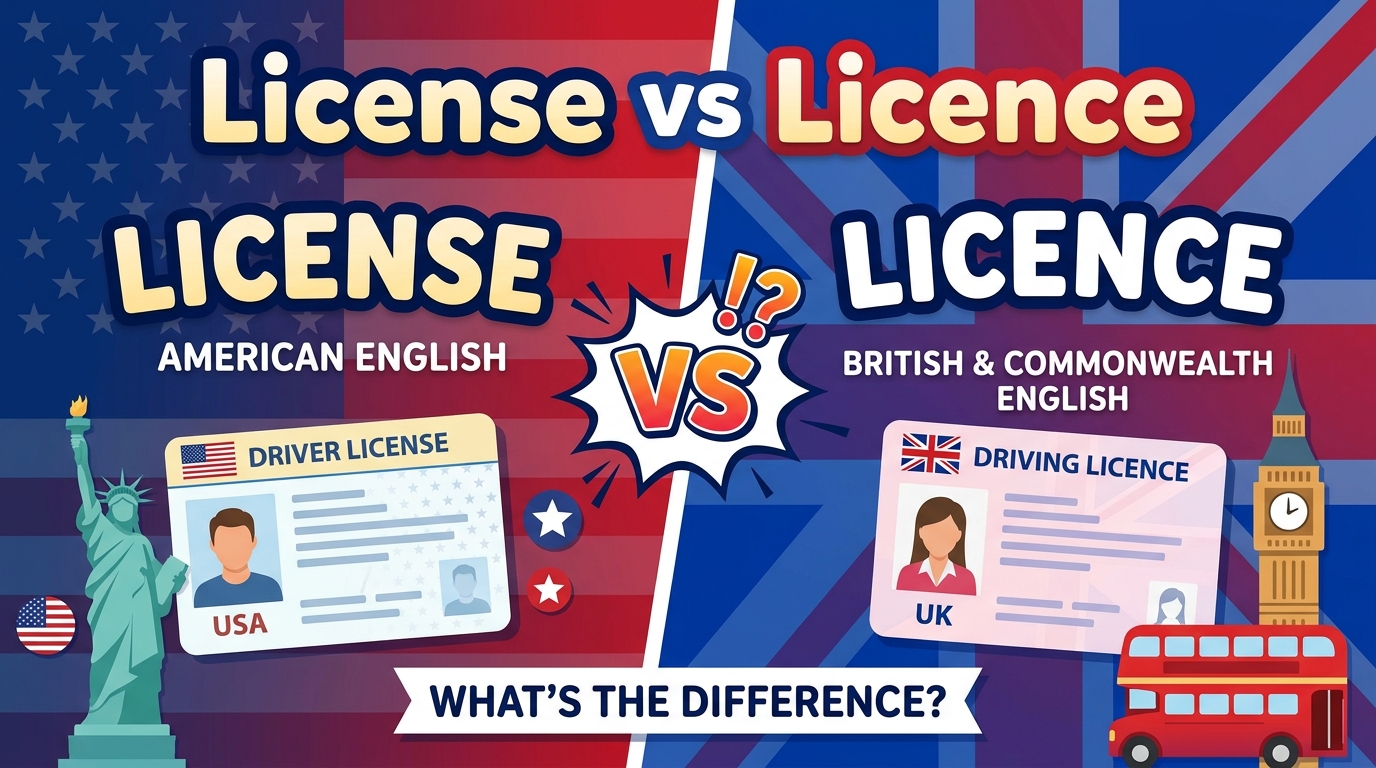
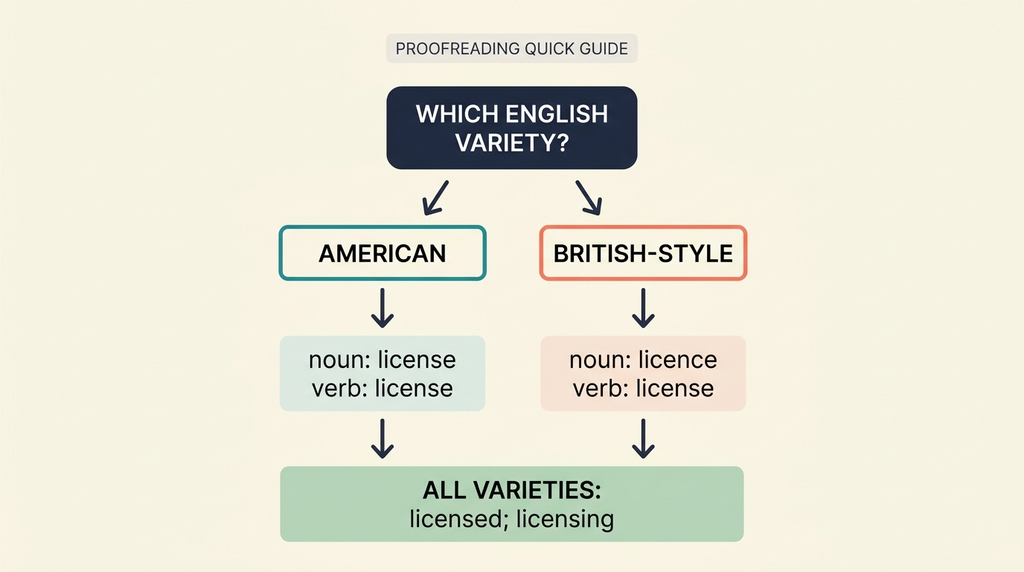
License is the correct spelling in American English for both the noun and the verb. Licence is the standard British English spelling for the noun, while license is used for the verb.
The main difference between license vs licence is regional spelling and grammatical function, not meaning. Both spellings refer to official permission or authorization when used as nouns.
- American English: a driver’s license, to license a business.
- British English: a driving licence, to license a business.
- Canadian English: licence is generally the noun, and license is the verb, following the traditional British-style distinction.
- Australian and New Zealand English: licence is generally the noun, and license is the verb.
For example, an American might write, “I renewed my driver’s license,” while a British writer would normally write, “I renewed my driving licence.”
License vs Licence: At-a-Glance Table
| Feature | License | Licence |
|---|---|---|
| American English noun | Correct | Not standard |
| American English verb | Correct | Not standard |
| British English noun | Not standard | Correct |
| British English verb | Correct | Not standard |
| Canadian English noun | Used in some contexts, but licence is standard | Standard |
| Canadian English verb | Standard | Not standard |
| Australian English noun | Not standard | Standard |
| Australian English verb | Standard | Not standard |
| Meaning | Official permission or the act of granting permission | Official permission |
| Pronunciation | /ˈlaɪsəns/ | /ˈlaɪsəns/ |
| Plural noun in American English | Licenses | — |
| Plural noun in British English | — | Licences |
| Past tense of the verb | Licensed | Licensed |
The simplest way to remember the difference is this: American English uses license for both grammatical roles, while British English distinguishes between the noun licence and the verb license.
What Is the Difference Between Licence and License?
The difference between licence and license depends on the variety of English you are using and, in British-style spelling systems, whether the word functions as a noun or a verb.
1. License as a noun
A noun names a person, place, thing, or concept. When license is a noun in American English, it refers to permission granted by an authority or to a document that provides that permission.
Examples:
- I need to renew my driver’s license.
- The restaurant received a liquor license.
- She applied for a professional license.
- The software license allows installation on two computers.
- The city issued a license to operate the business.
In American English, license is the standard spelling in all these sentences.
In British English, the corresponding noun is spelled licence:
- I need to renew my driving licence.
- The restaurant received an alcohol licence.
- She applied for a professional licence.
- The software licence permits installation on two computers.
- The city issued a licence to operate the business.
The meaning does not change when the spelling changes.
2. License as a verb
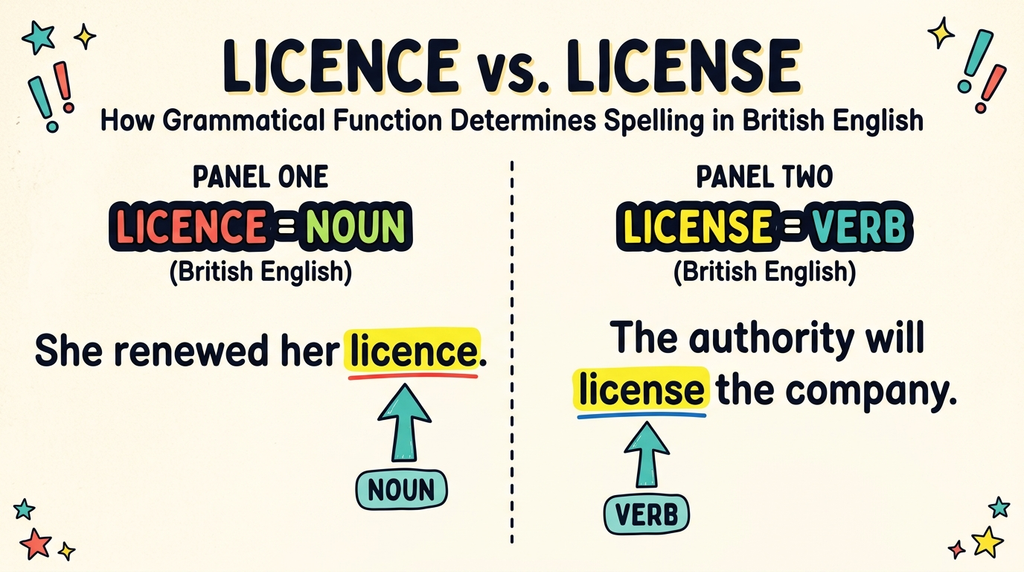
A verb expresses an action or state. The verb license means to grant official permission, authorize an activity, or issue a licence.
Examples:
- The council will license the new premises.
- The agency licenses qualified professionals.
- The government licenses certain commercial activities.
- The company is licensed to distribute the product.
- The state licensed the facility last year.
In both American and British English, the verb is spelled license.
This is why a British sentence can correctly contain both spellings:
The council will license the business after reviewing its licence application.
Here, license is the verb describing the action, while licence is the noun naming the application-related document or authorization.
When to Use License or Licence
The correct choice becomes straightforward once you identify your audience and the word’s grammatical role.
Use license in American English
Choose license for both nouns and verbs when writing for an American audience.
Examples:
- He passed his driving test and received his driver’s license.
- The company has a license to sell the product.
- You must license the vehicle before using it on public roads.
- The licensing authority approved the application.
- She holds a valid nursing license.
Notice that American English also uses licensing, not licencing, for the activity of granting or obtaining authorization.
Use licence for nouns in British English
Choose licence when referring to permission or a document in British English.
Examples:
- My driving licence expires next month.
- You need a television licence in certain circumstances.
- The business applied for a premises licence.
- Her professional licence is valid for three years.
- Please provide your licence number on the form.
However, use license when the word describes the act of granting permission.
Examples:
- The regulator will license the operator.
- The authority licenses qualified practitioners.
- The company is licensed by the relevant agency.
What about Canadian English?
Canadian spelling generally follows the noun–verb distinction:
- Noun: She renewed her driver’s licence.
- Verb: The province will license the business.
- Noun: The company holds a valid operating licence.
- Verb: The regulator licenses the profession.
Canadian usage can vary by institution, industry, and house style. When preparing official documents, follow the spelling used by the relevant Canadian authority.
What about Australian and New Zealand English?
Australian and New Zealand English generally use licence as a noun and license as a verb.
Examples:
- Australian English: He renewed his driver’s licence.
- Australian English: The authority will license the provider.
- New Zealand English: She has a valid driver’s licence.
- New Zealand English: The agency licenses the business.
For a local government form, professional application, or legal document, always check the terminology used by the issuing organization.
License vs Licence Examples by Context
Different contexts make the spelling distinction easier to understand. The following examples show how to choose the appropriate form in everyday writing, business communication, education, and technology.
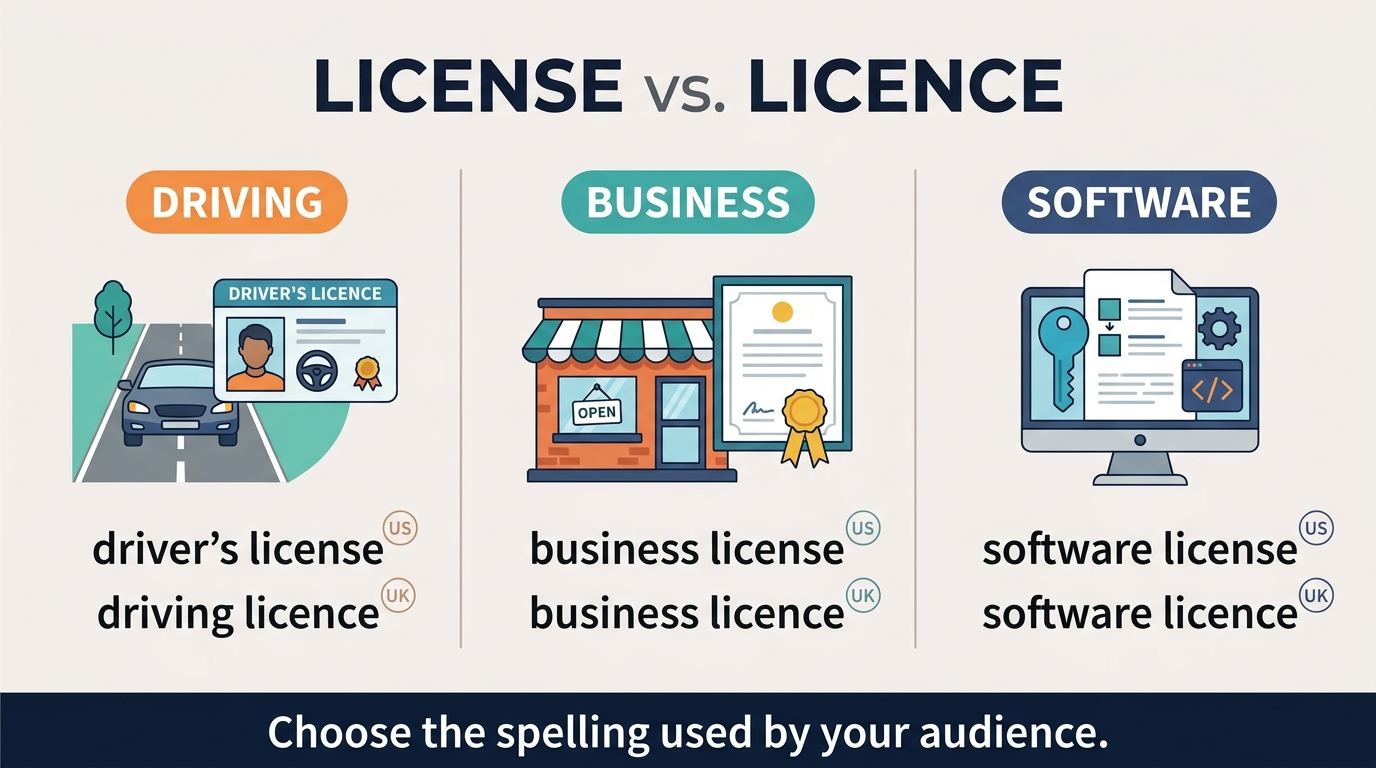
1. Driving and transportation
Driving documents are among the most common reasons people search for license vs licence.
| American English | British English |
|---|---|
| driver’s license | driving licence |
| commercial driver’s license | commercial driving licence |
| license renewal | licence renewal |
| license number | licence number |
| to license a vehicle | to license a vehicle |
Examples:
American English: “I forgot to bring my driver’s license to the appointment.”
British English: “I forgot to bring my driving licence to the appointment.”
British English verb: “The authority may license the vehicle once the requirements are met.”
A small but important detail: driver’s license and driving licence are also different established expressions. Do not assume that changing the spelling alone is sufficient when adapting a document for another country.
2. Business and professional qualifications
Organizations may need licences to operate, while regulators license businesses and professionals.
Examples:
- The restaurant renewed its operating licence.
- The agency licenses qualified financial advisers.
- Every applicant must hold a valid professional licence.
- The company is licensed to provide the service.
- The local authority issued a business licence.
In American English, replace the noun licence with license. The verb licenses and the participle licensed remain unchanged.
For example:
- American: The company holds a business license.
- British: The company holds a business licence.
- Both: The regulator licenses the company.
3. Software and technology
The same distinction applies to software permissions and agreements.
Examples:
- Read the software licence before installing the program.
- The company purchased a commercial software licence.
- This license permits use on one device.
- The developer licenses the software to other businesses.
- The application requires a valid licence key.
The choice between licence and license depends on the English variety used in the surrounding text. Technical terminology may also be prescribed by a software publisher or an organization’s style guide.
A licence does not necessarily mean ownership of the software itself. It commonly describes the permission granted under particular terms.
4. Legal and government documents
Legal writing requires particular care because official terms and document titles may be jurisdiction-specific.
Examples:
- The applicant submitted a licence application.
- The authority revoked the operator’s licence.
- The regulator may license eligible providers.
- The company operates under a valid licence.
- The agency is responsible for licensing the activity.
These examples follow common British-style spelling conventions. In American documents, use license as the noun as well as the verb.
If you are quoting the exact title of a law, form, or official document, preserve its official wording rather than changing the spelling to match your preferred variety.
5. Education and everyday communication
In emails, school assignments, and ordinary conversation, consistency is usually more important than choosing one national variety over another.
Examples:
- “Could you send me a copy of your licence?”
- “I need to renew my license before it expires.”
- “The university licenses certain educational materials.”
- “Please check whether your licence is still valid.”
- “The organization is licensed to provide training.”
If you are writing for an international audience, you can make the meaning clearer by naming the type of document, such as driving licence, professional license, or software licence, rather than relying on the word alone.
Licenses or Licences: Which Plural Is Correct?
Both licenses and licences are correct plural forms, but the appropriate spelling depends on the English variety.
- Licenses: standard American English plural noun.
- Licences: standard British, Australian, New Zealand, and generally Canadian plural noun.
Examples:
- American: The state issued 500 new licenses.
- British: The authority issued 500 new licences.
- Canadian: Several professional licences must be renewed annually.
- Australian: Drivers must carry the appropriate licences when required.
How do you spell licenses?
Spell it licenses in American English when referring to multiple permissions or documents.
Example: “The company holds licenses for several products.”
In British English, the equivalent is licences.
How do you spell licence?
Spell it licence when using the British-style noun spelling.
Example: “Her licence expires in December.”
In American English, write license instead.
License or licenses: singular and plural
The word changes according to number as well as grammatical role.
| Grammatical form | American English | British English |
|---|---|---|
| Singular noun | license | licence |
| Plural noun | licenses | licences |
| Base verb | license | license |
| Third-person singular verb | licenses | licenses |
| Past tense | licensed | licensed |
| Present participle | licensing | licensing |
The form licenses can therefore be either a plural noun or a verb, depending on the sentence.
- Noun: “The company renewed its licenses.”
- Verb: “The authority licenses new operators.”
Grammar, rather than spelling alone, tells you which function the word performs.
Licensing vs Licencing: Which Spelling Is Correct?
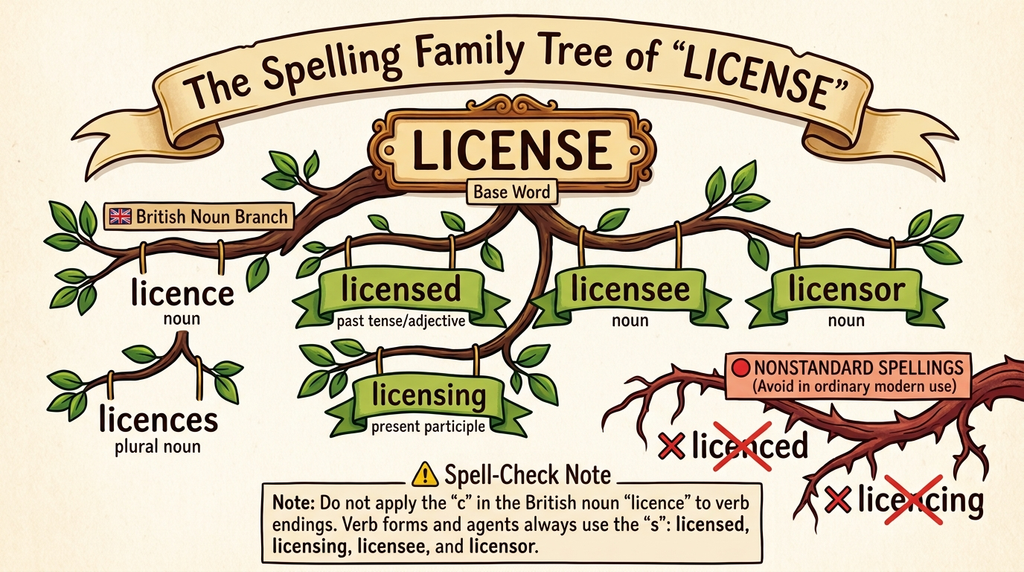
Licensing is the standard spelling in both American and British English. Licencing is generally considered a misspelling in standard modern usage.
The distinction between license and licence does not carry over to this ending. The standard form is licensing, regardless of whether the surrounding text uses American or British spelling.
Examples:
- The company is licensing its technology to other businesses.
- Licensing requirements vary by jurisdiction.
- The agency handles professional licensing.
- The licensing agreement sets out the permitted uses.
The same spelling applies to related forms:
- Licensee: the person or organization receiving permission.
- Licensor: the person or organization granting permission.
- Licensed: having received permission.
- Licensing: the act or process of granting or obtaining permission.
Avoid licencing, licenced, and similar forms in standard contemporary English when you mean the ordinary licensing process or a person or organization that has been licensed.
Licensed or Licenced: Which Is Correct?
Licensed is the standard spelling in both American and British English.
Although British English uses licence as a noun, the past-tense and past-participle forms of the verb are spelled licensed.
Examples:
- The business is licensed to sell the product.
- She became a licensed professional.
- The company was licensed by the regulator.
- Only licensed operators may perform the work.
The spelling licenced is not standard in ordinary modern British English.
Remember the pattern:
- Noun: licence (British), license (American).
- Verb: license.
- Past tense: licensed.
- Present participle: licensing.
Common Mistakes With License and Licence
Some mistakes arise from mixing regional spelling systems, while others involve grammar or misunderstanding the word’s meaning.
| Incorrect or inconsistent usage | Better version | Why |
|---|---|---|
| She renewed her driving license. (in British-style writing) | She renewed her driving licence. | The noun takes -ce in British English. |
| The council will licence the business. (in standard British English) | The council will license the business. | The verb takes -se. |
| The company has three licence. | The company has three licences. | The noun must be plural. |
| The authority is licencing new providers. | The authority is licensing new providers. | Licensing is the standard spelling. |
| She is a licenced professional. | She is a licensed professional. | The standard participle is licensed. |
| The company licenses were renewed. | The company’s licenses were renewed. (American) | The possessive form is needed. |
| The business license the product. | The business licenses the product. | A third-person singular verb needs -s. |
| He needs a licences. | He needs a licence. (British) | The singular article a takes a singular noun. |
Mistake 1: Assuming British English always uses licence
British English distinguishes between the noun and the verb. The noun is licence, but the verb is license.
Correct: “The regulator will license the business after checking its licence.”
Mistake 2: Using licence in American English
American English normally uses license for both grammatical roles.
Correct: “The state issued a license to the company.”
Mistake 3: Writing licencing because the noun is licence
The spelling of the noun does not determine the spelling of every related form.
Correct: “The authority is licensing the new providers.”
Mistake 4: Confusing license with licensee
A license is permission or a document granting permission. A licensee is the person or organization that receives permission.
Example: “The licensor granted the licensee a licence to use the software.”
This sentence uses licensor for the granting party, licensee for the receiving party, and the British noun licence for the permission.
Mistake 5: Treating every country’s official terminology as interchangeable
Even when the general spelling rule is clear, a government agency may use a specific term for a particular authorization. For example, driver’s license, driving licence, and other official document names may differ by jurisdiction.
When accuracy matters, follow the relevant authority’s wording.
A Simple Memory Trick: License vs Licence
Use these two reminders to make the distinction easier to remember.
Memory trick 1: American English uses S for both.
In American English, write license whether you mean the document or the action.
- A license (noun).
- To license (verb).
Memory trick 2: British English separates the noun and verb.
In British English, the noun ends in -ce and the verb ends in -se.
- A licence (noun).
- To license (verb).
The same noun–verb pattern generally applies in Canadian, Australian, and New Zealand English.
The five-second proofreading test
Before publishing, ask yourself these questions:
- Who is reading this? Identify the intended English variety.
- Is the word a noun? Use license in American English and licence in standard British-style spelling.
- Is the word a verb? Use license.
- Is it a related form? Use licensed or licensing.
- Is it a plural noun? Use licenses in American English and licences in British-style spelling.
For example, consider this sentence:
“The authority will licence the business after reviewing its license application.”
If the text follows standard British English, revise it to:
“The authority will license the business after reviewing its licence application.”
If the text follows American English, revise it to:
“The authority will license the business after reviewing its license application.”
Both revised sentences are correct for their respective spelling systems.
Formal vs Casual Usage and Regional Notes
The difference between license and licence is primarily a spelling convention, not a difference in formality.
Formal writing
In contracts, official correspondence, professional documents, academic writing, and business policies, consistency is essential.
Examples:
- British-style: “The licence must remain valid throughout the contract period.”
- American: “The license must remain valid throughout the contract period.”
- Both: “The regulator may license the provider.”
Do not change spelling conventions halfway through a document. If an organization has an editorial style guide, follow it.
Casual writing
In text messages, emails, and informal conversations, readers will generally understand both spellings.
However, if you are writing for a specific audience, using its standard spelling is still preferable.
Examples:
- “Can you send me a copy of your licence?”
- “I need to renew my license this week.”
- “Is the company licensed to operate here?”
Informality does not make licencing or licenced standard spellings.
Regional spelling differences
| Region | Noun | Verb | Related forms |
|---|---|---|---|
| United States | License | License | Licensed, licensing |
| United Kingdom | Licence | License | Licensed, licensing |
| Canada | Licence generally | License | Licensed, licensing |
| Australia | Licence generally | License | Licensed, licensing |
| New Zealand | Licence generally | License | Licensed, licensing |
This table describes common standard conventions rather than every institutional preference. Some organizations, industries, or legal systems prescribe specific terminology.
Does pronunciation change?
No. License and licence are pronounced the same way in standard English: /ˈlaɪsəns/.
A simple approximation is LY-suhns, with the stress on the first syllable.
The difference is written, not spoken. You generally cannot hear whether someone intends the British noun spelling licence or the American noun spelling license.
Is there a difference in meaning?
In ordinary use, there is no inherent difference in meaning between the two noun spellings. Both refer to official permission or a document granting permission.
The distinction is regional and grammatical:
- Spelling: license versus licence.
- Grammar: noun versus verb.
- Meaning: generally the same.
- Register: both are appropriate in formal and informal contexts when used according to the relevant style.
Frequently Asked Questions
1. Is it license or licence?
Both are correct, depending on the English variety. American English uses license as both a noun and a verb. British English uses licence as a noun and license as a verb.
2. Can I say license in British English?
Yes. In British English, license is the standard verb spelling. For example, “The regulator will license the business.” Use licence when referring to the permission or document.
3. What is the licence and license difference?
The principal difference is grammatical function in British-style spelling and regional convention. Licence is the British noun; license is the verb in both British and American English. American English also uses license as the noun.
4. Is licence American or British?
Licence is the standard noun spelling in British English and is also generally used in Canada, Australia, and New Zealand. American English normally spells the noun license.
5. How do you spell licence?
Spell it licence when using the British-style noun spelling. In American English, spell the noun license.
6. How do you spell licenses?
Use licenses for the American plural noun and for the third-person singular verb in both American and British English.
Examples:
- American noun: “The company renewed its licenses.”
- British verb: “The authority licenses the operators.”
The British plural noun is licences.
7. Is licensing or licencing correct?
Licensing is the standard spelling in both American and British English. Licencing is generally nonstandard in modern usage.
8. Is it licensed or licenced?
Use licensed in both American and British English.
Example: “The provider is licensed by the relevant authority.”
9. Is licence a verb?
In standard modern British English, licence is the noun, not the usual verb spelling. The verb is license. In American English, license is both a noun and a verb.
10. What does licence or license mean?
Both words refer to permission or authorization when used as nouns. Their spelling differs according to regional convention. The verb license means to grant or authorize that permission.
11. What does licensed mean?
Licensed means officially authorized or permitted to do something, or having received a licence.
Example: “Only licensed technicians may perform the work.”
12. Is license more formal than licence?
No. Neither spelling is inherently more formal. The appropriate form depends on regional spelling conventions, grammatical function, and any applicable house style.
13. Should I write license v licence or license versus licence?
Both phrases are understandable ways to describe the spelling comparison. In a British English article, the heading Licence vs License is also acceptable if the discussion covers both spellings. The important thing is to apply each form correctly in the explanations and examples.
14. What is the correct spelling: liscence or liscense?
Neither liscence nor liscense is the standard spelling. Use license in American English and for the verb in British English; use licence for the noun in British-style spelling.
15. Is so much thanks or thank you much related to this spelling rule?
No. These are separate English usage questions. License vs licence concerns regional spelling and grammatical function, whereas expressions of gratitude follow different idiomatic and grammatical conventions.
Final Takeaway: License vs Licence
The difference between license and licence is easy to remember once you separate regional spelling from grammar.
- American English: license (noun and verb).
- British English: licence (noun), license (verb).
- Canadian, Australian, and New Zealand English: generally licence (noun), license (verb).
- All these varieties: licensed and licensing.
When proofreading, identify your audience first, check whether the word is a noun or verb, and keep the spelling consistent throughout the document. If you are writing about an official document, use the terminology of the relevant authority.