Aunty or Auntie: Which Spelling Is Correct?
Quick Answer
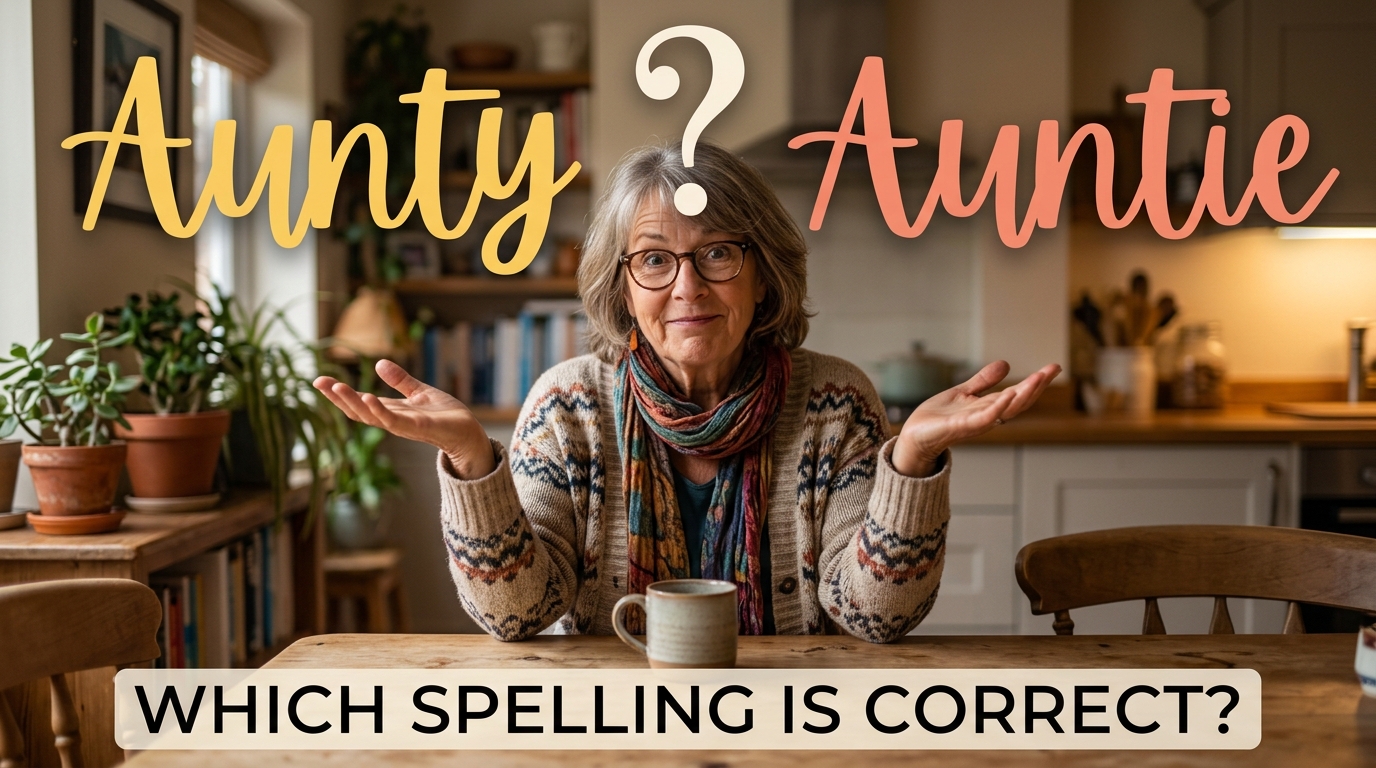
Both “aunty” and “auntie” are correct English spellings. They mean the same thing: an aunt, or a woman who is addressed affectionately as an aunt. Neither spelling is universally more correct than the other.
- Aunty is a common spelling in British English, South Asian English, and several other varieties of English.
- Auntie is also widely used in British English and American English, particularly as an affectionate or familiar form of address.
- Aunt is the standard, neutral term in formal writing and is the safest choice when you do not need an affectionate tone.
For example, both “My aunty lives in Lahore” and “My auntie lives in Lahore” are correct. The best choice depends on your preferred spelling, regional convention, and the style you want to maintain.
At-a-Glance Table
| Feature | Aunty | Auntie |
|---|---|---|
| Correct spelling? | Yes | Yes |
| Meaning | Aunt or affectionate form of address | Aunt or affectionate form of address |
| Part of speech | Noun | Noun |
| British English | Commonly used | Commonly used |
| American English | Understood, but less typical in some contexts | Widely recognized |
| South Asian English | Very common | Also common |
| Tone | Familiar, warm, informal | Familiar, warm, informal |
| Pronunciation | Usually the same as auntie | Usually the same as aunty |
| Formal writing | Usually prefer aunt | Usually prefer aunt |
| Plural | Auntys | Aunties |
| Possessive | Aunty’s | Auntie’s |
The main difference is spelling and regional or personal preference, not meaning. In most contexts, you can use either form without changing the message.
1. What Is the Difference Between Aunty and Auntie?
The difference between aunty and auntie is primarily orthographic: they are alternative spellings of the same familiar noun.
Neither spelling indicates a different family relationship, age, level of respect, or emotional connection. A person might use aunty in one message and auntie in another, but the meaning remains the same.
Meaning of aunty
Aunty is an informal noun used to refer to an aunt or address a woman affectionately, depending on the family and cultural context.
Examples:
- My aunty is visiting us this weekend.
- I bought a birthday present for my aunty.
- Thank you for the delicious dinner, Aunty.
- We call our mother’s close friend Aunty Sara.
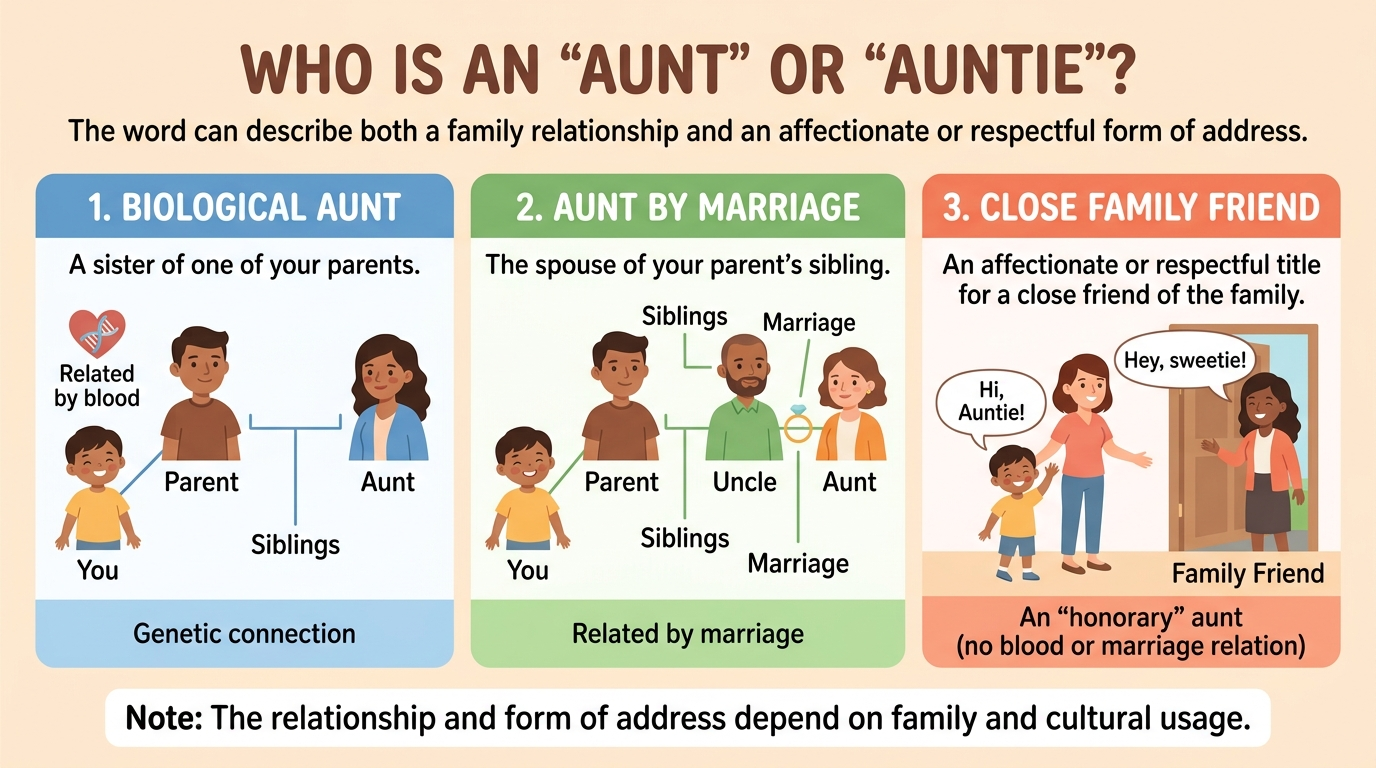
The word can refer to a biological aunt, an aunt by marriage, or a woman treated as an aunt in a family or community.
Meaning of auntie
Auntie has the same basic meaning. It is frequently used in family conversations, greetings, children’s speech, and affectionate messages.
Examples:
- My auntie taught me how to bake.
- I am going to visit Auntie this afternoon.
- Happy birthday, Auntie!
- The children call our neighbour Auntie because she is close to the family.
In some communities, auntie is also a respectful or affectionate form of address for an older woman who is not a relative.
Are aunty and auntie interchangeable?
2. When Should You Use Aunty?
Choose aunty when it matches your established writing style, family preference, or regional convention.
It is particularly familiar in South Asian English, including everyday communication in Pakistan and India, although usage varies from person to person.
Use aunty in family conversations
Examples:
- My aunty is coming over for tea.
- I spent the holidays at my aunty’s house.
- Please give my aunty your regards.
- My aunty always makes us feel welcome.
These sentences sound natural in informal English. The spelling does not make them less grammatically correct.
Use aunty in messages and greetings
Examples:
- Happy birthday, Aunty! Wishing you happiness and good health.
- Thank you, Aunty, for always supporting me.
- Eid Mubarak, Aunty! May your day be filled with joy.
- Good morning, Aunty. I hope you are doing well.
Capitalization depends on how the word is used. When it functions as a direct form of address, capitalize it as a name or title in standard edited writing: Thank you, Aunty.
Use aunty in South Asian English when it suits the context
In Pakistan, India, and other South Asian communities, aunty is a familiar way to address certain older women, family friends, or neighbours.
For example:
- Aunty, could you please help me?
- Our neighbour Aunty brought us some sweets.
- I met Aunty Nadia at the family gathering.
In polished writing, the exact construction may depend on whether the word functions as a title, a name-like form of address, or a common noun. For example, our neighbour, whom we call Aunty Nadia is a clear choice when explaining the relationship to an unfamiliar audience.
Important: Calling someone Aunty can communicate warmth or respect in one community but feel overly familiar in another. Consider the person’s preference and the local social context.
3. When Should You Use Auntie?
Choose auntie when it matches your preferred spelling or the conventions of the publication, family, or community you are writing for.
It is widely understood across English-speaking regions and is particularly familiar as an affectionate form of address.
Use auntie in affectionate messages
Examples:
- Happy birthday to the sweetest auntie!
- I am lucky to have such a caring auntie.
- Thank you for your kindness, Auntie.
- Sending lots of love to my wonderful auntie.
Use auntie when writing for children
Auntie is a natural choice in stories, family conversations, and children’s books.
Examples:
- Auntie Rose read a bedtime story to the children.
- The little girl ran to greet her auntie.
- Auntie helped Sam plant flowers in the garden.
- The children spent Sunday afternoon with Auntie.
The spelling itself does not make the word inherently more childish than aunty. Both are familiar forms, and either may be appropriate for children.
Use auntie in informal storytelling
Examples:
- My auntie has the funniest stories about our family.
- We always visit Auntie during the holidays.
- My auntie taught me to make her favourite recipe.
- Everyone gathered at Auntie’s house for lunch.
These examples show that auntie works as an ordinary noun, a familiar form of address, and a name-like term in family storytelling.
4. Aunty vs Auntie: Examples by Context
The easiest way to understand the distinction is to see how both spellings work in real situations.
| Context | Example using aunty | Example using auntie |
|---|---|---|
| Family conversation | My aunty is here. | My auntie is here. |
| Birthday greeting | Happy birthday, Aunty! | Happy birthday, Auntie! |
| Thank-you message | Thank you, Aunty, for the gift. | Thank you, Auntie, for the gift. |
| Social media caption | A lovely day with my aunty. | A lovely day with my auntie. |
| Family story | My aunty told us a story. | My auntie told us a story. |
| Visiting relatives | We visited our aunty. | We visited our auntie. |
| Addressing a neighbour | Good evening, Aunty. | Good evening, Auntie. |
| Possessive construction | My aunty’s garden is beautiful. | My auntie’s garden is beautiful. |
Every example is acceptable. There is no universal grammatical rule requiring aunty in British English or auntie in American English.
Examples for everyday English
Here are additional sentences you can use in conversation and writing.
Using aunty
- My aunty lives in another city.
- I called my aunty yesterday.
- My aunty gave me some useful advice.
- We are having dinner at my aunty’s house.
- I always look forward to seeing my aunty.
- My aunty helped us organise the celebration.
Using auntie
- My auntie is visiting next week.
- I sent my auntie a birthday card.
- My auntie makes the best homemade cakes.
- We stayed with my auntie during our trip.
- Auntie, would you like some tea?
- My auntie’s garden is full of flowers.

Examples for formal and professional writing
Although both spellings are correct, the neutral word aunt is often more suitable for formal documents.
- Less formal: My aunty will attend the ceremony.
- Less formal: My auntie will attend the ceremony.
- Neutral: My aunt will attend the ceremony.
For an official form, legal document, family history, or professional biography, use aunt unless the person’s preferred name or a specific title requires another form.
5. How to Spell Aunty or Auntie Correctly
If you are wondering how to spell aunty or auntie, remember that both spellings are accepted.
- Aunty: A-U-N-T-Y
- Auntie: A-U-N-T-I-E
- Aunt: A-U-N-T
The spelling aunty ends in -y, while auntie ends in -ie.
Both forms are singular nouns. Neither is a misspelling simply because the other form is more familiar in your region.
Is aunty spelling in English correct?
Yes. Aunty is a recognised English spelling. It is not automatically incorrect in British, American, or international English.
Is auntie spelling in English correct?
Yes. Auntie is also a recognised English spelling. It is not an incorrect alternative to aunty.
What about aunty or anty?
The standard spellings are aunty and auntie. Anty is not the usual standard spelling for this family term and should generally be avoided in edited English.
If you are writing a message, article, or school assignment, choose aunty or auntie instead.
How do you spell aunt?
The standard spelling is aunt: A-U-N-T.
Examples:
- My aunt is a teacher.
- I visited my aunt last weekend.
- My aunt and uncle live nearby.
Use aunty or auntie when you want a more familiar or affectionate form.
6. Grammar: Aunty, Auntie, Aunts and Aunties
Understanding how these nouns behave in sentences helps prevent common spelling and grammar mistakes.
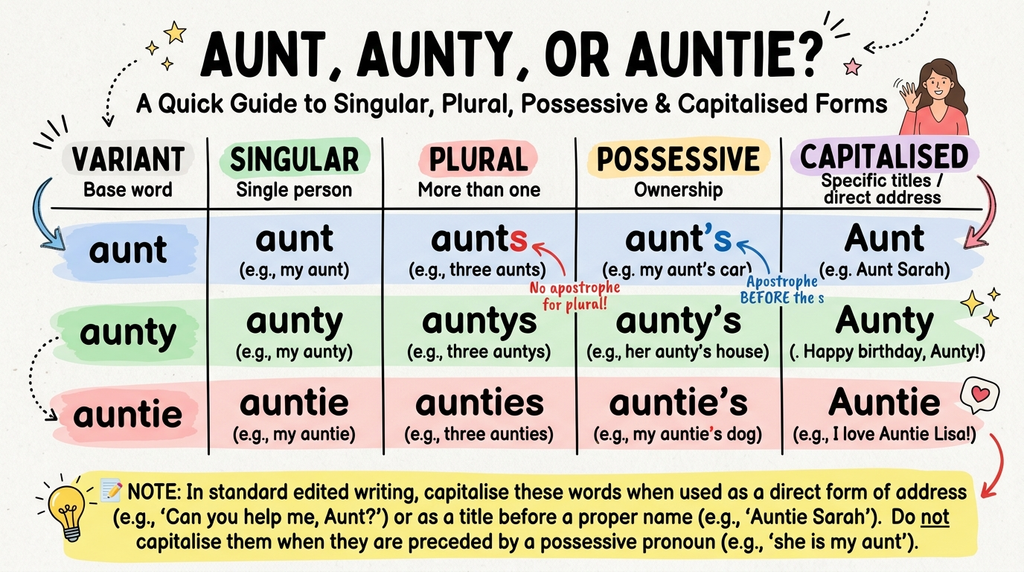
Singular and plural forms
| Singular | Plural |
|---|---|
| Aunt | Aunts |
| Aunty | Auntys |
| Auntie | Aunties |
The regular plural of aunty is auntys, because the word ends in a consonant plus y. The plural of auntie is aunties, because the final y follows a vowel.
Examples:
- My aunt has three children.
- My aunts live in different cities.
- My aunty visits us every summer.
- My auntys visit us every summer.
- My auntie is very kind.
- My aunties are very kind.
Although auntys follows the standard English pluralisation pattern, aunties is also widely used. The right choice is the plural of whichever singular form you have selected.
Possessive forms
Use an apostrophe to show ownership or association.
| Singular noun | Possessive |
|---|---|
| Aunt | Aunt’s |
| Aunty | Aunty’s |
| Auntie | Auntie’s |
Examples:
- My aunt’s car is outside.
- My aunty’s birthday is tomorrow.
- My auntie’s house is near the park.
For plural possessives:
- My aunts’ houses are nearby.
- My aunties’ children are playing outside.
- My auntys’ gifts are on the table.
The last example is grammatically possible, but it is less likely to appear because aunties is the more familiar plural spelling in many contexts.
Capitalisation rules
Capitalise Aunty or Auntie when it is used as a direct form of address or as part of a name-like title.
- Good morning, Aunty.
- Thank you, Auntie.
- I am visiting Auntie Sara.
Use lowercase when it is a general noun.
- My auntie is visiting.
- Her aunty lives nearby.
- We invited my aunt to dinner.
Capitalisation conventions can vary somewhat by editorial style, particularly for family terms used like names. The important point is to be consistent.
7. British Aunty vs American Auntie
One common question is whether British English prefers aunty while American English prefers auntie.
The reality is more flexible.
British English
Both aunty and auntie are used in British English. Neither is exclusively British, and neither is incorrect in the United Kingdom.
Examples:
- My aunty lives in Manchester.
- My auntie lives in Manchester.
- I am visiting my aunt this weekend.
The first two examples are familiar forms; the third uses the neutral family term.
American English
Auntie is widely recognised in American English, while aunty is also understood. The spelling selected can depend on the family, publication, or community.
Examples:
- My auntie is coming to visit.
- My aunt lives in Chicago.
- We call our family friend Auntie May.
For formal American writing, aunt is generally the safest neutral option.
South Asian English
In Pakistan and India, aunty is particularly familiar in everyday conversation. It can be used for a relative or as a respectful form of address for an older woman or family friend.
Examples:
- Aunty, please come in.
- My aunty is visiting us.
- We invited our neighbour, whom the children call Auntie.
Both spellings occur in South Asian English. Local habits, family preferences, and individual choices matter more than a rigid regional rule.
Which spelling should you choose?
| Your situation | Recommended choice |
|---|---|
| Everyday conversation in Pakistan | Aunty or auntie |
| British English writing | Either spelling; follow house style |
| American English writing | Either spelling; follow house style |
| Formal or official document | Aunt |
| A family member’s preferred title | Use their preferred spelling |
| Consistent website or publication style | Choose one form and apply it consistently |
The distinction is one of convention and preference, not a strict British-versus-American spelling rule.
8. Pronunciation: Are Aunty and Auntie Pronounced Differently?
Usually, aunty and auntie are pronounced the same way. Both are commonly pronounced with two syllables, and the difference between their spellings does not normally create a difference in meaning or pronunciation.
However, the pronunciation of aunt itself varies across English accents.
Some speakers pronounce aunt with a vowel similar to the one in ant, while others use a vowel similar to the one in ahnt. Because aunty and auntie derive from this word, their pronunciation can reflect the speaker’s accent.
There is no single pronunciation that makes one spelling correct and the other incorrect.
Practical tip: Follow the pronunciation customary in your community, and choose the spelling that fits your writing style.
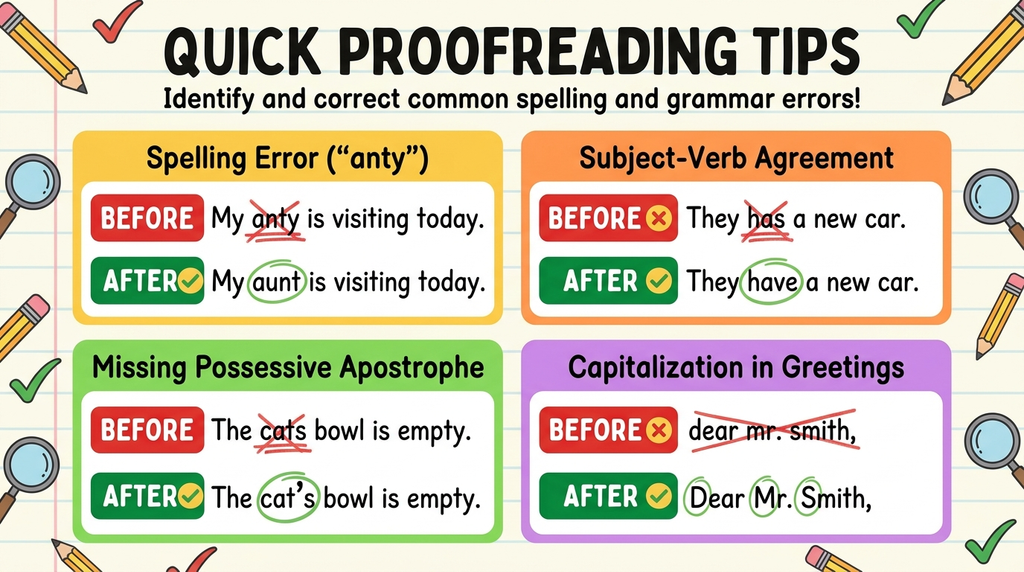
9. Common Mistakes: Aunty or Auntie
Here are frequent errors and the corrections that make the intended meaning clear.
| Incorrect or less suitable | Correct or preferred | Why |
|---|---|---|
| My anty is coming. | My aunty is coming. | Anty is not the usual standard spelling. |
| My auntie are here. | My auntie is here. | A singular subject takes a singular verb. |
| My aunties is visiting. | My aunties are visiting. | A plural subject takes a plural verb. |
| My aunty house is big. | My aunty’s house is big. | The apostrophe marks possession. |
| Happy Birthday aunty! | Happy birthday, Aunty! | Capitalisation and punctuation improve the greeting. |
| I visited my auntie yesterday, and my auntie gave my auntie a gift. | I visited my auntie yesterday, and she gave me a gift. | Avoid unnecessary repetition. |
| My Aunty is a doctor. | My aunty is a doctor. | Lowercase is appropriate for a general noun. |
| Dear aunty, thank you. | Dear Auntie, thank you. | Capitalisation is appropriate when used as a direct form of address. |
The final two examples reflect common editorial conventions; capitalisation can depend on whether the term is being used as a name or title.
Mistake 1: Assuming one spelling is wrong
Incorrect assumption: Auntie is correct, but aunty is a spelling mistake.
Correction: Both are accepted spellings.
Mistake 2: Treating aunt and auntie as completely different relationships
Incorrect assumption: An auntie is not a real aunt.
Correction: Either word can refer to a biological aunt or another woman treated as family, depending on context.
Mistake 3: Using the wrong plural
Incorrect: My aunties is coming tomorrow.
Correct: My aunties are coming tomorrow.
The issue is subject–verb agreement, not the choice between aunty and auntie.
Mistake 4: Forgetting the apostrophe
Incorrect: My aunties house is beautiful.
Correct: My auntie’s house is beautiful.
The apostrophe indicates that the house belongs to, or is associated with, one auntie.
10. A Simple Memory Trick and Proofreading Test
If you often confuse aunty and auntie, use these steps.
Memory trick
- Aunty: Ends in Y.
- Auntie: Ends in IE.
- Aunt: The shorter, neutral form.
You do not need to memorise a complicated rule because the first two spellings are both correct.
The three-question decision test
Before publishing your sentence, ask:
- Do I want a familiar or affectionate tone? Use aunty or auntie.
- Am I writing a formal document? Prefer aunt unless a particular name or title is required.
- Have I used one spelling consistently? If you started with aunty, check that you have not switched to auntie without a reason.
Practical proofreading exercise
Choose the best form for each sentence.
1. My ___ is visiting us this weekend.auntyauntieEither spelling
2. My ___ house is near the school.auntie’sauntiesaunties’
3. My ___ are coming for dinner.auntieauntiesauntie’s
4. Which is the safest neutral term in a formal document?AuntyAuntieAunt
0 of 4 answeredReset quiz
The key lesson is that spelling, grammar, and register are separate issues. A sentence can use a valid spelling but still contain a grammatical error, such as a singular subject paired with a plural verb.
11. Formal vs Casual and Regional Usage
Choosing between aunty, auntie, and aunt is easier when you consider the audience and purpose of your writing.
Casual writing
In a text message, social media caption, or family greeting, either familiar form is appropriate.
Examples:
- Love you, Aunty!
- Miss you, Auntie.
- Thank you for everything, aunty.
- Happy birthday to my favourite auntie!
Academic and professional writing
In essays, reports, and formal correspondence, aunt usually provides a more neutral tone.
Examples:
- My aunt works in education.
- The interview included information provided by the participant’s aunt.
- The applicant listed an aunt as an emergency contact.
This preference is about register, not correctness. Aunty and auntie are not inherently unprofessional, but they may sound too familiar for the context.
Personal names and family preferences
Some families use Aunty or Auntie as part of a person’s customary title. If a person is known as Auntie Mary, it is sensible to retain that spelling in a greeting, invitation, or family publication.
For example:
- Dear Auntie Mary,
- We are celebrating Aunty Mary’s birthday.
- Please pass my regards to Auntie Mary.
Consistency matters more than trying to impose a universal spelling preference.
Regional conventions and house style
A publisher, school, or organisation may prefer one spelling. If so, follow its style guide.
For example, a publication might use auntie throughout its articles, while a family website might consistently use aunty. Both choices are reasonable.
There is no need to change every instance of one form to the other unless consistency is part of the editing task.
12. Frequently Asked Questions
Is aunty or auntie correct?
Both are correct. They are alternative spellings of the same familiar noun. Choose the form that suits your region, family preference, or publication style.
Aunty or auntie: Which is correct in British English?
Both aunty and auntie are used in British English. Neither is exclusively British, and neither should automatically be treated as incorrect.
Is aunty a British spelling?
Aunty is used in British English, but it is not limited to Britain. It is also common in South Asian English and other English-speaking communities.
Is auntie an American spelling?
Auntie is widely recognised and used in American English, but it is not exclusively American. It is also used in British and South Asian English.
How do you spell aunty in English?
The spelling is aunty: A-U-N-T-Y. The alternative accepted spelling is auntie, ending in I-E.
Is aunty a real English word?
Yes. Aunty is a recognised English spelling used as an informal noun or familiar form of address.
Is auntie more affectionate than aunty?
Not necessarily. Both forms can communicate affection, familiarity, or respect. The emotional tone depends more on the relationship and context than on the spelling.
What is the plural of aunty?
The standard plural is auntys. The plural of auntie is aunties. Both follow the usual English pluralisation patterns for words ending in y.
What is the difference between aunt and auntie?
Aunt is the neutral term for a parent’s sister or a woman related through marriage. Auntie is a familiar or affectionate form of the same term and can also be used for a woman treated as family.
Is anty a correct spelling?
Anty is not the usual standard spelling for this meaning. Use aunty or auntie instead.
Can I write “Happy birthday, Aunty”?
Yes. It is a natural greeting when you use Aunty as a direct form of address. The comma separates the greeting from the person being addressed.
Should I use aunty or auntie on a website?
Either can work. Choose one form based on your audience and editorial style, use it consistently, and use aunt when a neutral or formal tone is preferable.
Can auntie refer to someone who is not a relative?
Yes. In some cultures and communities, auntie is a respectful or affectionate form of address for a family friend, neighbour, or older woman. The exact meaning depends on the social context.
Final Takeaway
Aunty and auntie are both correct English spellings. They generally have the same meaning, and neither is universally better than the other.
Use aunty if it matches your family’s preference or regional usage. Use auntie if that is the spelling you prefer or the convention your publication follows. For formal writing, aunt is usually the most neutral choice.
Remember three simple points:
- Aunty: Correct, familiar, and widely used.
- Auntie: Correct, familiar, and widely used.
- Aunt: The standard, neutral term.
The best spelling is the one that fits your context and remains consistent throughout your writing.