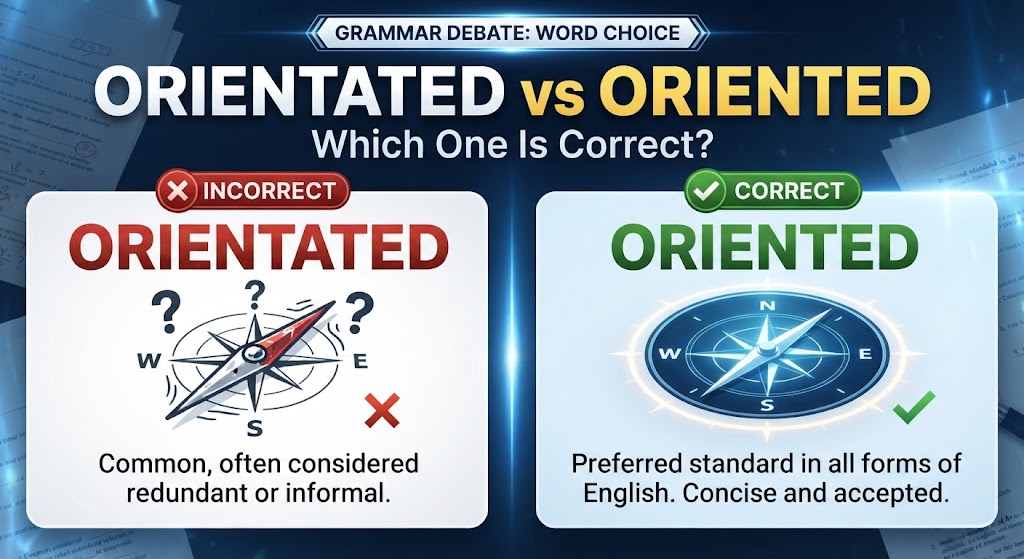
Orientated vs Oriented: Which One Is Correct?
Quick Answer
Oriented and orientated are both correct forms of the verb orient, but their use varies by regional English and context.
In general:
- Oriented is the more widely used form, especially in American English.
- Orientated is also standard English and is particularly common in British English.
- Both can mean directed toward something, focused on something, or made familiar with a situation or place.
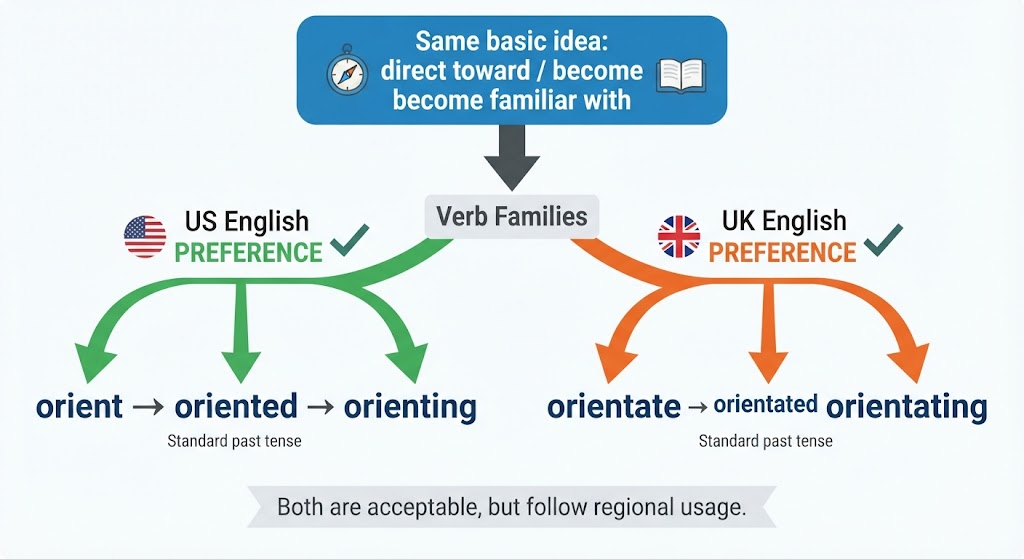
- In British English, orientate → orientated → orientating is an established verb pattern.
- In American English, orient → oriented → orienting is normally preferred.
- In compound adjectives, both forms occur: customer-oriented and customer-orientated, for example.
So if you are asking “is it oriented or orientated?”, the answer is: both are legitimate, but choose according to the variety of English and the style you are following.
For most international, American, technical, and digital writing, oriented is usually the simpler choice. If you are writing specifically in British English, orientated is perfectly acceptable.

At-a-Glance Table
| Feature | Oriented | Orientated |
|---|---|---|
| Part of speech | Past tense, past participle, adjective | Past tense, past participle, adjective |
| Basic meaning | Directed toward, focused on, or made familiar with something | Same |
| Base verb | orient | orientate |
| Common regional preference | Especially US English | Especially UK English |
| Present form | orient | orientate |
| Third-person form | orients | orientates |
| Past form | oriented | orientated |
| -ing form | orienting | orientating |
| Compound adjective | customer-oriented | customer-orientated |
| Standard English? | Yes | Yes |
| Is one inherently wrong? | No | No |
The important point is that oriented vs orientated is not primarily a difference in meaning. It is mostly a difference in the verb form selected by different varieties of English.
Cambridge identifies orientate as mainly British and gives orient as the mainly American alternative in this use. It likewise identifies orientated as mainly British and oriented as mainly American. Oxford also lists orient and orientate as alternatives, with their corresponding past forms oriented and orientated.
Oriented vs Orientated: The Detailed Difference
What does “oriented” mean?
Oriented is the past tense and past participle of orient. It is also commonly used as an adjective.
Its central meaning is that something is directed toward a particular person, purpose, subject, or goal.
For example:
- The course is oriented toward practical skills.
- The company is strongly customer-oriented.
- The building is oriented toward the river.
- She is highly career-oriented.
It can also describe becoming familiar with a new environment:
After a few days, I felt more oriented to the new workplace.
The verb orient can mean to direct someone or something toward a particular purpose, or to help someone understand their position or surroundings. Oxford lists both the directional and familiarization meanings.
What does “orientated” mean?
Orientated is the past tense and past participle of orientate. It can also function as an adjective.
Its meanings are essentially the same as oriented:
- directed toward something
- focused on something
- adapted for a particular purpose
- familiarized with a situation or environment
Examples include:
- The program is orientated toward young professionals.
- The company is export-orientated.
- She quickly became orientated to her new surroundings.
- The policy is orientated toward long-term development.
Oxford gives orientate the meanings “to direct” or “to make or adapt” someone or something for a particular purpose, as well as the meaning of becoming familiar with a new situation.
Why are there two forms?
The difference comes from the existence of two related verbs:
orient → oriented
and
orientate → orientated
The two verbs overlap heavily in meaning. The main practical difference today is regional preference rather than a major semantic distinction.
This is why oriented and orientated can often replace each other without changing the basic meaning of a sentence.
Compare:
- The training is oriented toward customer service.
- The training is orientated toward customer service.
Both communicate that the training is designed or directed toward customer service.
When to Use Oriented
Use oriented when you want the form that is especially common in American English or when you are writing for a broad international audience and want a widely recognized form.
Examples:
- The workshop is oriented toward beginners.
- We need a more customer-oriented approach.
- The research is oriented toward practical applications.
- She is very goal-oriented.
- The software is user-oriented.
- He became better oriented after studying the map.
Oriented is especially common in compound adjectives such as:
- results-oriented
- detail-oriented
- service-oriented
- customer-oriented
- career-oriented
- family-oriented
- solution-oriented
- research-oriented
- performance-oriented
- community-oriented
Cambridge specifically gives -oriented as a combining form meaning directed toward something, while noting -orientated as the mainly British alternative.
When to Use Orientated
Use orientated when you are following British English conventions or when the surrounding document consistently uses the orientate verb family.
Examples:
- The course is orientated toward professional development.
- The organization is customer-orientated.
- The project is research-orientated.
- The training is orientated toward practical skills.
- The new employee quickly became orientated to the workplace.
In British English, orientate is an established verb rather than a grammatical mistake. Cambridge labels it “mainly UK,” and Oxford provides its full verb forms, including orientated and orientating.
Oriented or Orientated UK: Which Is Better?
If the question is specifically “oriented or orientated UK?”, the answer requires a little nuance.
Orientated is particularly characteristic of British English, so it is entirely natural in UK writing:
The course is orientated toward the needs of new teachers.
However, oriented is not automatically wrong in British English. British English also uses orient, oriented, and -oriented forms. Oxford lists orient as an alternative to orientate, while Cambridge describes oriented as mainly US but also recognizes it in UK usage.
Therefore, it is too simplistic to say:
UK = orientated
US = oriented
A better rule is:
Orientated is especially associated with British English, while oriented is especially associated with American English, but both forms can occur in British usage.
For a British publication, consistency matters more than trying to eliminate every occurrence of oriented.
Oriented vs Orientated in Compound Adjectives
Compound adjectives create some of the most visible differences between the two forms.
Consider:
- detail-oriented
- detail-orientated
- customer-oriented
- customer-orientated
- profit-oriented
- profit-orientated
- family-oriented
- family-orientated
Both patterns are grammatical.
Cambridge lists detail-oriented as mainly American and says detail-orientated is usually used in the UK.
The same pattern appears with many other compounds.
For example:
She is extremely detail-oriented.
and:
She is extremely detail-orientated.
Neither sentence is inherently ungrammatical. The choice mainly reflects regional preference and house style.
One useful editorial rule is to avoid mixing the two forms unnecessarily within the same document. If a British document repeatedly uses customer-orientated, suddenly switching to customer-oriented can make the style feel inconsistent.
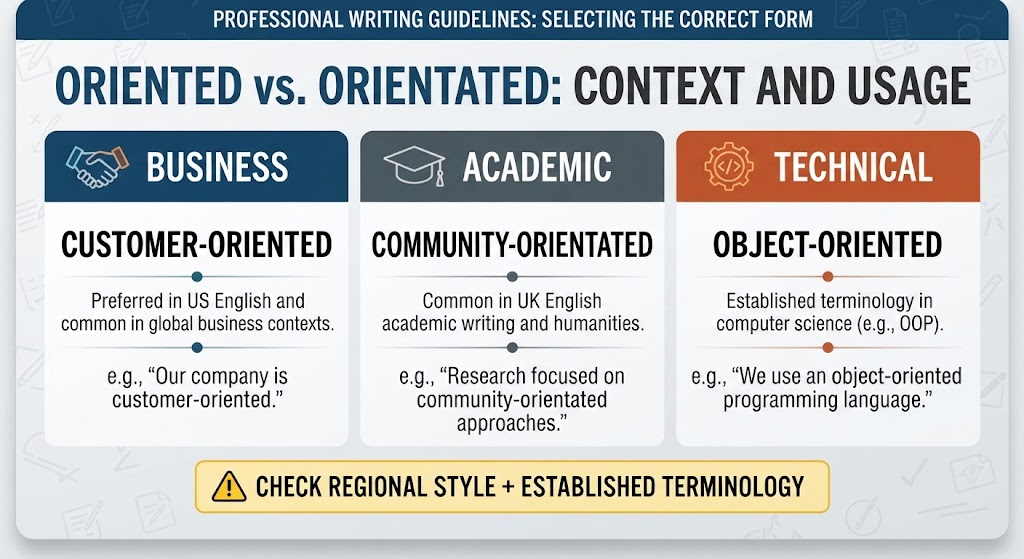
Oriented vs Orientated in Professional Writing
Both forms can appear in business, academic, technical, and professional English.
Business writing
Both are possible:
We need a more customer-oriented strategy.
We need a more customer-orientated strategy.
American-oriented business writing will generally favor the first. British business writing may favor the second.
Academic writing
Academic writers should primarily follow the style guide, publisher, institution, or variety of English required for the document.
For example:
The study adopted a community-oriented approach.
A British academic publication might instead use:
The study adopted a community-orientated approach.
The meaning remains essentially unchanged.
Technical writing
Oriented is often convenient because many established technical compounds use it:
- object-oriented programming
- user-oriented design
- data-oriented architecture
- service-oriented architecture
However, orientated is not automatically incorrect simply because the context is technical.
The key question is whether the particular technical term has an established conventional spelling. In a named methodology, framework, product, or discipline, follow the terminology normally used by that field rather than changing it merely to fit a regional preference.
Oriented vs Orientated: Examples by Context
Direction and physical position
Oriented can describe the direction in which something faces:
The solar panels are oriented toward the south.
The British alternative is also possible:
The solar panels are orientated toward the south.
Here, the basic idea is physical direction.
Goals and objectives
The program is oriented toward improving literacy.
The program is orientated toward improving literacy.
Both mean that the program is directed toward that objective.
Customers and users
The website is user-oriented.
The website is user-orientated.
Both describe a website designed with users as its main focus.
Personality or interests
She is strongly career-oriented.
She is strongly career-orientated.
Both describe someone whose interests or priorities are strongly focused on a career.
Becoming familiar with a place
I took a few minutes to orient myself before starting the hike.
In British English:
I took a few minutes to orientate myself before starting the hike.
Cambridge explicitly distinguishes the mainly UK orientate yourself construction from the mainly US orient yourself construction in this sense.
Becoming familiar with a new situation
It took me a week to become oriented to the new system.
A British alternative is:
It took me a week to become orientated to the new system.
The intended meaning is that the person became familiar with how the new system worked.
Orienting or Orientating?
The same regional distinction appears in the -ing forms.
The two patterns are:
- orient → orienting
- orientate → orientating
Oxford lists orienting as the -ing form of orient and orientating as the -ing form of orientate.
Examples:
The map is useful for orienting yourself in the city.
The map is useful for orientating yourself in the city.
Both can be correct.
If you have already chosen orient, use orienting. If you have chosen orientate, use orientating.
Avoid creating mixed forms such as:
❌ orientate → orienting
or:
❌ orient → orientating
These forms combine two different verb patterns.
Orient or Orientate?
Orient and orientate are also both established verbs.
The main distinction is regional preference:
- orient: widely used, especially in American English
- orientate: especially associated with British English
Compare:
The instructor helped us orient ourselves.
The instructor helped us orientate ourselves.
Or:
The company wants to orient the program toward younger users.
The company wants to orientate the program toward younger users.
Oxford explicitly lists orient and orientate as alternatives.
Which verb should you choose?
If you are writing American English, orient is normally the straightforward choice.
If you are writing British English, orientate is available and natural, but orient is also used.
For an international audience, orient is often the simpler choice because it avoids the additional -ate form and works naturally in widely used compounds such as oriented and -oriented.
Common Mistakes
Mistake 1: Assuming “orientated” is always wrong
Incorrect assumption:
“Orientated isn’t a real English word.”
That is false. Orientate and orientated are established English forms, especially associated with British English. Cambridge and Oxford both document them.
Better:
“Orientated is standard English, although oriented is often preferred in American English.”
Mistake 2: Assuming “oriented” is only American
This is also too absolute.
Oriented is particularly common in American English, but it is not restricted to the United States. British English uses it too.
Mistake 3: Mixing the verb families
Avoid:
❌ The course was orientated, so we are orienting new students.
If you are intentionally using the orientate family, use:
The course was orientated, so we are orientating new students.
Or choose the other family:
The course was oriented, so we are orienting new students.
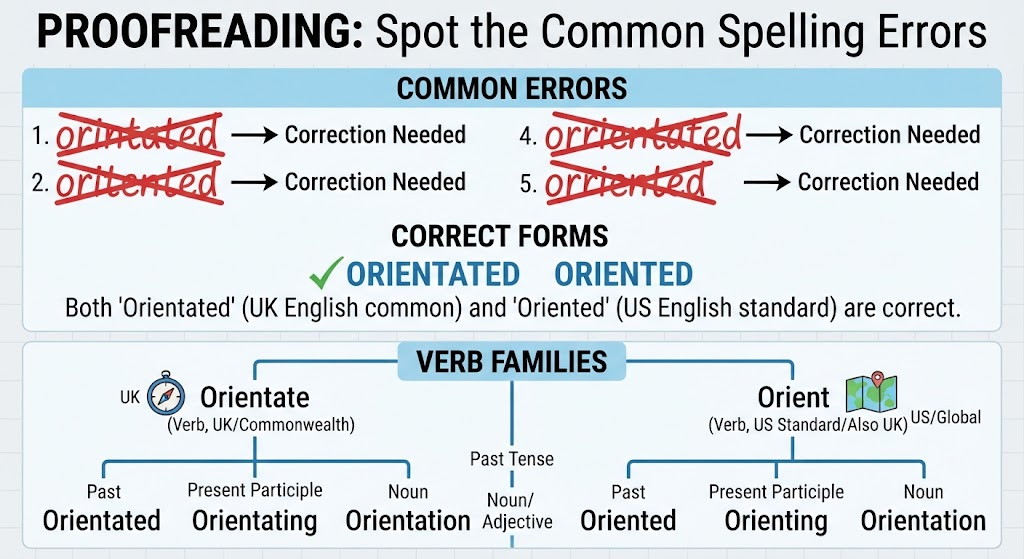
Mistake 4: Treating “orintated” as a variant
Orintated is a misspelling.
The correct spelling is:
orientated
There is an e before the -ated ending: orientated.
Mistake 5: Writing “oritented”
Oritented is also a misspelling.
The correct word is:
oriented
The sequence is:
orient + ed = oriented
Mistake 6: Confusing “oriented” with “orientation”
The words are related, but they have different grammatical roles.
The company is customer-oriented.
Here, oriented is an adjective.
The company has a strong customer orientation.
Here, orientation is a noun.
Oxford defines orientation in several senses, including a person’s or organization’s aims or interests and the direction in which something faces.
How to Spell Oriented
The correct spelling is:
oriented
Break it down as:
orient + ed → oriented
Common incorrect spellings include:
- orinted
- orintated
- oritented
- oreinted
- orianted
The most useful spelling memory is to preserve the base word:
ORIENT + ED = ORIENTED
The spelling does not require an extra t before -ed.
How to Spell Orientated
The correct spelling is:
orientated
Break it down as:
orientate + d → orientated
A useful visual pattern is:
orient + ate → orientate → orientated
This helps distinguish it from oriented.
Remember:
orient → oriented
but:
orientate → orientated
That distinction also predicts the present participles:
orient → orienting
orientate → orientating
A Fast Decision Rule
When proofreading, use this three-step test.
Step 1: Identify your English variety
Are you writing primarily:
- American English?
- British English?
- another variety or an international audience?
If American English is your target, oriented will usually be the natural choice.
If British English is your target, orientated is an established choice, although oriented also occurs.
Step 2: Check the base verb
If your sentence uses orient, choose:
oriented
If it uses orientate, choose:
orientated
Step 3: Check the established compound
If the phrase is a recognized technical or professional term, check how that field normally writes it.
For example:
object-oriented programming
should not be changed to object-orientated programming simply because a writer prefers the British pattern. Established terminology deserves consistency.

Memory Trick: “Orient” Keeps It Short
A useful memory aid is:
ORIENT is short → ORIENTED is short.
ORIENTATE has -ate → ORIENTATED keeps that pattern.
Think in complete families rather than isolated spellings:
Family A
orient → oriented → orienting
Family B
orientate → orientated → orientating
If you remember the family, the individual forms become much easier to spell.
Formal vs Casual and Regional Notes
There is no simple rule saying that oriented is formal and orientated is informal, or vice versa.
Both can appear in professional and formal writing.
The more important distinction is regional usage and consistency.
British English commonly uses forms such as:
customer-orientated
research-orientated
orientated toward users
American English commonly uses:
customer-oriented
research-oriented
oriented toward users
Cambridge’s dictionary entries consistently identify orientated and -orientated as mainly UK forms and oriented and -oriented as mainly US forms in these meanings.
This does not mean every British writer must use orientated or every American writer must use oriented. English varieties overlap, and individual publications can have their own style preferences.
The best editorial practice is therefore:
Choose deliberately, then remain consistent.
Orientate vs Orient: Is One More Correct?
Neither verb needs to be treated as inherently incorrect.
Orient is an established verb with meanings including directing something toward a particular purpose and helping someone determine their position or become familiar with a situation. Orientate has the same broad functions and is particularly associated with British English.
Historically, the two forms do not need to be treated as arbitrary spelling variants. Oxford records orient as an older verb and describes orientate as a later formation associated with orientation.
For modern editing, however, the practical issue is simpler: both forms are established, and regional convention should guide the choice.
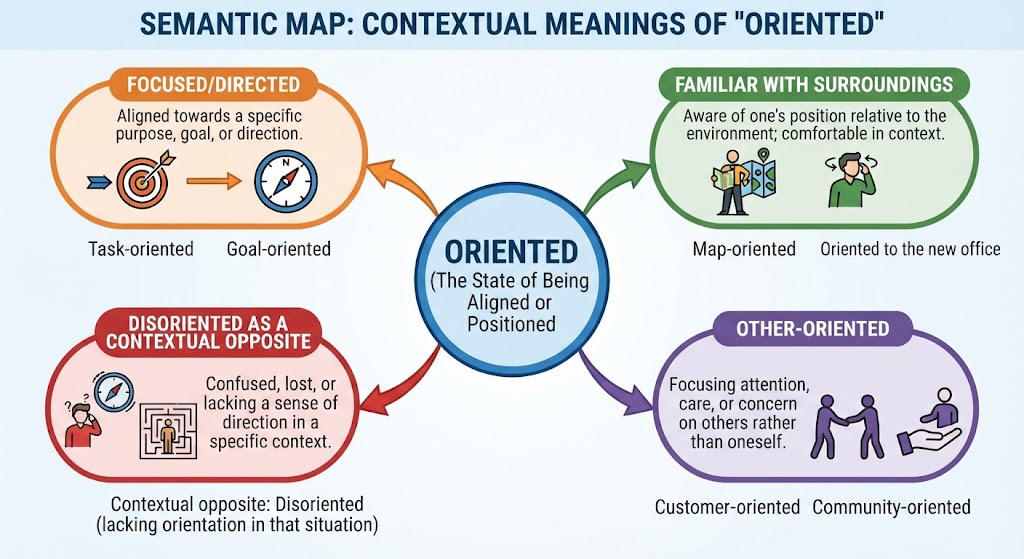
What Does It Mean to Be “Other-Oriented”?
Other-oriented is a separate compound adjective built from oriented.
It generally describes a person, behavior, attitude, or approach that is focused on other people rather than primarily on oneself.
For example:
Her approach to leadership is strongly other-oriented.
The expression can be used in contexts involving concern, attention, empathy, cooperation, or responsiveness to other people’s needs.
The important point is that other-oriented does not mean “oriented toward another physical direction.” Here, other identifies the focus of attention: other people.
A related example is other-oriented empathy, where the focus is on another person’s experience or welfare. Cambridge corpus material uses other-oriented in discussing empathic concern.
Is There an Antonym of “Oriented”?
There is no single universal antonym for oriented because its meaning changes with context.
If oriented means directed toward a goal, possible opposites include:
- undirected
- unfocused
- aimless
If it means familiar with one’s surroundings, possible contrasts include:
- disoriented
- confused
- unfamiliar with the surroundings
For example:
After the map was explained, she became oriented.
versus:
Without the map, she became disoriented.
Disoriented is therefore a particularly useful opposite when oriented means having a clear sense of one’s position or surroundings.
Do not assume that unoriented is always the best opposite. The appropriate antonym depends on the sense being used.
What Does “Orientedness” Mean?
Orientedness is a possible noun formation referring broadly to the state or quality of being oriented, but it is much less common than ordinary expressions such as:
- orientation
- being oriented
- degree of focus
- direction
- outlook
For most general writing, orientation will sound more natural.
For example:
The study examined the organization’s customer orientation.
is generally more idiomatic than trying to use customer-orientedness or orientedness without a specific reason.
This is another useful distinction: English allows productive word formation, but a grammatically possible formation is not necessarily the most natural everyday choice.
Frequently Asked Questions
Is “orientated” correct English?
Yes. Orientated is a standard English form, particularly common in British English. It is the past tense and past participle of orientate.
Is “oriented” correct in British English?
Yes. Oriented is also used in British English, although orientated is particularly characteristic of British usage in many contexts.
Is “orientated” American English?
It can occur in American English, but oriented is generally the more usual American form. Cambridge identifies orientate as mainly UK and orient as mainly US in the relevant meanings.
Which is more common: oriented or orientated?
Usage varies by region, context, and compound. Oriented is especially common in American English and is widely recognized internationally, while orientated is especially associated with British English.
Is “orientate” a real word?
Yes. Orientate is a dictionary-listed verb meaning to direct something toward a particular purpose or to become familiar with one’s position or situation.
Should I write “orienting” or “orientating”?
Both are correct. Orienting belongs to the verb orient, while orientating belongs to orientate.
Should I write “orient” or “orientate”?
Both are established. Orient is especially common in American English, while orientate is especially associated with British English.
Is “orintated” correct?
No. Orintated is a misspelling. The correct form is orientated.
Is “oritented” correct?
No. Oritented is a misspelling. The correct form is oriented.
What does “oriented” mean?
Depending on context, oriented can mean directed toward a particular person, purpose, subject, or goal, or familiar with one’s surroundings or situation.
What does “orientated” mean?
Orientated has essentially the same core meanings as oriented: directed toward something, adapted for a purpose, or familiarized with a situation. It is particularly associated with British English.
Is “customer-oriented” or “customer-orientated” correct?
Both are possible. Customer-oriented is especially common in American English, while customer-orientated fits British English usage.
Is “detail-oriented” or “detail-orientated” correct?
Both occur. Cambridge identifies detail-oriented as mainly American and notes detail-orientated as the usual British form.
What is the best way to remember the spelling?
Remember the two complete families:
orient → oriented → orienting
orientate → orientated → orientating
Do not mix the endings between the two families.
Final Takeaway
The simplest answer to orientated vs oriented is that both are correct.
The difference is primarily one of regional preference and verb choice, not a fundamental difference in meaning.
Use:
orient → oriented → orienting
when you prefer the shorter verb family, particularly in American English.
Use:
orientate → orientated → orientating
when following a British English style that uses orientate.
For compound adjectives, the same distinction appears:
customer-oriented / customer-orientated
detail-oriented / detail-orientated
Neither form should automatically be labeled wrong. The strongest editing approach is to identify the intended English variety, check whether the expression is an established term, and then maintain consistency throughout the document.
A final proofreading test is simple:
If your base verb is “orient,” use “oriented.” If your base verb is “orientate,” use “orientated.”