Fiancé or Fiancée: Which Spelling Is Correct?
Quick Answer
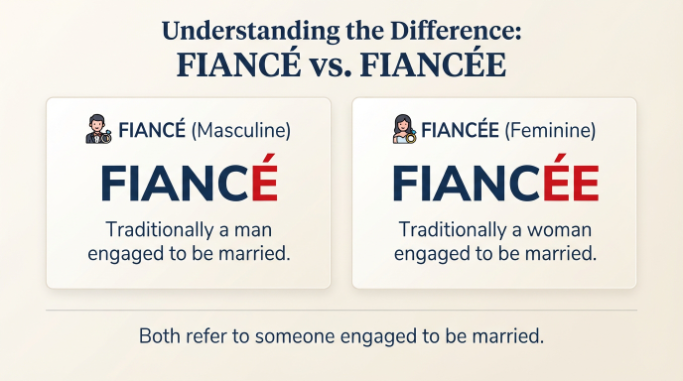
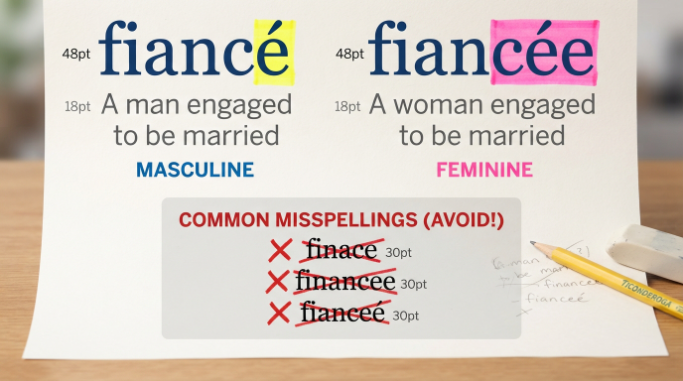
Fiancé and fiancée are both correct English words, but traditionally they identify different people:
- fiancé = a man who is engaged to be married
- fiancée = a woman who is engaged to be married
So, if you are asking “What is the male version of fiancé?”, the traditional spelling is fiancé. If you are asking “How do you spell fiancé for a woman?”, the traditional spelling is fiancée, with two e‘s at the end.
The accent marks are also part of the traditional spellings: fiancé and fiancée. In ordinary English writing, however, you will sometimes see fiance and fiancee without accents. The meaning is usually still clear, but the accented forms are the standard dictionary spellings. Cambridge defines fiancé as the man someone is engaged to marry and fiancée as the woman someone is engaged to marry.
A useful shortcut is:
One e at the end: fiancé → traditionally male
Two e’s at the end: fiancée → traditionally female
At-a-Glance Table
| Feature | fiancé | fiancée |
|---|---|---|
| Traditional meaning | A man engaged to be married | A woman engaged to be married |
| Part of speech | Noun | Noun |
| Number | Singular | Singular |
| Plural | fiancés | fiancées |
| Final spelling | -é | -ée |
| Pronunciation | Essentially the same | Essentially the same |
| Meaning in modern general usage | Can sometimes be used more broadly | Traditionally female-specific |
| Example | “Her fiancé proposed in June.” | “His fiancée starts a new job next month.” |
The central distinction is therefore not pronunciation but spelling and traditional gender reference. The two words are pronounced alike in standard English varieties, although their pronunciation has British and American variations. Cambridge gives UK pronunciations around /fiˈɒn.seɪ/ and US pronunciations around /ˌfiː.ɑːnˈseɪ/.
What Does Fiancé Mean?
Fiancé is a noun traditionally used for a man who is engaged to be married.
For example:
- Daniel is her fiancé.
- She introduced me to her fiancé.
- Her fiancé will arrive tomorrow.
- My sister’s fiancé is helping with the wedding.
- She has been engaged to her fiancé for six months.
The word identifies the person’s relationship status. It does not simply mean “boyfriend.” A boyfriend may or may not be engaged to marry someone, whereas a fiancé is specifically someone who is engaged to be married.
Cambridge’s dictionary definition likewise identifies fiancé as the man someone is engaged to marry.
Fiancé as a noun
Fiancé is normally a countable noun.
You can therefore say:
- a fiancé
- my fiancé
- her fiancé
- his fiancé
- two fiancés
Examples:
Laura invited her fiancé to dinner.
Three fiancés attended the couples’ workshop.
The plural is formed with -s:
fiancé → fiancés
The accent remains on the final é.
What Does Fiancée Mean?
Fiancée is traditionally a noun for a woman who is engaged to be married.
Examples include:
- Michael introduced his fiancée.
- His fiancée is planning the reception.
- I met Sarah’s fiancée yesterday.
- Her fiancée works in London.
- He bought a gift for his fiancée.
Cambridge specifically defines fiancée as the woman someone is engaged to marry.
Like fiancé, fiancée is a countable noun:
- a fiancée
- my fiancée
- her fiancée
- his fiancée
- several fiancées
Its plural is:
fiancée → fiancées
Notice what happens to the spelling:
fiancée + s = fiancées
You do not normally write fiancéees.

Fiancé vs. Fiancée: The Detailed Difference
The difference is largely inherited from French grammatical gender.
In traditional English usage:
fiancé refers to a male engaged partner.
fiancée refers to a female engaged partner.
The extra e in fiancée is therefore useful as a visual distinction.
Consider these two sentences:
Emma introduced her fiancé, James.
James is the man who is engaged to Emma.
James introduced his fiancée, Emma.
Emma is the woman who is engaged to James.
The relationship is the same from either person’s perspective, but the traditional noun changes according to the person’s gender.
This is why the question “fiancé or fiancée?” cannot be answered by choosing one spelling as universally correct. Both spellings are correct; the appropriate form depends on the person being described.
Is Fiancé Male or Female?
Traditionally, fiancé is male and fiancée is female.
This answers several common spelling questions:
- Male fiancé: fiancé
- Female fiancé: fiancée
- Man who is engaged: fiancé
- Woman who is engaged: fiancée
- Male version of fiancée: fiancé
- Female version of fiancé: fiancée
For example:
My brother’s fiancée is a doctor.
The person being described is a woman.
My sister’s fiancé is a doctor.
The person being described is a man.
However, English usage is not perfectly uniform. Some English speakers use fiancé as a gender-neutral term, particularly because many borrowed French words have lost some of their original gender distinctions in English. Major dictionaries can reflect broader usage alongside the traditional distinction. Cambridge, for example, gives fiancé a general definition in one of its English entries while also explicitly identifying the female form as fiancée.
For formal or careful writing where the person’s gender is known and the traditional distinction is appropriate, fiancé for a man and fiancée for a woman remains the clearest choice.
How Do You Spell Fiancé?
The traditional spelling is:
fiancé
It contains:
f + i + a + n + c + é
There is one e-like letter at the end, represented by accented é.
Common misspellings include:
- finace
- fiance
- fiancee
- fiancéé
- fianceé
- financee
- feoncay
- feonsay
- fiancai
- fiancè
The spelling fiance without the accent is common in informal digital writing, but fiancé is the conventional dictionary spelling.
The accent matters in the original French spelling and is retained in the established English form.
How Do You Spell Fiancée?
The traditional spelling is:
fiancée
It contains two e’s at the end, with the final one represented by accented é:
f + i + a + n + c + é + e
The visual difference is:
fiancé
fiancée
The easiest way to see it is to focus on the ending:
fiancé = -cé
fiancée = -cée
If you are referring to a woman in traditional usage, choose fiancée.
How Do You Pronounce Fiancé and Fiancée?
In English, fiancé and fiancée are generally pronounced the same.
A common pronunciation is approximately:
fee-ahn-SAY
Cambridge gives the UK pronunciation as approximately /fiˈɒn.seɪ/ and the US pronunciation as approximately /ˌfiː.ɑːnˈseɪ/.
So you normally cannot hear the difference between:
fiancé
and
fiancée
The distinction is primarily visible in writing.
This is one reason spelling can be confusing: the extra e in fiancée does not create a separate syllable in ordinary English pronunciation.
Is “fiancé” pronounced differently from “fiancée”?
Usually, no.
The spelling difference does not normally produce a meaningful pronunciation difference in English.
That means you should not try to pronounce the final -ee in fiancée as an additional syllable.
A useful approximation for both is:
fee-ahn-SAY
The exact vowel quality varies by accent, so this is a pronunciation guide rather than a claim that every English speaker uses exactly the same sounds.
Fiancé and Fiancée in British and American English
The traditional distinction between fiancé and fiancée is used in both British and American English.
There is no simple rule such as:
British English = fiancée
American English = fiancé
That would be incorrect.
Both varieties use both forms. The distinction is traditionally based on the person being described, not on whether the writer uses British or American English.
Pronunciation does vary somewhat between British and American English. Cambridge lists /fiˈɒn.seɪ/ for UK English and /ˌfiː.ɑːnˈseɪ/ for US English.
Spelling conventions can also vary in how carefully writers preserve accents. In emails, forms, databases, and plain-text environments, fiance and fiancee are frequently encountered. When accents are available, fiancé and fiancée are the conventional spellings.
When to Use Fiancé
Use fiancé when the person you are describing is a man, if you are following the traditional gender distinction.
In personal conversation
Have you met my fiancé?
My fiancé and I are looking for a new apartment.
Her fiancé surprised her with a weekend trip.
In introductions
This is David, my fiancé.
I’d like you to meet my fiancé, Alex.
In formal writing
The applicant’s fiancé will accompany her during the ceremony.
Mr. Patel attended the event with his fiancé.
The word works naturally in both casual and formal contexts. It is not slang.
When to Use Fiancée
Use fiancée when the person you are describing is a woman, under the traditional distinction.
In personal conversation
Have you met my fiancée?
My fiancée loves old movies.
His fiancée is arriving this afternoon.
In introductions
This is Maria, my fiancée.
I’d like you to meet my fiancée, Anna.
In formal writing
The groom arrived with his fiancée.
Her fiancée attended the meeting with her.
Again, the word is a normal English noun and is not restricted to formal writing.
Examples by Context
Wedding planning
My fiancé has already chosen the venue.
Her fiancée is handling the invitations.
The couple asked their fiancés to confirm attendance.
When discussing multiple engaged men, use fiancés. When discussing multiple engaged women, use fiancées.
Family conversations
My daughter’s fiancé is coming for dinner.
My son’s fiancée has a long commute.
Her parents have already met her fiancé.
Workplace writing
Please let us know whether your fiancé will attend the reception.
She asked whether her fiancée could join the company dinner.
In professional writing, the word is perfectly acceptable when the relationship is relevant.
Social media
Can’t wait to marry my fiancé!
Wedding countdown with my beautiful fiancée.
Introducing someone
Meet my fiancé, Daniel.
Meet my fiancée, Olivia.
These are especially useful because the surrounding context makes the meaning unmistakable.

The Plural of Fiancé
The plural of fiancé is:
fiancés
Example:
The wedding planner met with several fiancés before the ceremony.
The apostrophe is not used to make the word plural.
Incorrect:
fiance’s
Correct:
fiancés
The form fiancé’s is possessive singular, not plural.
For example:
My fiancé’s car is outside.
Here, the car belongs to one fiancé.
Compare:
Several fiancés attended the event.
Here, fiancés simply means more than one fiancé.
The Plural of Fiancée
The plural of fiancée is:
fiancées
Example:
The three fiancées compared wedding-planning notes.
Again, the apostrophe is not needed for an ordinary plural.
Correct:
fiancées
Possessive singular:
my fiancée’s dress
Possessive plural:
the fiancées’ dresses
This distinction is important because apostrophes show possession, not ordinary plurality.
Fiancé, Fiancée, Fiancés, and Fiancées
Here is the complete pattern:
| Form | Meaning |
|---|---|
| fiancé | one man who is engaged |
| fiancée | one woman who is engaged |
| fiancés | more than one male fiancé |
| fiancées | more than one female fiancée |
| fiancé’s | belonging to one fiancé |
| fiancée’s | belonging to one fiancée |
| fiancés’ | belonging to multiple fiancés |
| fiancées’ | belonging to multiple fiancées |
Examples:
My fiancé’s parents arrived early.
My fiancée’s parents arrived early.
The two fiancés’ families met.
The two fiancées’ families met.
This is a grammar issue as much as a spelling issue. The apostrophe tells the reader that you are expressing possession.
Common Mistakes
“Fiance” when you mean the standard spelling
Less careful:
My fiance is coming tonight.
Standard spelling:
My fiancé is coming tonight.
The version without the accent is widespread, particularly where keyboards or systems make accented characters inconvenient, but the conventional spelling is fiancé.
“Fiancee” without the accent
Less careful:
She is my fiancee.
Standard spelling:
She is my fiancée.
The unaccented form can still be understood, but fiancée is the conventional spelling.
“Financee”
A particularly common typo is:
financee
This can happen because finance is a familiar English word. But fiancée has nothing to do with finance.
Correct:
fiancée
“Finace”
Another common misspelling is:
finace
The letters should be:
fiance
and, in the standard accented spelling:
fiancé
“Fiancéé”
The spelling does not need two accented e’s.
Incorrect:
fiancéé
Correct:
fiancée
The final sequence is -ée, not -éé.
“Fiancè”
The accent normally goes in the other direction.
Correct:
fiancé
Not:
fiancè
The standard spelling uses é, not è.
“Fiancée” for a man
Under the traditional distinction:
He is my fiancée. ❌
He is my fiancé. ✅
“Fiancé” for a woman
Under the traditional distinction:
She is my fiancé. ❌
She is my fiancée. ✅
Because some modern English usage treats fiancé more broadly, you may encounter the shorter form for people of different genders. But if your goal is the traditional gender-specific spelling, use fiancé for a man and fiancée for a woman.
Fiancé vs. Fiancée vs. Finance
These three words can look surprisingly similar:
fiancé — an engaged man
fiancée — an engaged woman
finance — the management or study of money
For example:
Her fiancé works in banking.
Her fiancée works in banking.
She is studying finance.
The pronunciation and meaning are different, so context is important.
Is “Fiancé” Always Gender-Specific?
This is one of the more nuanced questions.
Traditional English usage distinguishes:
- fiancé for a man
- fiancée for a woman
However, English has increasingly used many borrowed words in ways that do not preserve every feature of their source language. Dictionary entries can therefore show broader usage alongside traditional distinctions. Cambridge’s English entry for fiancé includes a general sense of a person formally promised to marry another, while separately listing fiancée as the female form.
That means there are two practical considerations.
If you are following traditional usage:
Use fiancé for a man and fiancée for a woman.
If you are editing contemporary English:
Recognize that some speakers and publications may use fiancé more generally.
For a spelling guide, formal document, educational text, or careful edited prose, the traditional distinction is still the clearest way to avoid ambiguity.
Is Fiancée Only for Women?
Traditionally, yes.
Fiancée is the feminine form in the traditional distinction. Cambridge explicitly defines it as the woman who someone is engaged to marry.
So if the question is:
“Is fiancée female?”
The traditional answer is yes.
If the question is:
“Can fiancée mean a man?”
That is not the traditional English use. A male engaged partner is traditionally a fiancé.
What Is the Male Version of Fiancée?
The male counterpart is:
fiancé
So:
woman → fiancée
man → fiancé
Examples:
Her fiancé is named James.
His fiancée is named Emma.
This is the simplest answer to one of the most common questions about these words.
What Is the Female Version of Fiancé?
The traditional female form is:
fiancée
The additional e distinguishes the feminine form in writing.
Therefore:
He is her fiancé.
She is his fiancée.
The pronunciation generally remains the same.
Where Does the Word Fiancé Come From?
Fiancé is a French loanword that entered English from French. The French verb fiancer means “to get engaged” or, in the causative sense, “to betroth,” and the English nouns developed from this French vocabulary. Cambridge’s French-English dictionary translates fiancer in the relevant sense as “to get engaged.”
The French connection also helps explain why English retains the accented forms fiancé and fiancée.
It is important not to overinterpret the final e as an English grammatical rule. The spelling reflects the historical French form and the traditional gender distinction that English has retained.
Formal vs. Casual Usage
Formal English
In formal writing, invitations, biographies, journalism, and edited prose, fiancé and fiancée are appropriate.
Examples:
The bride arrived with her fiancé.
The couple announced that her fiancée would attend the ceremony.
If the distinction matters, retaining the accents also gives the writing the conventional dictionary spelling.
Casual English
In texts, chats, and informal online writing, you may see:
fiance
fiancee
without accents.
This is usually a matter of typing convenience rather than a different word.
For example:
My fiance is picking me up.
is easily understood, but:
My fiancé is picking me up.
is the standard spelling.
A Practical Decision Rule
When you need to choose quickly, use this three-step test.
Step 1: Are you describing someone who is engaged?
If no, neither fiancé nor fiancée is the appropriate word.
If yes, continue.
Step 2: Are you following the traditional gender distinction?
If yes:
- man → fiancé
- woman → fiancée
Step 3: Check the ending
Ask:
One e or two?
fiancé → one final e sound represented by é
fiancée → ée at the end
Then check the accent:
é, not è.
A Fast Proofreading Test
If you have written a sentence containing one of these words, replace the word temporarily with “engaged man” or “engaged woman.”
For example:
Sarah introduced her fiancé.
Replace it:
Sarah introduced her engaged man.
The sentence is awkward, but the reference is to a man, so fiancé is appropriate.
Now:
Daniel introduced his fiancée.
Replace it:
Daniel introduced his engaged woman.
The reference is to a woman, so fiancée is appropriate.
An even faster test is to ask:
“Who is the noun describing?”
If the answer is a man, use fiancé under traditional usage.
If the answer is a woman, use fiancée.

Memory Trick: One E for Him, Two E’s for Her
A common memory aid is:
Fiancé = one E → man
Fiancée = two E’s → woman
You can remember the second form as having an extra e for the feminine form.
This is only a spelling mnemonic; it should not be treated as a general rule that applies to French-derived words. Its purpose is simply to help you remember these two particular English spellings.
Another useful visual:
fiancé → -cé
fiancée → -cée
If you see the extra e, think female.
Edge Cases You Should Know
What if the person’s gender is not known?
If the person’s gender is unknown or irrelevant, you can use a more neutral expression such as:
- engaged partner
- betrothed
- partner
- person they are engaged to marry
For example:
Their engaged partner will attend the ceremony.
This avoids making an assumption.
What if the couple is same-sex?
The traditional gender distinction still applies if you know the gender of the person being described:
His fiancé is arriving tomorrow.
Her fiancée is arriving tomorrow.
For a gender-neutral reference where gender is unknown or intentionally unspecified, fiancé is sometimes used more broadly in contemporary English, but engaged partner is an unambiguous alternative.
What if gender is irrelevant?
You do not have to use either gender-marked form.
Instead of:
The CEO’s fiancé(e) attended the event.
you can write:
The CEO’s engaged partner attended the event.
This is often cleaner in professional writing when the partner’s gender has no relevance to the subject.
What if you cannot type accents?
Writing fiance or fiancee without accents is commonly understood in informal contexts and technical systems that do not handle diacritics well.
However, when you can use the standard spelling, prefer:
fiancé
fiancée
Fiancé vs. Fiancée: What About “Fiancé’s”?
The apostrophe changes the grammatical function.
fiancé = noun
My fiancé is here.
fiancé’s = possessive singular
My fiancé’s phone is ringing.
fiancés = plural
Several fiancés attended.
The same pattern applies to fiancée:
fiancée = singular
My fiancée is here.
fiancée’s = possessive singular
My fiancée’s phone is ringing.
fiancées = plural
Several fiancées attended.
This distinction is especially important in proofreading because fiancés and fiancé’s look similar but mean completely different things.
Fiancé or Fiancée in a Wedding Invitation?
Either form can be correct depending on the person.
For a man:
Please join us as we celebrate Sarah and her fiancé, Daniel.
For a woman:
Please join us as we celebrate Daniel and his fiancée, Sarah.
For a gender-neutral construction:
Please join us as we celebrate the couple and their engaged partners.
In a wedding invitation, accuracy matters because the text is highly visible and often preserved as a formal keepsake.
Fiancé or Fiancée in UK English?
Both fiancé and fiancée are used in UK English.
The traditional distinction remains:
fiancé = male engaged partner
fiancée = female engaged partner
Cambridge’s British dictionary entries explicitly give these gender-specific meanings.
The major difference worth noticing is pronunciation rather than the fundamental spelling distinction. Cambridge lists the UK pronunciation approximately as /fiˈɒn.seɪ/.
Fiancé vs. Fiancée Pronunciation
Because both words are generally pronounced alike, pronunciation is not a reliable way to decide which spelling you need.
Think of the distinction as:
Meaning → determines the traditional form
Spelling → records the distinction
Pronunciation → usually does not distinguish them
This is why someone can say “fee-ahn-SAY” and still leave you wondering whether they mean fiancé or fiancée. You need the context or the spelling to know.
Is “Fiancé” the Correct Spelling for a Man?
Yes, under traditional usage.
He is her fiancé.
The standard spelling is fiancé, with an accented final é.
Is “Fiancée” the Correct Spelling for a Woman?
Yes, under traditional usage.
She is his fiancée.
The standard spelling is fiancée, ending in -ée.
Frequently Asked Questions
What is the difference between fiancé and fiancée?
Traditionally, fiancé refers to a man engaged to be married, while fiancée refers to a woman engaged to be married. Both are nouns and both are generally pronounced the same in English.
Which fiancé is female?
The traditional female form is fiancée, with two e’s at the end.
Which fiancé is male?
The traditional male form is fiancé, with one e at the end.
How do you spell fiancé?
The standard spelling is fiancé.
How do you spell fiancée?
The standard spelling is fiancée.
What is the plural of fiancé?
The plural is fiancés.
What is the plural of fiancée?
The plural is fiancées.
Is “fiance” correct without an accent?
Fiance is widely understood as an unaccented version, especially in informal typing, but fiancé is the conventional spelling in standard edited English.
Is “fiancee” correct without an accent?
Similarly, fiancee is commonly encountered when accents are omitted, but fiancée is the conventional spelling.
Is fiancé pronounced differently from fiancée?
Generally, no. The two forms are normally pronounced alike in English. Cambridge gives essentially the same pronunciation for the two words, with regional British and American differences.
Can fiancé be gender-neutral?
It can be used more broadly by some English speakers, and dictionary treatment reflects that broader usage in some contexts. However, the traditional distinction remains fiancé for a man and fiancée for a woman.
What does fiancée mean?
Fiancée traditionally means a woman who is engaged to be married.
What does fiancé mean?
Fiancé traditionally means a man who is engaged to be married.
Is “financee” the correct spelling?
No. Financee is a misspelling of fiancée.
Is “finace” the correct spelling?
No. The standard spelling is fiancé for a man or fiancée for a woman under the traditional distinction.
Is “fiancè” correct?
No. The conventional spelling uses é, as in fiancé, not è.
Can I say “engaged partner” instead?
Yes. Engaged partner is a useful gender-neutral alternative, particularly when gender is unknown, irrelevant, or intentionally not specified.
Final Takeaway
The answer to “fiancé or fiancée?” is straightforward once you focus on the person being described.
Fiancé = traditionally a man engaged to be married.
Fiancée = traditionally a woman engaged to be married.
The standard spellings are fiancé and fiancée, and they are generally pronounced the same in English. Their plurals are fiancés and fiancées.
The quickest memory rule is:
fiancé = one e → traditionally male
fiancée = two e’s → traditionally female
If gender is irrelevant or unknown, engaged partner is a clear alternative. And if you are proofreading formal English, remember that the accent belongs on é, not è.