Here Here or Hear Hear? Which Is Correct?
Quick Answer
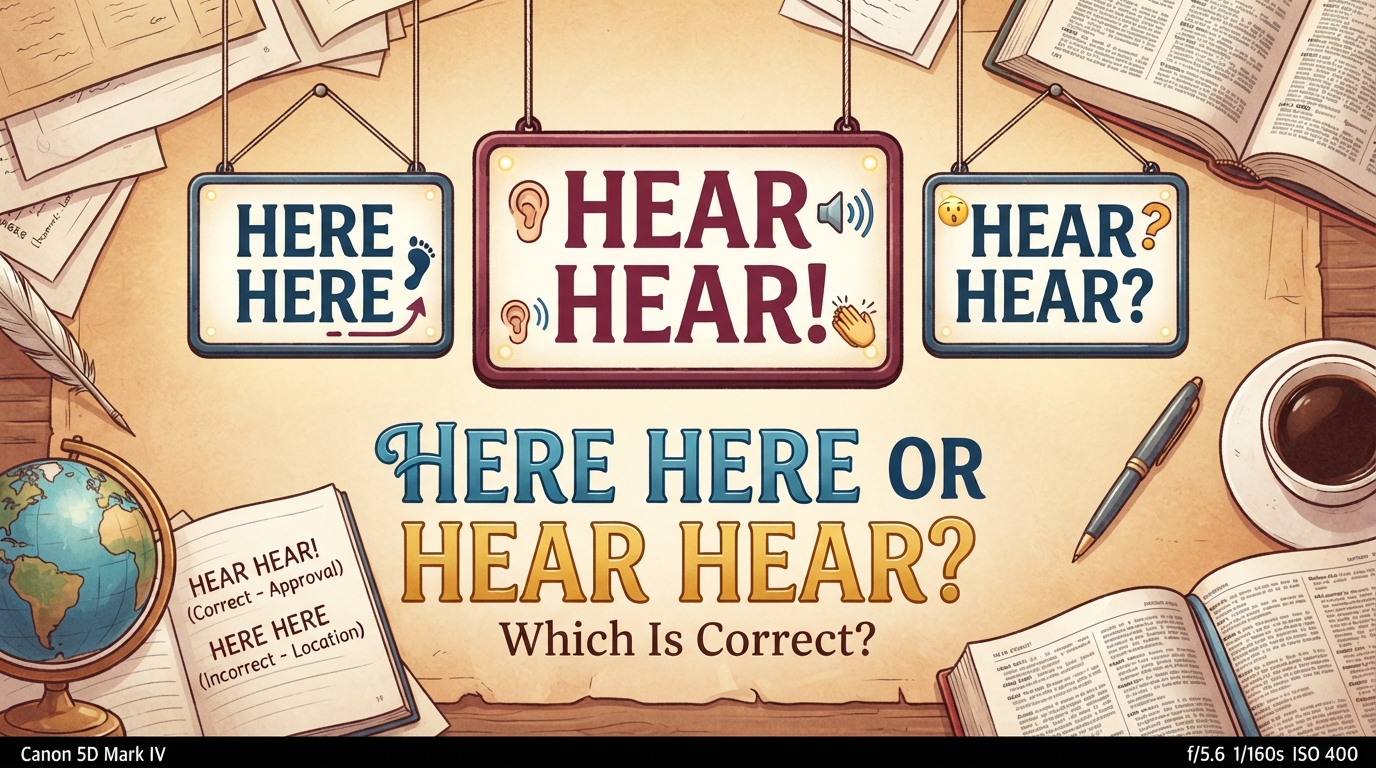
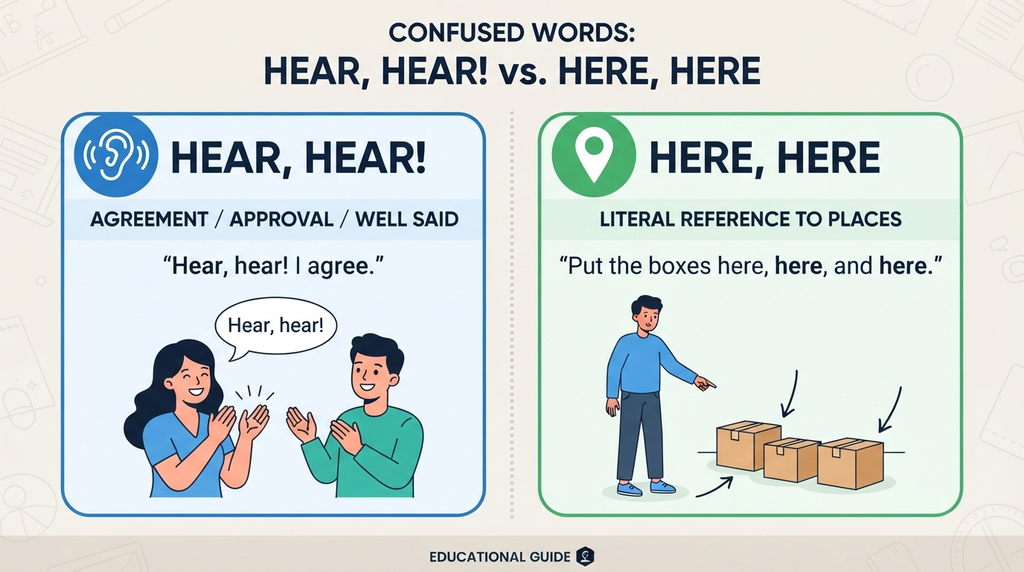
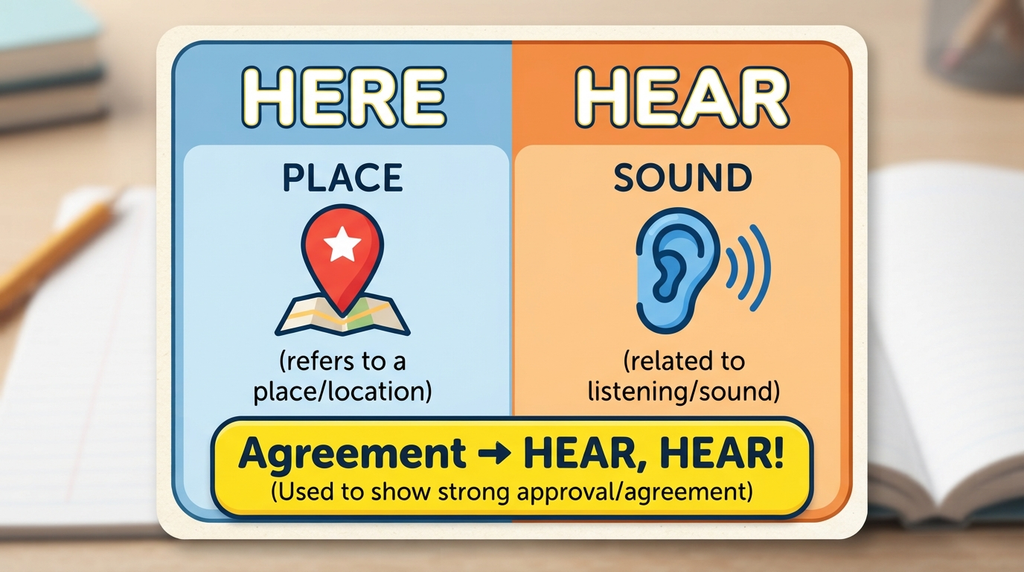
If you mean the expression used to show agreement, approval, or support, the correct phrase is “hear, hear!”
“Hear, hear!” = I agree with that. / Well said. / I support what you just said.
“Here, here” is usually a spelling mistake when someone intends the expression “hear, hear!” However, the two words here and here can appear together legitimately when they literally refer to a place, as in:
“The two signs should go here, here, and here.”
So, if you are wondering “Is it here here or hear hear?”, the answer depends on what you mean:
- Hear, hear! → agreement or approval of someone’s words.
- Here, here → two uses of the place word here, usually referring to locations.
- Here, hear → generally not the standard expression.
- Hear, here → generally not the standard expression.
At-a-Glance Table
| Expression | Meaning | Part of speech | Typical use | Correct for agreement? |
|---|---|---|---|---|
| hear, hear! | I agree; well said | Verb + interjection-like expression | Responding positively to a statement | Yes |
| here | In, at, or toward this place | Adverb | Referring to a location | No |
| here, here | Two literal uses of here | Adverb + adverb | Referring to multiple places or emphasizing locations | No |
| hear | Perceive sound | Verb | Listening or receiving sound | Not by itself |
| here, hear | No standard idiomatic meaning | Adverb + verb | Only meaningful in a special literal sentence | No |
| hear, here | No standard idiomatic meaning | Verb + adverb | Possible only in a literal sentence | No |
The important distinction is between sound and place.
Hear is connected with the act of perceiving sound:
I can hear music from the next room.
Here refers to a location:
Please put the folder here.
The expression “hear, hear!” uses hear in an idiomatic way to signal approval of something that has just been said.
What Does “Hear, Hear!” Mean?
“Hear, hear!” is an expression used to show agreement, approval, or enthusiastic support for a speaker’s statement.
For example:
“Everyone deserves a fair chance to be heard.”
“Hear, hear!”
The second speaker is not necessarily asking someone to improve their hearing. Instead, they are effectively expressing:
- “I agree.”
- “Exactly.”
- “Well said.”
- “I support that.”
- “That is worth emphasizing.”
The expression is particularly associated with speeches, debates, meetings, public discussions, and situations where one person responds to another person’s statement.
It can also be used informally:
“We should stop wasting food.”
“Hear, hear!”
In modern everyday writing, “hear, hear!” can sound somewhat emphatic, traditional, or playful. The exact tone depends on context.
Why Is It “Hear, Hear” Rather Than “Here, Here”?
The spelling hear is important because the expression is associated with listening to and acknowledging what someone has said.
Although hear and here sound the same in standard English, they have completely different meanings and spellings.
- hear = perceive sound
- here = in or at this place
That makes this a classic homophone problem. Homophones are words that sound alike but have different meanings and spellings.
For example:
I can hear the speaker clearly.
versus:
Please wait here.
When someone types “here here!” to mean “I agree,” they are normally confusing the homophones and using the wrong spelling for the established expression.

“Here Here” or “Hear Hear”: The Detailed Difference
Hear, Hear!
Hear, hear! is the established expression for agreement or approval.
Example:
“This community deserves better public transportation.”
“Hear, hear!”
Here, the speaker is reacting to the statement that was just made.
Another example:
“We should thank everyone who volunteered.”
“Hear, hear!”
Again, the response means that the second speaker agrees with the sentiment.
Here, Here
Here is a location word. It tells someone where something is, where something happens, or where someone should look or go.
For example:
Put your signature here.
Using here twice can be grammatically possible when the two instances have a literal spatial function:
“The first label goes here, and the second one goes here.”
A deliberately shortened version could be:
“Here, here, and here.”
That does not mean “I agree.” It means that multiple locations are being identified.
Therefore, “here, here” is not the standard spelling of the agreement expression.
When to Use “Hear, Hear!”
Use “hear, hear!” when you are reacting positively to something someone has said.
Agreement with an opinion
“People should have more time to disconnect from work.”
“Hear, hear!”
Approval of a proposal
“Let’s make the meeting shorter and more focused.”
“Hear, hear!”
Supporting a statement
“Good writing should be clear before it tries to be clever.”
“Hear, hear!”
Showing enthusiastic agreement
“We need to give credit to the people who did the work.”
“Hear, hear!”
In a humorous conversation
“Everyone deserves an extra hour of sleep on Monday.”
“Hear, hear!”
The expression does not require a formal setting. However, it can sound more dramatic or old-fashioned than a simple “I agree” or “Exactly.”
When “Here, Here” Can Actually Be Correct
It would be inaccurate to say that “here, here” can never be correct. The important issue is meaning.
If here is being used literally as a location word, two occurrences can appear together.
For example:
“The three buttons should be placed here, here, and here.”
Each here identifies a different location.
Another example:
“Look at these two points: here and here.”
In speech, a person might repeat here while pointing to separate locations:
“Start here, then move over here.”
So the spelling here is not inherently wrong. It is wrong when someone uses it as a substitute for the established expression “hear, hear!”
This distinction is important because spelling cannot be judged independently of context.

Examples by Context
In a Meeting
“I think we should give the team more time to test the proposal.”
“Hear, hear!”
The response expresses agreement with the speaker.
In a Debate
“Public discussion should focus on evidence rather than assumptions.”
“Hear, hear!”
Again, the listener is approving what was said.
In Everyday Conversation
“Nobody should have to answer work messages at midnight.”
“Hear, hear!”
This is informal but perfectly understandable.
In a Speech
“Our community has achieved a great deal through cooperation.”
“Hear, hear!”
The expression can work particularly naturally in an audience or speech setting.
Giving Directions
“Put one marker here, another here, and the last one here.”
Here, here is correct because the speaker is identifying locations.
Referring to a Document
“The heading belongs here, while the signature goes here.”
Both uses are spatial.
Pointing at Several Objects
“This label goes here, and that one goes here.”
Again, the meaning is location, not agreement.
“Hear Hear” Without the Comma
You may see the expression written as:
Hear, hear!
The comma is conventional and helps show that this is a repeated expression.
You may also encounter “hear hear” without punctuation in informal digital writing, especially in quick comments or messages.
For polished writing, however, “Hear, hear!” is the clearest standard presentation.
The comma also helps distinguish the expression visually from an ordinary sentence containing the verb hear twice.
Compare:
Hear, hear!
with:
“Did you hear what I heard?”
The first is an established expression of approval. The second is an ordinary grammatical sentence.
Is “Hear, Hear!” Formal or Casual?
“Hear, hear!” is grammatically acceptable in both formal and informal contexts, but its register can vary.
In a formal debate, meeting, speech, or public discussion, it can sound traditional or rhetorical:
“We must protect the integrity of the process.”
“Hear, hear!”
In casual conversation, it can be playful:
“Pizza is a perfectly reasonable breakfast.”
“Hear, hear!”
In some modern conversations, especially very casual ones, “Exactly!”, “Absolutely!”, “Agreed!”, or “So true!” may sound more natural.
That does not make “hear, hear!” incorrect. It simply means that style and audience influence whether the expression feels natural.
British vs. American English
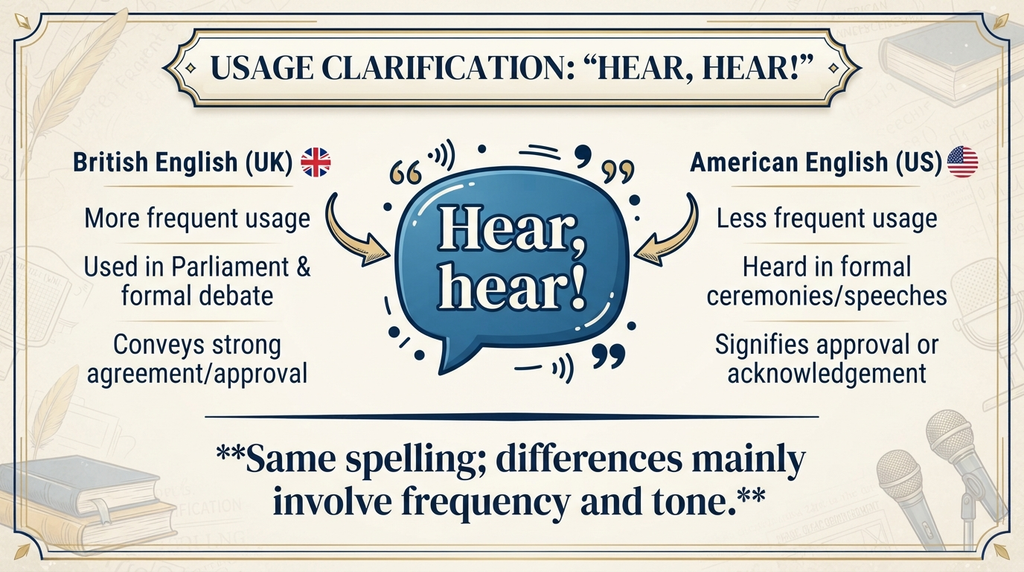
“Hear, hear!” is understood in both British and American English.
The expression has strong associations with parliamentary, debating, and public-speaking traditions, particularly in British English. American speakers also use and understand it, although everyday alternatives such as “I agree,” “exactly,” or “well said” may be more common in some situations.
There is therefore no British rule that changes hear, hear into here, here.
If the intended meaning is approval of someone’s words, the spelling remains:
Hear, hear!
The main variation between speakers is more likely to involve frequency, tone, and register, not the spelling of the expression.
Pronunciation: Why the Confusion Happens
Hear and here are homophones in standard English. They are normally pronounced alike.
This means you cannot reliably distinguish the two spellings by listening to the words.
Compare:
hear → /hɪr/ in many American pronunciations
here → /hɪr/ in many American pronunciations
Pronunciation can vary somewhat by accent, particularly in the exact vowel and treatment of the final sound, but the key point remains: the words are easily confused because they sound alike.
That is why the spelling has to be determined from meaning and context, not sound alone.
The same principle applies to other homophone pairs:
- their / there / they’re
- your / you’re
- to / too / two
- its / it’s
- they’re / their / there

Common Mistakes
Mistake 1: Writing “Here, here!” to Mean “I Agree”
Incorrect for the intended idiom:
“That is exactly what we need. Here, here!”
Correct:
“That is exactly what we need. Hear, hear!”
The problem is not pronunciation. The problem is that here means a place, whereas the idiomatic expression uses hear.
Mistake 2: Assuming “Hear, Hear!” Means “Listen!”
The expression is related to the idea of hearing what has been said, but in modern usage it primarily functions as an expression of agreement or approval.
For example:
“We should recognize the volunteers.”
“Hear, hear!”
The second speaker is expressing support rather than simply instructing everyone to listen.
Mistake 3: Thinking “Here, Here” Is Never Possible
This goes too far in the opposite direction.
Consider:
“Mark the three locations here, here, and here.”
The repeated here is perfectly understandable because each instance refers to a location.
The correct question is not simply “Is here here wrong?” The correct question is:
What does each word mean in this sentence?
Mistake 4: Choosing the Spelling by Sound
Because hear and here sound alike, listening to the phrase is not enough.
Instead, replace the questionable word with its meaning.
If you mean “I agree”, the expression is:
Hear, hear!
If you mean “in this place,” use:
here
Mistake 5: Writing “Hear, Here!”
This combination is not the standard expression for agreement.
For example:
“Hear, here! I completely agree.”
should normally be:
“Hear, hear! I completely agree.”
Hear, here can occur accidentally or in a specially constructed literal sentence, but it is not the conventional idiom.
A Fast Decision Rule
Use this three-second test:
Are you agreeing with something someone just said?
Use:
Hear, hear!
Are you talking about a location?
Use:
here
Are you identifying several locations?
You can use:
here, here, and here
Are you still unsure?
Replace the word mentally:
- hear → listen/perceive sound
- here → this place
If “this place” makes sense, you probably need here.
If you are expressing approval of someone’s statement, use hear, hear!
A Practical Proofreading Test
When proofreading here here or hear hear, do not rely on how the phrase sounds.
Ask:
Am I responding to someone’s words, or am I identifying a place?
If you are responding to someone’s words with agreement:
Hear, hear!
If you are identifying a place:
here
If you are identifying multiple places:
here, here, and here
This test works because it focuses on the semantic distinction rather than the spelling alone.
What Does “Hear Hear” Mean?
“Hear, hear!” means that the speaker agrees with, approves of, or strongly supports something that another person has just said.
For example:
“Good communication starts with listening.”
“Hear, hear!”
The response can be paraphrased as:
“I agree.”
or:
“Well said.”
or:
“Exactly.”
The exact emotional strength depends on context. It can be sincere, enthusiastic, formal, humorous, or mildly ironic.
What Does “Here Here” Mean?
There is no standard idiomatic meaning of “here, here” equivalent to “hear, hear!”
When written with here, the words normally retain their ordinary spatial meaning.
For example:
“Put the two chairs here and here.”
The first here and second here identify locations.
If someone writes:
“Here, here! That’s exactly right.”
they are almost certainly intending “Hear, hear!” and have confused the two homophones.
Is “Here Here” Ever a Saying?
“Here, here” is not the standard saying used to express agreement.
The established expression is:
“Hear, hear!”
People do sometimes write “here here” because the two expressions sound identical in speech. This is a common spelling confusion rather than a separate standard idiom with the same meaning.
You may therefore encounter here here in informal online writing, comments, social media, or messages. Its appearance does not change the conventional spelling of the expression.
“Hear Hear” or “Here Here” in Text Messages
In texting and casual online communication, you might see:
“Here here 😂”
or:
“Hear hear!”
The first is understandable as an informal spelling error or phonetic confusion. The second follows the conventional spelling.
If you are writing something that will be published, submitted, edited, or used professionally, choose:
Hear, hear!
If you are writing casually, readers may understand either version from context, but understanding does not make the nonstandard spelling the conventional one.
“Hear or Here”: A Simple Comparison
| Word | Core meaning | Example |
|---|---|---|
| hear | perceive sound | “Can you hear that noise?” |
| here | in or at this place | “Please sit here.” |
Now apply the meanings to the phrase:
Hear, hear! → approval of what was said
versus:
here, here → this place, this place
The spelling follows the meaning.
“Here and Hear”: How to Keep Them Straight
A useful memory association is:
Hear → ear
The word hear contains the sound-related idea of an ear.
Hear → ear → sound
Meanwhile:
Here → location
Think of here as pointing to a place:
Here → this place
So:
Hear, hear! → “I heard what you said, and I agree.”
and:
Here → “This is the place.”
This is a memory aid rather than a grammar rule, but it is useful for proofreading.
“H E R E” and “H E A R”: Spelling the Difference
If you are searching for h e r e here or h e a r here, the simplest distinction is:
H-E-R-E = HERE
Meaning:
in, at, or toward this place
Example:
“Leave the package here.”
H-E-A-R = HEAR
Meaning:
perceive or receive sound
Example:
“I can hear the announcement.”
The agreement expression therefore uses:
H-E-A-R, H-E-A-R: hear, hear!
not:
H-E-R-E, H-E-R-E: here, here!
FAQs
Is it “here here” or “hear hear”?
For the expression meaning “I agree” or “well said,” it is “hear, hear!”
“Here, here” can be grammatically possible when here refers to locations, but it is not the standard spelling of the agreement expression.
What does “hear, hear” mean?
“Hear, hear!” means “I agree,” “well said,” or “I support what you have just said.” It is commonly used as a response to a statement.
Is “here, here” grammatically wrong?
Not always. Two occurrences of here can be grammatically valid when they refer to places.
For example:
“Put the markers here, here, and here.”
But “here, here!” is not the conventional spelling when the intended meaning is agreement.
Why do people spell “hear, hear” as “here, here”?
Because hear and here are homophones: they sound alike but have different meanings and spellings. People therefore sometimes choose the location word here when they mean the expression “hear, hear!”
Is “hear hear” correct without a comma?
“Hear, hear!” is the conventional punctuation. In informal digital writing, the comma may be omitted, but polished writing should normally use the comma.
Does “hear, hear” mean “listen”?
Its modern use is primarily to express agreement or approval. It can be understood as a response acknowledging what has been said rather than simply an instruction to listen.
Is “hear, hear” British or American?
It is used and understood in both British and American English. It has particularly strong associations with formal speaking, debating, and parliamentary contexts, but it can also appear in informal conversation.
Can I say “hear, hear” in an email?
Yes. It is grammatically fine, but consider your audience and tone. In a professional email, “I agree,” “Absolutely,” or “Well said” may sound more straightforward depending on the situation.
What is the difference between “here” and “hear”?
Here refers to a place:
“Come here.”
Hear refers to perceiving sound:
“Can you hear me?”
How do you spell the phrase meaning “I agree”?
Spell it:
Hear, hear!
Not:
Here, here!
What does “here here here” mean?
There is no standard idiom called “here here here.” Three or more uses of here can occur in a sentence when someone is pointing out several locations, such as:
“The three labels go here, here, and here.”
The repeated word has a literal spatial meaning in that context.
What does “here he here he” mean?
“Here he here he” is not a standard English phrase. If you encountered it online, it may be a typo, transcription error, repeated words, or context-specific text. It should not be confused with “hear, hear!”
What does “herehe herehe” mean?
“herehe herehe” is not a standard English expression. Without additional context, it is most likely a typo, repeated text, or a stylized spelling rather than an established phrase.
Final Takeaway
The distinction is simple once you focus on meaning:
Hear, hear! = “I agree” / “Well said.”
Here = “in or at this place.”
So when someone says something you strongly agree with, write:
“Hear, hear!”
When you are pointing to a location, write:
“Put it here.”
And when you identify multiple locations, repeated here can be perfectly legitimate:
“The labels go here, here, and here.”
The reason this confusion persists is that hear and here sound alike. The reliable solution is therefore not to listen for the spelling but to ask what the word means in context: sound → hear; place → here; agreement with someone’s words → hear, hear.