Loosing or Losing: What Is the Difference?
Quick Answer
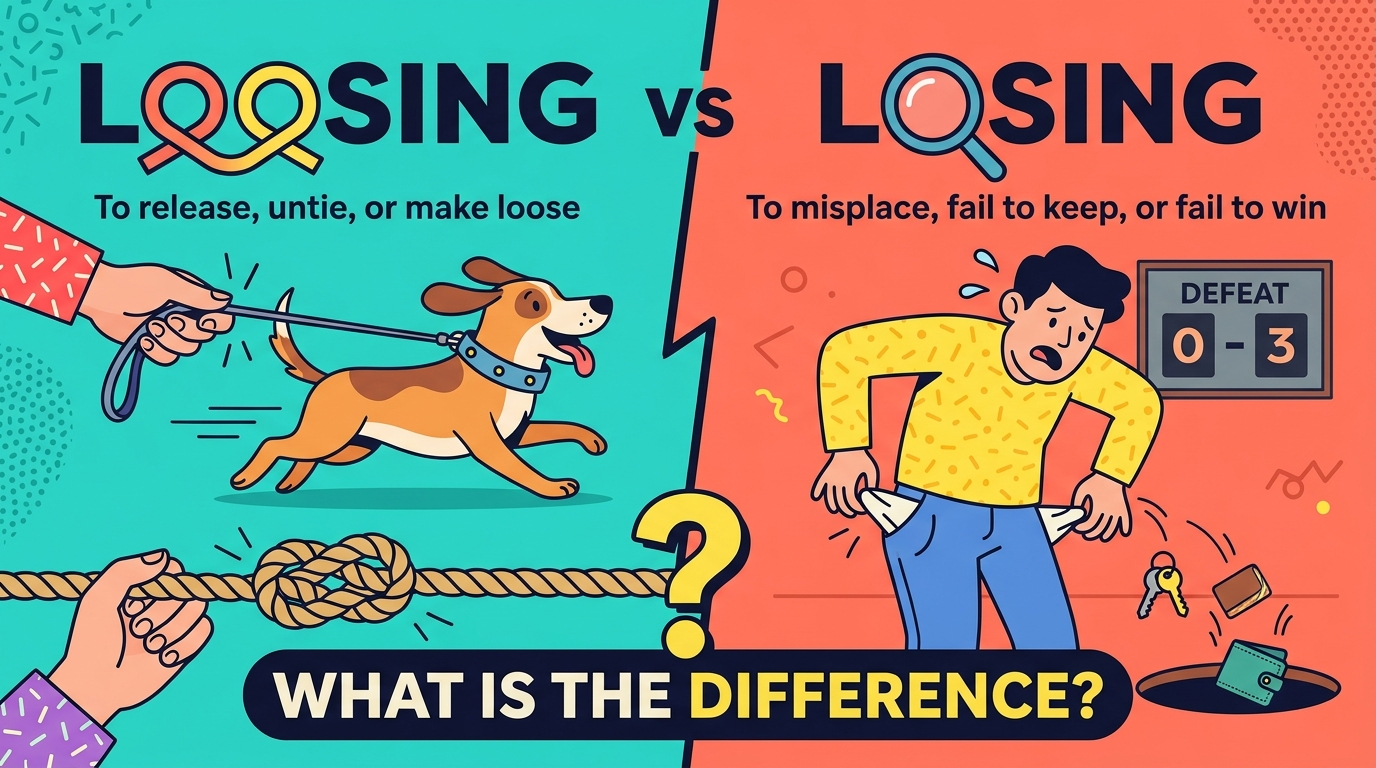
Losing is the correct spelling when you mean misplacing something, failing to win, or no longer having something. Loosing is also a real English word, but it means releasing, unfastening, or making something loose.
- Losing: She is losing her keys again.
- Loosing: The archer is loosing an arrow at the target.
If you are writing about losing a game, losing money, losing weight, losing an opportunity, or losing someone, use losing, with one o after the l and before the s.
The confusion happens because lose becomes losing when you add -ing, while loose becomes loosing. The words have different meanings, even though their spellings look similar.
At-a-Glance Table
| Feature | Losing | Loosing |
|---|---|---|
| Base word | Lose | Loose |
| Part of speech | Verb form | Verb form |
| Main meaning | Misplacing, failing to win, or ceasing to have something | Releasing, unfastening, or making something less tight |
| Common usage | Very common | Relatively uncommon |
| Example | We are losing the match. | The hunter is loosing the hounds. |
| Spelling pattern | Lose + ing = losing | Loose + ing = loosing |
| Pronunciation | Usually /ˈluːzɪŋ/ | Usually /ˈluːsɪŋ/ |
| Typical contexts | Games, money, possessions, opportunities, relationships | Arrows, restraints, animals, physical tension |
| American vs. British English | Same spelling and meaning | Same spelling and meaning |
The most important distinction is the base word: lose means to fail to keep or win something, whereas loose means not tight, not firmly attached, or free from restraint.
The Detailed Difference Between Losing and Loosing
1. What Does Losing Mean?
Losing is the present participle or gerund form of the verb lose. Depending on the sentence, it can describe an ongoing process, a developing situation, or an activity considered as a concept.
The verb lose has several common meanings.
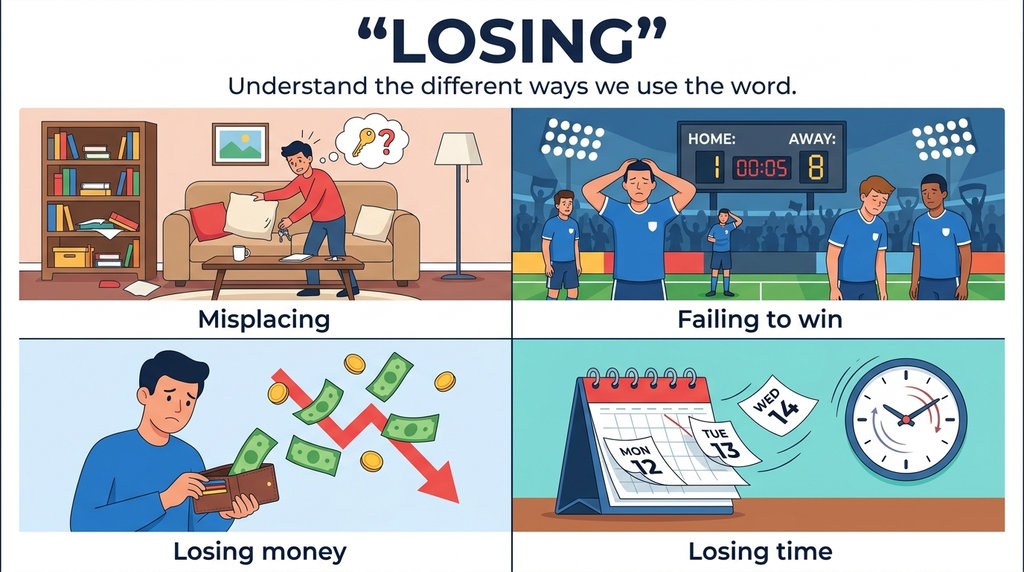
To misplace something
- I keep losing my glasses around the house.
- He is losing his car keys almost every week.
- Stop losing your important documents.
To fail to win
- Our team is losing the final by two points.
- The candidate is losing support among voters.
- They were losing the game until the last few minutes.
To no longer have something
- The company is losing customers.
- She is losing confidence in the plan.
- We are losing valuable time.
To experience a reduction
- The business is losing money this quarter.
- The plant is losing moisture in the heat.
- The athlete is losing strength after a long illness.
To experience the end of a relationship or connection
- He is afraid of losing his closest friend.
- The organization is losing experienced employees.
- The community is losing an important local tradition.
In all these examples, losing relates to something being misplaced, defeated, reduced, or no longer retained.
2. What Does Loosing Mean?
Loosing is the present participle or gerund form of loose, when loose is used as a verb. It means releasing, setting free, unfastening, or making something less tight.
Although the word is grammatically correct, it is much less common than losing. You are more likely to encounter it in literary writing, historical accounts, or specific descriptions of releasing something.
To release something
- The archer is loosing an arrow toward the distant target.
- The soldiers began loosing arrows from behind the wall.
- The illustration depicts a warrior loosing a spear.
To set something free
- The handler is loosing the dogs from their enclosure.
- The farmer is loosing the horses into the pasture.
- The story describes a character loosing a captive from chains.
To unfasten or loosen something
- She is loosing the knot that holds the bundle together.
- He worked carefully, loosing the tight cord around the package.
- The workers are loosing the restraints securing the equipment.
Some of these sentences sound formal or unusual because everyday English usually favors alternatives such as releasing, untangling, loosening, or unfastening.
There is also an important distinction between loosing and loosening. Loosing often suggests releasing something from restraint, while loosening usually means making something less tight.
For example:
- The archer is loosing an arrow. (Releasing it.)
- The mechanic is loosening a bolt. (Making it less tight.)
Both verbs are correct, but they describe different actions.
When to Use Losing
Use losing whenever you are talking about losing a possession, competition, amount, opportunity, advantage, or connection.
Losing a game or competition
Correct: Our school is losing the basketball tournament.
Incorrect: Our school is loosing the basketball tournament.
Why? The school is failing to win, not releasing anything.
Losing money or a business advantage
Correct: The company is losing money because costs have increased.
Incorrect: The company is loosing money because costs have increased.
Why? The sentence describes a financial decline, so the verb must be lose.
Losing a person or relationship
Correct: She worries about losing touch with her old classmates.
Incorrect: She worries about loosing touch with her old classmates.
Why? The expression lose touch means to stop communicating or maintaining contact. It does not mean to release a physical restraint.
Losing time or an opportunity
Correct: We are losing time by waiting for another approval.
Correct: He regrets losing the opportunity to study abroad.
Both sentences describe something that is slipping away or no longer available.
Losing in everyday expressions
The following phrases always use losing when they refer to the verb lose:
- Losing interest
- Losing patience
- Losing control
- Losing hope
- Losing track of time
- Losing your temper
- Losing sight of something
- Losing confidence
- Losing a chance
- Losing your way
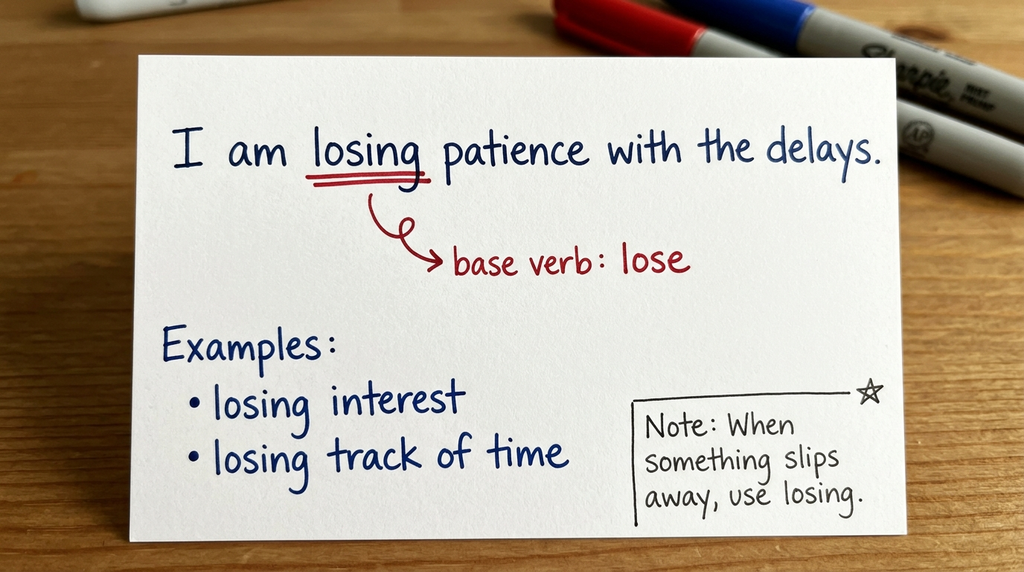
For example, “I am losing patience with the repeated delays” is correct because lose patience means to become less patient.
When to Use Loosing
Use loosing when the action involves freeing, releasing, or unfastening something. Because this meaning is relatively specialized, check that the sentence genuinely describes an act of release.
Releasing an arrow
Correct: The archer is loosing an arrow toward the target.
Here, loosing describes the moment the archer releases the arrow.
Releasing animals
Correct: At sunrise, the keeper began loosing the horses into the field.
The horses are being released from a place where they were confined.
Releasing a restraint
Correct: The workers spent several minutes loosing the ropes around the damaged equipment.
In this context, loosing means freeing the equipment by releasing the ropes. Depending on the intended meaning, loosening or untangling might sound more natural.
Literary and historical writing
Correct: The ancient account describes soldiers loosing arrows over the city walls.
The word can create a traditional or literary tone, particularly in descriptions of archery, battle, or ceremonial release.
However, do not choose loosing merely because the sentence sounds formal. The meaning must involve release or a related action.
Examples of Losing vs. Loosing by Context
The best way to understand the difference is to compare sentences in similar contexts.
| Context | Correct sentence | Why it works |
|---|---|---|
| Competition | We are losing the match. | The team is failing to win. |
| Archery | The archer is loosing an arrow. | The archer is releasing an arrow. |
| Money | I am losing money on the investment. | Money is being lost. |
| Restraints | The guard is loosing the prisoner from his bonds. | The guard is releasing the prisoner. |
| Time | We are losing time. | Time is slipping away. |
| Physical tension | She is loosening the tight strap. | The strap is becoming less tight. |
| Confidence | He is losing confidence in his decision. | His confidence is declining. |
| Animals | The farmer is loosing the sheep into the pasture. | The sheep are being released. |
| Contact | I am losing touch with my old friends. | Contact is fading. |
| Knots | He is loosing the knot to free the rope. | He is releasing or undoing the knot; loosening or untangling may be more natural. |
More natural examples of losing
- I keep losing my pens at school.
- The team is losing its advantage.
- She is losing interest in the project.
- We cannot afford to keep losing customers.
- He is losing sleep over the upcoming examination.
- The company is losing market share to its competitors.
- They are losing confidence in the new system.
- I was losing track of the conversation.
- The country is losing valuable natural resources.
- You risk losing your place if you stop practicing.
More natural examples of loosing
- The archer practiced loosing arrows at a straw target.
- The soldiers were loosing arrows from the battlements.
- The handler began loosing the dogs from their leads.
- In the historical scene, a warrior is loosing his arrow.
- The farmer was loosing the horses into an open pasture.
- The old text describes loosing a captive from his chains.
These examples illustrate why loosing appears less often in everyday writing: its meaning applies to a narrower range of situations.
Common Mistakes With Losing and Loosing
Even experienced writers sometimes confuse these spellings because their pronunciation is similar. The following mistakes are especially common.
Mistake 1: Writing “loosing” when you mean “losing”
Incorrect: I am loosing my patience.
Correct: I am losing my patience.
Why? Lose patience is an established expression meaning to become impatient. It has nothing to do with releasing a physical object.
Mistake 2: Writing “loosing” for a defeat
Incorrect: Our team is loosing the championship.
Correct: Our team is losing the championship.
Why? The team is failing to win. The correct base verb is lose.
Mistake 3: Confusing losing with loosening
Incorrect: He is losing the belt to make it more comfortable.
Correct: He is loosening the belt to make it more comfortable.
Why? The intended action is making the belt less tight, not misplacing it.
Mistake 4: Assuming loosing is never a word
Incorrect assumption: “Loosing” is always a spelling mistake.
Correct understanding: Loosing is a legitimate verb form of loose, but it is appropriate only when the intended meaning supports it.
For example: “The archer is loosing an arrow” is grammatically correct.
Mistake 5: Confusing lose, loose, loss, and losing
These related forms serve different grammatical purposes.
| Word | Part of speech | Meaning | Example |
|---|---|---|---|
| Lose | Verb | Fail to keep or win | Do not lose your ticket. |
| Loose | Adjective | Not tight or firmly attached | This button is loose. |
| Loosen | Verb | Make less tight | Please loosen the strap. |
| Losing | Verb form / gerund | The act of losing | Losing the game was disappointing. |
| Loosing | Verb form / gerund | The act of releasing | Loosing the arrow required practice. |
| Loss | Noun | The fact or result of losing | The defeat was a major loss. |
Notice that loss has one s at the end, whereas lose ends in e. The noun loss describes the result or experience of losing.
For example:
- Losing the match was disappointing.
- The loss affected the entire team.
The first sentence describes the event; the second names the result.
A Memory Trick: How to Spell Losing or Loosing
The simplest memory trick is to start with the base word.
LOSE → LOSING
If you are losing something, you are failing to keep it or win it.
Example: I am losing my keys.
LOOSE → LOOSING
If you are loosing something, you are releasing it or setting it free.
Example: The archer is loosing an arrow.
LOOSE → LOOSENING
If you are making something less tight, use loosening.
Example: She is loosening her shoelaces.
The fast decision rule
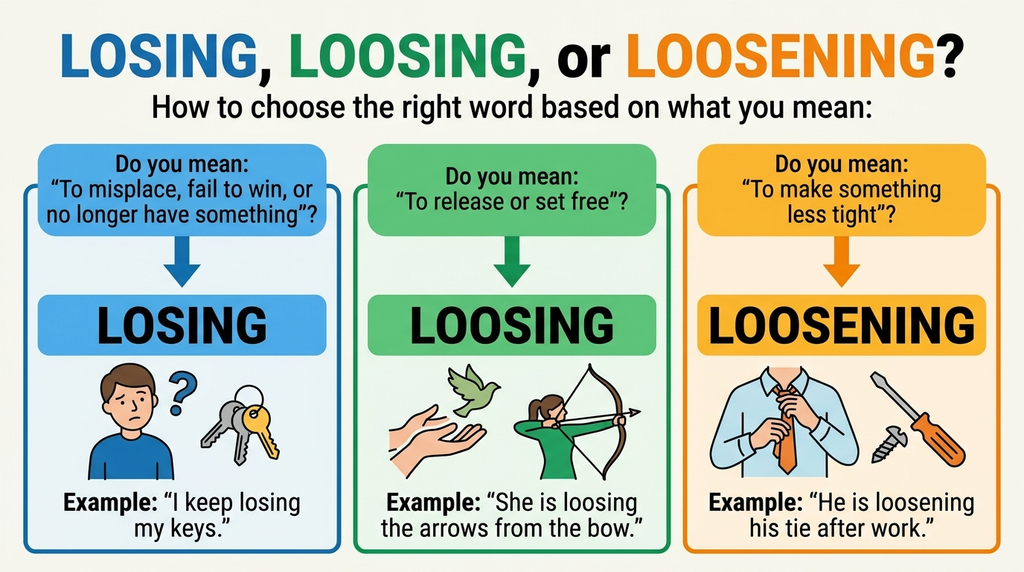
Ask yourself one question: What is happening in the sentence?
- If something is being misplaced, lost, reduced, or not won, choose losing.
- If something is being released or set free, choose loosing.
- If something is becoming less tight, choose loosening.
This rule works because the spelling follows the meaning of the original verb.
A practical proofreading test
When proofreading, replace the questionable word with its base verb.
For example:
“I am ___ my phone.”
Try the two possibilities:
- “I am lose my phone.” The meaning points to lose, although the sentence needs the correct verb form.
- “I am loose my phone.” This does not express the intended meaning.
The correct sentence is “I am losing my phone.”
Now consider:
“The archer is ___ an arrow.”
The base verb loose can mean to release an arrow, so the correct form is “The archer is loosing an arrow.”
This test is more reliable than simply counting the letters because it makes you check the intended meaning.
Formal vs. Casual Usage and Regional Differences
Is there a British and American spelling difference?
No. British English and American English use the same spellings:
- British English: losing, loosing, loosening
- American English: losing, loosing, loosening
Neither variety uses loosing as an alternative spelling of losing. The distinction is semantic and grammatical, not regional.
Is losing more common than loosing?
Yes. Losing appears in ordinary conversations, business writing, news reporting, academic work, and personal communication. It applies to a wide range of situations.
Loosing is less common and tends to appear in specific contexts involving release, archery, restraint, or literary description.
For everyday writing, you will usually need losing or loosening, not loosing.
Are losing and loosing pronounced differently?
Usually, yes. In common English pronunciations, the main difference is the consonant sound before the -ing ending.
- Losing: the middle consonant has a /z/ sound, as in zoo.
- Loosing: the middle consonant has an /s/ sound, as in sun.
This distinction can help you remember the words, although accents and individual speech habits may affect how clearly the difference is heard.
The vowel sound at the beginning is generally the same in both words. Do not rely on pronunciation alone, however; checking the base word and meaning is more dependable.
Is loosing too informal for professional writing?
Not necessarily. The word is grammatically valid, but it can sound unusual if the context does not clearly involve release.
For example:
- Professional and natural: “The technician is loosening the fastener.”
- Accurate in an archery report: “The archer is loosing an arrow.”
- Incorrect in a business report: “The company is loosing customers.”
In the last example, losing customers is required because the business is failing to retain them.

Frequently Asked Questions
1. Is it losing or loosing?
It depends on the meaning, but losing is correct in most everyday situations involving failure, misplacement, or reduction. Use loosing when you mean releasing or setting something free.
2. Does losing have one or two o’s?
Losing has one o after the l: l-o-s-i-n-g. It comes from the verb lose.
Loosing has two consecutive o’s: l-o-o-s-i-n-g. It comes from loose.
3. What is the difference between losing and loosing in meaning?
Losing means failing to keep or win something, or experiencing a reduction. Loosing means releasing, freeing, or unfastening something.
For example, “losing a key” means no longer having it, while “loosing an arrow” means releasing it.
4. Is loosing a real word?
Yes. Loosing is a valid form of the verb loose. It is uncommon in everyday writing but correct in contexts such as releasing an arrow or setting an animal free.
5. What does losing mean in a sentence?
The meaning depends on context. In “She is losing her wallet,” it refers to misplacing it. In “The team is losing,” it means the team is failing to win. In “The business is losing money,” it describes a financial decline.
6. What is the meaning of loosing?
Loosing means releasing, setting free, or unfastening something. For instance, “The archer is loosing an arrow” means the archer is releasing the arrow.
7. How do you spell losing correctly?
Spell it L-O-S-I-N-G. It comes from lose, not loose. Remember that the final e in lose is dropped before adding -ing.
8. What is the difference between losing and loss?
Losing is a verb form that describes an action or process. Loss is a noun that describes the result or experience of losing.
Examples:
- “Losing the match was frustrating.”
- “The loss was frustrating.”
9. Is “I am loosing weight” correct?
No, not if you mean that your body weight is decreasing. The correct sentence is “I am losing weight.”
Loosing would suggest releasing or setting something free, which does not express the intended meaning.
10. Should I write “losing control” or “loosing control”?
Write losing control when you mean that someone is no longer able to manage a situation, emotion, or action.
For example: “The driver was losing control of the vehicle.”
11. Is “loosing an arrow” grammatically correct?
Yes. It means releasing an arrow, often in archery or historical and literary descriptions. Although shooting an arrow is more familiar in modern everyday English, loosing an arrow is also correct.
12. What is the easiest way to remember losing vs. loosing?
Connect each word to its base form:
- Lose → losing: fail to keep or win something.
- Loose → loosing: release something.
- Loose → loosening: make something less tight.
Checking the base verb is the quickest way to select the right spelling.

Final Takeaway
The difference between loosing and losing comes down to the meaning of the base verb.
- Losing comes from lose and means misplacing something, failing to win, or no longer having something.
- Loosing comes from loose and means releasing, setting free, or unfastening something.
- Loosening means making something less tight.
If you are unsure which spelling to use, identify what the sentence is describing before you check the spelling. If something is slipping away, use losing. If something is being released, use loosing. If something is becoming less tight, use loosening.