Siring Meaning: Definition, Usage, Examples, and More
Quick Meaning
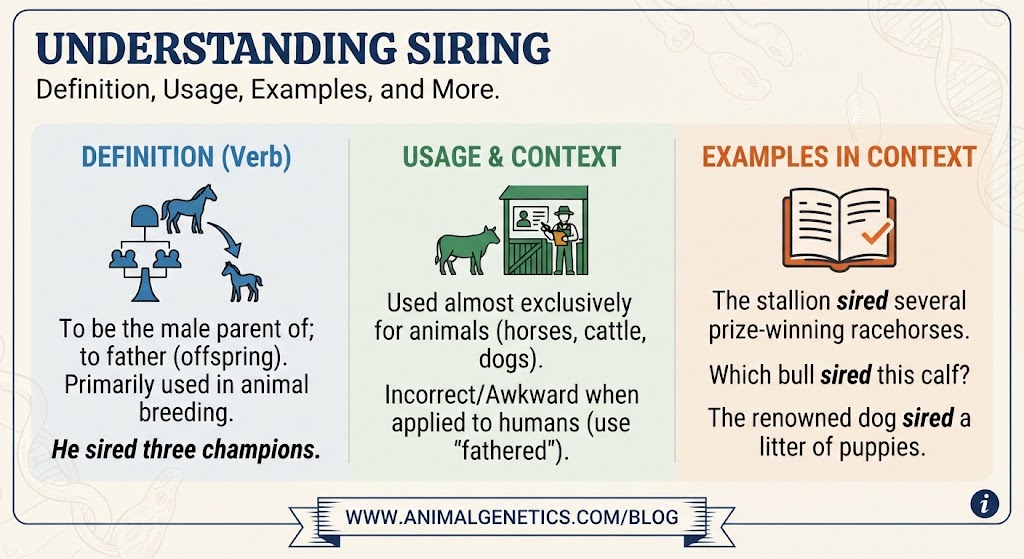
Siring means fathering or producing offspring, especially when referring to a male animal. It is the -ing form of the verb “sire.” For example, “The stallion is siring several foals” means that the stallion is fathering those offspring.
The word can also be used for a man who fathers a child, but this use is generally old-fashioned or formal. In modern English, siring is most common in discussions of animal breeding, genetics, pedigrees, horses, livestock, and other breeding contexts. Collins specifically identifies the animal-breeding sense as technical and the human-child sense as old-fashioned.
So, if you are asking “what does siring mean?”, the simplest answer is:
Siring = fathering offspring, especially by a male animal.

Definition Table
| Term | Meaning | Typical use |
|---|---|---|
| siring | Fathering or producing offspring | Especially animal breeding |
| sire | To father offspring | Verb |
| sired | Fathered or produced offspring | Past tense/past participle |
| sire | A male parent | Especially a breeding male animal |
| siring in human contexts | Fathering a child | Formal, old-fashioned, or deliberately elevated |
| sirings | Rare plural/nominal use; not normally needed in everyday English | Uncommon |
The word siring is the present participle and gerund form of sire. The verb is normally transitive, meaning it takes a direct object: siring offspring, siring a foal, or siring a child. Collins lists the principal forms as sire, sired, siring.
Siring definition in simple English
A simple siring definition is:
Siring = the act of a male fathering offspring.
In animal breeding, the word can describe the biological contribution of a male animal to its young. In a sentence such as “The champion stallion has sired dozens of foals,” sired means “fathered.”
Meaning in Context
Siring animals
This is the most natural modern use of siring.
Breeders commonly talk about a male animal siring young. Horses are particularly associated with the terminology, but it can also apply to cattle, dogs, sheep, and other animals.
Examples include:
- The stallion is siring another generation of racehorses.
- The bull has been siring calves for several breeding seasons.
- The dog is known for siring healthy puppies.
- The champion ram has sired many offspring.
In these examples, siring does not simply mean “being present when an animal is born.” It specifically refers to the male’s role as the father of the offspring.
Siring a child
Siring a child is grammatically possible, and dictionaries recognize this meaning. However, it is not the ordinary modern way to say that a man became the biological father of a child. Collins labels this human use old-fashioned.
For everyday conversation, people would normally say:
- He fathered a child.
- He had a child.
- He became a father.
Siring a child may instead appear in historical writing, formal genealogy, literary prose, or contexts deliberately emphasizing biological parentage.
For example:
The king was said to have sired several children.
Here, sired gives the sentence a historical or formal tone.
Siring in genetics and breeding discussions
You may encounter siring in scientific or technical writing about inheritance, breeding programs, pedigrees, or reproductive success.
For example:
The male was responsible for siring a large proportion of the offspring in the study.
The word is useful because it identifies the male parent specifically. It contrasts naturally with terminology such as dam, which is used for the female parent of an animal.

Usage and Grammar
Siring as a verb form
Siring is the present participle and gerund of sire.
The basic forms are:
- Base form: sire
- Third-person singular: sires
- Past tense: sired
- Past participle: sired
- Present participle: siring
Examples:
- The stallion sires many foals.
- The stallion sired a foal last spring.
- The stallion has sired several champions.
- The stallion is siring another group of foals.
Common grammatical pattern
The most common structure is:
subject + siring + object
For example:
The stallion is siring several foals.
Here, stallion is the subject, is siring is the verb phrase, and several foals is the direct object.
Another structure is:
the act/process of + siring + object
For example:
The breeding program focuses on siring offspring with particular traits.
Because siring can function as a gerund, it can act like a noun within a larger sentence.
Is “siring” a noun?
It can function as a gerund, which is a verb form ending in -ing that performs a noun-like role.
For example:
Siring healthy offspring requires careful selection.
Here, siring is the subject of the sentence.
It is therefore more accurate to say that siring is the -ing form of the verb “sire” and can also function as a gerund, rather than treating it as an ordinary standalone noun in every context.
Examples of “Siring” in Different Contexts
Animal breeding
The stallion is siring foals with several different mares.
Meaning: The stallion is fathering those foals.
Livestock
The farmer selected the bull for siring calves with desirable traits.
Meaning: The bull was chosen to father calves.
Genetics
Researchers recorded which males were responsible for siring the offspring.
Meaning: Researchers recorded which males fathered the young.
Historical writing
The monarch was reputed to have sired numerous children.
Meaning: The monarch was said to have fathered numerous children.
Literary style
He dreamed of siring an heir who would continue the family name.
Meaning: He wanted to father a child who would inherit the family line.
Figurative-sounding but literal use
The old champion continued siring winners long after his racing career ended.
This may sound figurative because winners are not literally offspring. In breeding contexts, however, the expression can mean that the animal continued to father offspring that later became winners.

Tone and Register
The tone of siring depends strongly on what is being discussed.
In animal breeding, it is neutral and technical:
The horse has sired more than 100 foals.
In human contexts, it can sound formal, archaic, literary, or detached:
The nobleman sired an heir.
In ordinary conversation, saying “He sired three children” may sound noticeably less natural than “He fathered three children” or “He has three children.”
This difference matters when deciding whether siring is appropriate. A word can be grammatically correct without being the most natural choice for everyday communication.
“What Does Sired Mean?”
Sired is the past tense and past participle of sire.
It means fathered or produced offspring, particularly when talking about a male animal.
For example:
The stallion sired twelve foals.
This means:
The stallion fathered twelve foals.
You may also see:
The bull sired a calf.
Again, sired means that the bull was the male parent.
When applied to humans, sired means fathered, but the wording can sound old-fashioned or formal. Collins distinguishes this human use from the more technical animal-breeding sense.
“To Sire” Meaning
The phrase to sire means to father or beget offspring.
Its strongest modern association is with male animals, particularly breeding animals.
For example:
The stallion was chosen to sire the next generation.
The construction to sire is an infinitive:
- to sire offspring
- to sire a foal
- to sire a calf
- to sire a child
The last example is grammatically valid but usually more formal or old-fashioned than everyday alternatives.
Is “Siring” Slang?
No. “Siring” is not normally classified as slang.
The phrase siring meaning slang sometimes appears in searches because people encounter unfamiliar words online and wonder whether they have a special informal meaning. In standard English, however, siring is simply the -ing form of “sire.”
Its specialized feel comes from its association with breeding and its somewhat formal tone in human contexts, not from a separate slang definition.
If someone writes “He is siring children,” they are generally using the established verb sire, not a secret slang expression.
What About “Sirings”?
Sirings is not a common everyday plural form.
The ordinary word you are likely looking for is siring, especially when describing the process or activity of fathering offspring.
For example:
- Natural: The horse has been siring foals for years.
- Less natural: The horse has had many sirings.
If you encounter sirings in a specialized text, its meaning has to be determined from that particular context. It should not automatically be treated as the normal plural of siring.
“Surings” Meaning: Is It the Same Word?
Usually, surings is not the standard spelling of siring.
If you searched for surings meaning because you saw this spelling, check the original context carefully. It may be:
- a spelling error,
- a transcription error,
- a different word,
- or a specialized term unrelated to siring.
Do not assume that surings means “fathering offspring.”
Similarly, orintated, sometimes encountered in searches for oriented, illustrates why an unusual spelling should not automatically be treated as a separate English word. Search queries often preserve misspellings that do not represent standard vocabulary.

Origin and History
The history of siring follows the history of sire.
Reliable dictionary evidence traces sire to Middle English and Old French, ultimately connected with Latin senior, meaning “older” or “elder.” Collins dates the word’s English development to the medieval period and gives an Old French and Latin pathway for its origin.
Historically, sire had broader meanings connected with a father, forefather, lord, or person of rank. Some of these senses survive only in archaic or literary language. The modern breeding sense developed as the word became established for a male parent, especially a male animal used for reproduction.
The relationship between sire and sir is also historically interesting. Collins identifies sir as a medieval variant of sire, although the two words have developed distinct modern uses.
There is no need to attach a colorful folklore story to the word’s origin: the documented dictionary etymology provides a sufficient historical explanation.
Similar Expressions and Synonyms
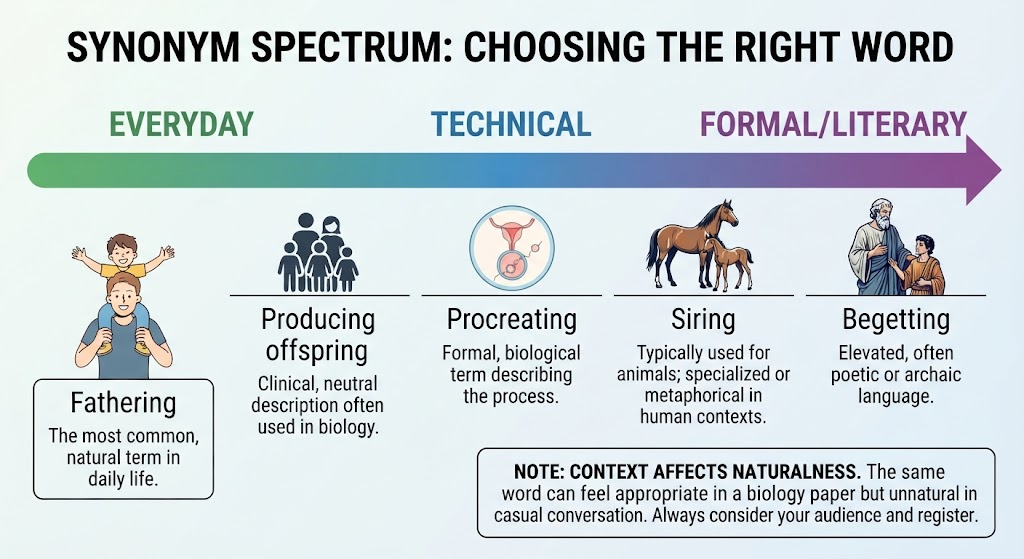
Depending on context, useful synonyms of siring include:
- fathering — most natural for humans and also possible for animals
- begetting — formal, literary, or biblical-sounding
- procreating — biological and formal
- breeding — broader; does not necessarily specify the male parent
- producing offspring — neutral and explicit
- fathering offspring — clear and precise
- being the sire of — formal breeding terminology
These are not interchangeable in every situation.
For example:
The stallion is siring three foals.
can become:
The stallion is fathering three foals.
But siring is particularly natural in breeding and pedigree contexts because it identifies the male parent.
Breeding is broader:
The farm is breeding horses.
This does not necessarily mean that a particular male is the father.
Common Mistakes
Mistake 1: Assuming “siring” is slang
It is not normally slang. It is a standard form of sire.
Mistake 2: Using “siring” when “breeding” is intended
Siring specifically identifies the male’s role in producing offspring. Breeding can refer to the broader reproductive process or activity.
Mistake 3: Assuming “siring” always sounds natural for humans
Although dictionaries recognize the human sense, it can sound old-fashioned or formal.
Instead of:
He is siring three children.
ordinary modern English would usually say:
He is fathering three children.
or simply:
He has three children.
Mistake 4: Confusing “sire” with “sir”
Sire and sir are historically related, but they are not interchangeable in modern English.
- sire = father/beget; also a male parent
- sir = a polite form of address or a title
For example:
Yes, sir.
does not have anything to do with fathering offspring.
Mistake 5: Treating “siring” as a synonym for “having children”
The word emphasizes fathering rather than simply having a family or raising children.
A man can have children without the sentence focusing on biological fatherhood. Siring specifically foregrounds the biological fathering role.
FAQs About Siring Meaning
What is the siring meaning?
Siring means fathering or producing offspring, especially when referring to a male animal.
What is the siring definition?
The siring definition is the act or process of a male fathering offspring. It is especially common in animal-breeding terminology.
What does siring mean in simple terms?
Siring means becoming the biological father of offspring or fathering offspring.
For animals, it is commonly used in breeding contexts.
What does sired mean?
Sired means fathered or produced offspring. For example, “The stallion sired a foal” means that the stallion was the foal’s father.
What does “to sire” mean?
To sire means to father or beget offspring. The verb is particularly common when discussing male breeding animals.
Is siring a real English word?
Yes. Siring is the standard present participle and gerund form of sire.
Is siring slang?
No. Siring is standard English, although it can sound technical when used for animals and formal or old-fashioned when used for humans.
What are the synonyms of siring?
Depending on context, synonyms include fathering, begetting, procreating, breeding, producing offspring, and being the father of. The best choice depends on whether the context is everyday, biological, technical, or literary.
Is “sirings” a common word?
No. Sirings is uncommon and should not normally be used as though it were the ordinary plural form of siring. In most contexts, simply use siring.
Does “surings” mean siring?
No. Surings is not the standard spelling of siring. If you encounter it, check the surrounding context because it may be a typo or a different word.
Summary
Siring means fathering offspring, particularly in animal-breeding contexts. It is the -ing form of “sire”, while sired is the past tense and past participle.
The word is most natural in discussions of horses, livestock, breeding, pedigrees, and genetics. It can describe a man fathering a child, but that usage is generally more formal or old-fashioned than everyday alternatives such as fathering.
A useful way to remember it is:
sire = male parent → to sire = father offspring → siring = fathering offspring → sired = fathered offspring.
The established etymology traces sire through Middle English and Old French to Latin senior, rather than to an unsupported folk explanation.