Zit Meaning: Definition, Examples, Origin, and Similar Words
Quick Meaning
A zit is an informal word for a small, inflamed spot on the skin, usually caused by a blocked pore. It is another word for a pimple, especially in everyday American English.
For example: “I woke up with a zit on my forehead.”
The word zit is a noun. Its plural form is zits. People commonly use it when talking casually about acne, skin blemishes, or an unexpected breakout. Although the word is informal, it is widely understood and is not considered vulgar.
In simple terms: If someone asks, “What’s a zit?” the answer is a pimple or small acne-related spot on the skin.

Definition Table
| Term | Meaning | Usage |
|---|---|---|
| Zit | A small pimple or inflamed skin spot | Informal |
| Zits | More than one zit | Informal plural |
| Pimple | A small raised spot on the skin | Neutral, widely used |
| Acne | A skin condition involving pimples and other blemishes | Medical and everyday use |
| Blemish | An imperfection or mark on the skin | General and neutral |
| Whitehead | A small acne lesion with a closed surface | More specific skin terminology |
| Blackhead | A clogged pore with a darkened surface | More specific skin terminology |
The meaning of zits is simply the plural meaning of zit: two or more pimples or similar acne-related spots. The word does not describe a separate skin condition.
Meaning in Context
What Does Zit Mean in Everyday English?
In everyday conversation, zit refers to a visible spot that develops when a pore becomes clogged and inflamed. It often appears on the face, particularly the forehead, nose, chin, or cheeks, but zits can also occur on the back, chest, and shoulders.
The word is especially common in casual conversations about appearance, skincare, school, dating, and unexpected breakouts. Someone might say they have a zit before a party or complain that a new zit appeared just before taking a photograph.
Examples:
- “I’ve got a huge zit on my chin.”
- “She covered the zit with a little concealer.”
- “My skin always seems to break out before an important event.”
- “Don’t squeeze that zit; it could become more irritated.”
The word generally describes an individual spot rather than an entire acne condition. However, people sometimes use zits loosely to refer to multiple acne-related blemishes.
Is Zit a Real Word?
Yes. Zit is a standard English word, although it is informal rather than formal or medical. It appears in dictionaries and is commonly used in conversation.
You can use it naturally when speaking with friends, writing casual messages, or discussing everyday skincare. In a medical appointment, a dermatologist might prefer terms such as pimple, acne lesion, or inflamed papule, depending on the actual skin condition.
The fact that zit is informal does not make it incorrect. It simply belongs to a more relaxed style of English.

Literal vs. Figurative Meaning
The primary meaning of zit is literal: a small spot or pimple on the skin. For example, “A zit appeared on my cheek” describes an actual skin blemish.
The word does not have a widely established figurative meaning comparable to an idiom such as “a thorn in one’s side.” A writer could use zit metaphorically to describe an unwanted mark or an ugly spot on something, but that would be a creative comparison rather than a standard dictionary meaning.
For instance, a fictional character might call a tiny defect on a polished surface “a zit on the perfect finish.” Readers could understand the comparison, but the surrounding context would be necessary to make the meaning clear.
In ordinary conversation, assume that zit refers to a skin blemish unless the speaker clearly signals a joke, metaphor, or unusual context.
What Is the Difference Between a Zit and a Pimple?
In everyday English, there is essentially no difference between a zit and a pimple. Both words refer to a small spot on the skin, commonly associated with acne.
The main distinction is tone. Zit sounds more casual and is particularly familiar in American English. Pimple is also common in American English and is widely understood across other varieties of English.
| Feature | Zit | Pimple |
|---|---|---|
| Basic meaning | A small skin blemish | A small skin blemish |
| Tone | Very casual | Neutral or casual |
| Typical context | Conversation, jokes, informal writing | Conversation, skincare, general writing |
| Medical precision | Limited | Limited |
| Plural | Zits | Pimples |
Neither term identifies a precise medical diagnosis. A dermatologist may distinguish among different types of acne lesions, including papules, pustules, whiteheads, and blackheads. Those terms describe more specific features than the everyday word zit.
What Is the White Stuff in a Zit?
The white material that comes out of a zit may contain sebum, dead skin cells, and inflammatory material, depending on the type of blemish. Sebum is the oily substance naturally produced by the skin’s sebaceous glands.
A white-tipped pimple may contain pus, which consists of inflammatory cells, fluid, and other cellular material. A whitehead, by contrast, is a clogged pore whose opening remains closed; its contents are not necessarily visible from the surface.
Not every white bump contains the same material, and the appearance alone cannot establish exactly what it is. Avoid squeezing or picking at pimples, because doing so can increase inflammation, damage the skin, and raise the risk of scarring.
What Comes Out of a Zit?
What comes out depends on the type of spot and whether it has opened. Possible contents include:
- Sebum: Natural oil produced by the skin.
- Keratin and dead skin cells: Material that can contribute to a blocked pore.
- Pus: Inflammatory material that may be present in a pustule.
- Blood or clear fluid: These may appear if the skin is damaged or the spot is squeezed.
These are explanations of the physical contents of some skin blemishes, not additional meanings of the word zit. The word itself describes the spot, not the material inside it.

Usage and Grammar
Grammatical Role of Zit
Zit is a countable noun. This means you can refer to one zit or several zits.
Common grammatical patterns include:
- A zit: “I’ve developed a zit on my nose.”
- The zit: “The zit near my eyebrow is healing.”
- Zits: “He gets zits occasionally.”
- A zit on + body part: “She noticed a zit on her chin.”
- A zit before + event: “I always seem to get a zit before picture day.”
The standard plural is zits, formed by adding -s. The spelling zittes is incorrect.
The word can also appear in compound expressions such as zit cream or zit treatment in informal product descriptions, although acne treatment and pimple treatment may sound more neutral.
Common Sentence Patterns
Here are some natural ways to use zit:
| Pattern | Example |
|---|---|
| Get a zit | “I got a zit overnight.” |
| Have a zit | “He has a zit on his cheek.” |
| Develop a zit | “She developed a zit after the weekend.” |
| Pop a zit | “He was tempted to pop the zit.” |
| Cover a zit | “She used concealer to cover the zit.” |
| Get rid of zits | “He’s looking for ways to manage recurring zits.” |
| A zit breaks out | “A zit broke out on her forehead.” |
In the last example, a zit broke out is understandable, but many speakers would more naturally say “a zit appeared” or “I broke out in pimples.” A person typically breaks out in acne or gets a zit.
Tone and Register
Register refers to how formal or informal a word sounds in a particular situation.
Zit is informal and conversational. It can sound humorous, blunt, or mildly embarrassing, especially when someone is discussing a visible facial blemish. It is not inherently insulting, although using it to tease another person’s appearance may come across as unkind.
Consider these alternatives:
- Casual: “I’ve got a zit.”
- Neutral: “I’ve got a pimple.”
- More clinical: “I have an inflamed acne lesion.”
The most appropriate choice depends on the audience and setting. Friends may naturally say zit, while a healthcare professional may use more specific terminology.
Is Zit More Common in American or British English?
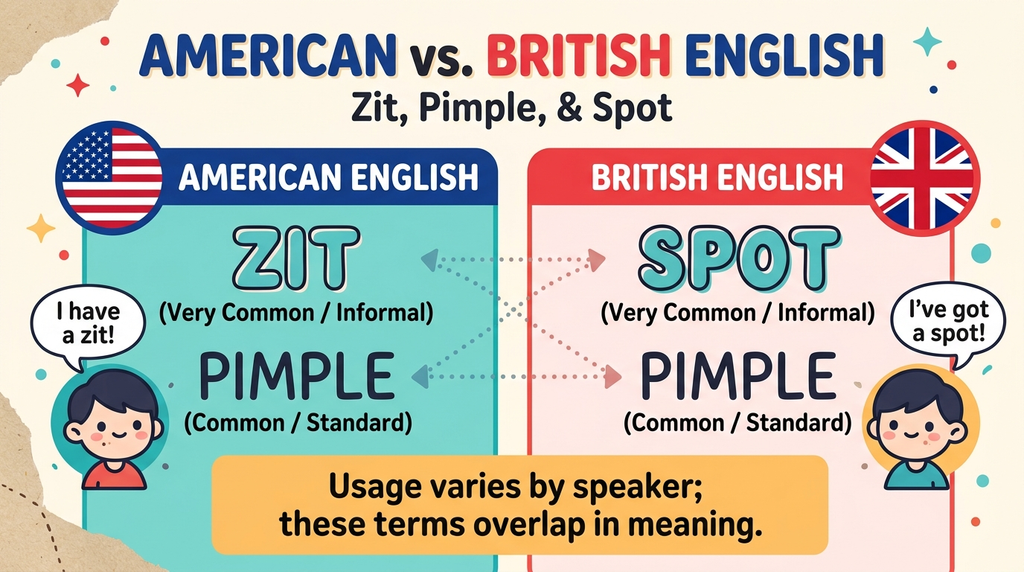
Zit is particularly associated with informal American English, where it is a familiar everyday term. It is also understood in other English-speaking regions, including Britain, although spot and pimple are common alternatives.
Regional preferences are not absolute. A British speaker may use zit, and an American speaker may prefer spot or pimple. The important point is that zit is not restricted to one country, even though its strongest association is with American casual speech.
Examples of Zit in Sentences
The following original examples show how the word works in different everyday situations.
Casual Conversation
- “I woke up with a zit right in the middle of my forehead.”
- “Do you have anything that might help with this zit?”
- “That zit appeared out of nowhere.”
- “I’ve had this zit for a few days, and it still hasn’t gone away.”
- “He joked about his zit, but he was actually embarrassed by it.”
School, Work, and Social Situations
- “She worried that everyone would notice the zit in her class photo.”
- “I have a job interview tomorrow, and naturally, a zit appeared today.”
- “He checked the mirror before the presentation because he thought he had a zit.”
- “My friend reminded me that one zit isn’t something to be ashamed of.”
- “The makeup artist showed her how to conceal the blemish without irritating it.”
Skincare and Health Discussions
- “A zit can become more inflamed if you keep touching it.”
- “The pharmacist suggested asking a healthcare professional about recurring acne.”
- “Not every red bump is a zit; some skin conditions can look similar.”
- “She stopped picking at her zits and followed a gentler skincare routine.”
- “If the bumps are painful, persistent, or leaving scars, a dermatologist can assess them.”
Humor and Figurative Language
- “The enormous zit seemed to have its own postcode.” This is humorous exaggeration, not a literal measurement.
- “That tiny defect was a zit on an otherwise flawless design.” Here, zit is used metaphorically to suggest a small but noticeable flaw.
- “He treated one zit like a national emergency.” This humorously exaggerates someone’s reaction to a minor blemish.
These examples demonstrate that zit works in literal statements, casual jokes, and occasional creative metaphors. Only the literal skin-related meaning is the ordinary, established sense.
Origin and History of Zit
The word zit is an informal English term associated with pimples and acne. Its precise origin is uncertain, so it is best not to assign it a definite root or historical story without reliable evidence.
The word became familiar in American informal speech and is now widely recognizable in everyday English. Its short, blunt sound suits casual conversation, but that observation is not proof of how the word originally developed.
It is also important to distinguish a word’s history from its current meaning. Even if people associate zit with teenagers or puberty, the word itself does not mean “a teenage pimple.” Adults can get zits, too.
There is no need to assume that zit is an acronym. The spelling “Z-I-T” simply spells the ordinary English word. Writing the letters separately does not establish a different definition.
Similar Expressions and Synonyms
Several English words can replace zit, but they are not identical in every context.
| Word or expression | Meaning | Best use |
|---|---|---|
| Pimple | A small raised skin blemish | General conversation |
| Spot | A mark or small blemish on the skin | Particularly common in British English |
| Acne | A skin condition involving different types of blemishes | General and medical discussions |
| Blemish | An imperfection on the skin | Neutral descriptions |
| Whitehead | A clogged pore with a closed surface | A specific type of blemish |
| Blackhead | A clogged pore with a darkened surface | A specific type of blemish |
| Pustule | An inflamed skin lesion containing pus | More technical or medical contexts |
| Papule | A small, solid, raised skin lesion | Medical or dermatological contexts |
What Is a Synonym for Zit?
The closest everyday synonym for zit is pimple. Depending on the speaker and context, spot may also work.
For example:
- “I’ve got a zit on my cheek.”
- “I’ve got a pimple on my cheek.”
- “I’ve got a spot on my cheek.”
All three can communicate a similar idea. However, spot has a broader meaning and can refer to marks that are not pimples. Likewise, acne refers to a skin condition rather than necessarily to one individual zit.

Common Mistakes About Zit
Mistake 1: Thinking Zit Is Not a Real English Word
Zit is a genuine English word. It is informal, but informality does not make a word incorrect. Use it naturally in casual conversation, while choosing more neutral or technical wording when appropriate.
Mistake 2: Treating Zit and Acne as Exactly the Same
A zit usually refers to an individual blemish. Acne is a broader skin condition that can involve multiple types of lesions. Someone may have acne that includes zits, but the terms are not interchangeable in every sentence.
Mistake 3: Assuming Every Zit Has White Pus
Some pimples develop a white or yellowish head, while others appear red, feel firm, or have no visible white center. The appearance of a blemish does not always reveal its exact contents.
Mistake 4: Thinking Zit Is Only Used for Teenagers
Teenagers commonly experience acne, but people of different ages can develop pimples. The word zit has no age restriction.
Mistake 5: Using Zit in Formal Medical Writing
Although readers will understand it, zit may be too casual for a clinical report or formal health article. Terms such as pimple, acne lesion, or a more precise clinical description are usually preferable.
Mistake 6: Assuming Z-I-T Has a Separate Meaning
Writing z i t with spaces between the letters does not create a different word or standard acronym. Unless a specific context establishes an abbreviation, the intended word is simply zit.
Mistake 7: Assuming Zit Is Always an Insult
The word is not inherently offensive. It can be a neutral description of a skin blemish. However, calling attention to another person’s zits to embarrass them can be hurtful, depending on the situation and tone.
Frequently Asked Questions
What does zit mean in simple words?
A zit is a pimple or small acne-related spot on the skin. The word is informal and especially common in American English.
What is the meaning of zits?
Zits is the plural of zit. It refers to two or more pimples or similar skin blemishes. For example, “He gets zits on his forehead.”
What’s a zit, and is it the same as a pimple?
Yes. In ordinary conversation, a zit and a pimple generally mean the same thing. Zit is more informal, while pimple is a widely used neutral alternative.
Is zit a word in the dictionary?
Yes. Zit is an established English noun used informally for a pimple or acne-related skin blemish. It is not merely internet slang or an invented abbreviation.
How do you spell zit?
The correct spelling is z-i-t, written as one word: zit. Its plural is zits. The spelling zitt or zittes is not standard for this meaning.
What is the difference between zit, pimple, and acne?
A zit and a pimple usually mean an individual blemish. Acne is the broader skin condition that can cause pimples and other lesions. In everyday conversation, people sometimes use these terms loosely, but they are not medically identical.
What is the white stuff in a zit?
Depending on the type of blemish, it may contain sebum, dead skin cells, and inflammatory material, including pus. Not every white bump has the same contents, and appearance alone cannot establish its exact composition.
What comes out of a zit when you pop it?
A squeezed blemish may release sebum, dead skin cells, pus, or a mixture of material. Blood or clear fluid may appear if the skin is damaged. Picking or squeezing can worsen inflammation and increase the risk of scarring.
Is zit slang?
Yes, zit is informal English slang or colloquial vocabulary for a pimple. It is widely recognized and acceptable in casual conversation, although a more neutral or technical term may be preferable in formal writing.
What is another word for zit?
The closest synonym is pimple. Depending on the context and region, spot may also be appropriate. Blemish is broader, while acne describes a skin condition rather than one specific spot.
Does zit have a figurative meaning?
Not a widely established one. Writers can use zit metaphorically to describe an unwanted mark or flaw, but this is a creative extension of its literal meaning, not a standard idiom.
What does Z-I-T stand for?
In ordinary English, zit does not need to stand for anything. It is a complete word, not an acronym. If the letters appear as an abbreviation in a specialized document, their meaning would depend on that context.
Summary
The meaning of zit is straightforward: it is an informal English word for a pimple or small acne-related skin blemish. Its plural is zits, and its closest everyday synonym is pimple.
The word is particularly familiar in American English and is suitable for casual conversation. It does not have a widely established figurative meaning, and its precise historical origin remains uncertain.
Remember the key distinction: a zit is an individual blemish, while acne is the broader skin condition that may cause it. Understanding that difference makes it easier to use zit, pimple, spot, and acne naturally and accurately.