What Is Verbiage? Meaning, Definition, Usage, and Examples
Quick Meaning
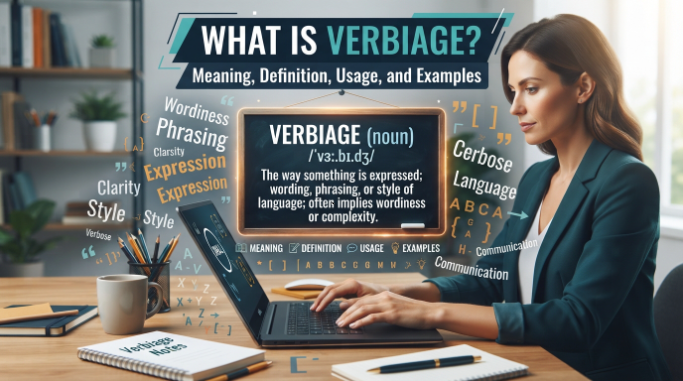
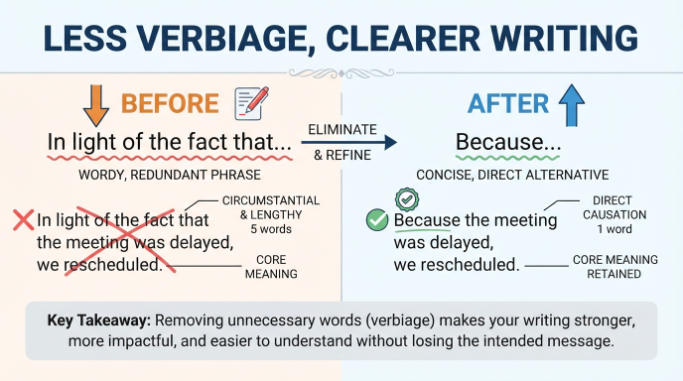
Verbiage means the words used to express something, especially when there are more words than necessary. It can refer neutrally to the wording of a text or speech, but it often carries a slightly negative sense of wordiness or unnecessarily complicated language.
So, if someone says, “The contract contains a lot of legal verbiage,” they usually mean that the contract uses a large amount of formal or complicated wording.
The correct spelling is verbiage, not verbage. Verb age, verbige, and berbiage are also incorrect spellings of the standard word. However, verbage does exist as a historical variant of verbiage, although it is much less common in modern standard English.
In simple terms:
Verbiage = the wording of something, especially wording that is unnecessarily long or complicated.

Definition Table
| Feature | Explanation |
|---|---|
| Word | verbiage |
| Part of speech | Noun |
| Basic meaning | Words or wording used to express an idea |
| Common implication | Excessive, complicated, or unnecessary wording |
| Spelling | verbiage |
| Less common variant | verbage |
| Plural | verbiage is normally uncountable; verbiages is possible but uncommon |
| Register | Neutral to formal; often mildly critical |
| Related word | verbosity |
| Common phrase | “a lot of verbiage” |
| Typical context | Writing, contracts, reports, instructions, speeches, policies |
What does verbiage mean?
The meaning of verbiage depends slightly on context. In its broadest sense, it refers to the words or wording used in a particular piece of communication. In everyday modern English, however, it frequently suggests that the speaker or writer has used too many words.
For example:
“The proposal contains unnecessary verbiage.”
Here, verbiage clearly has a critical meaning: the proposal could communicate its ideas more efficiently.
But consider:
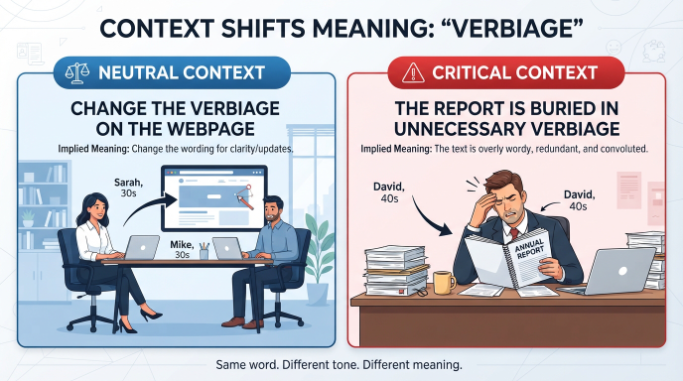
“Please review the verbiage on the website before publication.”
This use is more neutral. Here, verbiage simply means the wording or text appearing on the website.
That difference is important because verbiage does not always mean “bad writing.” Context determines whether the word is simply describing wording or criticizing excessive wording.
Meaning in Context
Neutral meaning: wording or language
In professional settings, people sometimes use verbiage simply to mean the actual words used in a document.
For example:
“We need to change the verbiage in the final paragraph.”
This could simply mean:
“We need to change the wording in the final paragraph.”
There is not necessarily an accusation that the paragraph is too long.
You may hear this usage in business, editing, law, marketing, government, technical writing, and workplace communication.
Negative meaning: unnecessary wordiness
The more traditional or widely recognized implication is excessive or unnecessarily elaborate language.
For example:
“The instructions are buried under pages of technical verbiage.”
The speaker is not merely talking about words. They are suggesting that there are too many complicated or unnecessary words, making the instructions harder to understand.
This is why verbiage can sometimes sound critical even when the speaker does not explicitly say that something is badly written.
Verbiage can be complicated without being meaningless
It is also worth distinguishing verbiage from nonsense.
If a document contains complicated legal language, that language may have a precise purpose. Calling it verbiage can criticize its amount or style without claiming that it has no meaning.
For example:
“The agreement contains considerable legal verbiage.”
This does not necessarily mean that the legal wording is meaningless. It may simply mean that the agreement contains a substantial amount of specialized language.
Verbiage vs. Wording
Verbiage and wording can overlap, but they are not perfect synonyms.
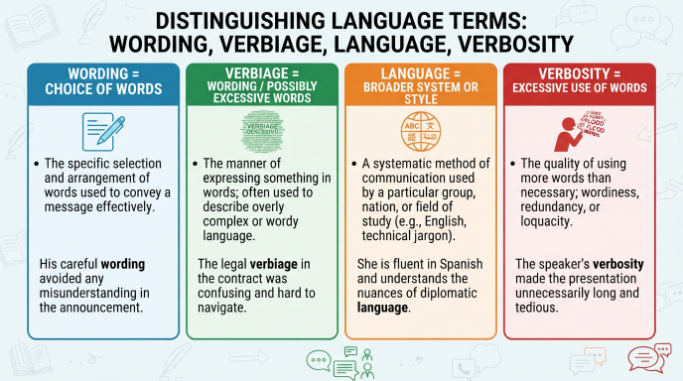
Wording usually refers to the particular choice or arrangement of words used to express something. It is generally neutral.
Verbiage can also refer to wording, but it often suggests an abundance of words, especially unnecessarily complicated or elaborate ones.
Compare:
“I like the wording of your email.”
This is neutral and may even be complimentary.
“I like the verbiage of your email.”
This is possible, particularly in workplace language, but it sounds more specialized and may draw attention to the actual language used.
Now compare:
“The policy has confusing wording.”
versus:
“The policy contains confusing verbiage.”
Both are grammatical, but verbiage can carry a stronger suggestion that the policy uses an excessive amount of language.
Verbiage vs. language
Language is much broader than verbiage.
Language can mean an entire linguistic system, such as English or Telugu, or the particular style of expression used in a context.
For example:
“English is an international language.”
You cannot replace language with verbiage here.
But:
“The language of the contract is highly technical.”
and:
“The contract contains highly technical verbiage.”
can be similar in meaning, although the second focuses more specifically on the wording.
Verbiage vs. verbosity
These words are closely related, but they have different grammatical roles.
Verbiage is a noun referring to words or wording, particularly excessive wording.
Verbosity is a noun referring to the quality or condition of using too many words.
Compare:
“The article contains unnecessary verbiage.”
“The article suffers from excessive verbosity.”
The first points to the actual words or wording. The second describes the characteristic of being overly wordy.
Usage and Grammar
What part of speech is verbiage?
Verbiage is a noun.
It normally functions as a mass or uncountable noun when referring to wording in general.
Common constructions include:
- the verbiage
- some verbiage
- a lot of verbiage
- unnecessary verbiage
- legal verbiage
- technical verbiage
- marketing verbiage
- the verbiage in the contract
- change the verbiage
For example:
“The editor removed some unnecessary verbiage.”
Is “verbiage” countable?
In ordinary modern usage, verbiage is usually uncountable.
Natural:
“There is too much verbiage in this report.”
“The contract contains a lot of verbiage.”
Less natural in ordinary writing:
“There are three verbiages in the report.”
When you need to count individual instances, use words such as phrases, passages, expressions, sections, or pieces of wording.
For example:
“The editor identified three passages that contained unnecessary wording.”
Can you say “verbiages”?
Verbiages is grammatically possible in specialized contexts where separate bodies or varieties of wording are being treated as distinct, but it is uncommon.
For normal writing, verbiage is the safer and more natural choice.
How do you use verbiage in a sentence?
Here are several natural patterns:
“The contract uses complicated legal verbiage.”
“Could you simplify the verbiage in this paragraph?”
“The website’s verbiage needs to be updated.”
“The report contains unnecessary verbiage.”
“We changed the verbiage to make the instructions clearer.”
Notice that verbiage commonly appears with words such as legal, technical, unnecessary, complicated, excessive, confusing, formal, and marketing.
Examples of Verbiage in a Sentence
Everyday examples
“There is too much verbiage in this email.”
“Can you simplify the verbiage?”
“The instructions contain some confusing verbiage.”
Workplace examples
“The team agreed to revise the verbiage before sending the announcement.”
“The presentation would be clearer with less technical verbiage.”
“Please check the verbiage in the customer-facing message.”
Legal and formal writing
“The agreement contains considerable legal verbiage.”
“The lawyer explained the unfamiliar verbiage in the contract.”
Technical writing
“The manual uses technical verbiage that new users may not understand.”
“We removed unnecessary technical verbiage from the installation guide.”
Marketing
“The marketing team changed the verbiage on the product page.”
Here, verbiage is relatively neutral.
But:
“The advertisement is full of vague marketing verbiage.”
Here, the word is clearly critical.
Academic writing
“The essay contains impressive ideas, but some of the verbiage could be simplified.”
This means that the writer’s ideas may be worthwhile, while the expression is unnecessarily complicated.
Literal vs. Figurative Meaning
Unlike many idioms, verbiage does not have a strongly separate figurative meaning. Its uses are primarily connected to words, wording, and excessive language.
The important distinction is between its literal lexical meaning and its contextual implication.
Literally, verbiage concerns words or wording.
Contextually, it can imply:
- excessive words
- unnecessary detail
- complicated language
- formal wording
- bureaucratic language
- wordiness
For example:
“The contract is full of legal verbiage.”
This is not a literal reference to something physical. It refers to the language contained in the contract, with an implication that the language is dense or complicated.
Tone and Register
Verbiage is most common in formal, professional, editorial, technical, and workplace contexts.
It can sound more sophisticated or bureaucratic than simply saying words or wording.
Compare:
“Change the wording.”
with:
“Change the verbiage.”
The first is plain and universally natural. The second sounds more professional or specialized and is particularly common in workplace communication.
The word can also sound mildly critical:
“The report is full of unnecessary verbiage.”
That sentence suggests the writer should be more concise.
Because of this, verbiage is useful when discussing writing quality, but it may not always be the best choice when plain language is the goal.
Is Verbiage a Word?
Yes. Verbiage is a standard English word.
The standard spelling is:
verbiage
The spelling verbage is also historically attested as a variant, but verbiage is the established modern spelling most readers expect.
So if you are writing an essay, report, article, email, or professional document, use verbiage.
How do you spell verbiage?
The spelling is:
V-E-R-B-I-A-G-E
A useful visual breakdown is:
verb + iage → verbiage
Do not spell it verbage if you want the standard modern form.
What is “verbage”?
Verbage is a real historical variant of verbiage, not simply a meaningless typo. Historical evidence dates verbage to the late 18th century as a variant of verbiage.
Nevertheless, verbiage is the standard spelling to use in contemporary formal English.

Origin and History of Verbiage
The history of verbiage is reasonably well documented.
The English noun is recorded from 1721, from French verbiage, meaning roughly “wordiness” or an abundance of words. French verbiage came from verbier, meaning “to chatter,” and is related to Old French verbe, “word,” ultimately from Latin verbum, “word.”
The historical development therefore connects verbiage with the broader family of words associated with words and speech.
The related word verbage appeared later, by the late 18th century, as a variant of verbiage.
It is important not to interpret the spelling as evidence that verbiage is simply “verb + age.” Its documented history comes through French rather than from a modern English construction based on the grammatical term verb.
Similar Expressions and Synonyms
Depending on the context, useful alternatives to verbiage include:
- wording — the particular words used
- language — words or style of expression
- wordiness — use of more words than necessary
- verbosity — excessive use of words
- prolixity — excessive length or wordiness
- phraseology — particular style or choice of phrases
- diction — choice and style of words
- expression — the way an idea is put into words
- text — written words in a document
- rhetoric — language used especially for persuasive effect
These are not interchangeable in every sentence.
For example, wording is usually the best alternative when you simply mean “the words used”:
“Please change the wording of the sentence.”
Verbosity is better when you mean the quality of being excessively wordy:
“The report’s verbosity makes it difficult to read.”
Diction is more appropriate when discussing deliberate word choice or style:
“The author’s diction is formal and precise.”

Common Mistakes
Mistake 1: Spelling it “verbage”
❌ “The contract has a lot of verbage.”
✓ “The contract has a lot of verbiage.”
Verbage has historical usage, but verbiage is the standard modern spelling.
Mistake 2: Assuming verbiage always means bad writing
Not necessarily.
“Please review the verbiage before publication.”
This can simply mean “review the wording.”
But:
“The report contains unnecessary verbiage.”
Here, the speaker is clearly criticizing excessive language.
Mistake 3: Treating verbiage and wording as perfect synonyms
They overlap, but wording is more neutral.
If you simply want to discuss how something is expressed, wording is often clearer.
Mistake 4: Using “verbiage” to mean “language” in every context
You cannot say:
“Spanish is a verbiage.”
The correct word is language.
Verbiage refers to wording or an amount/style of words in a particular communication.
Mistake 5: Assuming verbiage is always countable
In ordinary usage, say:
“There is too much verbiage.”
rather than:
“There are many verbiages.”
Use passages, phrases, or examples of wording when you need to count individual instances.
FAQs
What is verbiage in simple words?
Verbiage means the words or wording used to express something, especially when there are more words than necessary.
What does verbiage mean?
It generally means wording or an abundance of words. Depending on context, it can be neutral or can suggest unnecessary, complicated, or excessive language.
What is the correct spelling of verbiage?
The standard spelling is verbiage: V-E-R-B-I-A-G-E.
Is it “verbiage” or “verbage”?
Verbiage is the standard modern spelling. Verbage is a historically attested variant, but it is much less common today.
What is verbage?
Verbage is a variant spelling of verbiage that has historical usage. In contemporary formal English, verbiage is the preferred form.
Is verbiage a noun?
Yes. Verbiage is a noun, normally used as an uncountable noun.
What is a synonym for verbiage?
Depending on the intended meaning, synonyms include wording, language, wordiness, verbosity, phraseology, diction, and expression.
What is the antonym of verbiage?
There is no single perfect antonym in every context. Depending on what you mean, possible opposites include conciseness, brevity, succinctness, clarity, or plain language.
If verbiage means excessive wording, brevity or conciseness is often the closest conceptual opposite.
Can verbiage be positive?
Yes, although the word often has a neutral or mildly negative association. In a sentence such as:
“The verbiage was carefully revised for clarity.”
it simply refers to wording. It does not necessarily criticize the writing.
What is the meaning of verbiage in Telugu?
In Telugu, the closest translation depends on context. Verbiage can refer to wording, excessive words, or unnecessarily elaborate language. A context-specific Telugu translation is therefore more accurate than assigning one fixed equivalent to every use.
What is the difference between verbiage and language?
Language is a much broader term. It can refer to a complete linguistic system such as English or Telugu, while verbiage refers to the words or wording used in a particular communication, often with an implication of excess.
What is the difference between verbiage and verbosity?
Verbiage refers to words or wording, while verbosity refers to the excessive use of words.
“The document contains unnecessary verbiage.”
“The author’s verbosity makes the document difficult to read.”
What does “legal verbiage” mean?
Legal verbiage means the specialized or formal wording used in legal documents. The phrase can be neutral, although it may also imply that the language is complicated or difficult for ordinary readers.
What does “marketing verbiage” mean?
Marketing verbiage refers to the wording used in advertising, promotional material, sales copy, or marketing communications. It can be neutral, but speakers sometimes use it critically to describe vague or overly promotional language.
Summary
Verbiage is a standard English noun meaning the words or wording used to express something, often with the additional implication of excessive, unnecessary, or complicated language.
The most important distinctions are:
- Verbiage = wording, often suggesting excess
- Wording = choice or arrangement of words, usually neutral
- Language = broader system or style of communication
- Verbosity = excessive use of words
- Wordiness = use of more words than necessary
- Verbage = historical variant of verbiage, but not the preferred modern spelling
If you are unsure whether to use verbiage or wording, wording is usually the simpler and more neutral choice. Use verbiage when you specifically want to discuss the language or wording itself, particularly when its amount, complexity, or unnecessary nature is relevant.