What Is a Byproduct? Definition, Meaning, and Examples
Quick Meaning: What Is a Byproduct?
A byproduct is something produced unintentionally or incidentally while making something else or carrying out a process. It is usually secondary to the main result, but it can still be useful, valuable, or harmful.
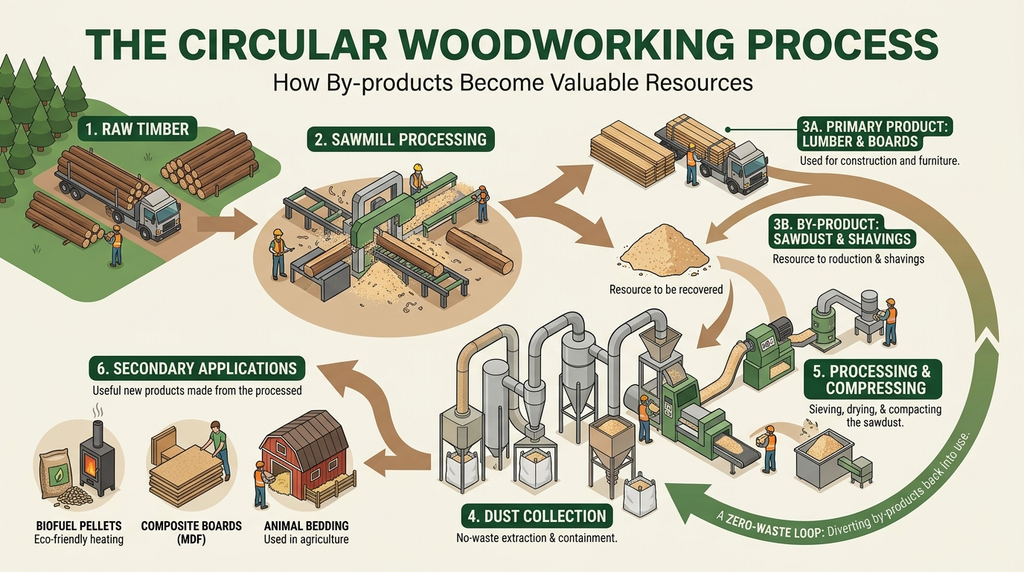
Example: Sawdust is a byproduct of cutting wood. The main purpose is to produce wooden pieces, while the sawdust is a secondary result.
In simple terms, a byproduct is an additional result that comes from producing something or doing something else.
Byproduct Definition: Meaning at a Glance
| Term | Definition |
|---|---|
| Byproduct | A secondary result of making something or carrying out a process |
| Byproduct meaning | Something produced alongside the main product or outcome |
| Byproducts | The plural form of byproduct |
| By-product | An alternative spelling of byproduct |
| By-product meaning | The same as byproduct |
| Figurative byproduct | An indirect or secondary result of an action or experience |
| Byproduct example | Sawdust from woodworking or extra knowledge gained through experience |
Dictionary-style definition: A byproduct is a secondary product or result that arises during the production of something else or as a consequence of an activity.
The term is used in manufacturing, chemistry, agriculture, business, everyday conversation, and figurative expressions.
Meaning of Byproduct in Different Contexts
The meaning of byproduct becomes clearer when you consider how it is used in real situations.
1. Literal Meaning of Byproduct
The literal meaning refers to a physical substance or material generated during a process whose primary purpose is to produce something else.
Examples include:
- Sawdust: Produced when wood is cut or sanded.
- Whey: Separated from milk during certain cheese-making processes.
- Molasses: Obtained during sugar production.
- Bagasse: Fibrous material left after juice is extracted from sugarcane.
- Heat: Generated as a secondary output by many machines.
A literal byproduct does not have to be useless or unwanted. Some byproducts are collected, sold, recycled, or used to make other products.
2. Figurative Meaning of Byproduct
In figurative usage, a byproduct is an indirect or secondary outcome of an action, habit, experience, or situation. It does not have to be a physical object.
For example:
- Confidence can be a byproduct of regular practice.
- Strong friendships can be a byproduct of working together.
- Stress can be a byproduct of excessive workload.
- Better communication may be a byproduct of learning a new language.
In these sentences, confidence, friendship, stress, and communication skills are outcomes rather than manufactured goods.
The expression is natural when one result emerges alongside the main activity, even if nobody specifically intended to create it.

3. Byproduct Meaning in Science and Industry
In science and industry, a byproduct is a secondary substance or output generated during a chemical reaction, manufacturing operation, or other process.
For example, a chemical reaction may produce a desired compound along with other substances. Whether those substances count as byproducts depends on the reaction and the process being discussed.
In agriculture, food processing, and energy production, byproducts can become useful raw materials for other industries.
However, a byproduct is not automatically safe, environmentally friendly, or commercially valuable. Its properties and possible uses depend on what it contains and how it is produced.
4. Byproduct Meaning in Tamil
The English word byproduct can be translated into Tamil in different ways depending on the context.
- துணைப் பொருள் — a secondary or subsidiary product.
- உபவிளைபொருள் — a secondary product or byproduct.
- பக்கவிளைவு — a side effect or secondary consequence, particularly in contexts where an effect is emphasized.
For example:
- “Sawdust is a byproduct of woodworking.” — மரவேலையின் போது மரத்தூள் ஒரு துணைப் பொருளாக உருவாகிறது.
- “Confidence is a byproduct of practice.” — பயிற்சியின் மூலம் தன்னம்பிக்கை ஒரு துணை விளைவாக உருவாகிறது.
The best Tamil translation depends on whether the word refers to a physical product, an indirect result, or an adverse side effect.
Usage and Grammar: How to Use Byproduct Correctly
Is Byproduct a Noun?
Yes. Byproduct is a countable noun. It names a secondary product or result.
It can be used in the singular or plural.
| Grammatical form | Example |
|---|---|
| Singular | A byproduct of the process is heat. |
| Plural | The factory reuses several byproducts. |
| With an article | This is a byproduct of fermentation. |
| With a possessive phrase | The process produces byproducts of sugar extraction. |
| Figurative use | Patience is a byproduct of experience. |
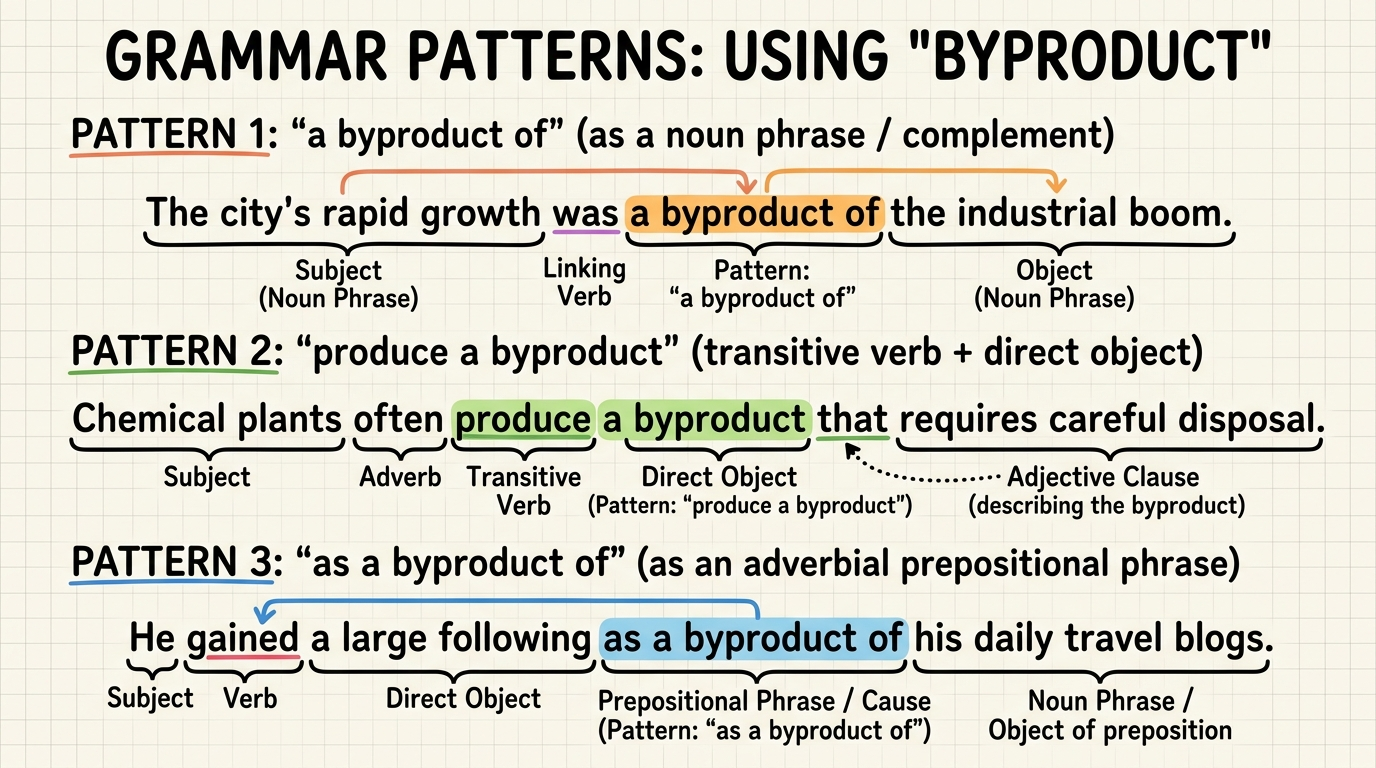
Common Sentence Patterns
1. A byproduct of + noun or activity
Use this pattern to identify what caused the secondary result.
- Creativity is a byproduct of experimentation.
- Wastewater may be a byproduct of industrial production.
- Improved teamwork was a byproduct of the project.
2. Produce or generate + a byproduct
Use this structure when describing a process that creates an additional output.
- The machine generates heat as a byproduct.
- The process produces several useful byproducts.
3. As a byproduct of + activity
Use this phrase to explain how something happens indirectly.
- She developed strong research skills as a byproduct of her studies.
- The company reduced waste as a byproduct of improving efficiency.
Tone and Register
Byproduct is a neutral word suitable for both formal and informal communication.
- Academic: “The observed change was a byproduct of repeated exposure.”
- Business: “Lower operating costs were a byproduct of process improvements.”
- Scientific: “The reaction generated a secondary byproduct.”
- Everyday conversation: “Getting fitter was a byproduct of taking up cycling.”
The figurative meaning often sounds slightly analytical because it describes a secondary consequence rather than the main goal.
Examples of Byproducts in Everyday Life
Here are practical examples of byproducts across different fields.
| Context | Main product or activity | Byproduct |
|---|---|---|
| Woodworking | Cutting wood | Sawdust |
| Cheese-making | Producing cheese | Whey |
| Sugar processing | Extracting sugar | Molasses or bagasse, depending on the process |
| Electricity generation | Producing electricity | Waste heat |
| Coffee preparation | Brewing coffee | Used coffee grounds |
| Agriculture | Processing crops | Residues such as husks or straw |
| Education | Learning a subject | Improved problem-solving skills |
| Teamwork | Completing a project | Stronger working relationships |
| Regular practice | Developing a skill | Greater confidence |
| Excessive workload | Completing demanding work | Stress or fatigue |
These examples show that a byproduct can be a physical substance, a useful resource, or an abstract consequence.
Original Example Sentences
- The furniture workshop sells sawdust to a local business that makes composite materials.
- Whey is a byproduct of certain cheese-making processes.
- The factory found a way to reuse its byproducts instead of discarding them.
- Improved customer communication was an unexpected byproduct of the new training program.
- She gained confidence as a byproduct of preparing for public presentations.
- Waste heat is a byproduct of many energy-conversion processes.
- The farmer uses some crop residues as animal bedding.
- Better time management became a byproduct of organizing his schoolwork.
- The researchers examined the byproducts formed during the reaction.
- The new recycling system turned an unwanted byproduct into a useful material.
Can a Byproduct Be Useful?
Yes. A byproduct may be unwanted at first but later prove useful as a resource.
For instance, used coffee grounds can be composted, some agricultural residues can be used as fuel, and sawdust can be incorporated into certain manufactured materials.
The key distinction is that a byproduct is defined by its relationship to the main process, not by whether it has value.
Origin and History of Byproduct
The word byproduct combines by, meaning secondary or incidental in this construction, and product, meaning something produced or created.
The spelling reflects the idea of a product that arises alongside the main product rather than being the principal output.
The closed form byproduct is widely used in modern English. The hyphenated form by-product is also established, particularly in some publications and style traditions.
The word has long been associated with manufacturing and production. Its figurative use extends the same idea to indirect results of experiences, actions, and social processes.
The general meanings of its two components support this explanation, but a precise first-use date or a specific historical origin story should not be asserted without reliable historical dictionary evidence.
Similar Expressions: Byproduct vs. Related Words
Several words are close in meaning to byproduct, but they are not always interchangeable.
| Word or phrase | Meaning | Difference from byproduct |
|---|---|---|
| Side effect | An additional effect of an action or treatment | Often emphasizes an unintended or unwanted effect |
| Consequence | A result of an action or event | Broader; does not necessarily involve a main product |
| Spin-off | A secondary development, business, or benefit | Often suggests a new opportunity or separate development |
| Residue | Material left behind after a process | Usually refers to remaining physical material |
| Waste product | Material discarded or treated as waste | Emphasizes disposal rather than secondary value |
| Co-product | Another significant product made in the same process | Often implies that multiple outputs are intentionally valuable |
| Outcome | The result of an action or process | Neutral and broad; does not imply a secondary result |
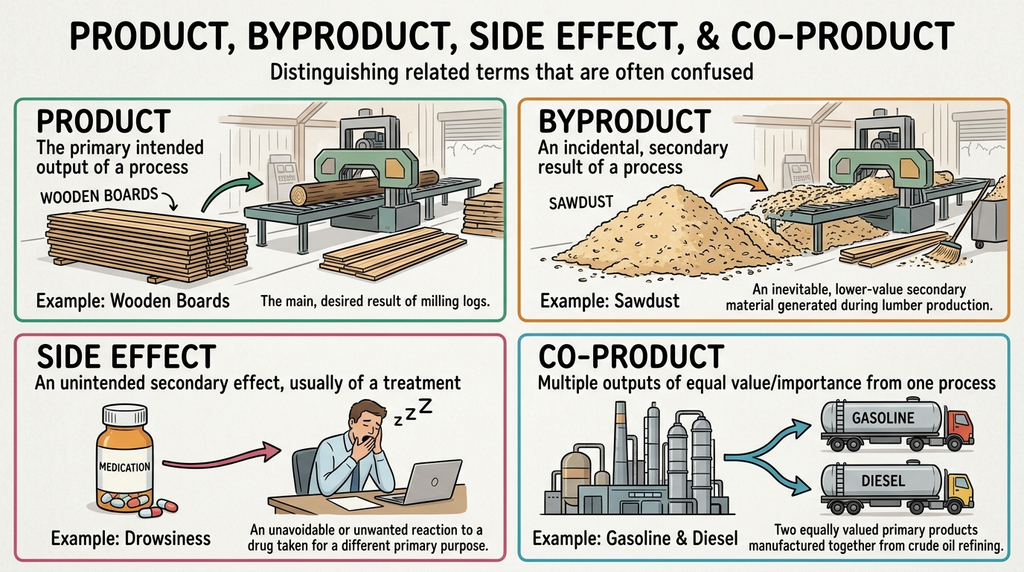
Byproduct vs. Side Effect
A byproduct is a secondary result of a process, whereas a side effect is an additional effect, often one that is unintended or undesirable.
For example:
- “Sawdust is a byproduct of woodworking.”
- “Drowsiness can be a side effect of some medicines.”
A byproduct may be beneficial, neutral, or harmful. A side effect can also be beneficial, but the term is commonly associated with unintended consequences.
Byproduct vs. Co-product
A byproduct is generally secondary to the process’s principal output. A co-product is another output that is also regarded as an important product.
For example, a food-processing facility might treat one material as its main product and another as a byproduct. If both outputs are intentionally produced and commercially significant, co-products may be a more appropriate term.
The distinction can depend on the industry and the accounting or technical framework being used.
Byproduct vs. Product
A product is something produced or made. A byproduct is a secondary product or result associated with producing something else.
For example, wooden boards may be the main product of a sawmill, while sawdust is a byproduct. However, if sawdust is collected and sold as a principal output of a separate operation, its role can change with the context.
Common Mistakes About Byproduct
1. Writing “By Product” as Two Words
In standard contemporary English, byproduct is commonly written as one word. By-product, with a hyphen, is also an accepted spelling.
The two-word form by product is generally not the preferred spelling when referring to the noun.
- Preferred: “Heat is a byproduct of the process.”
- Also accepted: “Heat is a by-product of the process.”
Follow the style guide used by your publication or organization.
2. Assuming Every Byproduct Is Waste
A byproduct is not necessarily waste. Some byproducts have commercial value or can be reused.
For example, molasses from sugar production can be used in food products and other applications.
3. Confusing a Byproduct With the Main Product
The main product is the primary output; the byproduct is secondary in relation to that process.
However, the distinction may change when a material is reused or processed separately for another purpose.
4. Assuming Byproduct Always Means Something Unintentional
A byproduct often arises incidentally, but whether it is intentional is not the only factor in how the term is used. A manufacturer may anticipate, collect, and reuse a secondary output that is still classified as a byproduct.
5. Using “Byproduct” Only for Physical Objects
The word also applies to abstract results, such as confidence, experience, or improved communication.
For example, “Patience was a byproduct of learning to play the piano” is a natural figurative use.
6. Confusing “Biproduct” With “Byproduct”
The standard spelling is byproduct or by-product. Forms such as biproduct, biproducts, byprodcut, and byporduct are generally misspellings when the intended word is byproduct.
FAQs About Byproduct
What is a byproduct in simple words?
A byproduct is an extra result produced while making something else or doing an activity. Sawdust produced when cutting wood is a simple example.
What does byproduct mean?
Byproduct means a secondary product or result that occurs during a process or as a consequence of an activity.
What is the definition of byproducts?
Byproducts is the plural of byproduct. It refers to two or more secondary products or results arising from a process.
Example: “The factory reuses several byproducts.”
Is byproduct one word or two?
The usual modern spelling is byproduct, written as one word. By-product, written with a hyphen, is also accepted. The two-word spelling by product is generally not preferred for this noun.
Is by-product or byproduct correct?
Both are correct. Byproduct is the closed form, while by-product is the hyphenated form. Choose one spelling and use it consistently.
What is an example of a byproduct?
Sawdust is a common example because it is generated when wood is cut. Other examples include whey from certain cheese-making processes and waste heat from many machines.
What are the byproducts of manufacturing?
Manufacturing byproducts vary by industry. They can include scrap material, sawdust, heat, chemical residues, and other secondary outputs. Some can be reused, while others require appropriate treatment or disposal.
What is the difference between a product and a byproduct?
A product is an output of production. A byproduct is a secondary output associated with making the main product. A sawmill may produce wooden boards as its main product and sawdust as a byproduct.
Can a byproduct be positive?
Yes. A byproduct can be useful, beneficial, neutral, or harmful. For example, increased confidence can be a positive byproduct of practicing a skill.
What is the meaning of byproduct in Tamil?
Depending on context, byproduct can be translated as துணைப் பொருள் or உபவிளைபொருள். When referring to an indirect effect, பக்கவிளைவு may be appropriate.
What does “as a byproduct of” mean?
The phrase means that something occurs as a secondary or indirect result of an activity.
Example: “He developed leadership skills as a byproduct of managing the project.”
Is a byproduct always unwanted?
No. A byproduct can be unwanted, but it may also be useful, valuable, or deliberately collected for reuse.
What is the plural of byproduct?
The plural is byproducts. The hyphenated alternative is by-products.
What is the origin of the word byproduct?
The word combines by, meaning secondary or incidental in this construction, with product, meaning something produced. A precise historical first-use claim requires confirmation from a reliable historical dictionary.
What is meant by “byproduct of success”?
It refers to an additional result that develops alongside success rather than being the main objective. For example, stronger professional relationships may be a byproduct of completing successful projects.
Summary: What Is a Byproduct?
A byproduct is a secondary product or result that arises while making something else or carrying out an activity. It can refer to a physical substance, such as sawdust or whey, or an abstract outcome, such as confidence gained through practice.
Remember these key points:
- Byproduct is the standard one-word spelling; by-product is also correct.
- Byproducts is the plural form.
- A byproduct can be useful, unwanted, beneficial, or harmful.
- The word has both literal and figurative meanings.
- Side effect, co-product, and byproduct have related but distinct meanings.
The simplest way to understand the term is this: a byproduct is a secondary result of something else.