Sans Meaning Explained: Definition, Usage, Examples, and Origin
Quick Meaning
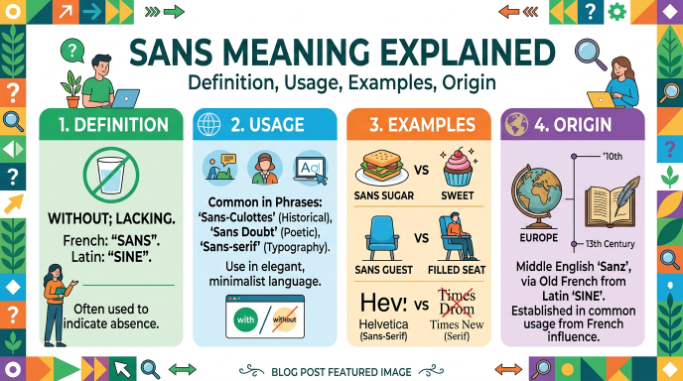
Sans means “without.” It is used to describe something that is missing or absent.
For example:
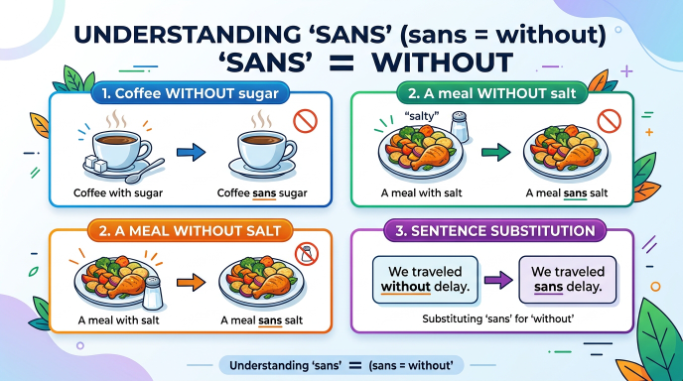
- Coffee sans sugar = coffee without sugar
- A world sans war = a world without war
- He left sans his phone = he left without his phone
In modern English, sans usually sounds more formal, literary, playful, or stylistically deliberate than the ordinary word without.
Definition Table
| Word | Meaning | Part of speech | Common English equivalent |
|---|---|---|---|
| sans | Without; lacking | Preposition | without |
| sans something | Without that particular thing | Prepositional phrase pattern | without something |
The simplest sans definition is:
Sans: without; lacking or excluding something.
If you are asking what does sans mean, what does the word sans mean, or what is the meaning of sans, the answer is straightforward: sans means without.
Is “sans” English?
Yes. Sans is used in English, although it originally came into English through French. Today, it is an established English word, especially in formal, literary, humorous, and stylistic writing.
So, sans in English meaning is simply “without.”
Meaning in Context
The meaning of sans usually depends on what follows it.
Sans + noun
The most common pattern is:
sans + noun
Examples:
- Tea sans milk
- A speech sans notes
- A holiday sans stress
- Life sans music
In every example, the thing after sans is absent.
What does “sans something” mean?
When someone says “sans something,” they mean “without something.”
For example:
- Pizza sans cheese = pizza without cheese.
- The room was sans furniture = the room had no furniture.
- He arrived sans invitation = he arrived without an invitation.
The phrase sans something is especially common in playful or stylish writing.
Literal and figurative meaning
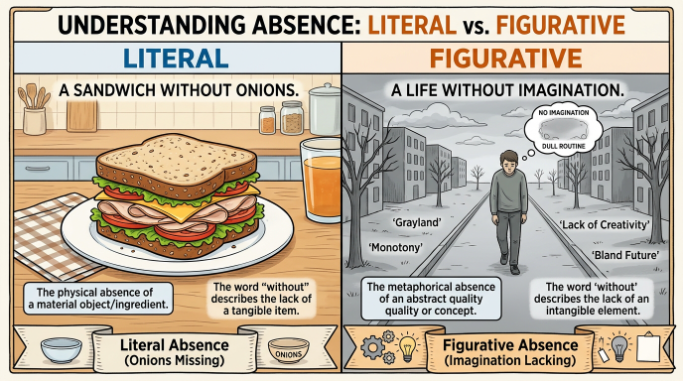
Usually, sans has a literal meaning: something is genuinely absent.
Literal example:
She ordered her burger sans onions.
The burger does not contain onions.
However, sans can also appear in figurative or expressive writing.
Figurative example:
A childhood sans imagination would be a very different experience.
Here, the sentence is discussing the absence of imagination as an idea rather than describing a physical object.
Unlike some idioms, sans does not normally have a hidden meaning. It generally means exactly what without means.
Usage and Grammar
What grammatical role does “sans” have?
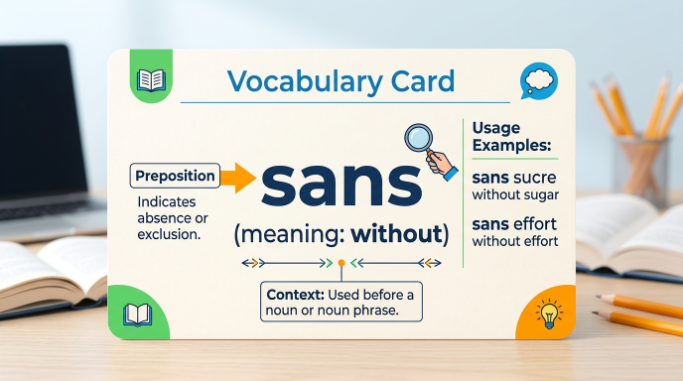
Sans is primarily a preposition.
A preposition connects ideas and shows a relationship between them. In this case, sans expresses absence.
The basic pattern is:
sans + noun or noun phrase
Examples:
- sans doubt
- sans warning
- sans permission
- sans sugar
- sans any hesitation
Can “sans” replace “without” in every sentence?
Not always naturally.
Although sans means without, the two words do not always have exactly the same tone.
Compare:
I went to work without breakfast.
This sounds completely natural in everyday conversation.
I went to work sans breakfast.
This is understandable, but it sounds more stylized, humorous, literary, or deliberately unusual.
That is an important part of understanding sans meaning in English: the definition may be simple, but the register is different.
Modern usage and tone
In modern English, sans can sound:
- Formal
- Literary
- Witty
- Playful
- Stylish
- Slightly ironic
For example:
Monday morning, sans coffee, is difficult.
This has a playful tone.
A restaurant might use:
Available sans gluten.
However, in ordinary customer communication, without gluten may be clearer depending on the context.
Is “sans” formal?
It can be, but not always.
In older or literary writing, sans may sound elevated or formal:
He departed sans explanation.
In modern casual writing, it can sound humorous:
Me, sans Wi-Fi, for three hours.
So the word can move between formal and playful registers depending on context.

Examples of Sans in a Sentence
Here are several examples showing how sans is used in different contexts.
Everyday and playful examples
- I cannot start the day sans coffee.
- She ordered the salad sans dressing.
- We survived the trip sans any major problems.
- My phone feels useless sans internet.
- He showed up sans jacket, despite the cold weather.
Formal or literary examples
- The decision was made sans consultation.
- She left sans explanation.
- The building stood sans decoration.
- The proposal was submitted sans revision.
- They continued sans complaint.
Creative and expressive examples
- A garden sans flowers feels incomplete.
- A story sans conflict may struggle to hold attention.
- A celebration sans laughter would feel strangely quiet.
- Life sans friendship can feel lonely.
- The city seemed almost unrecognizable sans its usual crowds.
These examples demonstrate how to use sans in a sentence naturally.
Common Variations and Related Uses
Sans serif
One of the most familiar modern uses of sans appears in sans serif.
A serif is a small decorative stroke attached to letters in certain typefaces. Sans serif literally means without serifs.
For example:
- Times New Roman is a serif typeface.
- Arial is a sans-serif typeface.
In this expression, sans still carries its original meaning of without.
Sans doute
Because sans comes from French, people may encounter it in French expressions such as sans doute. In French, the phrase has meanings related to “without doubt,” though its exact translation can depend on context.
When using English, however, it is best not to assume that every French expression beginning with sans functions naturally as an English phrase.
“Sans” as a stylistic substitute
Modern writers sometimes deliberately use sans instead of without for effect:
Weekend plans: brunch, movies, and relaxation—sans responsibilities.
This style is common in headlines, captions, advertising-style copy, and humorous writing.

Origin and History of “Sans”
The origin of sans is well established.
English borrowed sans from French, where it means “without.” The French word ultimately comes from Latin sine, meaning “without.”
The word has a long history in English and appears particularly in literary and formal styles.
One reason sans may feel unusual in everyday modern English is that without became the ordinary, neutral choice for most situations. Sans survived as a more specialized stylistic alternative.
This history explains why the word appears both in English and French contexts.
Is there a hidden origin behind “sans”?
No reliable evidence supports treating sans as an acronym or as a modern abbreviation.
Its meaning is not based on the letters S-A-N-S standing for separate words. If someone asks “what does S A N S mean?” in the vocabulary sense, sans should be understood as a word meaning “without.”
However, capitalization can matter in other contexts. Sans with a capital S may also refer to a name, character, brand, or other proper noun depending on where you encounter it. In those cases, the meaning may be completely different from the English word sans.
Similar Expressions
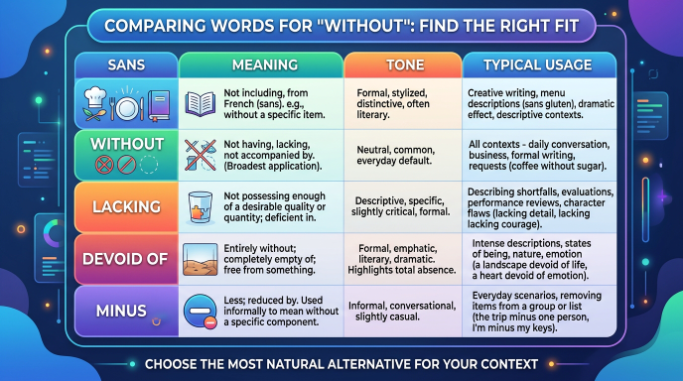
Several words and phrases can express a similar idea, although they are not always interchangeable.
Without
This is the closest and most common equivalent.
- Without sugar
- Sans sugar
Both communicate the same basic meaning, but without is more neutral and common.
Lacking
Lacking means not having something.
The report was lacking detail.
This is related to sans, but the grammar differs.
Devoid of
Devoid of means completely without something and often sounds formal.
The room was devoid of furniture.
Compare:
The room was sans furniture.
Both are understandable, but devoid of emphasizes complete absence.
Minus
Minus can sometimes mean “without” in informal or mathematical-style expressions.
The price, minus tax, is lower.
However, minus is not a direct replacement for sans in every sentence.
Common Mistakes
Mistake 1: Thinking “sans” means something more complicated than “without”
The basic meaning is simple.
Sans = without
Do not overcomplicate it unless the context suggests a proper name or specialized use.
Mistake 2: Using “sans” in every place where “without” appears
Although the meanings overlap, sans can sound unnatural in ordinary conversation.
Less natural in everyday speech:
I cannot live sans my keys.
More natural:
I cannot live without my keys.
The first sentence may work intentionally in humorous or literary writing, but the second is the normal everyday choice.
Mistake 3: Assuming “sans” is an abbreviation
Sans is a word, not an acronym.
It does not normally represent four separate words.
Mistake 4: Confusing “sans” with “sans-serif”
Sans alone means without.
Sans-serif is a typography term meaning without serifs.
The two are related because the typography term uses the same word.
Mistake 5: Using “sans” where clarity matters most
In legal, technical, educational, or international communication, without may sometimes be clearer because it is more familiar to many readers.
Choose sans when the tone or style genuinely suits it.
FAQs About Sans Meaning
What does sans mean?
Sans means “without.” It indicates that something is absent, missing, or excluded.
Does sans mean without?
Yes. Sans means without.
For example, coffee sans sugar means coffee without sugar.
What is the definition of sans?
The standard definition of sans is “without” or “lacking.” It functions primarily as a preposition.
What does the word sans mean in English?
In English, sans means “without.” It is often used in literary, formal, humorous, or stylistic contexts.
Is sans an English word?
Yes. Sans is an established word in English, although English borrowed it from French.
What is “sans” in a sentence?
An example is:
She drank her tea sans sugar.
This means she drank her tea without sugar.
How do you use sans in a sentence?
Use sans before the thing that is absent:
sans + noun
Examples:
- sans permission
- sans sugar
- sans warning
- sans hesitation
What does “sans something” mean?
Sans something means without that thing.
For example:
A trip sans luggage
means:
A trip without luggage.
Is “sans” formal or informal?
It can be either formal/literary or playful/stylish, depending on context. It is generally less neutral than without.
Can I use “sans” in everyday conversation?
You can, but it may sound deliberately humorous, sophisticated, or unusual. Without is usually the more natural everyday choice.
What is the origin of sans?
Sans entered English from French and ultimately comes from the Latin word sine, meaning “without.”
Is “sans” an idiom?
No. Sans itself is not generally an idiom. It is a word with the direct meaning “without.” Its meaning is usually literal rather than hidden or idiomatic.
Summary
Sans meaning explained in the simplest possible way: sans means “without.”
It is a preposition used to show that something is absent:
sans + something
For example:
- sans sugar = without sugar
- sans warning = without warning
- sans explanation = without explanation
Although sans and without have closely related meanings, they differ in tone. Without is the normal everyday choice, while sans often sounds literary, formal, playful, witty, or stylistically deliberate.
The easiest way to remember the word is simple: whenever you see sans, mentally test whether without fits the sentence. In most ordinary uses, it does.


