Different vs Differently: What Is the Difference?
Quick Answer
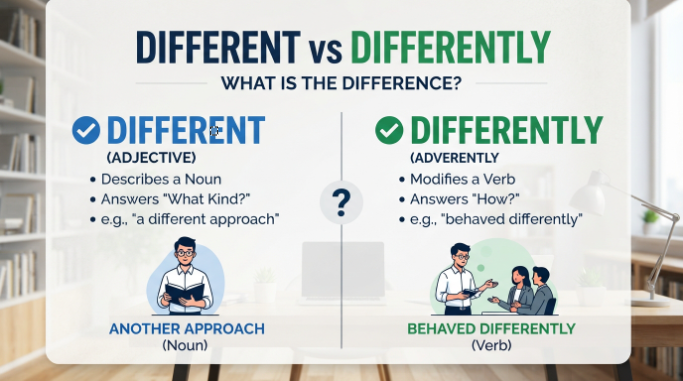
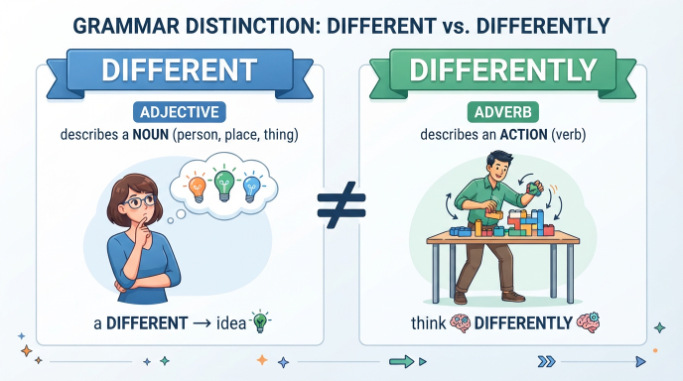
Different and differently are both correct English words, but they perform different grammatical jobs.
- Different is usually an adjective. It describes a noun or pronoun and means “not the same” or “unlike.”
- Differently is an adverb. It describes a verb and means “in a different way” or “not in the same manner.”
Compare these sentences:
Your approach is different.
Here, different describes the noun approach, so an adjective is needed.
You approach the problem differently.
Here, differently describes the verb approach, explaining how the action is performed.
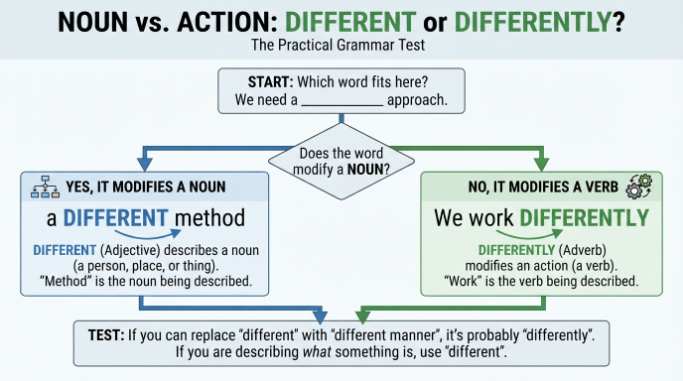
A quick test is to ask what the word is describing. If it describes a person, thing, idea, situation, or other noun, use different. If it describes how an action happens, use differently.
At-a-Glance Table
| Feature | Different | Differently |
|---|---|---|
| Part of speech | Adjective | Adverb |
| Basic meaning | Not the same; unlike | In a different way |
| Main job | Describes a noun or pronoun | Modifies a verb, adjective, or adverb in certain constructions |
| Typical question | What kind? Which one? | How? In what way? |
| Example | She has a different opinion. | She thinks differently. |
| Common pattern | different + noun | verb + differently |
| Comparative idea | different from | behave differently from |
| Pronunciation | /ˈdɪfərənt/ | /ˈdɪfərəntli/ |
| Common mistake | Using differently before a noun | Using different to describe an action |
The simplest distinction is thing versus manner.
We chose a different route.
We traveled differently this time.
The first sentence describes the route. The second explains how we traveled.
Different: Meaning and Grammar
Different is primarily an adjective. It tells us that one person, thing, idea, condition, or situation is not the same as another.
For example:
- I need a different answer.
- This situation is different.
- She bought a different laptop.
- Their opinions are different.
- We took a different approach.
In each example, different identifies or describes something.
The noun can appear immediately after it:
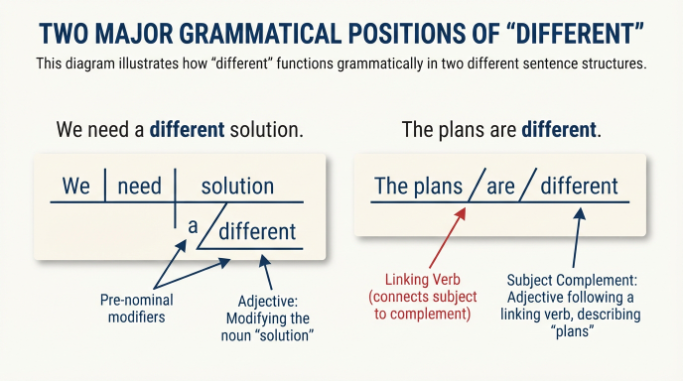
We need a different solution.
It can also appear after a linking verb such as be, seem, look, become, or feel:
The two plans are different.
You look different today.
The situation feels different now.
Here, different is a subject complement rather than an adverb. It describes the subject rather than describing the action of the verb.
Is “different” an adverb?
In standard modern English, different is normally an adjective, not an adverb.
This is why these sentences differ:
Her answer is different.
She answered differently.
The first sentence describes her answer. The second describes how she answered.
You may occasionally encounter nonstandard or dialectal uses of different in places where standard edited English would normally use differently. For formal writing, academic work, professional communication, and careful proofreading, differently is the normal adverbial form.
Is “different” a verb?
No. Different is not normally a verb in standard English.
You would not write:
She different from her sister.
Instead, use an appropriate verb:
She differs from her sister.
Or:
She is different from her sister.
This distinction is useful because differ, different, and differently belong to the same word family but have different grammatical functions.
Differently: Meaning and Grammar
Differently is an adverb formed from different + -ly. Its central meaning is “in a different way” or “in a way that is not the same.”
For example:
The new system works differently.
This means the new system works in a different way.
Other examples include:
- She thinks differently from her colleagues.
- The children reacted differently to the news.
- Try solving the problem differently.
- We approached the conversation differently this time.
- The two devices operate differently.
In each sentence, differently gives information about an action or process.
Is “differently” an adverb?
Yes. Differently is an adverb.
Its most common role is to modify a verb:
They communicate differently.
He handled the situation differently.
The machine operates differently in cold weather.
It answers a question such as How do they communicate?, How did he handle it?, or How does the machine operate?
What does “differently” mean?
Differently means in a way that is different from another way, person, situation, or previous example.
For example:
I would have done it differently.
This means:
I would have done it in another way.
That substitution is an excellent way to understand the word.
If “in a different way” fits naturally, differently is often the right choice.
“Differently” vs. “differentially”
These words are not interchangeable.
Differently is the ordinary adverb meaning “in a different way”:
The two groups responded differently.
Differentially is a more specialized technical word associated with differences, rates, or effects that vary according to particular factors:
The treatment affected the two groups differentially.
In everyday English, differently is overwhelmingly the normal choice.
Different vs. Differently in Sentences
The easiest way to see the distinction is to compare pairs.
Different + noun
We need a different strategy.
Different modifies strategy.
Verb + differently
We need to work differently.
Differently modifies work.
Another pair:
She has a different perspective.
She sees the issue differently.
The first describes her perspective. The second describes how she sees the issue.
Consider one more:
The second design is different.
The second design performs differently.
The first tells us that the design is not the same. The second tells us that its performance or operation occurs in a different way.
When to Use Different
Use different when you are describing a person, object, idea, place, result, condition, or other noun.
Before a noun
She chose a different restaurant.
We discussed a different topic.
He needs a different explanation.
They adopted a different method.
After a linking verb
The answer is different.
Your version sounds different.
The two results look different.
Things became different after the change.
Here, verbs such as is, sounds, looks, and became link the subject to an adjective.
With “from”
In many varieties of English, different from is the clearest and most widely accepted formal construction:
This model is different from the previous one.
Her approach is different from mine.
You will also encounter different than, particularly in American English, especially before a clause:
It turned out differently than I expected.
With different, constructions such as different from what I expected are often preferred in careful formal prose:
The result was different from what we expected.
English usage allows some variation here, so the choice can depend on sentence structure, dialect, and style.
When to Use Differently
Use differently when you want to explain that an action happens in another way.
After an action verb
They solved the problem differently.
She dresses differently now.
The children learned differently.
He explained the concept differently.
With “think”
One of the most common expressions is:
Think differently.
It means to approach ideas or problems in an unconventional or alternative way.
Compare:
His ideas are different.
with:
He thinks differently.
The first describes his ideas. The second describes his way of thinking.
With “look”
This verb deserves special attention because look different and look differently can both be grammatical, but they mean different things.
You look different today.
Here, different describes your appearance.
You look at things differently now.
Here, differently describes the manner in which you look at or consider things.
Another example:
The room looks different after the renovation.
The room’s appearance has changed.
She looks differently at the problem now.
Her manner or perspective has changed.
The word that follows look can therefore determine whether you need an adjective or an adverb.

Examples by Context
Everyday conversation
I want something different for dinner.
Let’s try something different tonight.
You handled that differently this time.
Why are you acting differently today?
These are natural in casual speech and writing.
Work and business
We need a different approach to this project.
The team should communicate differently with customers.
Her proposal is different from the previous version.
The department now operates differently.
Academic writing
The two studies produced different results.
The researchers interpreted the findings differently.
These populations have different characteristics.
The variables may affect the groups differently.
Academic writing frequently uses both forms because it often needs to distinguish between different things and different ways of behaving or responding.
Personal relationships
We have different expectations.
We may see the situation differently.
He has a different perspective.
She handles conflict differently from me.
Technology
This phone uses a different operating system.
The two applications process data differently.
The updated version looks different.
The software now responds differently to certain commands.
Describing change
The city feels different now.
People behave differently after major changes.
The new design is slightly different.
The updated system works a little differently.
Notice that slightly differently and a little differently are both perfectly natural. The words slightly and a little modify the degree of difference in the manner of the action.
“Different” or “Differently”? A Fast Decision Rule
Use this three-step test.
Step 1: Find the word you are describing.
If it is a noun or pronoun, start with different.
a different answer
a different person
the results are different
Step 2: Ask “How?”
If the word answers how an action happens, use differently.
They responded differently.
She writes differently.
We approached it differently.
Step 3: Try the substitution “in a different way.”
If the sentence works with in a different way, differently is probably correct.
She explained it differently.
→ She explained it in a different way.
That works naturally.
But:
She has a different explanation.
→ She has an in a different way explanation.
That does not work, because different is directly describing the noun explanation.

Common Mistakes
Mistake 1: Using “differently” before a noun
Incorrect:
She has a differently opinion.
Correct:
She has a different opinion.
Why? Opinion is a noun, so it needs the adjective different.
Mistake 2: Using “different” to modify an action
Incorrect in standard edited English:
They solved the problem different.
Correct:
They solved the problem differently.
Why? Differently tells us how they solved the problem.
Mistake 3: Confusing “look different” with “look differently”
You look different today.
This is correct when talking about someone’s appearance.
You look at the problem differently now.
This is correct when talking about the manner or perspective of looking at something.
The distinction comes from what the adjective or adverb modifies.
Mistake 4: Assuming every “-ly” word works the same way
The fact that differently ends in -ly is a useful grammatical clue, but the important issue is its function.
Compare:
a different answer
with:
answer differently
The endings are not what determines meaning by themselves. The relationship between the word and the rest of the sentence does.
Mistake 5: Confusing “different” with “differing”
Differing is related to the verb differ and can function as a participial adjective:
The researchers presented differing opinions.
Here, differing means that the opinions differ from one another.
Compare:
They have different opinions.
This simply states that the opinions are not the same.
They have differing opinions.
This emphasizes that the opinions vary or disagree.
The two forms overlap substantially, but differing can emphasize an active or ongoing state of variation.
Is “Differently” a Word?
Yes. Differently is a standard English word.
It is the adverb corresponding to the adjective different and is used to mean “in a different way.”
For example:
The two machines operate differently.
There is no spelling issue in differently. A common misspelling is diffrently, which incorrectly omits the second e.
The correct spelling is:
differently
The related adjective is:
different
Pronunciation and Spelling
Different is commonly pronounced approximately:
DIF-er-uhnt
Differently is approximately:
DIF-er-uhnt-lee
Pronunciation can vary somewhat by accent, especially in how clearly the middle vowel sounds are pronounced.
The spelling is worth remembering because the two words share the sequence differ-:
differ → different → differently
The spelling diffrent is incorrect in standard English.
British vs. American English
There is no major British-American difference in the basic distinction between different and differently.
Both varieties use:
a different idea
and:
think differently
There can, however, be differences in preferences for related constructions.
For example, different from is widely used in both British and American English:
This is different from the original.
American English also commonly uses different than, particularly in certain sentence structures:
The result was different than I expected.
British English may more often favor:
The result was different from what I expected.
These are usage preferences rather than a difference in the meanings of different and differently themselves.
Formal vs. Casual Usage
The distinction between the two words is the same in formal and casual English.
In professional writing:
The revised procedure is different from the original.
The revised procedure operates differently.
In casual conversation:
This one is different.
They do it differently.
Both are natural.
For formal writing, the most important consideration is grammatical accuracy rather than choosing one word because it sounds more sophisticated.
“How Different” vs. “How Differently”
These expressions look similar but ask different questions.
How different?
How different asks about the degree or nature of difference.
How different is the new version?
Possible answer:
It is slightly different.
How differently?
How differently asks about the manner of an action.
How differently does the new system operate?
Possible answer:
It processes requests much faster.
Compare:
How different are the two designs?
This asks about the difference between the designs.
How differently do the two designs perform?
This asks how their performance differs in manner.
The same principle applies to a little differently and slightly differently:
The updated program behaves a little differently.
She approaches meetings slightly differently now.
“What Does the Different…”?
The phrase “what does the different” by itself is usually incomplete or unnatural.
Different is generally an adjective, so it normally needs a noun or a suitable complement:
What is different?
What is the difference?
What does the different approach achieve?
If you are asking about the noun form, the relevant word is difference:
What is the difference between the two methods?
This gives us a useful word-family distinction:
| Word | Part of speech | Example |
|---|---|---|
| differ | Verb | The two methods differ. |
| different | Adjective | The methods are different. |
| differently | Adverb | The methods work differently. |
| difference | Noun | There is a difference between them. |
| differing | Participial adjective/verb form | They have differing views. |

A Practical Proofreading Test
When you are unsure whether to use different or differently, underline the word you are describing.
Then ask:
1. Is it describing a noun?
Use different.
a different method
2. Is it describing how something happens?
Use differently.
work differently
3. Does the sentence contain a linking verb?
Check whether an adjective is describing the subject:
The method is different.
4. Can you naturally replace the word with “in a different way”?
If yes, differently is likely appropriate:
They reacted differently.
→ They reacted in a different way.
5. Are you actually looking for the noun?
You may need difference, not either word:
What is the difference?
This test handles most everyday cases without requiring complicated grammatical terminology.
Frequently Asked Questions
Is differently an adverb?
Yes. Differently is an adverb. It most commonly modifies a verb and means “in a different way.”
They behave differently.
Is different an adverb?
In standard edited English, different is normally an adjective, not an adverb. Use differently when you need the standard adverbial form.
They behave differently.
What is the difference between different and differently?
Different describes something that is not the same, usually functioning as an adjective. Differently describes an action performed in another way and functions as an adverb.
a different method
use the method differently
Is “differently” a word?
Yes. Differently is a standard English adverb meaning “in a different way.”
What is the adjective form of differently?
The adjective corresponding to differently is different.
They behave differently.
They have different behaviors.
The exact noun and sentence structure may vary, but different is the adjective form.
Can I say “look differently”?
Yes, but the meaning depends on the construction.
You look different.
This normally means your appearance has changed.
You look at the situation differently.
This means your manner of considering the situation has changed.
Is “think differently” correct?
Yes. Think differently is completely standard English. Here, differently modifies the verb think and means “think in a different way.”
Is “slightly differently” correct?
Yes.
The newer model works slightly differently.
Here, slightly modifies differently and indicates a small degree of difference in the way the action occurs.
Is “a little differently” correct?
Yes.
She handles difficult conversations a little differently now.
It means she handles them in a somewhat different way.
What is the difference between differing and different?
Different simply describes things that are not the same. Differing can emphasize that things vary, disagree, or are in a state of difference.
They have different opinions.
They have differing opinions.
Both are grammatical, but the second can put more emphasis on the opinions varying from one another.
How do I say something differently?
If you want to express that something can be phrased in another way, natural expressions include:
How can I say this differently?
How else could I phrase this?
Can you word this another way?
Here, differently modifies say, which is why the adverb is appropriate.
Can “different” come after a linking verb?
Yes.
The two answers are different.
The situation seems different.
You look different.
In these sentences, different is an adjective functioning as a subject complement.
Relevant Internal-Link Suggestions
For a broader English word-choice and grammar resource, useful internal links could include:
- Different vs. Differing
- Difference vs. Different
- Differ vs. Difference
- Adjective vs. Adverb: Complete Guide
- How to Use Adverbs Correctly
- Common English Word Confusions
- Different From vs. Different Than
- How to Say Something in Another Way
Final Takeaway
The central distinction is simple:
Different = not the same; an adjective.
Differently = in a different way; an adverb.
Use different to describe a person, thing, idea, condition, or other noun:
We need a different solution.
Use differently to describe how an action happens:
We need to approach the problem differently.
When you are unsure, ask “What am I describing?” If you are describing a thing, different is usually the answer. If you are describing how an action is performed, differently is usually the right choice.
The most reliable final check is to try “in a different way.” If that replacement makes sense, you probably need differently.