Complaint vs Complain: What’s the Difference?
Quick Answer
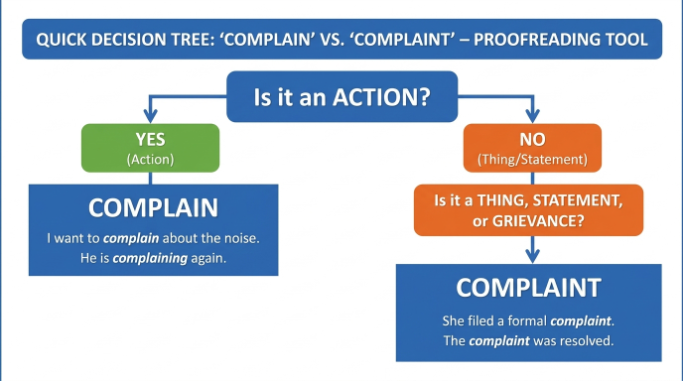
Complain is a verb. It means to express dissatisfaction, annoyance, or criticism about something.
Complaint is a noun. It refers to the statement, expression, or issue being complained about.
- I want to complain about the service. ✅
- I filed a complaint about the service. ✅
The simplest rule is:
You complain (an action), but you make, file, or have a complaint (a thing).
If you are describing what someone does, use complain. If you are naming the dissatisfaction or formal statement itself, use complaint.
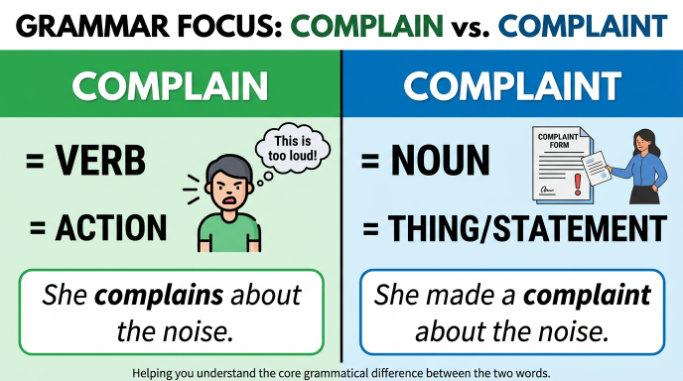
Complaint vs Complain at a Glance
| Feature | Complain | Complaint |
|---|---|---|
| Part of speech | Verb | Noun |
| Basic meaning | To express dissatisfaction | An expression or statement of dissatisfaction |
| Example | They complained about the delay. | They made a complaint about the delay. |
| Can show tense? | Yes: complain, complained, complaining | No verb tense; can be singular or plural |
| Common forms | complain, complains, complained, complaining | complaint, complaints |
| Common grammar | complain about something | make/file/lodge a complaint about something |
| Example question | Why are you complaining? | What is your complaint? |
The difference between complain and complaint is therefore mainly grammatical: complain is the action, while complaint is the noun that identifies the dissatisfaction, statement, or issue.
The Detailed Difference Between Complain and Complaint
What Does Complain Mean?
Complain means to say that you are unhappy, dissatisfied, annoyed, or concerned about something.
It is a verb, so it describes an action.
- Customers complained about the long wait.
- He always complains when the weather is too hot.
- She complained to the manager about the incorrect bill.
- Several residents complained about the noise.
In each example, someone is performing the action of expressing dissatisfaction.
This answers the common question “Is complain a verb?” Yes. Complain is a verb.
What Does Complaint Mean?
A complaint is the actual expression of dissatisfaction, or the issue that someone formally or informally raises.
- The customer made a complaint about the service.
- We received several complaints about the noise.
- Her complaint was taken seriously.
- You can submit a written complaint.
Here, complaint names something rather than describing an action.
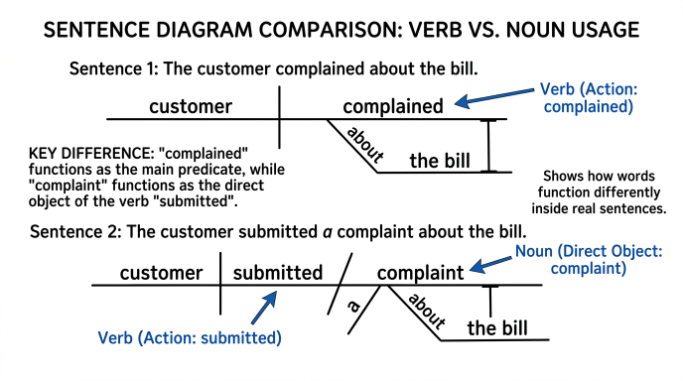
A useful comparison is:
- She complained about the problem. → What she did
- She made a complaint about the problem. → What she made or submitted
When to Use Complain
Use complain when you need a verb.
Use Complain for an Action
- I need to complain about my order.
- She complained about the broken air conditioner.
- They are complaining about the new policy.
- He complains too much.
The word can change form because it is a verb.
Complain Verb Forms
| Verb form | Example |
|---|---|
| Base form | complain |
| Third-person singular | complains |
| Present participle | complaining |
| Past tense | complained |
| Past participle | complained |
Examples:
- I complain when something is genuinely wrong.
- She complains about everything.
- They are complaining about the price.
- He complained yesterday.
- Several customers have complained.
The past tense of complain is complained.
❌ complainted
❌ complaint as the past tense
✅ complained
For example:
- She complained to the company last week.
Not:
- She complainted to the company last week. ❌
When to Use Complaint
Use complaint when you need a noun.
A Complaint Can Be Something You Make, File, Submit, or Receive
Common combinations include:
- make a complaint
- file a complaint
- submit a complaint
- lodge a complaint
- receive a complaint
- investigate a complaint
- handle a complaint
- withdraw a complaint
Examples:
- I would like to make a complaint.
- She filed a complaint with the company.
- The office received three complaints.
- The manager investigated the complaint.
The plural is complaints.
- One complaint
- Two complaints
- Many complaints
This is important for people searching for the difference between complaints vs complains.
Complaints vs Complains
These words may look similar, but they have different grammatical roles.
Complaints = plural noun
- The company received many complaints.
Complains = third-person singular verb
- She complains about the company.
A quick test:
- If you can use many before it, you probably need complaints.
- If the subject is he, she, or it performing an action in the present tense, you may need complains.
Complain or Complaint: How to Choose Quickly
Ask yourself one question:
Is someone doing something?
Use complain.
- They complain about the noise.
Are you talking about the dissatisfaction itself?
Use complaint.
- Their complaint concerns the noise.
Compare these pairs:
- The guest complained about the room.
- The guest made a complaint about the room.
- Several employees complained to management.
- Management received several complaints.
- If you want to complain, contact customer service.
- If you have a complaint, contact customer service.
Both sentences in the last pair are correct, but their grammatical structure is different.
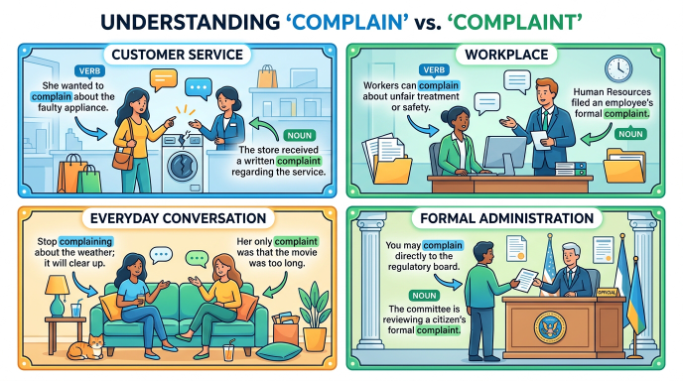
Examples of Complaint vs Complain in Different Contexts
Customer Service
Complain:
- I want to complain about a damaged product.
- The customer complained that the package arrived late.
Complaint:
- I want to make a complaint about a damaged product.
- The company responded to the customer’s complaint.
Workplace
Complain:
- Employees complained about the lack of communication.
- She complained to her supervisor.
Complaint:
- The employees submitted a formal complaint.
- The supervisor reviewed the complaint.
Everyday Conversation
Complain:
- Stop complaining about the traffic.
- He likes to complain about small problems.
Complaint:
- My only complaint is that the restaurant closes too early.
- She had one complaint about the hotel.
Formal Situations
Complain often describes the act:
- The tenant complained to the landlord.
Complaint often describes a document, case, allegation, or formal matter:
- The tenant submitted a written complaint to the landlord.
What Preposition Goes With Complain?
A common question involves the correct complain preposition.
Complain About
Use complain about when naming the problem.
- She complained about the noise.
- They complained about the food.
- We complained about the delay.
Complain To
Use complain to when naming the person or organization receiving the complaint.
- She complained to the manager.
- He complained to customer support.
Complain About Something to Someone
You can use both:
- She complained about the noise to the manager.
- The customer complained about the bill to the company.
Complain That
Use complain that to introduce a full statement or clause.
- They complained that the room was too cold.
- She complained that nobody had informed her.
What Preposition Goes With Complained?
The same basic patterns apply to complained, the past tense.
- He complained about the service.
- She complained to the manager.
- They complained that the instructions were unclear.
So if you are wondering about the correct complained preposition, the answer depends on what follows:
- about + the problem
- to + the person or organization
- that + a clause
Complaint or Complained?
This is another common source of confusion.
Complaint is a noun.
Complained is the past tense and past participle of the verb complain.
Compare:
- Her complaint was reasonable. ✅
- She complained yesterday. ✅
You cannot usually replace one with the other.
❌ Her complained was reasonable.
❌ She complaint yesterday.
The grammatical role determines the correct word.
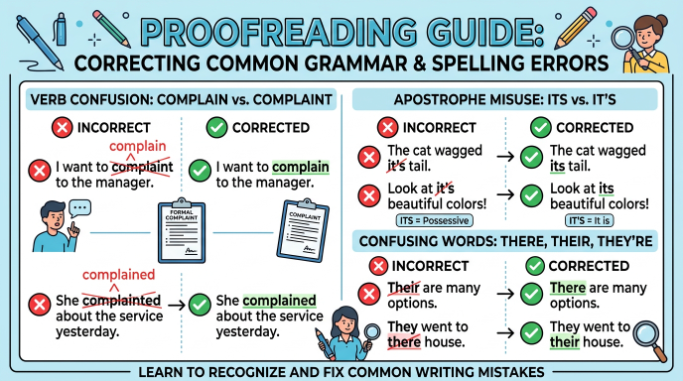
Common Mistakes With Complain and Complaint
Mistake 1: Using Complaint as a Verb
❌ I want to complaint about the service.
✅ I want to complain about the service.
Why? After to, English normally uses the base form of a verb. Complain is the verb.
Mistake 2: Using Complain as a Noun
❌ I want to make a complain.
✅ I want to make a complaint.
Why? After make a, you need a noun. Complaint is the noun.
Mistake 3: Saying “Complainted”
❌ She complainted about the problem.
✅ She complained about the problem.
Why? The verb is complain, and its regular past tense is formed by adding -ed: complained.
Mistake 4: Confusing Complains and Complaints
❌ She complaints about everything.
✅ She complains about everything.
Why? She needs a present-tense verb: complains.
But:
✅ Her complaints are frequent.
Here, complaints is a plural noun.
Mistake 5: Using the Wrong Spelling
Some misspellings include:
❌ complaine
❌ complanes
❌ complainted
The standard forms are:
✅ complain
✅ complains
✅ complained
✅ complaining
✅ complaint
✅ complaints
Complaint vs Compliant: Another Important Difference
Complaint and compliant are completely different words.
Complaint
A complaint is an expression of dissatisfaction.
- The company received a complaint.
Compliant
Compliant is an adjective meaning willing to follow rules, instructions, standards, or requirements.
- The software is compliant with the regulations.
- The employee remained compliant with company policy.
So:
- complaint = dissatisfaction or grievance
- compliant = following rules or requirements
Although the words look somewhat similar, they should not be confused.
Pronunciation of Complain and Complaint
The words are pronounced differently because their endings differ.
Complain
complain is commonly pronounced approximately:
kuhm-PLAIN
The stress falls on the second syllable.
Complaint
complaint is commonly pronounced approximately:
kuhm-PLAINT
Again, the main stress falls on the second syllable, but the final consonant sound changes.
For learners, the spelling difference is also useful:
- complain ends in -ain
- complaint ends in -aint
The extra t is important because it changes the word into a noun with a different grammatical function.
A Simple Memory Trick
Remember:
Complain = Do
Complaint = Thing
Someone does the action of complaining:
- They complain.
Someone has, makes, files, or submits a complaint:
- They file a complaint.
Another useful memory aid is:
-ed goes with complain → complained
Complaint is already a noun, not a past-tense verb.
So:
- Yesterday, I complained.
- Yesterday, I made a complaint.
Both are possible, but they use different grammatical structures.
The Fast Proofreading Test
When proofreading, replace the word with a simpler word.
Test 1: Can You Replace It With “Object” or “Issue”?
If yes, you probably need complaint.
- The complaint was serious.
- The issue was serious.
Test 2: Can You Replace It With “Protest” as an Action?
If you need an action, use complain.
- They complain about the rules.
- They protest about the rules.
The exact meanings are not always identical, but the grammatical comparison can help identify whether you need a verb or noun.
Test 3: Look at the Word Before It
Certain words strongly suggest one choice.
To + ___
- to complain ✅
A/an/the + ___
- a complaint ✅
- the complaint ✅
Make/file/submit + ___
- make a complaint ✅
- file a complaint ✅
This is one of the fastest ways to catch a mistake.
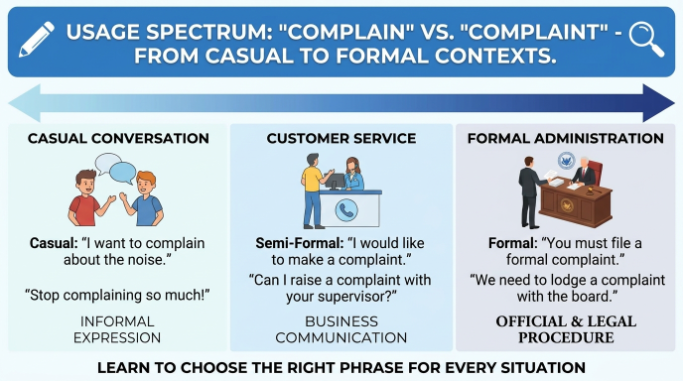
Formal vs Casual Usage
Both complain and complaint can be used in casual and formal English.
Casual English
- He keeps complaining about his job.
- My only complaint is the price.
Formal English
- The customer formally complained to the company.
- The customer submitted a formal complaint.
The noun complaint is especially common in administrative, legal, workplace, customer-service, and official contexts.
For example:
- a consumer complaint
- a formal complaint
- a written complaint
- a noise complaint
- a workplace complaint
However, complain itself is not informal. It can also appear in highly formal writing.
British vs American English
There is no major British vs American English difference in the basic distinction between complain and complaint.
Both varieties use:
- complain about something
- complain to someone
- make a complaint
- file a complaint
Some institutional or administrative phrases may vary depending on the organization or country. For example, one institution may prefer make a complaint, while another may use file a complaint or lodge a complaint.
These are differences in institutional style and collocation rather than differences in the basic meaning of the two words.
Lodge a Complaint
Lodge a complaint is particularly common in formal or official contexts and is widely understood in both British and international English.
- The passenger lodged a complaint with the airline.
File a Complaint
File a complaint is especially common in administrative and legal contexts.
- She filed a complaint with the relevant department.
Make a Complaint
This is a broad and neutral expression.
- You have the right to make a complaint.
Is There an Opposite of Complain?
There is no single perfect opposite of complain because the opposite depends on the context.
Possible opposites include:
- praise
- compliment
- approve
- express satisfaction
- be satisfied
For example:
- Customers complained about the service.
- Customers praised the service.
But praise is not always a direct grammatical opposite in every situation.
Similarly, the opposite of complaining may be:
- expressing satisfaction
- praising
- accepting without objection
The best choice depends on what exactly you mean.
What Is the Meaning of “Complaints”?
Complaints is the plural form of complaint.
It means more than one expression of dissatisfaction, grievance, or problem raised by people.
Examples:
- The company received several complaints.
- Noise complaints increased during the summer.
- The manager addressed the employees’ complaints.
The phrase “what complaints?” can mean different things depending on context. For example:
- What complaints did the customers make?
Here, it asks what problems or grievances they expressed.
Can Complaint Have Other Meanings?
Yes. This is one important edge case.
A complaint can refer not only to dissatisfaction but also, in some contexts, to a physical ailment or medical condition, especially in traditional or formal usage.
For example:
- The patient visited the doctor with a chest complaint.
This usage is more specialized and depends on regional and professional context.
That meaning does not change the main grammar rule: complaint is still a noun.
Can “Complain” Be Used Without “About”?
Yes.
You do not always need about.
- The customers complained.
- Nobody complained.
- She never complains.
When the problem is already clear from context, the object of dissatisfaction can be omitted.
You can also use other structures:
- He complained to the manager.
- She complained that the service was slow.
So while complain about is extremely common, it is not the only correct pattern.
Can “Complaint” Be Used Without “About”?
Yes.
- Your complaint has been received.
- The complaint was investigated.
- We take every complaint seriously.
You only need about when you want to specify the subject:
- Her complaint about the service was justified.
Other prepositions are also possible depending on the structure:
- a complaint against someone
- a complaint to an organization
- a complaint from a customer
For example:
- They filed a complaint against the contractor.
- The company received a complaint from a customer.
Frequently Asked Questions
Is Complain a Verb?
Yes. Complain is a verb meaning to express dissatisfaction or annoyance.
- They complain about the noise.
Is Complaint a Noun?
Yes. Complaint is a noun referring to an expression, statement, grievance, or formal report of dissatisfaction.
- They submitted a complaint.
Which Is Correct: “I Want to Complain” or “I Want to Complaint”?
I want to complain is correct.
After to, use the base form of the verb.
- I want to complain about the service. ✅
Which Is Correct: “Make a Complain” or “Make a Complaint”?
Make a complaint is correct.
- I would like to make a complaint. ✅
Complaint is the noun required after make a.
What Is the Past Tense of Complain?
The past tense of complain is complained.
- She complained yesterday.
The form complainted is incorrect.
What Is the Difference Between Complains and Complaints?
Complains is a verb:
- He complains frequently.
Complaints is a plural noun:
- He receives complaints frequently.
Is “Complaint” the Past Tense of Complain?
No.
The past tense of complain is complained.
Complaint is a noun.
How Do You Spell Complain?
The correct spelling is:
C-O-M-P-L-A-I-N
Its common forms are:
- complain
- complains
- complained
- complaining
How Do You Spell Complaint?
The correct spelling is:
C-O-M-P-L-A-I-N-T
Its plural is:
complaints
Are Complain and Complaint Interchangeable?
No. They are closely related in meaning but usually cannot replace each other because they have different grammatical functions.
- She complained. ✅
- She complaint. ❌
- She made a complaint. ✅
- She made a complain. ❌
Final Takeaway
The difference between complaint vs complain is straightforward once you identify the grammatical role:
- Complain = a verb → the action of expressing dissatisfaction.
- Complaint = a noun → the dissatisfaction, statement, grievance, or formal issue itself.
Use this quick rule:
People complain, but people make or file complaints.
If you are unsure, look at the sentence structure. After to, you will usually need complain. After a, the, make, file, or submit, you will usually need complaint.