Your Sincerely or Yours Sincerely: Which Is Correct?
Quick Answer
“Yours sincerely” is correct. “Your sincerely” is incorrect when you are ending a letter or email.
The reason is grammatical: your is a possessive determiner, while yours is a possessive pronoun. In the traditional letter closing “Yours sincerely,” the word yours is required.
Correct: Yours sincerely,
Incorrect: Your sincerely,
In British English, Yours sincerely is traditionally used when you know the recipient’s name. In American English, Sincerely and Sincerely yours are more common.

At-a-Glance Table
| Expression | Correct? | Main Use | Typical Register |
|---|---|---|---|
| Yours sincerely | ✓ Yes | Formal letter closing, especially British English | Formal |
| Your sincerely | ✗ No | Incorrect letter closing | Not standard |
| Sincerely | ✓ Yes | Professional letters and emails, especially American English | Formal to professional |
| Sincerely yours | ✓ Yes | Traditional formal closing, especially American English | Formal |
| Yours faithfully | ✓ Yes | Traditional British formal letter when the recipient’s name is unknown | Formal |
| Respectfully | ✓ Yes | Very formal communication showing respect | Highly formal |
| Kind regards | ✓ Yes | Professional but warmer correspondence | Semi-formal to professional |
| Yours truly | ✓ Yes | Traditional or conventional letter closing | Formal to neutral |
The short answer to your sincerely or yours sincerely is therefore simple: use Yours sincerely.
The Detailed Difference Between “Your” and “Yours”
The confusion between your sincerely or yours sincerely comes from the similarity between your and yours. They are related words, but they perform different grammatical jobs.
What does “your” mean?
Your is a possessive determiner. It normally comes before a noun.
Examples:
- Your letter was helpful.
- Your application has been received.
- I appreciate your time.
- Thank you for your assistance.
In each example, your introduces a noun:
- your letter
- your application
- your time
- your assistance
This is why “Your sincerely” does not work. The word sincerely is not a noun that can naturally follow your in this construction.
What does “yours” mean?
Yours is a possessive pronoun. It can stand without a following noun.
Examples:
- The decision is yours.
- This book is yours.
- The responsibility is yours.
In a traditional letter closing, Yours sincerely is an established conventional expression. Yours functions as part of the closing formula, while sincerely expresses the manner or sincerity of the writer’s sentiments.
So although Yours sincerely may look unusual if you try to analyze it exactly like an ordinary modern sentence, it is a conventional sign-off with a long-established role in formal correspondence.
What Does “Sincerely” Mean?
To understand expressions such as Yours sincerely and Sincerely yours, it helps to understand the word sincerely itself.
Sincerely means:
- genuinely
- honestly
- truly
- without pretending or deceiving
Examples:
- I sincerely apologize for the inconvenience.
- We sincerely appreciate your support.
- She sincerely hoped the problem would be resolved.
In a letter or email closing, sincerely signals genuine goodwill or honest feeling toward the recipient.
When someone asks what does sincerely mean in a letter, the answer is essentially that it expresses genuine and honest regard.
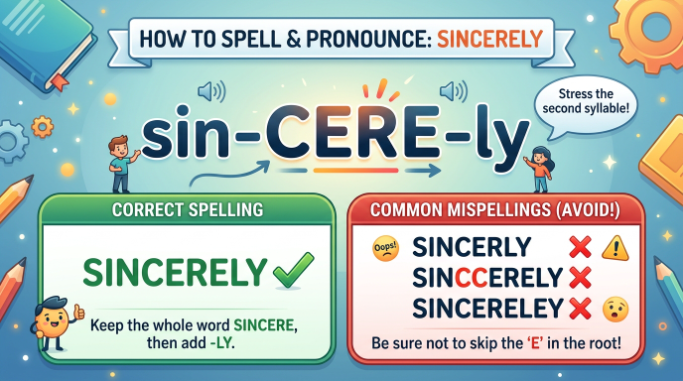
Pronunciation of “sincerely”
Sincerely is commonly pronounced:
sin-SEER-lee
The spelling can cause mistakes because several letters are easy to confuse when writing quickly.
The correct spelling is:
sincerely
Not:
- sincerly ✗
- sincerley ✗
- sincierly ✗
- sinceraly ✗
When Should You Use “Yours Sincerely”?
The traditional rule in British English formal correspondence is based partly on how you begin the letter.
Use “Yours sincerely” when you know the recipient’s name
For example:
Dear Mr Ahmed,
Thank you for your assistance with my application.
Yours sincerely,
[Your Name]
Or:
Dear Ms Taylor,
I am writing to confirm my attendance at the meeting.
Yours sincerely,
[Your Name]
The traditional British convention is:
Dear Mr Smith → Yours sincerely
Dear Ms Jones → Yours sincerely
You know the person’s name, so Yours sincerely is the conventional formal closing.
Is “Yours sincerely” professional?
Yes. Yours sincerely is professional and appropriate for formal letters, job applications, official correspondence, and other situations requiring a traditional tone.
However, it can sound more formal and traditional than necessary in many modern emails.
For everyday professional email communication, alternatives such as these are often more natural:
- Kind regards
- Best regards
- Regards
- Sincerely
The best choice depends on the relationship, workplace culture, country, and level of formality.
When Should You Use “Yours Faithfully”?
A major source of confusion is the difference between Yours faithfully and Yours sincerely.
In traditional British English letter-writing conventions:
| Opening | Traditional Closing |
|---|---|
| Dear Sir or Madam | Yours faithfully |
| Dear Mr Brown | Yours sincerely |
| Dear Ms Patel | Yours sincerely |
| Dear Hiring Manager | Often Yours faithfully in traditional style, though modern alternatives may be used |
The basic traditional rule is:
Known name → Yours sincerely
Unknown name → Yours faithfully
Example with an unknown recipient
Dear Sir or Madam,
I am writing to enquire about the position advertised on your website.
Yours faithfully,
[Your Name]
Example with a known recipient
Dear Mr Wilson,
Thank you for considering my application.
Yours sincerely,
[Your Name]
This distinction is especially useful for people asking when to use Yours sincerely and Yours faithfully.

“Yours Sincerely” vs “Sincerely Yours”
Both Yours sincerely and Sincerely yours are correct, but they differ in regional convention and style.
Yours sincerely
This is strongly associated with traditional British English correspondence.
Example:
Dear Dr Khan,
Thank you for your prompt response.
Yours sincerely,
Amelia Roberts
Sincerely yours
This is more familiar in traditional American English correspondence.
Example:
Dear Professor Miller,
Thank you for taking the time to review my work.
Sincerely yours,
Daniel Reed
Sincerely
Modern American professional writing often simply uses:
Sincerely,
This is concise, professional, and widely understood.
Which one should you choose?
If you are following traditional British formal-letter conventions, use Yours sincerely.
If you are writing in an American professional context, Sincerely is usually a natural choice.
Both forms can be grammatically correct. The difference is primarily one of regional convention and writing style, not basic grammar.
Examples by Context
Yours sincerely in a formal letter
Dear Mrs Green,
Thank you for meeting with me to discuss the position.
Yours sincerely,
Olivia Martin
This works because the writer knows and uses the recipient’s name.
Yours sincerely in a job application
Dear Mr Rahman,
Please accept my application for the position of Marketing Assistant.
I would welcome the opportunity to discuss my qualifications further.
Yours sincerely,
James Carter
Yours sincerely in an application is appropriate when the application follows a traditional formal-letter format and addresses a named person.
Sincerely in a professional email
Hello Maria,
Thank you for sending the revised schedule. I appreciate the clarification.
Sincerely,
David
This is professional, although in many workplaces Kind regards or Best regards may sound more natural.
Kind regards vs Yours sincerely
Kind regards is usually warmer and less formal.
Yours sincerely is more traditional and formal.
Compare:
Kind regards,
Suitable for routine professional communication.
Yours sincerely,
Suitable for a formal letter or traditional business correspondence.
Respectfully vs sincerely
Respectfully emphasizes respect or deference.
Sincerely emphasizes genuine feeling or goodwill.
For example:
Respectfully,
may be suitable when writing to a senior official, authority, or institution.
Sincerely,
is a more general professional closing.
Neither is automatically better. The correct choice depends on the relationship and context.
How Do You Write “Sincerely” in a Letter?
A typical letter ending looks like this:
Dear Ms Robinson,
[Body of the letter.]
Yours sincerely,
[Your Name]
In American style:
Dear Ms Robinson:
[Body of the letter.]
Sincerely,
[Your Name]
The punctuation and exact layout may vary according to house style.
Does “Yours Sincerely” Need a Comma?
This is partly a matter of regional style.
In modern American English, a comma after the closing is common:
Sincerely,
Sincerely yours,
In British English, particularly in traditional formal correspondence, the comma may be omitted:
Yours sincerely
Both practices can appear in real-world writing, depending on the style guide being followed.
The most important rule is consistency.
If you are writing for an organization, school, employer, or publication with an established style guide, follow that style.
Common Mistakes
Mistake 1: “Your sincerely”
Incorrect: Your sincerely,
Correct: Yours sincerely,
Why? Your normally needs to modify a noun. The established letter closing uses yours.
Mistake 2: “Your’s sincerely”
Incorrect: Your’s sincerely,
Correct: Yours sincerely,
The apostrophe is incorrect.
Possessive pronouns such as these do not use apostrophes:
- yours
- hers
- ours
- theirs
- its
Compare:
- The book is yours. ✓
- The book is your’s. ✗
Mistake 3: Misspelling “sincerely”
Incorrect: Yours sincerly,
Correct: Yours sincerely,
Incorrect: Yours sincerley,
Correct: Yours sincerely,
A useful proofreading step is to check the middle of the word carefully:
s i n c e r e l y
Mistake 4: Using “Yours faithfully” automatically
Dear Mr Adams,
Yours faithfully,
This may conflict with traditional British correspondence conventions because the recipient’s name is known.
Traditional pairing:
Dear Mr Adams → Yours sincerely
Mistake 5: Using a highly formal closing in a casual message
Writing this to a close colleague may sound unnecessarily stiff:
Hi Sam,
Can you send me the updated file?
Yours sincerely,
A more natural choice might be:
- Thanks
- Best
- Best regards
- Kind regards
Register matters as much as grammar.

A Quick Memory Trick
Use this simple test:
Can “your” naturally stand alone?
No.
You can say:
- This is yours. ✓
But not:
- This is your. ✗
Because your normally needs a noun:
- This is your book. ✓
The same distinction helps you remember the letter closing:
Yours sincerely ✓
Your sincerely ✗
The “noun test”
Ask yourself:
Is there a noun immediately after “your”?
If yes, your may be correct:
- your letter
- your application
- your response
If no, your may be the wrong form.
This test is not a substitute for understanding every English construction, but it is an excellent practical proofreading check for this particular confusion.
Fast Decision Rule
Use this checklist before ending a letter.
Step 1: Are you writing a traditional formal British letter?
If yes, continue to Step 2.
Step 2: Do you know the recipient’s name?
Yes: Use Yours sincerely.
No: Traditionally use Yours faithfully.
Step 3: Are you writing a modern professional email?
Consider the tone and workplace culture. Common options include:
- Sincerely
- Kind regards
- Best regards
- Regards
Step 4: Check the spelling
Always write:
Yours sincerely
Never:
Your sincerely
Formal, Casual, and Regional Notes
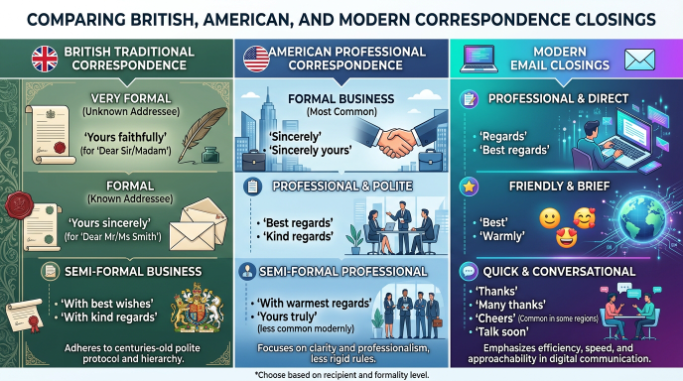
British English
Traditional British letter-writing conventions strongly distinguish between:
- Yours sincerely
- Yours faithfully
The recipient’s name traditionally determines the choice.
American English
American correspondence more commonly uses:
- Sincerely
- Sincerely yours
- Yours truly
The traditional British sincerely/faithfully pairing is generally less central to everyday American letter-writing practice.
Modern email
Email has made correspondence less formal.
A closing should match the message.
For example:
Formal:
Sincerely,
Kind regards,
Professional but neutral:
Best regards,
Regards,
Friendly:
Best,
Thanks,
A job application, complaint, official request, and message to a close coworker do not necessarily need the same closing.
Is “Sincerely” Professional?
Yes. Sincerely is generally professional.
However, professionalism is not determined by one word alone. The appropriateness of a closing depends on:
- your relationship with the recipient
- the purpose of the message
- the organization or industry
- regional writing conventions
- the overall tone of the email
For a formal application, Yours sincerely or Sincerely may work well depending on the style and region.
For routine workplace communication, Kind regards or Best regards may feel more natural.
What Is “Sincerely” Called at the End of a Letter?
Words such as Yours sincerely, Sincerely, and Kind regards are commonly called a complimentary close or complimentary closing.
A letter traditionally has several parts:
- Greeting or salutation
- Body of the letter
- Complimentary close
- Signature or name
For example:
Dear Ms Khan, → Salutation
[Letter body]
Yours sincerely, → Complimentary close
Aisha Malik → Signature/name
This explains the difference between a salutation and sincerely. Dear Mr Brown is the opening salutation, while Yours sincerely is the closing.
Other Words You Can Use Instead of “Sincerely”
If you are wondering what to say instead of sincerely, consider the context.
Formal alternatives
- Yours faithfully
- Respectfully
- Yours truly
Professional alternatives
- Kind regards
- Best regards
- Regards
Friendly professional alternatives
- Best
- Thanks
- Many thanks
Do not choose a closing simply because it sounds more formal. The best sign-off matches the relationship and purpose of the communication.
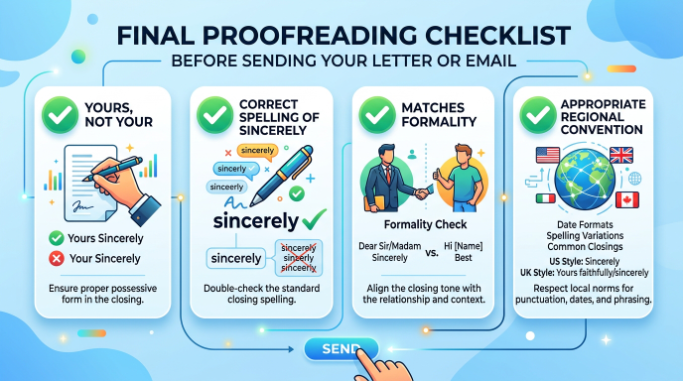
Practical Proofreading Test
Before sending your letter or email, ask:
1. Did I write “your” or “yours”?
For the traditional sign-off, it must be:
Yours sincerely
2. Did I spell “sincerely” correctly?
Check:
sincerely
3. Does the closing match the formality of the message?
A formal application may need a more formal closing than a quick internal email.
4. Does the regional convention matter?
For traditional British formal letters:
- Named recipient → Yours sincerely
- Unnamed recipient → Yours faithfully
5. Is my style consistent?
If you are following a particular organization’s style guide, follow its punctuation and formatting conventions consistently.
Frequently Asked Questions
Is it “your sincerely” or “yours sincerely”?
The correct expression is Yours sincerely.
Your sincerely is grammatically incorrect as a conventional letter closing.
When should you use Yours sincerely?
Traditionally in British formal correspondence, use Yours sincerely when you know the recipient’s name.
For example:
Dear Mr Ahmed → Yours sincerely
When do you use Yours faithfully?
Traditionally in British formal correspondence, use Yours faithfully when you do not know the recipient’s name.
For example:
Dear Sir or Madam → Yours faithfully
What does Yours sincerely mean?
Yours sincerely is a formal complimentary close expressing genuine goodwill and sincerity toward the recipient.
Is Yours sincerely used in emails?
Yes, but it is relatively formal and traditional. It may be suitable for formal professional emails, applications, and official correspondence.
For everyday workplace emails, Kind regards or Best regards may be more natural.
Is “Sincerely yours” correct?
Yes. Sincerely yours is a correct traditional letter closing and is particularly associated with American English usage.
Is “Yours sincerely” correct in American English?
It is understandable and grammatically correct, but it may sound more British or traditionally formal than the more common American closing Sincerely.
Should I write “Yours sincerely” with a comma?
Usage varies by regional and organizational style. A comma is common in some styles, while traditional British correspondence often omits it. Follow the relevant style guide and remain consistent.
How do you spell sincerely?
The correct spelling is:
sincerely
What is the difference between sincerely and respectfully?
Sincerely expresses genuine feeling or goodwill.
Respectfully emphasizes respect or deference.
The better choice depends on the relationship and the purpose of the message.
Final Takeaway
The answer to your sincerely or yours sincerely is clear:
Always write “Yours sincerely,” not “Your sincerely,” when using this traditional letter closing.
The key distinction is grammatical: your normally introduces a noun, while yours can stand independently and is the correct word in the established closing.
For traditional British formal letters, remember the classic rule:
Known recipient → Yours sincerely
Unknown recipient → Yours faithfully
In American and modern professional correspondence, Sincerely, Sincerely yours, Kind regards, and other closings may be more appropriate depending on context.
The most reliable approach is to check grammar, formality, regional convention, and spelling before sending your message.