Dialog vs Dialogue: What Is the Difference?
Quick Answer
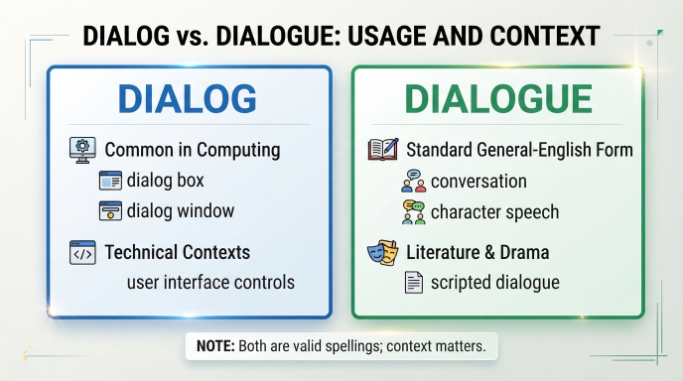
Dialog and dialogue are both correct spellings, but they are not equally common in every context.
- Dialogue is the standard spelling in general English, especially when referring to a conversation between people or the written speech in a story, play, film, or novel.
- Dialog is a recognized spelling, particularly common in American English and especially in computing and software, where terms such as dialog box and dialog window are widely used.
- In ordinary writing, dialogue is usually the safest choice: The two friends had a long dialogue about their plans.
- In software terminology, dialog is often preferred: Click OK to close the dialog.
So, if you are asking “Is it dialog or dialogue?”, the answer depends on context. Neither spelling is universally wrong.
At-a-Glance Table
| Feature | Dialog | Dialogue |
|---|---|---|
| Basic meaning | Conversation or exchange of ideas; also a software interface element | Conversation or exchange of ideas; speech in literature, drama, and film |
| Part of speech | Noun; occasionally used as a verb in specialized contexts | Noun; also a verb |
| General English | Correct, but less common | Standard and more common |
| American English | Used, particularly in technical contexts | Fully standard and widely used |
| British English | Used, especially in technical contexts | Preferred for general usage |
| Computing | Very common | Also possible, but less typical in interface terminology |
| Literature and drama | Possible, but uncommon | Standard choice |
| Plural | dialogs | dialogues |
| Example | Close the dialog. | The dialogue between the characters feels natural. |
| Safest general choice | — | Dialogue |
The important point is that dialog is not simply a misspelling of dialogue. It is an established variant. However, replacing dialogue with dialog in every situation can make ordinary prose look unusual, especially outside technical writing.
What Does Dialogue Mean?
Dialogue is a noun meaning a conversation or exchange between two or more people. It can also refer specifically to the spoken words of characters in a novel, play, television program, or movie.
For example:
The manager opened a dialogue with the employees about the proposed changes.
Here, dialogue means an exchange of ideas or communication.
In creative writing, dialogue usually means the words spoken by characters:
The dialogue between the two detectives reveals an important clue.
The word can also describe communication between groups, institutions, or countries:
The organizations agreed to continue dialogue after the meeting.
In this sense, dialogue does not necessarily mean an informal conversation. It can describe a structured or diplomatic exchange.
Dialogue as a Verb
Dialogue can also function as a verb, although this use is less common than the noun.
The two researchers dialogued about the implications of the discovery.
The verb is grammatical, but in ordinary modern English, writers often choose talk, discuss, communicate, or have a dialogue instead.
For example:
- Less natural in many contexts: The two teams dialogued for several hours.
- More natural: The two teams discussed the problem for several hours.
- Also natural: The two teams had a dialogue about the problem.
This distinction matters because knowing that a word exists as a verb does not mean that its verb form is the most idiomatic choice in every sentence.
What Does Dialog Mean?
Dialog has the same fundamental meaning as dialogue when it refers to conversation or an exchange of ideas.
However, dialog has a particularly important use in computing and user-interface terminology.
A dialog box or dialog window is a graphical interface element that asks the user to provide information, make a choice, confirm an action, or respond to a message.
For example:
The application displays a dialog asking whether you want to save the file.
You will also encounter expressions such as:
- dialog box
- dialog window
- dialog control
- modal dialog
- open a dialog
- close a dialog
- dialog buttons
In these technical contexts, dialog is not an accidental shortening. It is established terminology.

Dialog vs Dialogue: The Detailed Difference
The two forms overlap substantially in meaning. The major difference is where and how they are conventionally used.
Dialogue Is the General-Use Default
When you are talking about human conversation, fictional character speech, or an exchange of ideas, dialogue is generally the most natural choice.
Examples:
- We had a productive dialogue about the issue.
- The dialogue in the novel feels realistic.
- The film contains very little dialogue.
- The professor encouraged dialogue among the students.
- The characters’ dialogue reveals their conflicting goals.
If you are writing an essay, article, report, story, or general correspondence and mean conversation, dialogue is usually the form to choose.
Dialog Is Especially Common in Computing
Technical writing frequently uses dialog for an interface element.
Examples:
- Open the dialog from the File menu.
- A confirmation dialog appears on the screen.
- The dialog contains three options.
- Select a folder in the dialog.
- Close the dialog after entering your information.
In these examples, dialogue would be unusual because the writer is not referring to human conversation.
The Forms Can Overlap
The distinction is not absolute.
You can encounter dialog meaning conversation, particularly in American English and in technical or specialized writing. Likewise, dialogue can occur in computing documentation.
For example, Microsoft-style technical documentation and software developers may use dialog as the established UI term, while a general writer might describe the same interface element as a dialogue box.
The important lesson is not that one form is forbidden in a particular context. Instead, usage conventions make one form more natural than the other.
When to Use Dialogue
Choose dialogue when you mean a conversation or exchange in ordinary English.
Conversation Between People
The two neighbors had a friendly dialogue about the new parking rules.
Exchange of Ideas
The conference encouraged dialogue between scientists from different fields.
Literature
The author’s dialogue gives each character a distinctive voice.
Film and Television
The movie relies on visual storytelling and contains relatively little dialogue.
Drama
The opening dialogue establishes the conflict between the two characters.
Diplomacy and Public Discussion
The representatives called for continued dialogue.
In all of these examples, dialogue refers to communication, speech, or an exchange of ideas.
When to Use Dialog
Choose dialog when following a technical convention, particularly in software and user-interface writing.
Dialog Box
A dialog opens when you select Print.
Confirmation Dialog
The confirmation dialog asks you to verify the deletion.
Settings Dialog
Change the display options in the settings dialog.
Modal Dialog
The modal dialog prevents interaction with the main window until you respond.
Dialog Window
Move the dialog window if it is covering the text.
In these examples, dialog functions as established computing vocabulary.
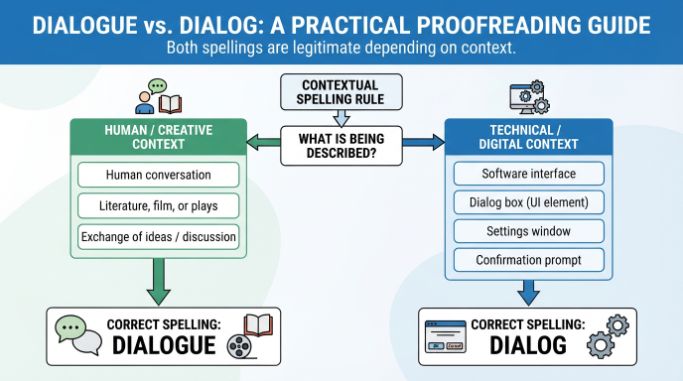
Examples by Context
Seeing the words in different contexts makes the distinction clearer.
Everyday Conversation
Natural:
Their dialogue became more relaxed after they resolved the misunderstanding.
Also possible:
Their dialog became more relaxed after they resolved the misunderstanding.
The second sentence is understandable and can be found in English, but dialogue is the conventional general-English choice.
Fiction
The dialogue between the protagonist and her brother becomes increasingly tense.
Here, dialogue is the normal spelling because the sentence refers to character speech.
Academic Writing
Meaningful dialogue between researchers can lead to new approaches.
Again, dialogue is the natural general-English form.
Politics, Diplomacy, or Public Discussion
The two organizations agreed to maintain dialogue.
This use refers to communication or discussion, so dialogue is standard.
Software
The program opens a dialog when you select the export option.
Here, dialog is conventional technical vocabulary.
User Interface Documentation
Enter your password in the login dialog.
The technical context strongly favors dialog.
Programming
The application creates a dialog for selecting a file.
In programming discussions, dialog is common because developers routinely use the term as an interface concept.
A Story About Software
Consider this sentence:
Maya’s dialogue with the support technician was interrupted by a security dialog on her laptop.
Both forms appear naturally because they describe two different things:
- dialogue = human conversation
- dialog = software interface
That sentence demonstrates why context matters more than memorizing a simplistic spelling rule.
Dialog vs Conversation
Dialogue and conversation are closely related, but they are not perfect synonyms in every context.
A conversation usually means an informal or ordinary spoken exchange between people.
I had a conversation with my sister yesterday.
Dialogue can mean conversation, but it often emphasizes an exchange of ideas, perspectives, or positions.
The meeting created an opportunity for dialogue between the two groups.
Dialogue can therefore sound more formal or deliberate than conversation.
There is also a literary meaning. Writers use dialogue to describe the spoken portions of a story:
The novel’s dialogue is sharp and economical.
You would not normally replace this with conversation, because the writer is discussing a literary technique rather than an actual conversation.
Is It “Dialog” or “Dialogue” in American English?
Both are used in American English.
For ordinary conversation, writing, literature, and general communication, dialogue remains a standard and very common form.
Dialog has strong currency in American technical and computing terminology. Expressions such as dialog box, dialog window, and modal dialog are familiar in software contexts.
Therefore, it is inaccurate to say that American English simply uses dialog while British English uses dialogue. The real distinction is more nuanced.
Is Dialogue the British Spelling?
Dialogue is the traditional and widely used spelling in British English, but it is not exclusively British.
American English also uses dialogue extensively, especially in general writing and literature.
Likewise, dialog is not exclusively American. It can appear in technical writing and software contexts regardless of the writer’s regional variety.
So the better rule is:
General English → dialogue
Technical software terminology → dialog is often preferred
Regional variation can influence preferences, but context is usually more useful than treating this as a strict British-versus-American spelling difference.

Common Mistakes
Mistake 1: Treating Dialog as Incorrect
Incorrect assumption:
“Dialog is always a misspelling.”
That is not true. Dialog is an established spelling and has a particularly strong presence in computing.
Better understanding:
Dialogue is the usual general-English spelling, while dialog is especially common in technical contexts.
Mistake 2: Using Dialogue for Every Software Element
Click the OK button in the dialogue.
This may be understandable, but if you are writing software documentation, dialog may better match the terminology used by the interface or development framework.
Click the OK button in the dialog.
Mistake 3: Assuming Dialog and Dialogue Always Have Different Meanings
They do not.
Both can refer to an exchange between people:
The two teams entered into dialogue.
The two teams entered into dialog.
The second is less conventional in many general-English contexts, but the underlying meaning is essentially the same.
Mistake 4: Assuming the Final “-ue” Is a General English Rule
English contains many words with different conventional spellings across varieties and fields. You cannot determine whether dialog is correct simply by applying a rule about word endings.
Usage and context matter.
Mistake 5: Confusing Dialogue With Monologue
A dialogue involves an exchange between participants.
A monologue is an extended speech by one person.
For example:
The play opens with a monologue.
versus:
The play’s dialogue begins when the two characters meet.
The concepts are related but not interchangeable.
Mistake 6: Writing “Diolog,” “Diaglog,” or “Dialoag”
Forms such as diolog, diaglog, and dialoag are misspellings.
The standard forms are:
- dialog
- dialogue
If you are wondering “What is a diolog?”, diolog is generally just a misspelling of dialog or dialogue.

Dialogs or Dialogues?
Both dialogs and dialogues can be correct plurals.
Dialogues
Dialogues is the standard plural of dialogue.
The book contains several memorable dialogues.
The actors rehearsed their dialogues before filming.
Dialogs
Dialogs is the plural of dialog.
The application uses several dialogs for different settings.
In software documentation, dialogs is therefore perfectly natural.
For example:
The program displays several dialogs during installation.
Do not assume that dialogs is an error simply because you are more familiar with dialogues.
What Is a Dialog Line?
A dialog line usually means a single line of spoken dialogue, especially in a script, screenplay, or game.
For example:
The actor delivered the dialog line with a deliberately quiet tone.
However, in general prose, dialogue line is also common:
The editor removed an unnecessary dialogue line from the scene.
The preferred spelling can depend on the terminology of the particular writing or production environment.
“Dialogging” and the Verb Form
Dialogging is possible as a form of the verb dialog, but it is specialized and relatively uncommon in general prose.
Likewise, dialogued can be formed from dialogue, but ordinary writers often avoid these constructions because simpler verbs sound more natural.
Instead of:
The managers dialogued about the problem.
you could write:
The managers discussed the problem.
Or:
The managers had a dialogue about the problem.
This is a matter of idiomatic style, not grammatical impossibility.
A Practical Decision Rule
When proofreading, ask one question:
“Am I talking about people communicating, or a software interface?”
If you mean people, characters, speech, discussion, or an exchange of ideas, choose:
dialogue
If you mean a software interface element, especially a box, window, or prompt, choose:
dialog
For example:
The characters’ dialogue sounds natural.
The program opens a dialog.
This rule will resolve most real-world cases.
A Three-Second Proofreading Test
Replace the word mentally with conversation.
If the sentence still makes sense, dialogue is usually the better choice.
The two organizations began a ___ about the proposal.
“Conversation” works → dialogue.
Now try:
Click the ___ to change the settings.
“Conversation” obviously does not work → dialog.
This is not an absolute grammatical rule, but it is an effective practical test.
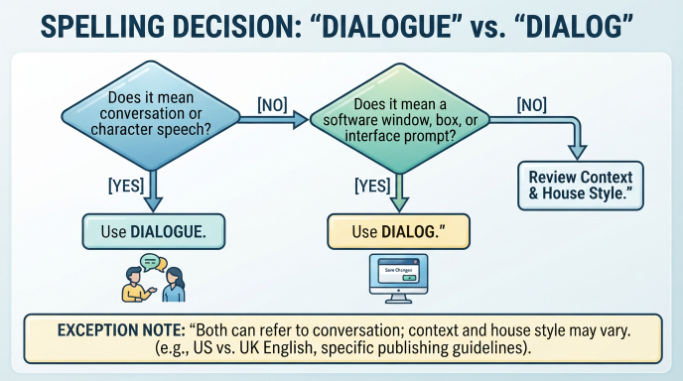
Memory Trick
Think of the -ue in dialogue as the form you are most likely to want in ordinary writing.
Conversation → dialogue
Software interface → dialog
You can also remember the familiar technical phrase:
dialog box
If you are describing something that appears on a computer screen and asks the user to make a choice, dialog is likely the form you need.
For literature, conversation, or character speech, think:
character dialogue
The important thing is to remember the context, rather than treating one spelling as universally correct.
Formal vs Casual and Regional Notes
Neither dialog nor dialogue is inherently a casual version of the other.
The distinction is primarily about usage and convention.
Dialogue is entirely appropriate in formal writing:
The report recommends continued dialogue between the participating organizations.
It is also natural in casual writing:
Their dialogue in that scene was hilarious.
Dialog is also not inherently informal. In a technical document, it may be the most appropriate professional term:
Select the required option from the dialog.
In other words, the choice is not simply:
formal = dialogue
casual = dialog
Instead, consider the subject and terminology of the document.
A software developer writing API documentation may naturally write dialog. A novelist will normally write dialogue. An academic discussing communication will generally write dialogue.
House Style Matters
Organizations sometimes establish their own style conventions. A software company might consistently use dialog throughout its documentation, while a publishing organization might consistently use dialogue.
When editing within an established publication, consistency with the house style can matter more than personal preference.
Frequently Asked Questions
How do you spell dialogue?
The standard spelling is dialogue: D-I-A-L-O-G-U-E.
There is also a valid shorter form, dialog, spelled D-I-A-L-O-G.
How do you spell dialog?
Dialog is spelled D-I-A-L-O-G. It is a valid English word, particularly common in computing and technical contexts.
Is it dialog or dialogue?
Both are correct. Use dialogue as the usual choice for general English, conversation, literature, and character speech. Use dialog frequently in computing and software terminology.
Is dialog a word?
Yes. Dialog is an established English word and is not simply a typographical error. It can mean an exchange or conversation and is especially common as a technical term for a software interface element.
What does dialog mean?
Dialog can mean a conversation or exchange of ideas. In computing, it commonly means a window or interface element through which a program communicates with the user or requests an action.
What is dialogue?
Dialogue is a conversation or exchange between people. It can also mean the spoken words of characters in literature, theater, television, or film.
What is the difference between dialog and dialogue?
The meanings overlap. Dialogue is the standard general-English spelling, while dialog is particularly established in technical and computing contexts. Both can refer to conversation.
Is “dialogue” only British English?
No. Dialogue is standard in both British and American English. American English also uses dialog, particularly in computing and other technical contexts.
Is “dialog” American English?
It is especially common in American technical usage, but it is not exclusively American. The word can occur in other varieties of English as well.
Are “dialogs” and “dialogues” both correct?
Yes. Dialogs is the plural of dialog, while dialogues is the plural of dialogue.
What is another name for dialogue?
Depending on context, possible alternatives include conversation, discussion, exchange, communication, or interaction. They are not perfect synonyms in every situation.
What does “dialog” mean in computing?
In computing, a dialog is an interface element—often a window or box—that communicates information to the user or asks the user to provide information or make a choice.
What does “dialog line” mean?
A dialog line generally means one line of spoken text in a script, screenplay, game, or similar work. Dialogue line is also used.
Is “dialogging” correct?
Dialogging can be formed from dialog, but it is uncommon in general English. Depending on the context, discussing, communicating, or having a dialogue will often sound more natural.
What does “diolog” mean?
Diolog is generally a misspelling, not the standard form. The intended word is usually dialog or dialogue.
How do you spell dialogue in English?
The standard spelling is dialogue. In some contexts, especially computing, dialog is also an accepted form.
Final Takeaway
The choice between dialog vs dialogue is not a simple matter of “correct” versus “incorrect.”
Dialogue is the standard choice for ordinary conversation, an exchange of ideas, and the speech of characters in books, plays, films, and television.
Dialog is a legitimate variant and has a particularly strong role in computing and software terminology, where phrases such as dialog box, modal dialog, and dialog window are common.
The easiest rule is:
Human communication or character speech → dialogue
Software interface → dialog
If you are writing general English and are unsure which spelling to use, dialogue is usually the safer choice. If you are documenting a software interface, follow the terminology used by the relevant software, framework, or house style.