Realise vs Realize: What’s the Difference?
Quick Answer
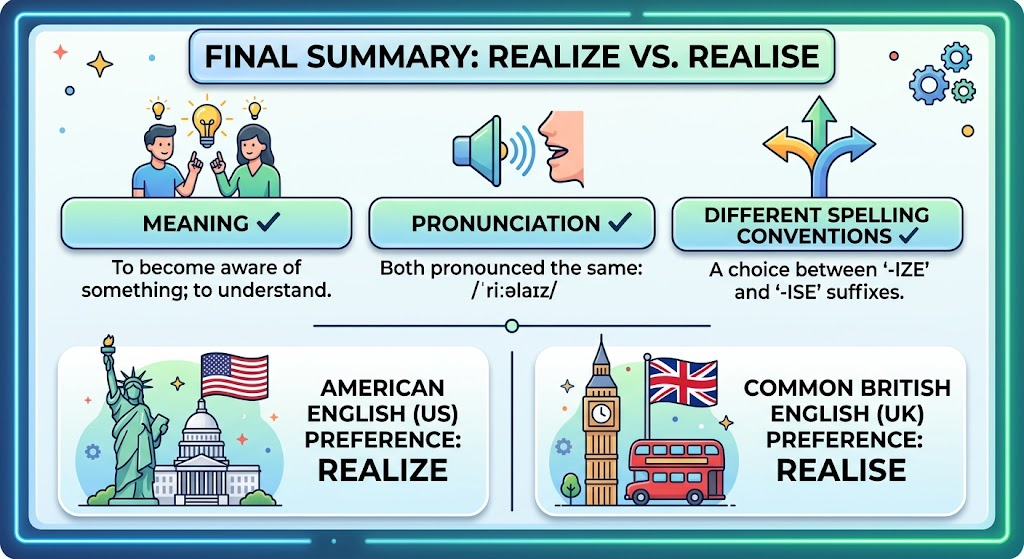
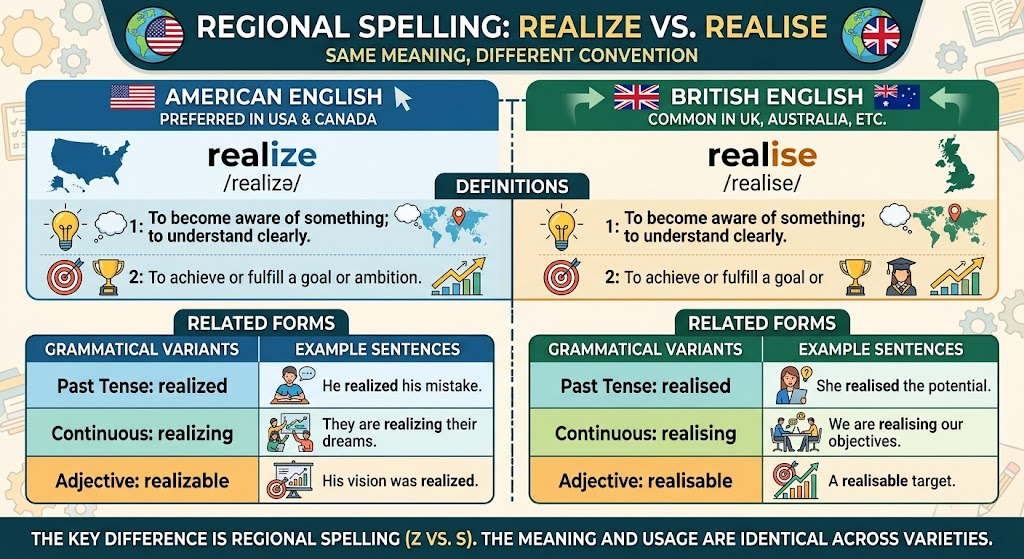
Both realise and realize are correct spellings. The main difference is regional spelling preference, not meaning or grammar.
- Realize is the standard and most common spelling in American English.
- Realise is widely used in British English and other varieties that follow British spelling conventions.
- In British English, both realise and realize can be acceptable in many style traditions, although realise with an s is more common in general British usage.
The words mean the same thing: to become aware of something, understand something, achieve something, or make something real, depending on context.
| Form | Common preference | Meaning |
|---|---|---|
| realize | American English; also accepted in some British styles | Become aware, understand, achieve, or make real |
| realise | British English and many Commonwealth styles | Exactly the same meanings |
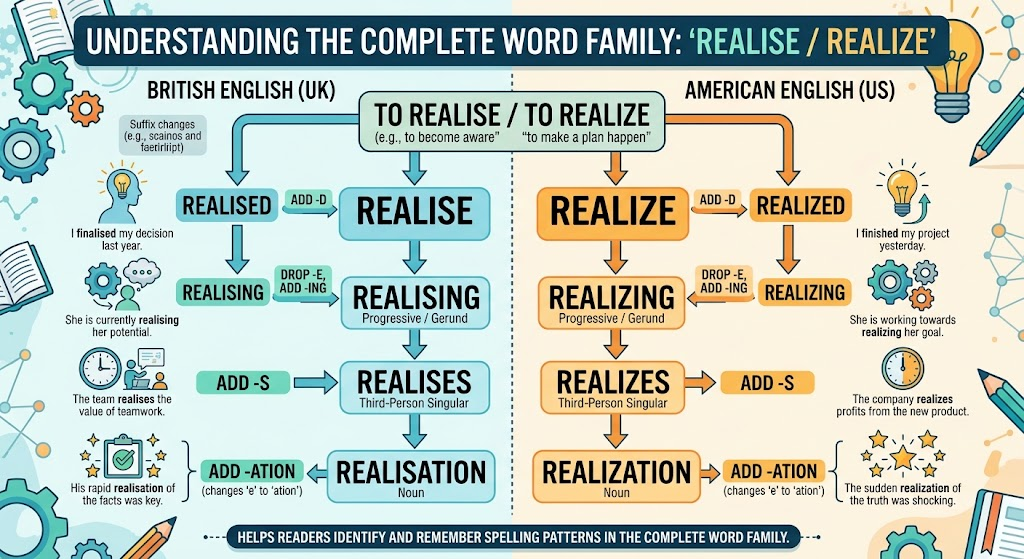
The same regional pattern usually applies to related forms:
- realized / realised
- realizing / realising
- realization / realisation
- realizes / realises
At-a-Glance Table
| Feature | Realise | Realize |
|---|---|---|
| Meaning | Same | Same |
| Part of speech | Verb | Verb |
| Pronunciation | Same | Same |
| American English | Less common | Standard preference |
| British English | Very common | Also accepted in some styles |
| Canadian English | Style-dependent | Often common |
| Australian English | Usually realise | Less common in general usage |
| Past tense | realised | realized |
| -ing form | realising | realizing |
| Noun form | realisation | realization |
The most important point is simple: you do not choose between these spellings because the meaning changes. You choose based on the spelling system or editorial style you are using.
The Detailed Difference Between Realise and Realize
The difference between realise vs realize is primarily a matter of orthography, which means spelling conventions.
Both words can express several closely related ideas.
To become aware of something
This is one of the most common meanings.
- I realized that I had left my keys at home.
- She realised that the meeting had already started.
Both sentences mean that someone suddenly or gradually became aware of a fact.
To understand something fully
Sometimes realize or realise means to understand the importance, truth, or consequences of something.
- He did not realize how difficult the decision would be.
- They eventually realised why the project had failed.
Again, there is no difference in meaning between the spellings.
To achieve something
The verb can also refer to making a goal, ambition, or possibility happen.
- She finally realized her dream of becoming a pilot.
- The company realised its long-term objectives.
This meaning is especially common in more formal writing.
To make something actual or real
In some contexts, the word refers to bringing an idea, plan, value, or possibility into reality.
- The architect realized the original design successfully.
- The team realised the full potential of the new system.
The spelling still depends on the English variety or style guide being followed.
When Should You Use Realise?
Use realise when you are writing in a spelling style that prefers the s form.
This is especially common in:
- British English
- Australian English
- New Zealand English
- Many publications using traditional British spelling conventions
Examples:
- I realise that this may sound surprising.
- Did you realise what happened?
- She realised her mistake immediately.
- We are realising how much preparation is required.
- They celebrated the realisation of their plan.
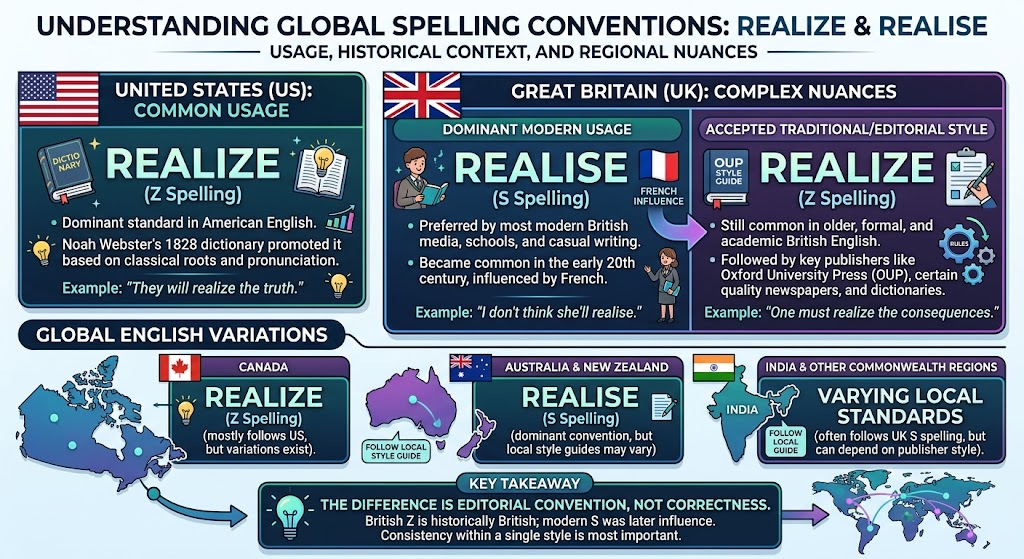
Is realise British?
Yes, realise is strongly associated with British spelling and is widely used in the UK.
However, there is an important nuance: British English is not always as simple as “British uses s and American uses z.”
Some respected British publishing traditions accept or prefer -ize spellings, including realize. This is sometimes called Oxford spelling in discussions of British usage.
So, if you are writing for a particular British publisher, university, organization, or style guide, check its preferred spelling convention.
When Should You Use Realize?
Use realize when writing in American English.
Examples:
- I realize that I was wrong.
- Do you realize how late it is?
- She realized the importance of the opportunity.
- We are realizing that the problem is more complicated than expected.
- His dream became a realization after years of work.
Is realize spelled with an s or z?
The answer depends on the spelling system:
- American English: usually realize
- British English: commonly realise, though realize is accepted by some British style systems
So, realize with a z is not automatically “American only” or incorrect in British English.
That distinction is important because many learners are taught an oversimplified rule that every British spelling uses s where American English uses z. English spelling conventions are more complicated than that.
Realized vs Realised
Realized and realised are both correct past-tense and past-participle forms.
Realized
Commonly preferred in American English:
- I realized my phone was missing.
- She realized that she had misunderstood the instructions.
- We had realized the problem too late.
Realised
Commonly preferred in British English:
- I realised my phone was missing.
- She realised that she had misunderstood the instructions.
- We had realised the problem too late.
What is the difference between realised and realized?
There is no difference in pronunciation, grammar, or basic meaning.
The difference is spelling preference.
Both are pronounced approximately as:
REE-uh-lized
The pronunciation does not change because the spelling changes from s to z.
Realising or Realizing?
The same pattern applies to the present participle.
- realising — commonly British spelling
- realizing — standard American spelling
Examples:
- I am realising how important patience can be.
- I am realizing how important patience can be.
Both sentences are grammatically correct.
Is it realising or realizing?
Both are correct. Choose the spelling that matches your English variety or style guide.
How do you spell realising?
If you use British-style s spelling, write:
realising
If you use American-style z spelling, write:
realizing
The same consistency rule applies throughout a document.
Realises or Realizes?
These are the third-person singular present forms.
- He realises the truth.
- He realizes the truth.
The grammar is identical.
The -s ending in these examples is part of the spelling choice for the verb itself, while the word remains a standard third-person singular verb.
British-style example
- Maria realises that she needs more information.
American-style example
- Maria realizes that she needs more information.
Do not mix forms randomly in the same piece of formal writing.
For example, this is inconsistent in a document following one spelling system:
- ❌ She realises the problem and later realized its cause.
Choose one system unless you have a specific reason to preserve original quotations or different source material.
Realisation vs Realization
The noun forms follow the same spelling pattern.
Realisation
Common in British-style spelling:
- The realisation came too late.
- Her realisation changed the direction of the conversation.
Realization
Standard in American English and accepted in some British style systems:
- The realization came too late.
- His realization changed everything.
Is it realization or realisation?
Both are correct.
Choose according to your preferred spelling convention.
Meaning: Realize vs Know
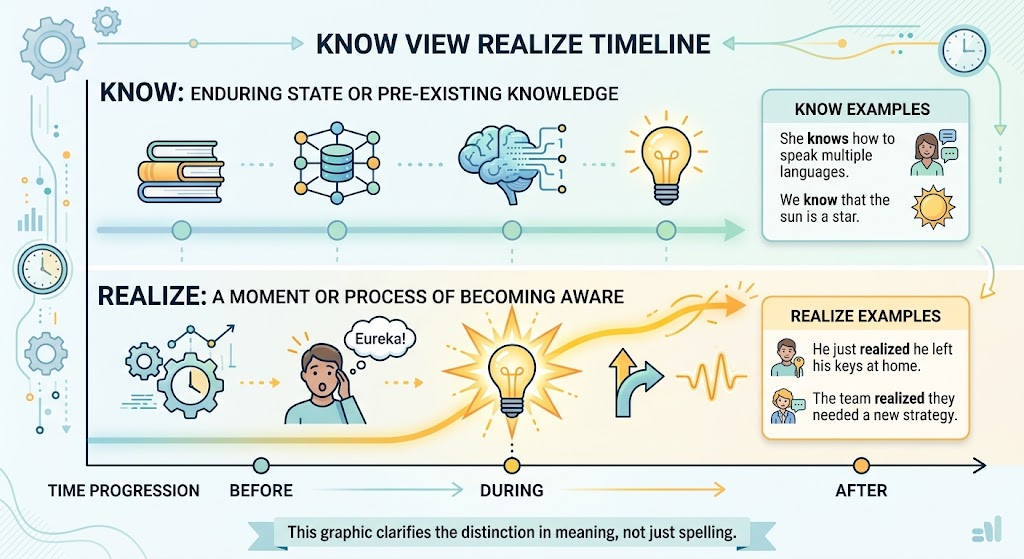
Although realize can sometimes mean know, the two words are not always interchangeable.
Realize often emphasizes becoming aware
- I realized that the door was unlocked.
This suggests that the speaker came to understand or notice something, perhaps at a particular moment.
Know usually describes existing knowledge
- I knew that the door was unlocked.
This simply describes having the information.
Compare:
- I realized that she was upset.
→ I became aware of it. - I knew that she was upset.
→ I already had that knowledge.
This difference is about meaning and context, not British versus American spelling.
Examples of Realise and Realize by Context
Becoming aware of something
British-style spelling:
- I realised that I had read the email incorrectly.
- She did not realise how quickly time had passed.
American-style spelling:
- I realized that I had read the email incorrectly.
- She did not realize how quickly time had passed.
Understanding a situation
British-style spelling:
- We gradually realised that the original plan would not work.
American-style spelling:
- We gradually realized that the original plan would not work.
Discovering the consequences of something
British-style spelling:
- He realised too late that the deadline was Friday.
American-style spelling:
- He realized too late that the deadline was Friday.
Achieving a goal
British-style spelling:
- After years of training, she realised her ambition.
American-style spelling:
- After years of training, she realized her ambition.
Formal business or academic contexts
- The research team realised the limitations of the method.
- The research team realized the limitations of the method.
Both can be formal. The difference is still primarily spelling convention.
Common Mistakes
Mistake: Thinking one spelling is universally wrong
❌ Realise is incorrect.
This is false.
Both realise and realize are established English spellings.
Mistake: Using s and z forms randomly
❌ The team realised the problem after they had realized the earlier mistake.
This may look inconsistent unless the different spellings are intentionally preserved from separate quoted sources.
Better in British-style spelling:
✓ The team realised the problem after they had realised the earlier mistake.
Better in American-style spelling:
✓ The team realized the problem after they had realized the earlier mistake.
Mistake: Changing the meaning unnecessarily
Some learners assume:
- realise = understand
- realize = achieve
That is incorrect.
Both spellings can express the same meanings.
Mistake: Confusing spelling with pronunciation
The words are pronounced the same way in the same accent.
The s/z spelling difference does not create two different pronunciations.
Mistake: Writing relize or relised
❌ relize
❌ relised
The standard spellings are:
✓ realize
✓ realise
✓ realized
✓ realised
The word includes real- at the beginning.
A Fast Decision Rule
Use this checklist when deciding between realise or realize:
Step 1: What English style are you using?
- Writing for a US audience? → realize
- Following common British spelling? → realise
- Following a British style guide that prefers -ize? → realize
Step 2: Check the rest of your document
If you already use:
- organise
- recognise
- realise
then continue with that spelling system.
If you use:
- organize
- recognize
- realize
then stay consistent with the z spelling system.
Step 3: Follow the required style guide
A university, employer, publisher, or client may have its own editorial requirements. That style should take priority over personal preference.

A Practical Proofreading Test
When proofreading, do not search only for realise or realize.
Check the entire word family.
Search your document for:
- realise
- realize
- realised
- realized
- realising
- realizing
- realises
- realizes
- realisation
- realization
Then ask:
Am I following one spelling system consistently?
This is especially useful in longer documents because writers sometimes change spelling automatically while typing or copying material from different sources.
A good proofreading test is to compare the spelling of this word with other similar words in your document.
For example, if your article uses recognize and organize, but suddenly uses realise, check whether that inconsistency is intentional.
Formal, Casual, and Regional Usage
The choice between realise and realize is generally not a difference between formal and informal English.
Both spellings can appear in:
- academic writing
- business writing
- journalism
- books
- emails
- everyday conversation when written down
The deciding factor is usually regional spelling or editorial style.
American English
American English strongly favors:
- realize
- realized
- realizing
- realization
British English
British English commonly uses:
- realise
- realised
- realising
- realisation
However, some British dictionaries, publishers, and academic traditions use or accept -ize spellings.
Canadian English
Canadian English can vary because Canadian writing reflects influences from both British and American traditions.
As a result, realize is commonly seen in Canadian writing, while some organizations may use realise depending on their editorial style.
The safest approach is not to assume that one spelling represents all Canadian writing. Follow the style guide used by your publication, school, organization, or client.
Australian and New Zealand English
These varieties generally favor British-style -ise spelling in ordinary usage:
- realise
- realised
- realising
- realisation
Again, institutional style guides can differ.
Pronunciation and Syllables
How many syllables are in realize?
Realize has three syllables:
re-a-lize
A simple pronunciation guide is:
REE-uh-lize
Realise has the same number of syllables and the same pronunciation pattern.
The spelling difference does not change how the word is normally pronounced.
Memory Trick
Try this simple memory rule:
Think about your audience before you think about the meaning.
You do not need to ask:
“Do I mean something different here?”
Instead, ask:
“Which spelling system am I using?”
A quick memory aid:
- Z → realize → usually think US spelling
- S → realise → commonly think British spelling
Then remember the important exception:
British English can also use -ize in certain editorial traditions.
So the memory trick helps you make a quick choice, but a specific style guide can override the general pattern.
Frequently Asked Questions
Is it realise or realize?
Both are correct. Realize is standard in American English, while realise is common in British-style spelling.
Is realize spelled with an s or z?
It can be spelled with either letter depending on the spelling convention: realise or realize.
Is realised correct spelling?
Yes. Realised is a correct spelling, especially in British English and other varieties that commonly use -ise forms.
How do you spell realized?
In American English, the standard spelling is:
realized
In common British spelling, write:
realised
How do you spell realise?
The British-style spelling is:
realise
The American-style equivalent is:
realize.
Is it realising or realizing?
Both are correct.
- realising is common in British-style spelling.
- realizing is standard in American English.
What is the difference between realised and realized?
There is no basic difference in meaning or grammar. They are different regional or editorial spellings of the same past-tense and past-participle form.
Is it realization or realisation?
Both are correct.
- realization is standard in American English.
- realisation is common in British-style spelling.
How do Canadians spell realize?
Canadian usage varies by publication and style guide. Realize is common, but some Canadian writing follows British-style conventions. Consistency with the chosen editorial style is more important than assuming a single universal Canadian rule.
Does realise mean something different from realize?
No. The spelling difference normally does not change the meaning.
Is realize the same as know?
Not always. Realize often emphasizes becoming aware of something, while know usually describes having information or knowledge already.
Final Takeaway
The answer to realise vs realize is straightforward once you separate meaning from spelling style.
Both words are correct and have the same basic meanings. The choice usually depends on the English variety or editorial convention you are following:
- Realize is standard in American English.
- Realise is common in British-style spelling.
- Some British editorial traditions also accept or prefer realize.
The same pattern applies to realized vs realised, realizing vs realising, realizes vs realises, and realization vs realisation.
The best proofreading rule is simple: choose the spelling system that fits your audience or style guide, then use it consistently throughout your writing.