Restroom vs Bathroom vs Washroom: What’s the Difference?
Quick Answer
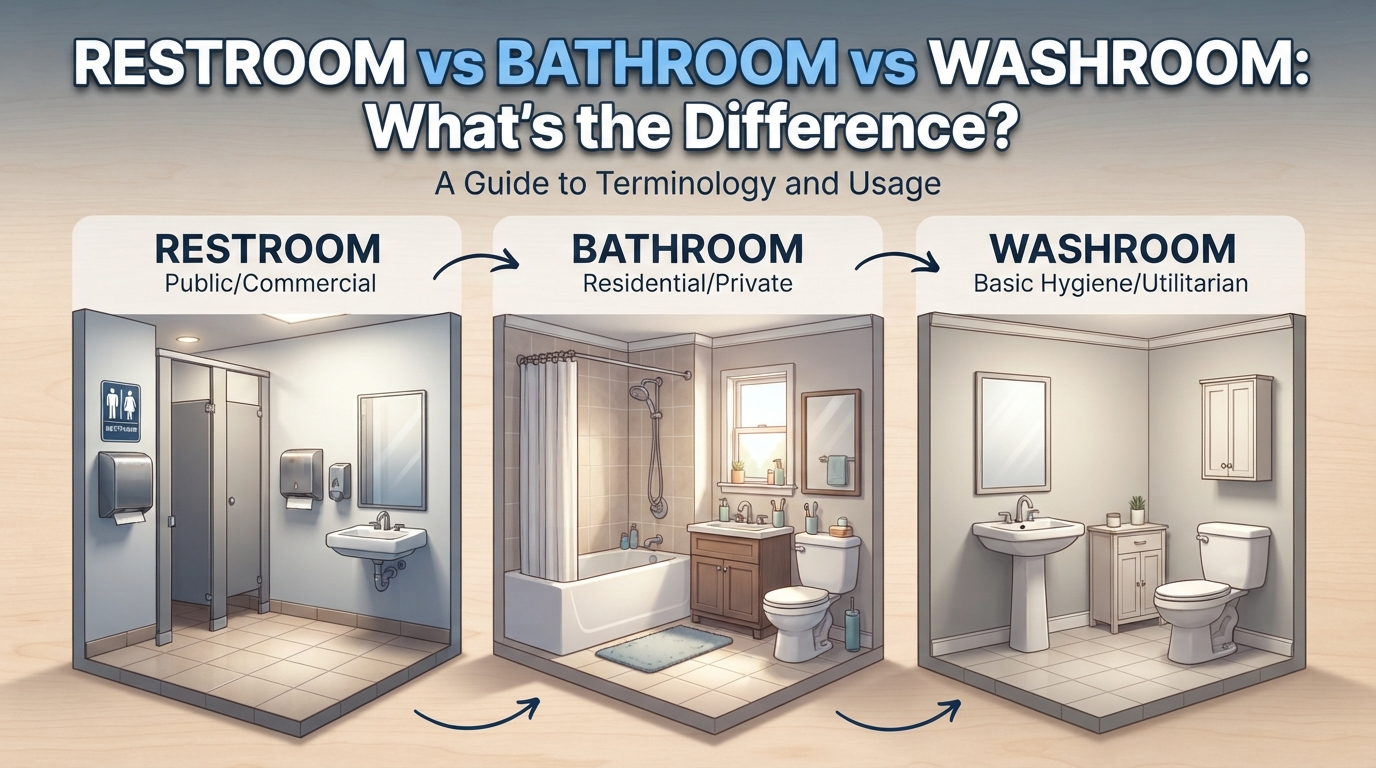
Restroom, bathroom, and washroom can all refer to a room with a toilet and facilities for personal hygiene, but they differ mainly by region, context, and the features being emphasized.
- Bathroom is the most broadly familiar term, especially in American English, and traditionally refers to a room containing a bath or shower, toilet, and sink. It is also commonly used for a toilet-only room in everyday speech.
- Restroom is primarily an American English term for a public or shared toilet facility. It is a polite, somewhat indirect way of referring to a place where people can use the toilet.
- Washroom is especially common in Canadian English and is also widely understood in other varieties of English. It emphasizes washing or personal hygiene rather than bathing.
- Toilet can mean either the plumbing fixture itself or, particularly in British English, the room containing it. In North American English, calling a public room a “toilet” is less usual.
- Lavatory is a more formal or traditional term, particularly in transportation, aviation, and some British contexts.
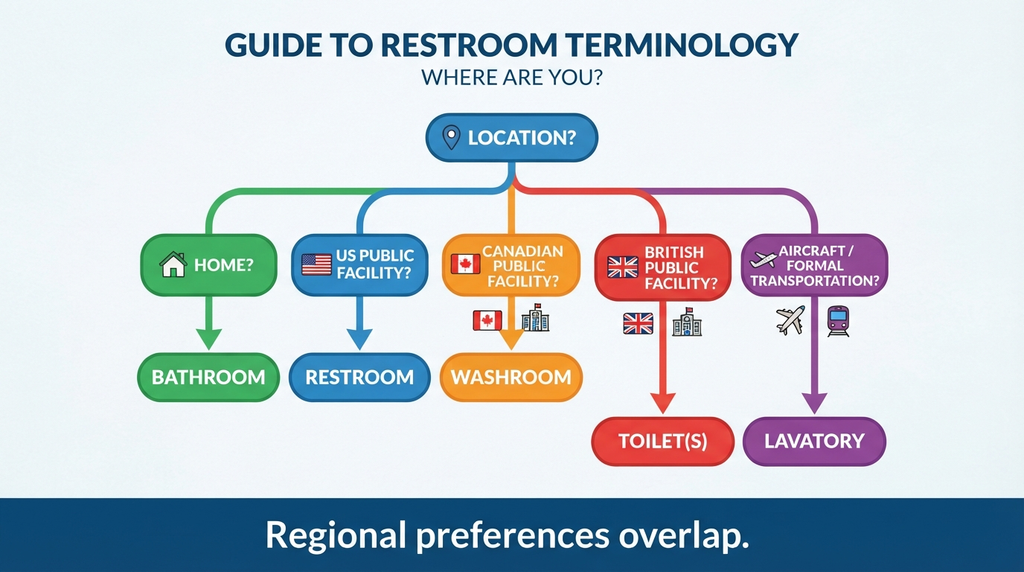
So, if you are talking about your home, “bathroom” is usually natural in American English and widely understood elsewhere. If you are asking for a public facility in the United States, “restroom” is usually the expected term. In Canada, “washroom” is particularly natural.

At-a-Glance Table
| Term | Main meaning | Common regional use | Typical setting | Register |
|---|---|---|---|---|
| Bathroom | Room with toilet and/or bathing facilities | Very common in American English; widely understood internationally | Home, hotel, workplace, public places | Neutral, everyday |
| Restroom | Polite term for a toilet facility | Especially American English | Public or shared facilities | Neutral to polite |
| Washroom | Room containing toilet and washing facilities | Especially Canadian English | Public, workplace, commercial, institutional | Neutral, polite |
| Toilet | Toilet fixture or, in some varieties, the room | Especially British English for the room | Home or public | Neutral, but region-dependent |
| Lavatory | Toilet facility | Formal, traditional, transportation contexts | Aircraft, trains, formal writing | Formal |
| Loo | Toilet/restroom | British and Irish English | Home or public | Informal |
The important point is that these terms overlap. A restroom can contain toilets, sinks, mirrors, and sometimes changing facilities. A washroom can contain exactly the same things. A bathroom may contain a shower or bathtub, but in ordinary conversation the word does not guarantee that one is present.
That is why there is no universal rule saying that a room with a toilet must be called a “restroom,” while one with a bathtub must be called a “bathroom.” English usage depends heavily on dialect and situation.
The Detailed Difference Between Restroom, Bathroom, and Washroom
Bathroom
Bathroom is a noun. It traditionally describes a room used for bathing and personal hygiene, but in modern everyday English it commonly means a room containing a toilet, sink, shower, bathtub, or some combination of these.
In American English, people routinely use bathroom even when the room contains no bathtub. For example:
“The guest bathroom has a shower but no bathtub.”
That sentence is completely natural.
In a home, “bathroom” is generally the safest everyday choice:
“The upstairs bathroom needs a new sink.”
“I left my towel in the bathroom.”
“There are two bathrooms in the house.”
The word can also be used for public facilities:
“Excuse me, where is the bathroom?”
However, in American public places, restroom is often more idiomatic:
“Excuse me, could you tell me where the restroom is?”
The difference is therefore not that “bathroom” is private and “restroom” is public in an absolute grammatical sense. It is a usage preference, especially in American English.
Restroom
Restroom is a noun, and its literal structure is rest + room. In contemporary American English, however, it normally means a facility containing toilets and sinks rather than a room specifically designed for resting.
The term is particularly common in public settings:
“The restrooms are near the entrance.”
“The restaurant has a restroom on the first floor.”
“Please ask an employee if you need assistance locating the restroom.”
It is also frequently used on signs:
RESTROOMS →
The word is generally more indirect than toilet. Instead of naming the fixture directly, it refers to the facility euphemistically.
That does not mean “restroom” always describes a room where people literally rest. In modern usage, that interpretation would normally be incorrect.
Washroom
Washroom is also a noun. It generally refers to a room containing facilities for washing and using the toilet.
The word is strongly associated with Canadian English, where “washroom” is a very ordinary term:
“Where’s the washroom?”
“The washrooms are at the back of the restaurant.”
“There is a public washroom beside the park.”
It is also understood in other English-speaking regions, but its frequency and naturalness vary.
“Washroom” can be especially useful when discussing public facilities because it avoids the potentially confusing distinction between a room used for bathing and a room used primarily for toilet facilities.
Bathroom and Restroom: What Is the Difference?
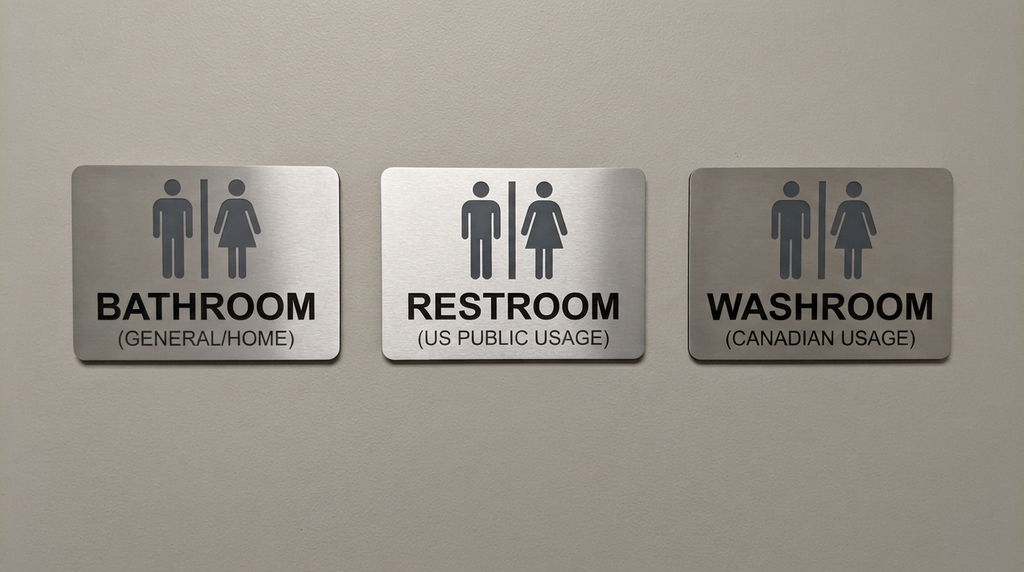
The difference between bathroom and restroom is mainly one of usage and context, not necessarily physical design.
In American English, “bathroom” is especially common for a facility in a home:
“My bedroom is next to the bathroom.”
“Restroom” is particularly common when referring to a public facility:
“The restroom is beside the cafeteria.”
But the boundary is flexible. Americans can certainly say:
“Where’s the bathroom?”
while visiting a restaurant, airport, store, or office.
Likewise, a person can say:
“The bathroom at the restaurant was clean.”
There is no grammatical error here.
A useful distinction is therefore:
bathroom = broad everyday term, especially for homes
restroom = public-facility term, especially in US English
This is a tendency, not an inviolable rule.
Washroom and Bathroom Difference
The washroom and bathroom difference is similarly based more on regional usage than on physical structure.
In Canada, “washroom” is particularly natural for both public and institutional facilities:
“The washroom is down the hall.”
“Bathroom” remains perfectly normal, especially when discussing a home:
“The house has three bathrooms.”
Thus, a Canadian speaker might naturally distinguish the terms by context, but the distinction is not universal.
In American English, washroom is understood but can sound less typical than “restroom” or “bathroom.”
For an international audience, “bathroom” is usually the easiest term to understand without regional context.
Difference Between Restroom and Washroom
There is often no meaningful physical difference between a restroom and a washroom.
A public facility labeled “restroom” may contain:
- toilets
- sinks
- mirrors
- hand dryers or paper towels
- accessible stalls
- baby-changing facilities
A washroom can contain exactly the same things.
The major difference is regional preference:
- Restroom → particularly associated with American English
- Washroom → particularly associated with Canadian English
- Bathroom → broad and internationally recognizable, with strong everyday use in American English
So if someone asks, “What is the difference between restroom and washroom?” the best answer is usually not a difference in architecture but a difference in regional vocabulary and context.
Difference Between Washroom and Toilet
This distinction is more important because toilet has two related meanings.
First, a toilet can mean the plumbing fixture itself:
“The toilet is leaking.”
Second, in British English and some other varieties, toilet can refer to the room containing the fixture:
“Where are the toilets?”
An American speaker is more likely to interpret “toilet” as the fixture and use “restroom” or “bathroom” for the room.
Compare:
British English: “Where are the toilets?”
American English: “Where is the restroom?”
Neither is inherently more correct. They belong to different usage patterns.

Why Is a Bathroom Called a Restroom?
The question “why is a bathroom called a restroom?” involves both historical language development and euphemism.
“Restroom” developed as a polite expression for a public facility. The idea was that such a room provided a place where someone could briefly stop, refresh themselves, or take a private break.
Over time, American English established restroom as a conventional term for public toilet facilities.
Importantly, the word does not require the room to contain beds, chairs, or a dedicated place for resting. Modern speakers generally understand “restroom” as a conventional euphemistic label for a toilet facility.
The same broader linguistic process can be seen in terms such as lavatory, washroom, and comfort room. Different communities have developed different polite or indirect ways of referring to bodily functions.
The Origin of “Restroom”
The history of restroom is more complicated than the simple claim that it literally means “a room for resting.”
The modern sense developed through the use of “rest” as a polite reference to taking a private break. The term became associated with public toilet facilities in American English.
It is therefore safer to understand the modern word as a conventional euphemism rather than interpreting its two component words literally.
If historical precision matters, avoid saying that “restroom” was originally invented specifically as another word for “bathroom” without qualification. Its development reflects broader changes in the vocabulary used for public sanitation and bodily functions.
Restroom vs Toilet
The difference between restroom and toilet depends heavily on whether you mean the fixture or the room.
| If you mean… | Natural term |
|---|---|
| The plumbing fixture | toilet |
| A public facility in US English | restroom |
| A room in a Canadian public building | washroom |
| A home facility in American English | bathroom |
| A public facility in British English | toilet / toilets |
| An aircraft facility | lavatory |
For example:
“The toilet is blocked.”
Here, toilet means the fixture.
But:
“The restroom is closed for cleaning.”
Here, restroom means the facility or room.
These words can therefore refer to related things without being exact synonyms in every sentence.
Lavatory vs Bathroom
Lavatory is another word that often enters this discussion.
In everyday American conversation, “lavatory” can sound formal or institutional. It is particularly familiar in contexts such as airplanes:
“The aircraft lavatory is located at the front of the cabin.”
In British English, “lavatory” has historically been used for a toilet or toilet room, although everyday speech often favors toilet or loo.
A bathroom, by contrast, is a much more ordinary everyday word, especially for residential settings.
Comfort Room vs Bathroom
Comfort room is a regional expression used in some varieties of English, particularly in parts of Asia. It can refer to a public toilet facility.
It should not be assumed to be standard everyday vocabulary throughout the English-speaking world.
For a broad international audience, bathroom, restroom, or washroom will generally communicate the intended meaning more reliably, depending on the regional context.
When Should You Use Each Word?
Use “bathroom” when talking about a home
This is the safest choice in many everyday situations:
“The bathroom needs cleaning.”
“I’ll be in the bathroom for a minute.”
“The master bathroom has a large shower.”
In American English, “bathroom” is also acceptable for many public facilities.
Use “restroom” for public facilities in American English
Choose “restroom” naturally in places such as:
- restaurants
- airports
- shopping centers
- offices
- schools
- theaters
- public buildings
Examples:
“The restrooms are on the second floor.”
“Could you tell me where the restroom is?”
“The men’s restroom is temporarily closed.”
Use “washroom” when Canadian English is relevant
Examples:
“The washroom is beside the dining area.”
“The public washrooms are near the entrance.”
For Canadian audiences, this can sound completely ordinary rather than unusual.
Use “toilet” when discussing the fixture
“The toilet needs repairing.”
“Please don’t put paper towels down the toilet.”
If you mean the room, regional context becomes important.
Use “lavatory” in formal or transportation contexts
“The lavatory is located at the rear of the aircraft.”
It is accurate, but often more formal than “bathroom” or “restroom.”
Examples by Context
At home
Natural:
“The bathroom is upstairs.”
“I need to clean the bathroom.”
“The children share one bathroom.”
“Restroom” is possible but unusual for most American speakers when talking about their own home.
In a restaurant
American English:
“Excuse me, where’s the restroom?”
Canadian English:
“Excuse me, where’s the washroom?”
Also widely understandable:
“Excuse me, where’s the bathroom?”
The three sentences communicate essentially the same practical request, but their regional naturalness differs.
At an airport
American English:
“Is there a restroom near Gate 12?”
British English:
“Are there toilets near Gate 12?”
Formal transportation language:
“The lavatory is located at the rear of the aircraft.”
In a hotel
All of these may occur:
“The bathroom is next to the bedroom.”
“There is a restroom in the lobby.”
“The public washroom is on the ground floor.”
The appropriate term depends on whether you are talking about a private guest bathroom or a public facility, as well as the variety of English being used.
In a workplace
American English:
“The restrooms are down the hall.”
At home or in a residential-office context:
“The bathroom is next to the conference room.”
Canadian English:
“The washroom is across from the elevator.”
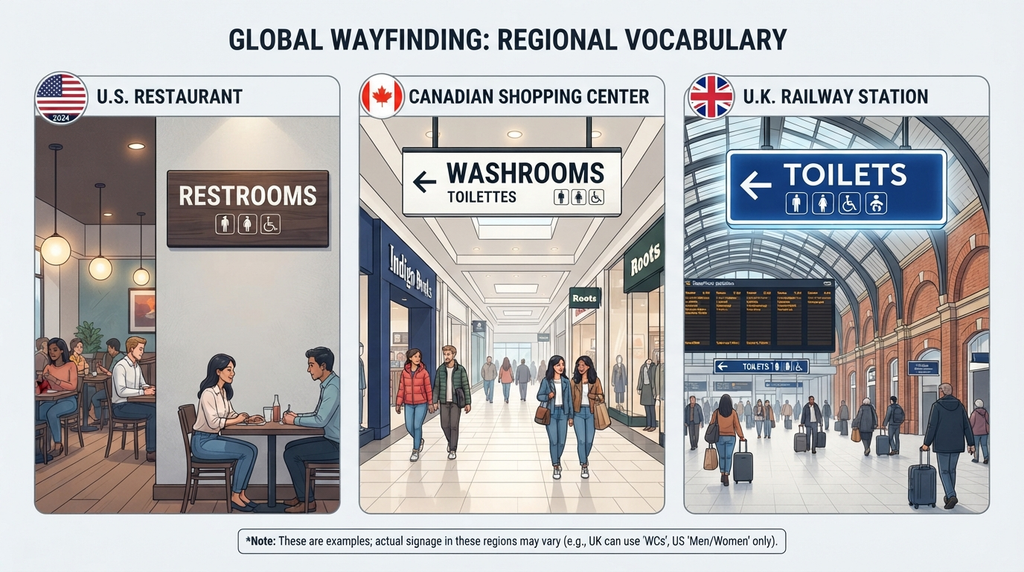
On a sign
Public signs tend to favor established local conventions:
RESTROOMS
WASHROOMS
TOILETS
These can all be perfectly natural in the right English-speaking region.
Grammar and Usage
All three primary terms are countable nouns.
Bathroom
Singular:
“The bathroom is clean.”
Plural:
“The bathrooms are clean.”
Possessive:
“The guest bathroom is upstairs.”
Restroom
Singular:
“The restroom is closed.”
Plural:
“The restrooms are open.”
Possessive:
“The women’s restroom is on the left.”
Washroom
Singular:
“The washroom is downstairs.”
Plural:
“The washrooms are downstairs.”
There is no special grammatical rule that makes one of these words grammatically different from the others. Their differences are primarily semantic, regional, contextual, and stylistic.
Rest Room or Restroom?
The standard modern spelling for the public-facility sense is generally restroom, written as one word.
“Where is the restroom?”
Rest room as two words can occur when the literal meaning is genuinely a room for resting:
“The hospital has a small rest room for staff.”
Even then, context can make the intended meaning clear.
For the ordinary American English public-toilet sense, restroom is the conventional spelling.
Common spelling mistakes
Informal searches sometimes produce forms such as:
- resthroom
- restrom
- restriom
- restrrom
- restroomm
These are spelling errors. The standard spelling is:
restroom
Pronunciation
Bathroom is commonly pronounced approximately:
BATH-room
In many American accents, the vowel in bath is different from the vowel used in many British accents.
Restroom is pronounced approximately:
REST-room
Washroom is pronounced approximately:
WOSH-room in many accents, although the exact vowel varies by dialect.
The pronunciation differences are not normally difficult enough to create major communication problems.
Common Mistakes and Corrections
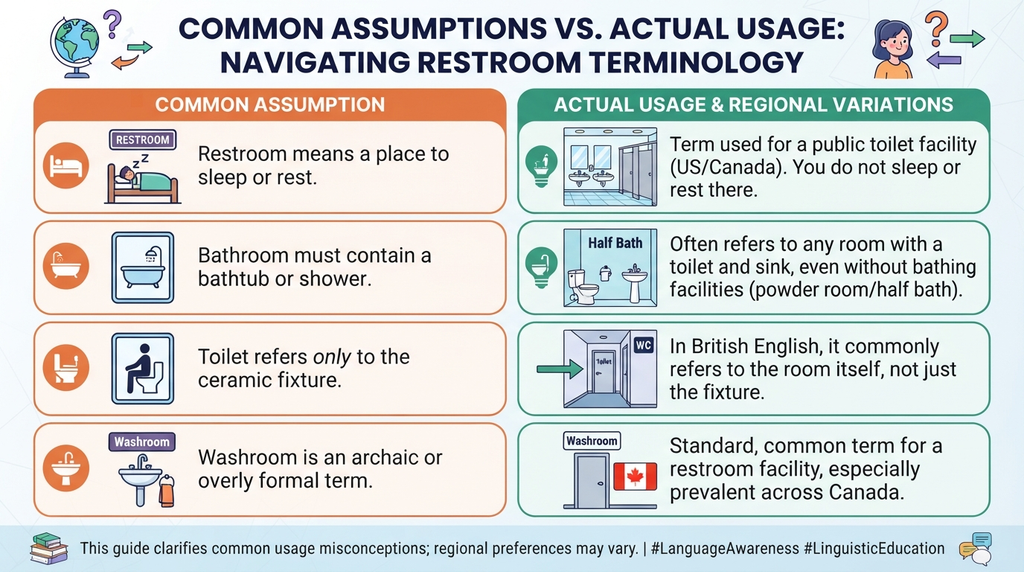
Mistake 1: Treating restroom and bathroom as completely different rooms
Incorrect assumption:
“A restroom cannot be a bathroom.”
In ordinary English usage, that is too rigid.
Better understanding: A restroom and a bathroom can refer to physically similar facilities; the choice often depends on setting and dialect.
Mistake 2: Assuming “bathroom” must contain a bathtub
A bathroom does not necessarily have to contain a bathtub in modern everyday American usage.
“The apartment has a small bathroom with only a shower.”
This is perfectly natural.
Mistake 3: Assuming “restroom” is universal
“Restroom” is especially characteristic of American English.
A British speaker may naturally say:
“Where are the toilets?”
A Canadian speaker may naturally say:
“Where’s the washroom?”
Mistake 4: Assuming “toilet” always means the fixture
In British English, “toilet” can naturally refer to the room:
“The toilets are at the end of the corridor.”
In American English, the same sentence may sound as though the speaker is referring specifically to toilet fixtures rather than the room.
Mistake 5: Using “washroom” as though it were the standard term everywhere
“Washroom” is especially associated with Canadian English. It is understood elsewhere, but its naturalness varies.
Mistake 6: Assuming “restroom” literally means a room for resting
Modern speakers normally interpret restroom as a toilet facility in American English.
Its historical development does not require the room to be used for relaxation.
A Fast Decision Rule
When choosing between restroom, bathroom, and washroom, ask two questions.
Question 1: What English variety am I writing for?
- American → bathroom/restroom
- Canadian → bathroom/washroom
- British → bathroom/toilet/loo, depending on context
Question 2: What setting am I describing?
- Home → bathroom is usually natural
- Public facility in the US → restroom
- Public facility in Canada → washroom
- British public facility → toilet/toilets
- Aircraft → lavatory is common in formal terminology
This is a useful decision rule, but it should not be treated as a grammar law.
The Practical Proofreading Test
If you are unsure which word to use, replace the word temporarily with “toilet facility.”
Then ask:
Am I talking about the room in a home?
Use bathroom in many varieties of English.
Am I referring to a public facility for an American audience?
Use restroom if that matches the tone.
Am I writing for Canadians?
Use washroom when that is the established local preference.
Am I writing British English?
Consider toilet or toilets, depending on the sentence.
The goal is not to find one universally correct word. The goal is to choose the word that sounds natural to the intended audience.
Formal vs Casual and Regional Notes
There is no simple hierarchy in which “bathroom” is casual, “restroom” is formal, and “washroom” is informal.
Instead, these terms belong to different regional and contextual patterns.
“Bathroom” is an ordinary everyday word.
“Restroom” is also ordinary everyday language in American English, although its public-facility association makes it more common in certain contexts.
“Washroom” is ordinary everyday language for many Canadian speakers.
“Lavatory” tends to be more formal or institutional.
“Loo” is informal British English.
This distinction matters when editing for an international audience. A sentence can be grammatically perfect and still sound regionally unusual.
For example, an American reader will understand:
“Where is the washroom?”
But “Where is the restroom?” may sound more expected in the same American setting.
Likewise, a British reader will understand “restroom,” but toilets may be the more familiar everyday choice.
Bathroom and Toilet Difference
A bathroom is primarily a room. A toilet can refer to the fixture inside that room or, in some varieties of English, the room itself.
Compare:
“The bathroom has a broken toilet.”
Here the two nouns clearly refer to different things.
The bathroom is the room.
The toilet is the fixture.
But:
“The toilets are downstairs.”
In British English, this can mean the toilet facilities or rooms downstairs.
This is why dictionary definitions alone do not always solve the problem. Context and regional usage determine what a listener is likely to understand.
What Is a Restroom?
A restroom is a room or public facility containing toilets and related hygiene facilities, especially in American English.
Example:
“The restroom is next to the elevators.”
The term is especially common in public places and on signs.
It is not normally used to mean a bedroom, lounge, or ordinary room where people take a rest.
What Is a Washroom?
A washroom is a room containing facilities for washing and usually using the toilet.
It is especially common in Canadian English:
“The washroom is on the left.”
Depending on the speaker and location, it can be synonymous in practical use with restroom or bathroom.
What Is a Restroom Used For?
A restroom is primarily used for:
- using the toilet
- washing hands
- personal hygiene
- changing or freshening up
- sometimes using accessibility or baby-care facilities
The term itself does not specify every facility inside the room.
Are “Restrooms” and “Bathrooms” the Same?
Sometimes, but not always.
A restroom generally refers to a toilet facility, particularly in public American contexts.
A bathroom can refer to a complete bathing and toilet room, especially in a home.
But an American “bathroom” can contain only a toilet and sink, and a public “restroom” can contain many of the same fixtures as a residential bathroom.
So the terms overlap substantially without being perfectly interchangeable in every context.
Is “Bathroom” or “Restroom” More Polite?
Neither is inherently more polite in every context.
In American English, restroom is a conventional euphemistic term for a public toilet facility. It can therefore sound more indirect than saying “toilet.”
But “bathroom” is also entirely polite:
“Excuse me, where’s the bathroom?”
For a formal setting, the best choice is usually the locally conventional term rather than the word that seems artificially formal.
Is “Washroom” or “Restroom” Better?
There is no universal winner.
For a Canadian audience, “washroom” is especially natural.
For an American audience, “restroom” is especially natural for public facilities.
If your audience is international and you are describing a private home, bathroom is often the clearest choice.
The appropriate word depends on the audience, not on an absolute hierarchy of correctness.
Frequently Asked Questions
What is the difference between restroom and bathroom?
The distinction is primarily contextual and regional. In American English, “bathroom” is especially common for homes, while “restroom” is particularly common for public facilities. The physical facilities can be very similar.
What is the difference between restroom and washroom?
There is usually little or no physical difference. “Restroom” is especially associated with American English, while “washroom” is especially associated with Canadian English.
What is the difference between washroom and bathroom?
Both can describe a room containing a toilet and washing facilities. “Bathroom” is broadly used, especially in American English, while “washroom” is particularly common in Canadian English.
What is the difference between washroom and toilet?
“Washroom” normally refers to the room or facility. “Toilet” can refer to the plumbing fixture itself and, especially in British English, can also refer to the room containing it.
Is restroom one word or two?
For the standard American public-facility meaning, restroom is normally written as one word.
Is “restroom” American or British?
Restroom is strongly associated with American English. British speakers are more likely to use toilet, toilets, or loo in ordinary conversation.
Do Americans say washroom?
Americans understand “washroom,” but “restroom” or “bathroom” is generally more typical depending on the situation.
Do Canadians say bathroom?
Yes. “Bathroom” is widely understood and used in Canada. “Washroom” is particularly characteristic of Canadian usage, especially for public facilities.
Can bathroom mean a room without a bathtub?
Yes. In modern everyday American English, a bathroom can contain a shower instead of a bathtub, or even primarily toilet and sink facilities.
Is “toilet” rude in American English?
Not inherently, but using “toilet” to mean a public room can sound less idiomatic in American English than “restroom.” When referring to the fixture, “toilet” is completely ordinary.
Is “lavatory” the same as “restroom”?
They can refer to the same type of facility, but lavatory is more formal or institutional and is particularly common in transportation contexts such as aircraft.
What does “restroom” mean?
A restroom is a room or facility with toilets and related hygiene facilities, especially in American English.
Why is it called a restroom?
“Restroom” developed as a polite, indirect expression associated with taking a private break. In modern American English, it became established as a conventional term for public toilet facilities.
What is the British word for restroom?
Toilet or toilets is the ordinary term in many British contexts. Loo is a common informal alternative.
What is the Canadian word for restroom?
Washroom is particularly common in Canadian English, although “bathroom” is also widely used.
Final Takeaway
Restroom vs bathroom vs washroom is mainly a question of regional vocabulary and context, not three rigidly different types of rooms.
Use bathroom for a broad, everyday term, especially when discussing a home. Use restroom for a public toilet facility when writing American English. Use washroom when Canadian English or a similar regional convention calls for it.
And remember the crucial distinction with toilet: it can mean the physical fixture, while in British English it can also naturally refer to the room or facility.
The best choice is therefore the one that matches your audience, region, setting, and intended meaning.