Instructions on or Instructions for: Which Is Correct?
Quick Answer
Both “instructions on” and “instructions for” are grammatically correct, but they are used in different contexts.
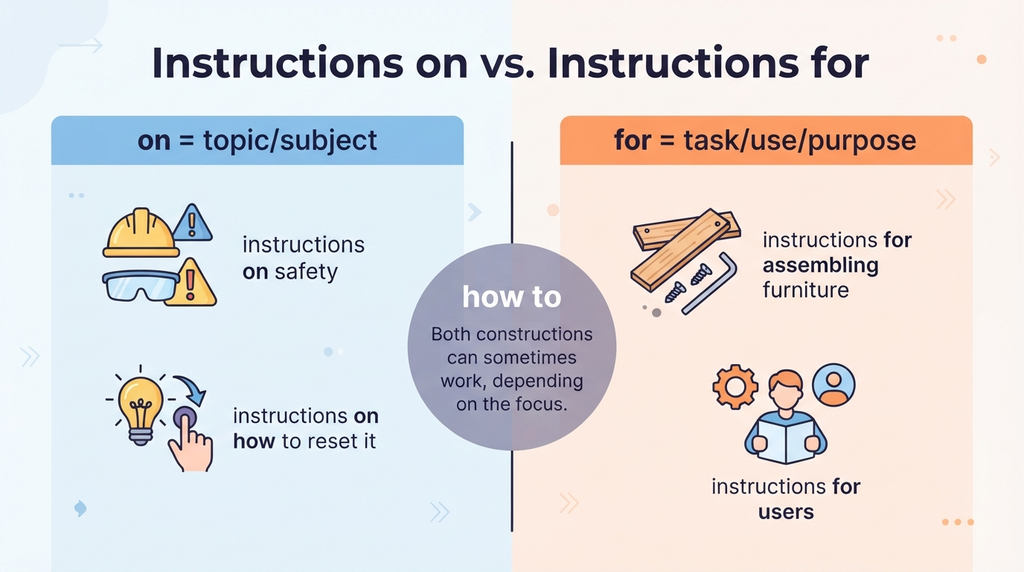
- Use instructions for when you mean directions explaining how to do something, use something, or complete a task.
- instructions for assembling the desk
- instructions for using the software
- instructions for completing the application
- Use instructions on when you mean guidance or information about a subject, topic, or procedure.
- instructions on how to reset the device
- instructions on workplace safety
- instructions on completing the form
There is considerable overlap. In many sentences, especially before how to + verb, both forms are possible:
instructions on how to install the printer
instructions for how to install the printer
The first is generally more idiomatic in standard edited English. However, instructions for installing the printer is also natural and often more concise.
So the practical rule is:
Use “instructions for” for a task, object, or purpose; use “instructions on” for a topic or subject.
At-a-Glance Table
| Expression | Main function | Typical meaning | Example |
|---|---|---|---|
| instructions for | Identifies a task, use, purpose, or thing | Directions intended to help someone do or use something | instructions for installing the app |
| instructions on | Identifies a topic or subject | Guidance or information concerning something | instructions on workplace safety |
| instructions on how to | Introduces a specific method or procedure | Guidance about how a particular action is performed | instructions on how to reset the router |
| instructions for how to | Possible, but often wordier | Directions concerning a method | instructions for how to reset the router |
| instructions to | Usually identifies the person receiving an instruction or a particular directive | A command or directions given to someone | instructions to employees |
| instructions about | Introduces a subject in a broad way | Information concerning a topic | instructions about the registration process |
The key difference is not that one preposition is “correct” and the other is “incorrect.” The difference is mainly what the following phrase represents.
For commonly points toward a purpose, task, use, recipient, or intended function. On commonly introduces a subject or topic.
The Detailed Difference Between “Instructions on” and “Instructions for”
When “instructions for” is the natural choice
Use instructions for when the noun phrase after for identifies something the instructions are intended to help someone accomplish.
For example:
I need the instructions for assembling this shelf.
Here, assembling this shelf is an activity. The instructions tell you how to perform that activity.
Other natural examples include:
- instructions for installing a ceiling fan
- instructions for operating the machine
- instructions for submitting an application
- instructions for preparing the equipment
- instructions for changing the password
- instructions for completing the survey
- instructions for connecting the cables
A useful grammatical pattern is:
instructions for + noun/gerund
Examples:
instructions for the machine
instructions for installation
instructions for installing the machine
The final version is especially common because installing functions as a gerund and names the activity being explained.
When “instructions on” is the natural choice
Use instructions on when the phrase following on represents a subject, topic, area of guidance, or procedure being discussed.
For example:
The handbook contains instructions on workplace safety.
The instructions are concerned with the subject of workplace safety. The phrase does not necessarily identify one particular physical task.
More examples:
- instructions on data protection
- instructions on emergency procedures
- instructions on safe handling
- instructions on account security
- instructions on using the reporting system
- instructions on how to contact support
The construction is especially natural when the following phrase feels like a topic heading.
Compare:
instructions on cybersecurity
instructions for securing the network
The first presents cybersecurity as a subject. The second presents securing the network as an action or task.

“Instructions for” With a Gerund
One of the most useful patterns to remember is:
instructions for + -ing
For example:
- instructions for cooking rice
- instructions for configuring the device
- instructions for opening the account
- instructions for updating the application
- instructions for cleaning the filter
This construction is concise because the -ing form names the activity.
Consider:
Please read the instructions for updating your account.
The instructions are designed to help the reader perform the activity of updating the account.
This is often more natural than:
Please read the instructions for how to update your account.
The longer version is not necessarily ungrammatical, but it can be unnecessarily wordy.
“Instructions on How to”
The structure instructions on how to + verb is very common and perfectly natural.
Examples:
The website provides instructions on how to change your username.
We received instructions on how to operate the emergency equipment.
The guide includes instructions on how to recover a deleted file.
Here, on introduces the subject of the instructions: the method or procedure for performing an action.
The construction is especially useful when the writer wants to emphasize the method rather than simply naming the task.
There is, however, a useful stylistic alternative:
instructions for changing your username
This version is shorter and often preferable in headings, manuals, labels, and other compact writing.
Is “Instructions for How to” Correct?
Yes, instructions for how to can occur in standard English, but it is often less economical than the alternatives.
For example:
The manual gives instructions for how to reset the device.
This is understandable and grammatically possible. But many editors would prefer:
The manual gives instructions on how to reset the device.
or:
The manual gives instructions for resetting the device.
The choice depends partly on style and sentence structure.
A useful editing principle is:
If “for how to” sounds unnecessarily long, replace it with either “on how to” or “for + -ing.”
Do not treat for how to as an automatic grammatical error. The issue is usually economy and idiomatic style, not a simple correct-versus-incorrect rule.
Instructions vs. Directions
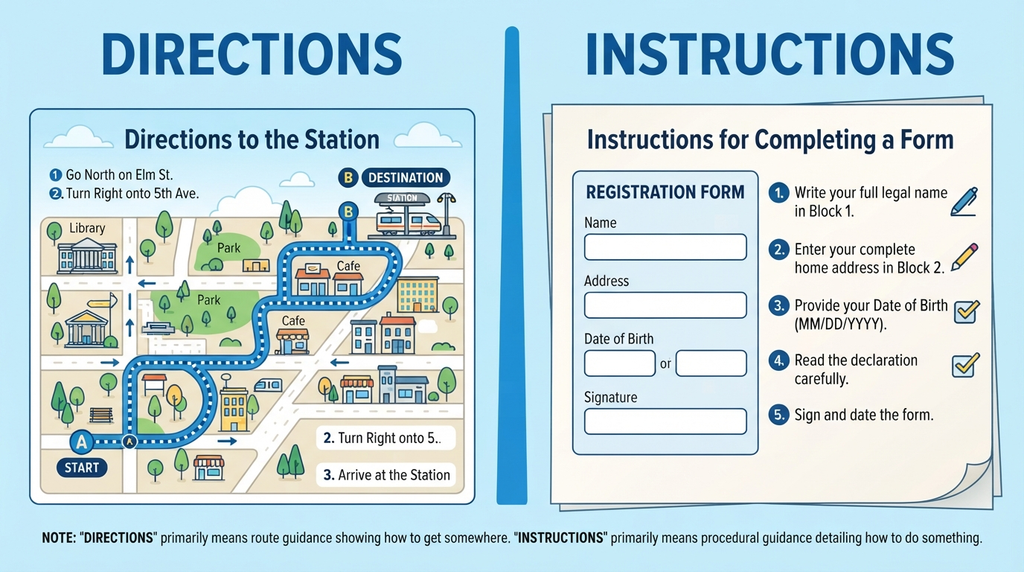
The words instructions and directions overlap, but they are not identical.
Instructions usually refer to information explaining how to perform a task, operate something, follow a procedure, or achieve a result.
Follow the instructions for installing the software.
Directions can also mean procedural guidance, but they have another especially common meaning: information about where to go or how to reach a place.
Can you give me directions to the station?
That distinction makes the following pairs useful:
| Context | More natural expression |
|---|---|
| How to assemble furniture | instructions |
| How to operate a machine | instructions |
| How to complete a form | instructions |
| How to reach a building | directions |
| How to get from one street to another | directions |
| Rules for completing a task | instructions |
| Steps in a recipe | instructions/directions, depending on context |
There is still overlap. A teacher might say:
Read the directions before beginning the exercise.
And a manual might say:
Follow the instructions carefully.
Neither word is restricted to one meaning.
The distinction is therefore a tendency, not an absolute grammatical boundary.
Instructions vs. Directions: Why the Difference Matters
Consider these sentences:
The website provides directions for completing the registration.
Here, directions means procedural guidance.
Now compare:
The website provides directions to the registration office.
Here, directions means route information.
The preposition can therefore help clarify the meaning:
- directions to the airport → how to get there
- directions for completing the form → how to complete it
This is one reason instructions is often the clearer choice when you are talking specifically about a procedure.
When to Use “Instructions for”
Choose instructions for when the following phrase names:
A task
instructions for assembling the cabinet
An activity
instructions for preparing the sample
A process
instructions for submitting a claim
A purpose or use
instructions for emergency use
A thing being operated or handled
instructions for the new printer
The construction is especially natural in titles and labels:
- Instructions for Installation
- Instructions for Use
- Instructions for Assembly
- Instructions for Applicants
- Instructions for Completing the Form
- Instructions for New Users
Notice that for can introduce either a person, thing, activity, or purpose. Its meaning is determined by the relationship between the words.
When to Use “Instructions on”
Choose instructions on when the following phrase names a topic or area of information.
A subject
instructions on data security
A broad area of guidance
instructions on safe storage
A procedure expressed as “how to”
instructions on how to reset the system
A technical or professional topic
instructions on handling confidential documents
This form is particularly natural when the writer is discussing guidance as a subject rather than naming a single task.
For example:
The training manual contains detailed instructions on cybersecurity.
That sounds natural because cybersecurity is the topic.
But:
The manual contains instructions for securing the network.
sounds more task-oriented because securing the network describes an action.
Examples by Context
Manuals and technical writing
Both forms are common in technical documentation.
Read the instructions for installing the software.
See the instructions on how to configure the server.
The manual provides instructions for connecting the device.
The guide contains instructions on network configuration.
A technical writer may choose for + -ing for concise task descriptions and on + noun/how to for topics and explanatory sections.
Workplace communication
Please follow the instructions for submitting your expenses.
Employees received instructions on workplace safety.
The supervisor gave us instructions on how to handle the equipment.
You will receive instructions for completing the onboarding forms.
Here, the choice depends on whether the writer is presenting a specific task or a subject/procedure.
Education
Read the instructions for completing the exercise.
The teacher gave instructions on how to structure the essay.
The worksheet contains instructions for the final activity.
Students received instructions on proper citation practices.
Applications and forms
Please read the instructions for completing this application.
The website includes instructions on how to upload your documents.
Follow the instructions for submitting your application.
The for + -ing construction is particularly efficient in formal forms and administrative writing.
Recipes and practical activities
The cookbook includes instructions for making fresh pasta.
Follow the instructions for preparing the sauce.
In these contexts, for + gerund is usually straightforward because the gerund names the activity.
Websites and help pages
You can find instructions on how to change your password.
See our instructions for resetting your account.
The support page contains instructions on account recovery.
All three structures can work, but their emphasis differs slightly.

Common Mistakes
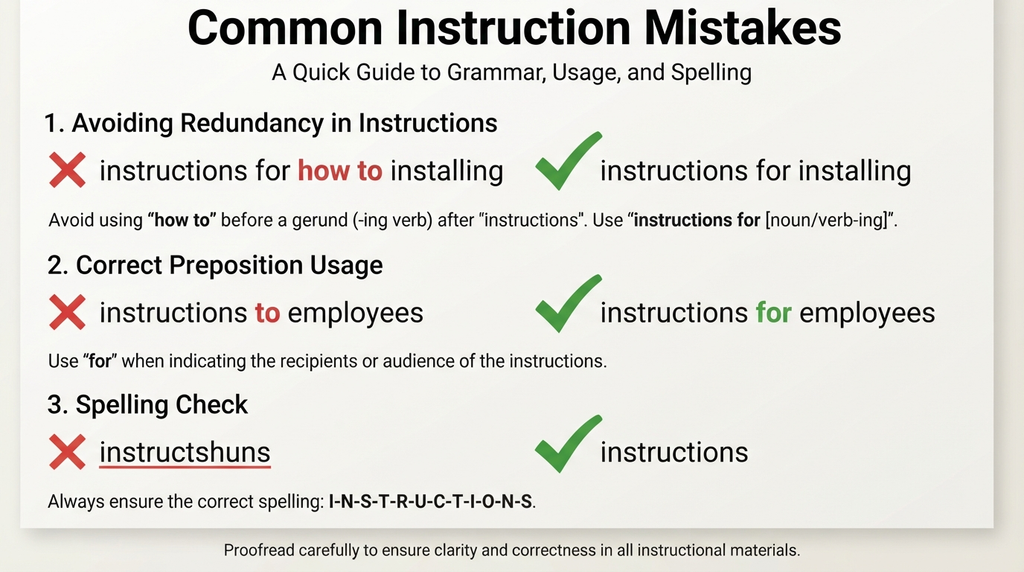
Mistake 1: Assuming “instructions on” is always wrong
Incorrect reasoning:
“You give instructions for something, so instructions on must be incorrect.”
That is not true.
Correct examples include:
instructions on workplace safety
instructions on how to use the software
instructions on emergency procedures
On is completely standard when it introduces a subject or topic.
Mistake 2: Assuming “instructions for” is always followed by a noun
It can be followed by a noun:
instructions for users
But it can also be followed by a gerund:
instructions for installing the program
The gerund identifies the activity.
Mistake 3: Automatically using “for how to”
instructions for how to repair the device
This is possible, but it is often unnecessarily long.
Prefer one of these when appropriate:
instructions on how to repair the device
or
instructions for repairing the device
Mistake 4: Confusing “instructions to” with “instructions for”
Compare:
instructions for employees
and:
instructions to employees
The first describes instructions intended for employees.
The second emphasizes instructions given to employees.
For example:
The handbook contains instructions for employees.
The manager issued instructions to employees.
The difference is subtle but useful.
Mistake 5: Treating “instructions” as a singular noun
In ordinary modern English, instructions is normally plural when referring to a set of directions.
Please follow the instructions.
Not:
Please follow the instruction.
However, instruction can be singular when referring to an individual directive or to teaching in a broader sense:
The teacher gave one clear instruction.
The course provides instruction in basic writing.
So instruction or instructions depends on meaning.
Mistake 6: Confusing “instructions” with spelling variants
The correct spelling is:
instructions
Common misspellings include forms such as insuctions and instrustions.
The singular is instruction.
A Fast Decision Rule
Use this three-question test.
1. Is the phrase naming a task or activity?
Use for.
instructions for installing the printer
2. Is the phrase naming a topic or subject?
Use on.
instructions on printer maintenance
3. Does the sentence use “how to”?
On how to is often the most natural choice.
instructions on how to install the printer
But if you can naturally change the verb into an -ing form, for + -ing may be cleaner:
instructions for installing the printer
This test will solve most everyday cases.
The Practical Proofreading Test
If you are unsure, replace the phrase with a question.
Ask:
“What is the subject of these instructions?”
If the answer is a topic, on may fit:
instructions on cybersecurity
If the answer is an action someone needs to perform, for + -ing is often a good choice:
instructions for securing the account
Another useful test is to remove how to:
instructions on how to update the account
becomes:
instructions for updating the account
If the shortened version remains clear, it may be the more economical choice.
A Useful Memory Trick
Think of the prepositions this way:
ON = the subject
FOR = the task or purpose
So:
instructions on + topic
instructions for + task/purpose
Examples:
instructions on cybersecurity
instructions for securing your account
instructions on emergency procedures
instructions for evacuating the building
instructions on password management
instructions for changing your password
This is a practical memory aid, not an absolute grammatical law. English usage allows overlap, especially with how to constructions.
Formal vs. Casual Usage
There is no major British-versus-American divide that makes instructions on correct in one variety and instructions for correct in the other.
Both constructions are established in British English and American English.
The difference is primarily semantic and stylistic, not regional.
In formal writing, clarity and economy matter more than choosing one preposition universally.
For example:
Instructions for completing the application are provided below.
is concise and formal.
Instructions on how to complete the application are provided below.
is also formal and emphasizes the procedure.
In casual communication, speakers may use longer constructions without concern for stylistic economy:
Here are the instructions for how to set it up.
That sentence is understandable and common enough in ordinary communication, even though a more edited version might be:
Here are the instructions for setting it up.
or:
Here are the instructions on how to set it up.
Pronunciation
The words instruction and instructions are pronounced with the stress on the second syllable of instruction.
The plural simply adds the plural ending.
Pronunciation is the same regardless of whether the phrase is instructions on or instructions for.
Is “Instructions on” More Correct Than “Instructions for”?
No. Neither preposition is universally more correct.
The correct choice depends on the relationship between the noun instructions and the phrase that follows.
Compare:
instructions on nutrition
and:
instructions for preparing a nutritious meal
Both are correct, but they communicate different relationships.
The first treats nutrition as a subject. The second identifies preparing a meal as an activity.
Therefore, replacing one with the other without considering context can change the meaning or make the sentence less natural.
Is “Instructions for” More Common?
It can be very common, particularly when the instructions identify a task or activity:
instructions for installation
instructions for use
instructions for completing the form
But frequency alone does not make for the correct choice in every sentence.
A phrase such as:
instructions on workplace safety
naturally uses on because workplace safety is presented as a subject.
The important distinction is meaning, not popularity.
“Instructions on,” “Instructions for,” “Instructions to,” and “Instructions About”
These four patterns can be compared directly:
| Pattern | Typical relationship | Example |
|---|---|---|
| instructions on | Topic/subject | instructions on cybersecurity |
| instructions for | Task, purpose, intended use | instructions for securing the account |
| instructions to | Recipient or target of a directive | instructions to staff |
| instructions about | Broad subject matter | instructions about the new procedure |
About is possible, but on is often more concise and idiomatic in formal instructional contexts.
For example:
The guide contains instructions on safe handling.
is generally tighter than:
The guide contains instructions about safe handling.
Neither is inherently impossible; they simply have slightly different stylistic profiles.
“Instruction” or “Instructions”?
Use instructions when you mean a set of directions or multiple procedural steps:
Follow the instructions carefully.
Use instruction when you mean one particular directive:
The first instruction is to turn off the power.
Instruction can also mean teaching or education:
The program provides instruction in advanced mathematics.
So the plural is not merely a stylistic preference. The meaning changes.
Frequently Asked Questions
What is the difference between “instructions on” and “instructions for”?
Instructions on generally introduces a topic or subject, while instructions for commonly introduces a task, activity, purpose, or intended use.
Should I say “instructions on how to” or “instructions for how to”?
Both can occur, but instructions on how to is often more idiomatic when followed directly by how to. Another concise option is instructions for + -ing.
For example:
instructions on how to install the program
or:
instructions for installing the program
Is “instructions for” grammatically correct?
Yes. It is a standard construction.
instructions for completing the form
instructions for using the device
Is “instructions on” grammatically correct?
Yes. It is also standard.
instructions on data security
instructions on how to use the device
Is “instructions for how to” wrong?
Not necessarily. It can be grammatical, but it may be wordier than necessary. In edited prose, instructions on how to or instructions for + -ing is often a cleaner choice.
Should I say “instructions or directions”?
Both words can refer to procedural guidance. Directions also commonly means route information, while instructions more strongly suggests steps for completing a task or following a procedure.
Which is correct: “instructions to employees” or “instructions for employees”?
Both can be correct, but the relationship differs.
Instructions for employees means instructions intended for employees.
Instructions to employees emphasizes that the instructions were given or addressed to employees.
Is “instructions on how to use” correct?
Yes. It is a very common and natural construction.
The manual contains instructions on how to use the equipment.
You can also say:
The manual contains instructions for using the equipment.
Is “instructions for use” correct?
Yes. Instructions for use is a standard expression, particularly in manuals, packaging, technical documentation, and formal notices.
What are instructions?
Instructions are directions or information that explain how to perform a task, operate something, follow a process, or achieve a particular result.
Are instructions and directions synonyms?
They overlap, but they are not always interchangeable. Directions can refer to procedural guidance or to information about how to travel from one place to another. Instructions more commonly refers to procedural or task-related guidance.
Final Takeaway
The easiest way to remember the difference is:
“Instructions on” usually introduces a subject.
instructions on workplace safety
“Instructions for” usually introduces a task, activity, purpose, or intended use.
instructions for installing the equipment
When how to follows, instructions on how to is especially natural:
instructions on how to reset the device
But instructions for + -ing is often a more concise alternative:
instructions for resetting the device
There is no universal rule that makes one preposition correct and the other incorrect. The best choice depends on what you are trying to express. If you are talking about the topic, think on. If you are talking about the task or purpose, think for.