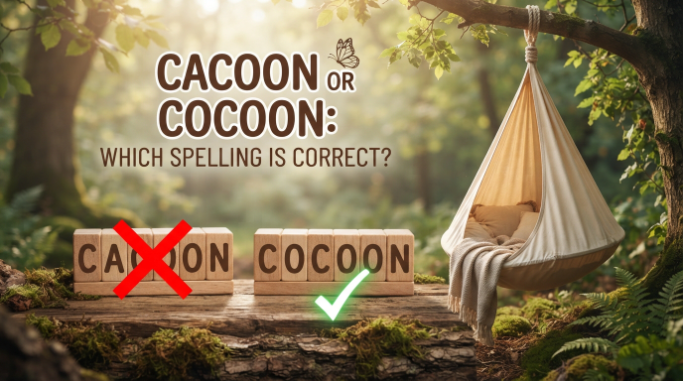
Cacoon or Cocoon: Which Spelling Is Correct?
Quick Answer
The correct English spelling is cocoon, not cacoon.
If you are asking how to spell the protective covering made by certain insect larvae, write cocoon. The plural is cocoons, and the related forms are cocooned and cocooning.
Cacoon is not the standard English spelling of this word. Likewise, concoon and cocon are not standard alternatives for the English word cocoon. Major English dictionaries list cocoon as the standard form.
So:
- ✅ cocoon
- ❌ cacoon
- ❌ concoon
- ❌ cocon when you mean the English word cocoon
If you need the spelling of cocoon, remember the middle: co-coon.

At-a-Glance Table
| Form | Correct standard English? | Meaning or use |
|---|---|---|
| cocoon | Yes | A protective covering made by some insect larvae; also a figurative protective enclosure |
| cocoons | Yes | Plural of cocoon; also third-person singular verb |
| cocooned | Yes | Past tense or past participle of cocoon |
| cocooning | Yes | Present participle/gerund of cocoon |
| cacoon | No | Common misspelling of cocoon |
| concoon | No | Nonstandard spelling, usually a mistaken form of cocoon |
| cocon | No, for this meaning | Not the standard English spelling of cocoon |
| chrysalis | Sometimes related, but not identical | The pupal stage of certain insects, especially butterflies and moths |
The key distinction is simple: cocoon is the English word you want. Dictionary sources define it as a protective covering surrounding certain insects during development, and they also recognize figurative uses involving protection or enclosure.
What Does Cocoon Mean?
A cocoon is a protective covering produced by certain insect larvae before they develop into adults. Moths and silkworms are familiar examples. The covering can consist of silk or other materials produced or arranged by the insect.
For example:
The moth remained inside its cocoon until it was ready to emerge.
The word also has a broader figurative meaning. A cocoon can describe something that surrounds a person or thing and provides comfort, privacy, safety, or protection.
For example:
Her apartment became a quiet cocoon during the stressful winter.
This figurative use is well established in English dictionaries. Cambridge, for example, defines the figurative noun as a safe, quiet place, while Oxford describes a soft covering that surrounds and protects someone or something.
Cocoon as a noun
The most common grammatical use is as a countable noun:
- a cocoon
- the cocoon
- one cocoon
- several cocoons
- a silk cocoon
Examples:
The caterpillar formed a cocoon.
Several cocoons were attached to the branches.
We found an empty cocoon beneath the leaf.
Cocoon as a verb
Cocoon can also function as a verb.
It can mean to surround or protect someone or something:
The thick blankets cocooned the sleeping child.
It can also be used figuratively for staying inside and withdrawing from outside activity. Oxford specifically identifies this sense as North American English usage.
Examples include:
After a long week, she likes to cocoon at home with a book.
The family cocooned themselves indoors during the storm.
The verb forms are:
- cocoon
- cocoons
- cocooned
- cocooning
Why Is “Cacoon” Incorrect?
The problem with cacoon is spelling, not grammar.
English has many words in which vowel patterns are difficult to predict. When people hear cocoon, they may incorrectly represent the first vowel as a, producing cacoon. But the standard spelling is cocoon, with co- at the beginning and -coon at the end.
The correct sequence is:
C-O-C-O-O-N
That gives:
CO + COON = COCOON
There is no standard English spelling cacoon for this noun.
This distinction matters because cacoon may look plausible when written from memory, but replacing the first o with a changes the spelling into a nonstandard form.

How Do You Spell Cocoon?
You spell it:
C-O-C-O-O-N
Or simply:
cocoon
The easiest way to remember the spelling is to notice that co appears twice at the beginning:
co + coon → cocoon
The word has two consecutive o’s near the end:
c o c o o n
So if you are wondering, “How do you spell cocoon?” the answer is cocoon.
Cocoon spelling in different forms
The spelling remains consistent when the word changes grammatical form:
- cocoon — singular noun/base verb
- cocoons — plural noun or third-person singular verb
- cocooned — past tense/past participle
- cocooning — present participle/gerund
Examples:
The insect built a cocoon.
The tree had several cocoons.
The larva had cocooned itself in a protected space.
She enjoys cocooning at home on quiet weekends.
“Cacoon” Meaning: Does It Have a Meaning?
If you searched for cacoon meaning, you are almost certainly looking for cocoon meaning.
In ordinary modern English, cacoon is not the standard spelling of the insect-related word. Therefore, you should not treat cacoon as a normal alternative spelling with a different definition.
For standard English writing, replace:
The butterfly came out of its cacoon.
with:
The butterfly came out of its cocoon.
The same applies in academic writing, schoolwork, professional writing, websites, captions, and general communication.
Is “Cocon” Correct?
If you mean the English word for an insect’s protective covering, cocon is not the standard spelling.
You may encounter cocon in other languages. For example, Cambridge’s French translation of cocoon is cocon.
That does not make cocon an English spelling.
This is an important distinction between English spelling and foreign-language vocabulary. A form can be a legitimate word in another language while still being incorrect when you are writing English.
So:
The moth emerged from its cocoon. ✓
not:
The moth emerged from its cocon. ✗
Is “Concoon” a Correct Spelling?
No. Concoon is not the standard English spelling of cocoon.
It is most likely an accidental rearrangement or addition of letters caused by uncertainty about the word’s pronunciation or spelling.
If you see:
The insect was protected inside a concoon.
The standard correction is:
The insect was protected inside a cocoon.
The spelling does not contain nc. It contains c-o-c-o-o-n.
Cocoon vs. Chrysalis
These words are related, but they are not always interchangeable.
A cocoon is a protective covering spun or produced by certain insects. A chrysalis refers specifically to the pupal stage or casing of a butterfly and, in some usage, certain moths.
That means it is safer not to automatically replace cocoon with chrysalis.
For example:
The moth developed inside a cocoon.
is appropriate when referring to the protective covering.
But:
The butterfly remained in its chrysalis.
is more precise when referring to the butterfly’s pupal stage.
The distinction is particularly useful in scientific or educational writing.

When to Use Cocoon
Use cocoon whenever you are talking about the standard English noun or verb.
For an insect covering
The caterpillar disappeared into its cocoon.
The scientist examined the newly formed cocoon.
Several cocoons were attached to the underside of the leaf.
For a figurative protective environment
The small community provided a cocoon of support.
She enjoyed the warm cocoon of her childhood home.
The hotel room felt like a peaceful cocoon after the long journey.
For the verb
Thick blankets cocooned him during the cold night.
The child was cocooned in soft bedding.
After the busy season, they cocooned themselves at home.
The verb is particularly useful when you want to emphasize surrounding, enclosing, or protecting someone or something. Oxford lists both the protective transitive sense and, in North American English, the sense of spending more free time at home.
Examples by Context
Biology and nature
The moth spent several days inside its cocoon.
The researcher carefully recorded when each insect emerged from its cocoon.
Empty cocoons remained attached to the stems.
Everyday writing
I wrapped myself in a blanket and created a little cocoon of warmth.
The quiet bedroom felt like a cocoon away from the noise outside.
Figurative writing
The family home became a cocoon of security during a difficult year.
Music created a cocoon around her while she worked.
Professional writing
The protective material formed a cocoon around the equipment.
The structure was designed to cocoon sensitive components from the surrounding environment.
Verb usage
The thick sleeping bag cocooned him against the cold.
She cocooned herself in blankets and watched a film.
The child was cocooned in layers of warm clothing.
Plural: cocoons
The plural of cocoon is cocoons, not cocoones or cocoonses.
The branch was covered with cocoons.
Researchers collected several cocoons for observation.
Past tense: cocooned
The past tense is cocooned.
The blankets cocooned the baby.
-ing form: cocooning
The present participle or gerund is cocooning.
She spent the weekend cocooning at home.
Dictionary sources recognize these forms as standard derivatives of cocoon.
Common Mistakes
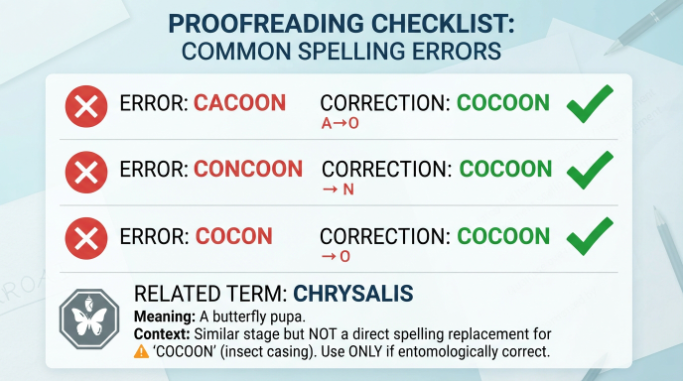
Mistake 1: Writing “cacoon”
Incorrect:
The caterpillar formed a cacoon.
Correct:
The caterpillar formed a cocoon.
The problem is the first vowel. Use o, not a.
Mistake 2: Writing “concoon”
Incorrect:
The moth stayed inside its concoon.
Correct:
The moth stayed inside its cocoon.
There is no n after the first co.
Mistake 3: Writing “cocon” in English
Incorrect:
The insect emerged from its cocon.
Correct:
The insect emerged from its cocoon.
The final part is oon, not simply on.
Mistake 4: Using “chrysalis” as an automatic synonym
Not every cocoon should be called a chrysalis.
If you are describing a silk covering made by an insect, cocoon is the appropriate term. If you specifically mean the pupal stage or casing of a butterfly, chrysalis may be more precise.
Mistake 5: Confusing the noun and verb
Both uses are legitimate:
The insect built a cocoon.
The blankets cocooned the child.
The first is a noun. The second is a verb.
A Simple Memory Trick
Think:
CO + COON
The word starts with co and then continues with coon:
COCOON
Another useful trick is to picture the word in two chunks:
CO | COON
That makes the spelling easier to reconstruct if you forget it.
You can also remember the sound pattern: the second part has the long oo sound, as in moon.
The important thing is not to invent the spelling from the sound alone. English spelling often cannot be predicted perfectly from pronunciation, so remembering the visual pattern COCOON is more reliable.
A Practical Proofreading Test
When proofreading, ask yourself:
Am I talking about an insect’s protective covering, a figurative protective enclosure, or the act of surrounding/protecting something?
If the answer is yes, check that you have written:
cocoon
Then look at the middle and ending:
c-o-c-o-o-n
If you have a where the first o should be, you probably wrote cacoon by mistake.
If you have n in the middle, you may have written concoon.
If you have only one o before the final n, you may have written cocon.
Fast decision rule
Use this:
In English, if you mean the insect covering or the figurative protective enclosure, choose “cocoon.”
There is normally no spelling choice between cacoon and cocoon. The standard English form is cocoon.
Formal vs. Casual and Regional Notes
There is no meaningful British-versus-American spelling difference here.
Both British and American English use:
cocoon
Both Cambridge’s UK and US entries give the same basic spelling and pronunciation.
There can, however, be differences in usage, especially with the verb. Oxford identifies the meaning “to spend more of your free time at home rather than going out” as North American English.
So you should not write cacoon on the assumption that it might be a British variant. It is not the normal British alternative to cocoon.
Pronunciation
Standard dictionaries give the pronunciation as /kəˈkuːn/ in both British and American English.
The main stress falls on the second syllable.
The spelling is therefore worth memorizing rather than trying to reconstruct from pronunciation.
Another Name for a Cocoon
There is no single universal synonym that can replace cocoon in every context.
Depending on what you mean, related terms include:
- chrysalis — specifically associated with the pupal stage/casing of butterflies and some moths
- pupal case — a more descriptive biological term in appropriate contexts
- protective covering — a broad descriptive phrase
- case — sometimes useful when the surrounding context makes the meaning clear
- shell — possible metaphorically or descriptively in some contexts, but not an exact biological synonym
For ordinary English, cocoon remains the clearest choice when that is the object you mean.
“Cocoons” Meaning
Cocoons is simply the plural form of cocoon.
One cocoon
Two cocoons
Several cocoons
It can also be the third-person singular present form of the verb:
The material cocoons the equipment.
So the meaning depends on grammar.
As a noun:
The scientist examined several cocoons.
As a verb:
The protective layer cocoons the device.
This is a useful example of why context matters when interpreting words ending in -s.

What About “Cacoon Definition”?
If you specifically search for cacoon definition, the important point is that the search term itself is usually a spelling error.
For standard English writing, you should search for cocoon definition instead.
A concise definition is:
Cocoon: a protective covering made by certain insect larvae around themselves during development; also, figuratively, a protective or comfortable enclosure.
That definition covers both the literal and common figurative senses.
What About “Cocoon Spell” or “Cocoon Spelling”?
If your question is simply “How do you spell cocoon?” the answer is:
Cocoon.
The spelling is:
C-O-C-O-O-N
There is no British spelling such as cacoon, and there is no standard American spelling such as cacon or concoon. English uses cocoon in both major varieties.
FAQs
Is cacoon or cocoon correct?
Cocoon is correct. Cacoon is a nonstandard spelling when you mean the English word for an insect’s protective covering.
How do you spell cocoon?
Spell it C-O-C-O-O-N: cocoon.
What does cocoon mean?
A cocoon is a protective covering made by certain insect larvae during development. Figuratively, it can mean a safe, quiet, comfortable, or protective enclosure.
Is cacoon a word?
It is not the standard English spelling for cocoon. In ordinary English writing, use cocoon instead.
Is cocon the correct spelling?
No, not when you mean the English word cocoon. Cocoon is the standard spelling.
Is concoon correct?
No. Concoon is not the standard spelling. The correct English form is cocoon.
What is the plural of cocoon?
The plural is cocoons.
The branch was covered with cocoons.
What is the past tense of cocoon?
The past tense is cocooned.
The blankets cocooned the sleeping child.
What is the present participle of cocoon?
The -ing form is cocooning.
They spent the weekend cocooning at home.
Is cocoon the same as chrysalis?
Not exactly. A cocoon is a protective covering made by certain insects, while chrysalis specifically refers to the pupal stage or casing associated especially with butterflies and some moths. The terms can overlap in casual discussion, but they are not universally interchangeable.
Is cocoon spelled differently in British English?
No. Cocoon is the standard spelling in both British and American English. The pronunciation is also essentially the same in the major dictionary entries.
What is another name for a cocoon?
Depending on the context, you might use protective covering, pupal case, or, in specific butterfly contexts, chrysalis. None is a perfect universal replacement.
Why is cocoon spelled with two o’s?
The standard spelling is simply c-o-c-o-o-n. A useful memory aid is to divide it visually into CO + COON. The spelling should be memorized rather than inferred entirely from pronunciation.
Is “cacoon” a British spelling?
No. British English uses cocoon, just like American English.
How long does it take to emerge from a cocoon?
There is no single answer. Development time varies considerably according to the insect species and environmental conditions. If your search for “how long to beat cocoon” refers to a game, rather than the biological meaning of cocoon, that is a separate usage and should be treated as a gaming question rather than a spelling question.

Final Takeaway
When choosing between cacoon or cocoon, use cocoon.
Cocoon is the standard English spelling for the protective covering made by certain insect larvae and for related figurative and verbal uses. Its main forms are cocoon, cocoons, cocooned, and cocooning.
The quickest memory aid is:
CO + COON = COCOON
So if you are wondering how do you spell cocoon, write:
C-O-C-O-O-N → cocoon