Drive Thru or Drive Through: Which Spelling Is Correct?
Quick Answer
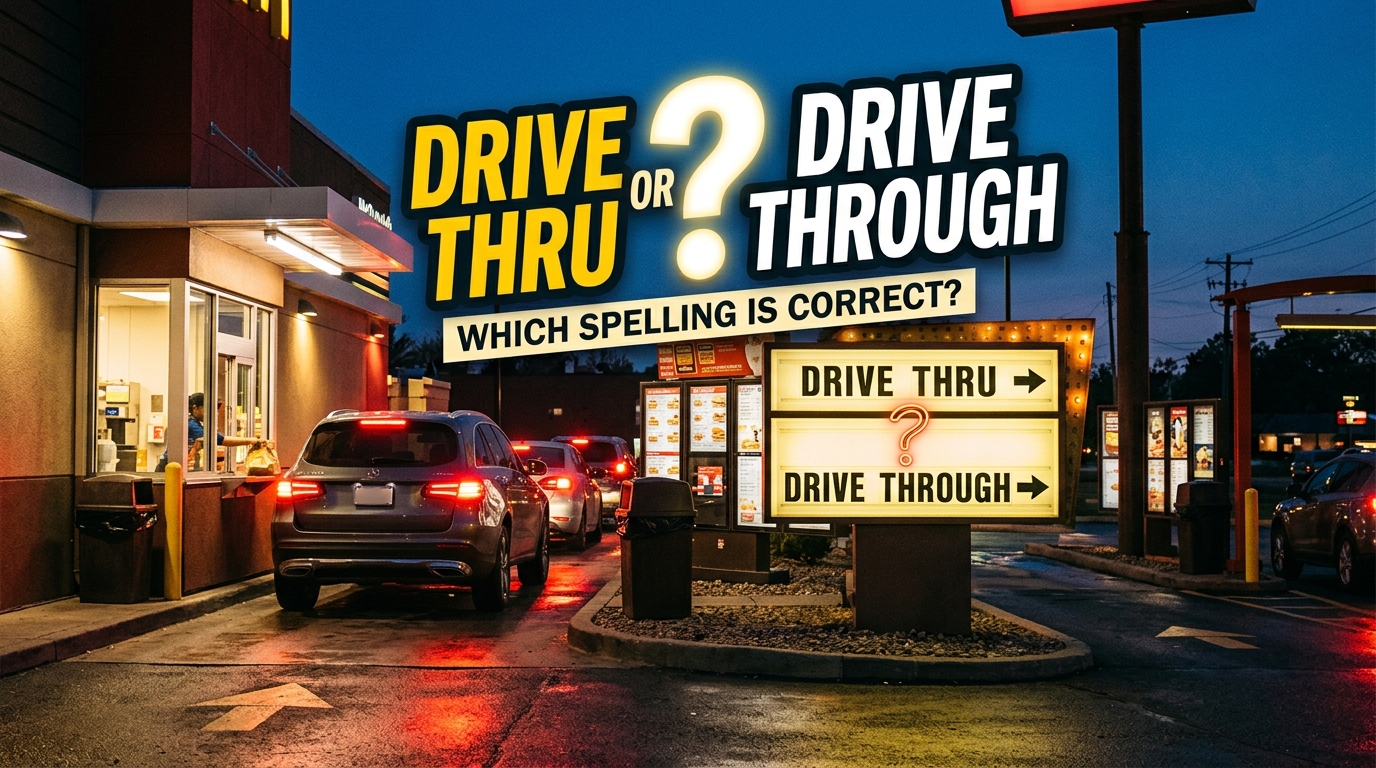
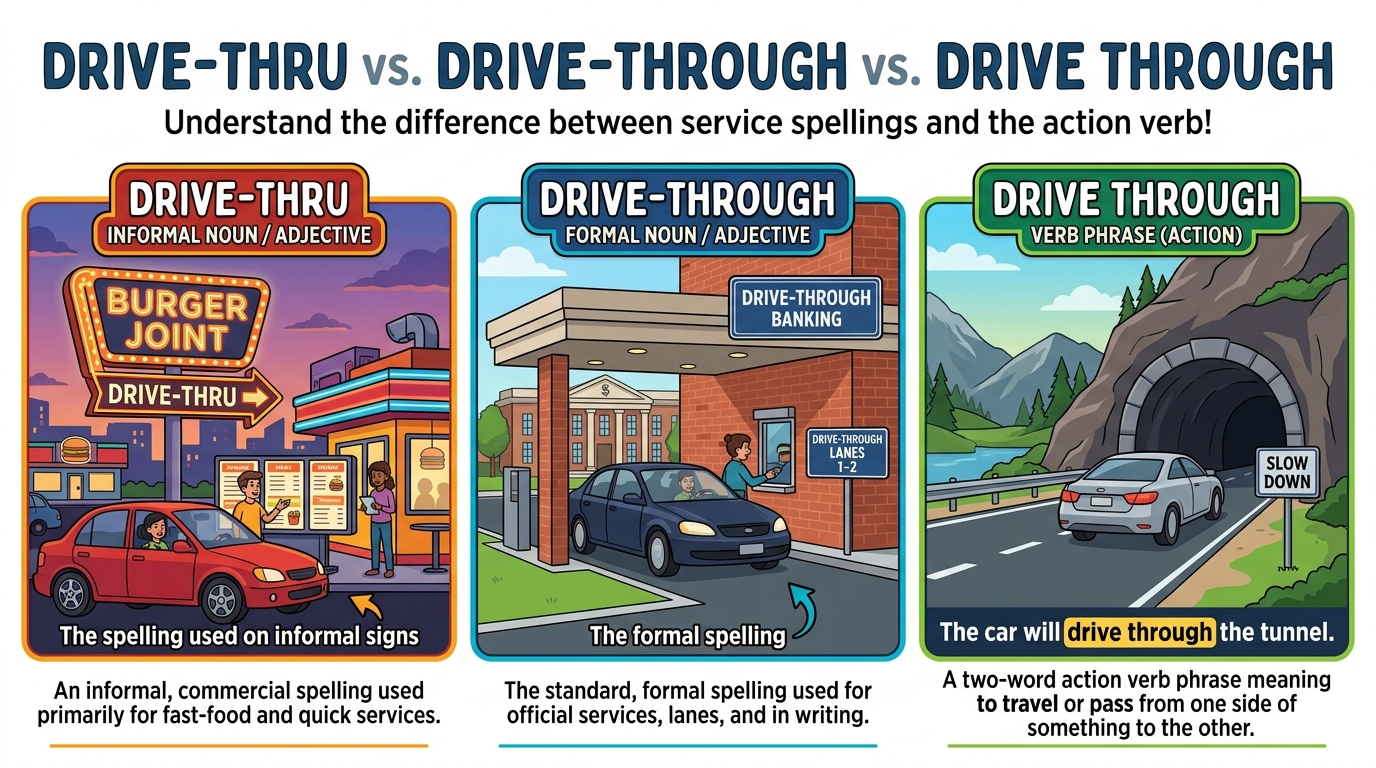
Both “drive-thru” and “drive-through” are correct. They refer to a service that allows customers to order, pay for, or collect food and other items without leaving their vehicles. The shorter spelling, drive-thru, is especially common on signs and in informal American English, while drive-through is a standard, more traditional spelling that works well in formal writing.
The open form drive through is also correct when the words function as a verb and its particle, as in “We drove through the tunnel.” The correct choice depends on whether you mean a service, a place, or the action of passing through something.
- Drive-thru: A common spelling for a vehicle-based service, especially in American English.
- Drive-through: A standard alternative, suitable for general and formal writing.
- Drive through: A verb phrase describing movement through a place or area.
At-a-Glance Table
| Feature | Drive-thru | Drive-through | Drive through |
|---|---|---|---|
| Correct spelling? | Yes | Yes | Yes, when used as a verb phrase |
| Typical meaning | A service for motorists | The same type of service | To travel or pass through an area |
| Grammatical role | Noun or adjective | Noun or adjective | Verb phrase |
| Example | The drive-thru is open. | The drive-through is open. | We drove through the city. |
| Register | Often casual and commercial | General, neutral, or formal | Neutral |
| Typical usage | Restaurant signs, menus, everyday American English | General prose, descriptions, formal writing | Ordinary descriptions of movement |
| Hyphenation | Usually hyphenated as a compound | Usually hyphenated as a compound | No hyphen in the ordinary verb phrase |
The key distinction: When referring to a service, use drive-thru or drive-through. When describing an action, use drive through if the sentence calls for the verb drive followed by through.
The Detailed Difference Between Drive-Thru and Drive-Through
1. What does “drive-thru” mean?
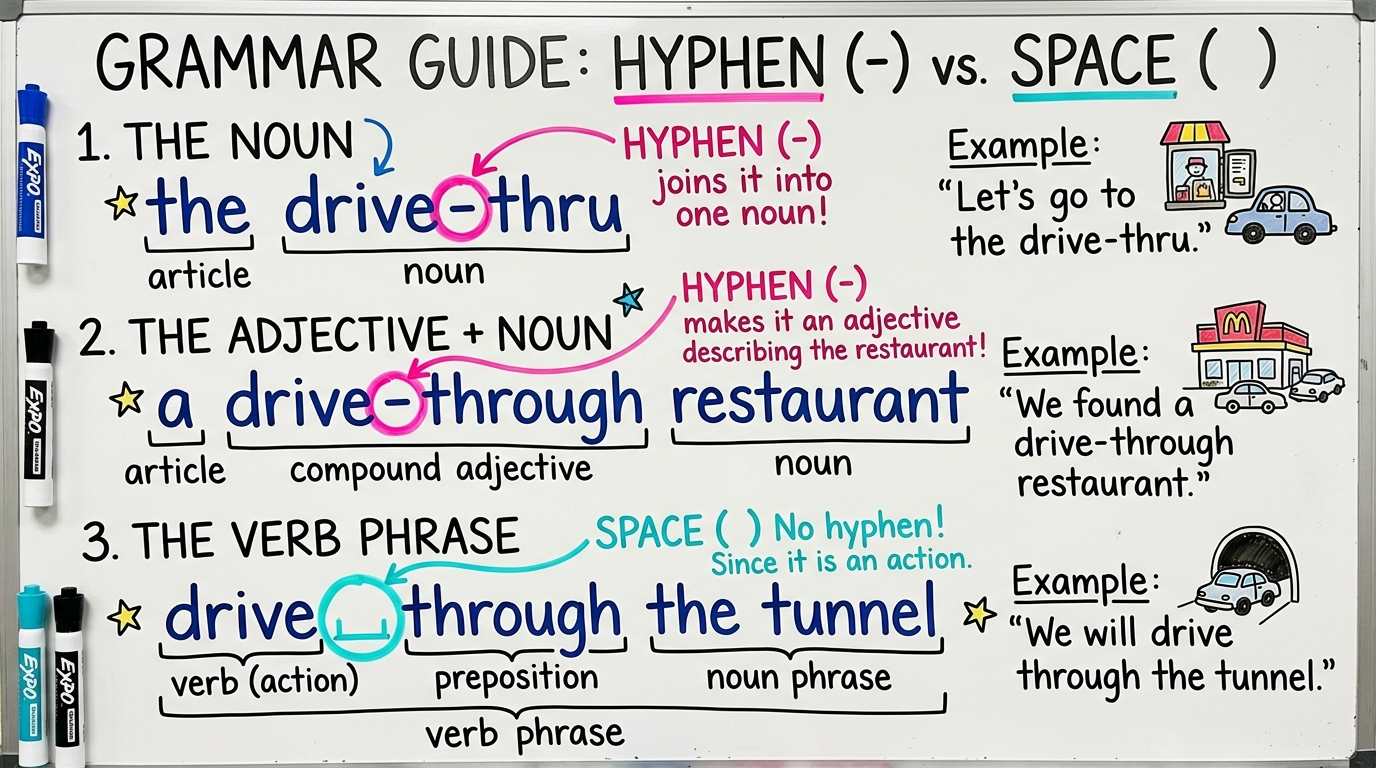
A drive-thru is a service that lets people in vehicles complete a transaction without entering a building. It is especially associated with fast-food restaurants, coffee shops, pharmacies, and banks.
Examples:
- We ordered breakfast at the drive-thru.
- The coffee shop has a drive-thru for busy customers.
- She picked up her prescription through the pharmacy’s drive-thru window.
- The bank offers drive-thru services on weekdays.
In these sentences, drive-thru names a service or facility, so it functions as a noun.
It can also describe another noun:
- a drive-thru restaurant
- a drive-thru window
- a drive-thru lane
- a drive-thru coffee shop
Here, drive-thru modifies a noun and tells readers what kind of restaurant, window, lane, or shop is being described.
2. What does “drive-through” mean?
Drive-through has essentially the same meaning as drive-thru when referring to a vehicle-based service. It is a standard spelling that uses the full word through.
Examples:
- The drive-through closes at midnight.
- We found a restaurant with a drive-through.
- The company plans to add a drive-through window.
- A drive-through bank can make routine transactions more convenient.
Like drive-thru, drive-through can function as a noun or an adjective.
The two spellings generally do not indicate different services. A drive-thru restaurant and a drive-through restaurant offer the same basic type of service.
3. What does “drive through” mean?
Drive through is usually a verb phrase when drive describes movement and through indicates the route or area being crossed.
Examples:
- We drove through the countryside.
- Please drive through the gate slowly.
- They will drive through three towns before reaching their destination.
- The car drove through a tunnel.
Notice the difference between these two sentences:
- We stopped at the drive-through for lunch.
- We will drive through the town before lunch.
In the first sentence, drive-through names a service. In the second, drive through describes an action.
When to Use Each Spelling
Use “drive-thru” for everyday service-related writing
Choose drive-thru when writing casual American English, creating restaurant signs, describing a quick-service facility, or following a publication’s specified style.
Examples:
- The drive-thru is open until 11 p.m.
- Turn left to enter the drive-thru lane.
- I ordered a sandwich at the drive-thru.
- Our new location includes a drive-thru coffee counter.
This spelling is short and familiar in commercial contexts. However, its casual appearance does not make it incorrect.
Use “drive-through” for general or formal writing
Choose drive-through when you want the full spelling, particularly in educational writing, formal descriptions, or publications that prefer dictionary-standard forms.
Examples:
- The restaurant introduced a new drive-through service.
- Customers can collect their orders at the drive-through window.
- The proposed building includes a two-lane drive-through facility.
- The company is reviewing demand for drive-through banking.
The full spelling is clear and widely understood. It is a good default when no house style specifies otherwise.
Use “drive through” for movement
Use the two-word form without a hyphen when drive and through function separately in a sentence.
Examples:
- We drive through this neighborhood every morning.
- The delivery driver had to drive through heavy rain.
- You can drive through the park on the designated road.
- They drove through the entrance and parked outside.
The tense of drive can change, but the phrase remains open: drive through, drives through, drove through, or driving through.
Use the plural “drive-thrus” or “drive-throughs”
Both spellings can form regular plurals.
- Three drive-thrus operate along this road.
- Several drive-throughs have opened in the area.
- The chain plans to renovate two drive-thrus.
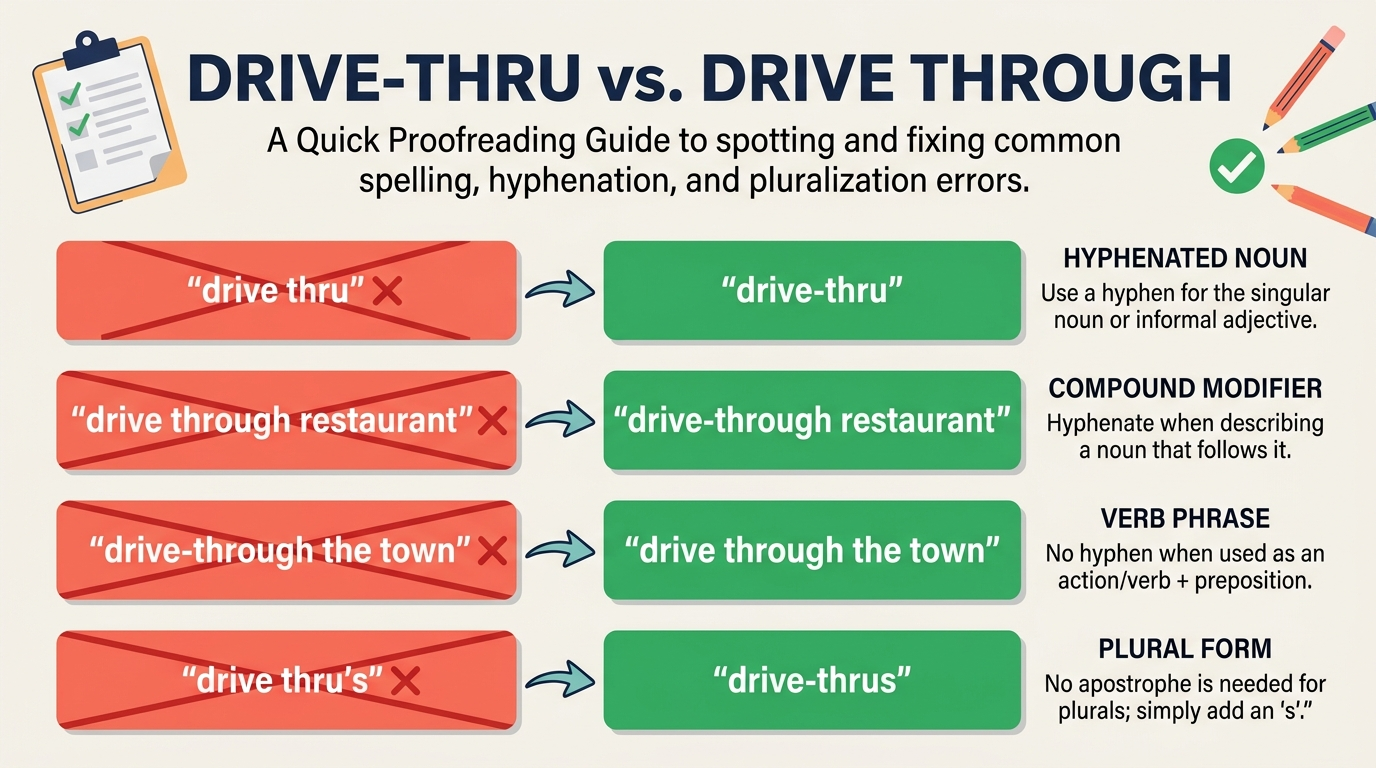
The plural ending belongs to the complete compound word. Do not write drive-thru’s when you mean more than one facility; an apostrophe generally marks possession or a contraction, not an ordinary plural.

Examples by Context
Restaurant and food-service examples
| Sentence | Why it works |
|---|---|
| The drive-thru line is long. | Drive-thru names a service lane. |
| We ordered through the drive-through. | Drive-through names the service. |
| This restaurant has a drive-thru window. | The compound modifies window. |
| The restaurant added a second drive-through lane. | The compound modifies lane. |
| We drove through the restaurant district. | Drove through describes movement. |
| Please drive through the pickup lane. | The words form a verb phrase. |
Banking, retail, and other services
The term is not limited to restaurants.
- The bank has a drive-through ATM.
- Customers can use the drive-thru pharmacy window.
- The store introduced drive-through collection for online orders.
- The customer drove through the parking area to reach the exit.
- A drive-thru donation point allows people to drop off supplies without entering the building.
The same spelling distinction applies in each context: a named facility or service can take the compound form, while an action normally uses the verb phrase.
Examples in everyday conversation
- “Is the drive-thru still open?”
- “Let’s use the drive-through instead of going inside.”
- “I drive through this intersection on my way to school.”
- “We drove through the mountains during our trip.”
- “The sign says the drive-thru is temporarily closed.”
- “The new restaurant has a drive-through, but no indoor seating.”
All six sentences are natural. The first two name a service, the third and fourth describe movement, and the last two describe a facility and its features.
Examples for business and academic writing
- The proposed development includes a drive-through facility.
- The business will evaluate the cost of installing a drive-thru window.
- The report examines customer preferences for drive-through services.
- Vehicles must drive through the designated inspection area.
- The restaurant’s drive-through lane will remain closed during construction.
For formal documents, consistency matters more than choosing one spelling for every possible context. Pick the form appropriate to the grammatical role, then follow your publication’s style.
Common Mistakes and How to Correct Them
The most frequent errors involve confusing the service name with the verb phrase, omitting the hyphen in a compound, or treating thru as a universal replacement for through.
| Incorrect or less suitable | Better version | Explanation |
|---|---|---|
| The drive thru is busy. | The drive-thru is busy. | Use the established hyphenated compound in this style. |
| The drive through is busy. | The drive-through is busy. | When naming the service, the hyphen clarifies the compound. |
| We will drive-through the city. | We will drive through the city. | The verb phrase takes a space, not a hyphen. |
| We stopped at the drive through. | We stopped at the drive-through. | The compound names a service or facility. |
| Walk thru the doorway. | Walk through the doorway. | In ordinary prose, use the standard spelling through. |
| There are two drive-thru’s nearby. | There are two drive-thrus nearby. | An ordinary plural does not need an apostrophe. |
| The drive-thru’s window is open. | The drive-thru window is open. | No possessive apostrophe is needed when the compound modifies window. |
| We drove thru the tunnel. | We drove through the tunnel. | Use through in standard prose. |
Some unhyphenated forms may appear in business names, headlines, or informal signs. That does not mean they are universally wrong in every context. The important question is whether you are following a particular house style or writing ordinary prose.
Is “drive thru” one word or two?
Strictly speaking, drive thru contains two words, but it is generally written drive-thru when naming the service. The full alternative is drive-through.
If you are asking whether the service name is written as one word, two words, or a hyphenated compound, the practical answer is:
- Drive-thru: hyphenated compound.
- Drive-through: hyphenated compound.
- Drive through: two separate words when used as a verb phrase.
Is “drive-thru” hyphenated?
Yes, the established compound spelling is drive-thru. The standard full spelling is drive-through, which is also hyphenated.
However, a business may use its own branding or signage conventions. Preserve an official business name when reproducing it exactly, and use your chosen style consistently in ordinary writing.
Is “drive-through” hyphenated?
When drive-through names or describes the service, the hyphenated spelling is standard.
For example:
- The drive-through is closed.
- We ordered from a drive-through restaurant.
- The city approved a new drive-through facility.
Compare these with “The bus will drive through the town,” where the verb phrase has no hyphen.
A Memory Trick and a Practical Proofreading Test
The simplest memory trick
Remember this rule:
A service gets a hyphen; an action gets a space.
- Service: The drive-thru is busy.
- Service: The drive-through restaurant is popular.
- Action: We drive through the city.
This is a useful shortcut, not an absolute rule for every compound or every publication’s style. If you are writing for a newspaper, company, or academic institution, check its style requirements too.
The substitution test
When you are uncertain, replace the disputed phrase with a clearer expression.
Test 1: Can you replace it with “service” or “facility”?
- “The drive-through is closed.”
- “The service is closed.”
The substitution works, so the compound spelling is appropriate.
Test 2: Can you replace it with “travel through” or “pass through”?
- “We drive through the village.”
- “We travel through the village.”
The meaning remains similar, so drive through is a verb phrase.
Test 3: Does the phrase describe another noun?
- “A drive-through restaurant.”
- “A drive-thru window.”
If it identifies the kind of restaurant or window, the hyphenated compound is appropriate.
Quick decision checklist
Use this checklist while proofreading.I am naming a vehicle-based service or facility.I am describing movement through a place.The compound is modifying another noun.I am following a specific style guide or brand spelling.
Select the statement that best matches your sentence to see the relevant rule.
Formal vs. Casual English and Regional Differences
American English
In the United States, both drive-thru and drive-through are familiar. The shorter spelling is particularly visible in restaurant branding, menus, and commercial signs.
The two forms generally mean the same thing. Choosing between them is a matter of spelling convention, register, and editorial style—not a difference in the service itself.
British English
In British English, drive-through is a familiar spelling, while drive-thru also appears, especially in commercial settings and the names used by international chains.
British English has no universal rule that makes drive-thru incorrect. If you are writing for a British audience, drive-through is a clear, neutral choice unless a house style or brand uses a different form.
Other varieties of English
Usage varies across countries and organizations. Some businesses adopt drive-thru for short, prominent signs; others use drive-through in descriptions and formal material.
There is no need to change the spelling solely because the audience is international. Choose a recognized form and maintain consistency.
Is “thru” a proper English spelling?
Thru is a recognized informal variant used in certain established expressions, including drive-thru. It is not a general replacement for through in standard prose.
For example:
- Commercial spelling: drive-thru
- Standard prose: drive through the entrance
- Standard prose: walk through the door
- Standard prose: read the document through to the end
The existence of drive-thru does not make “walk thru the door” the preferred spelling in formal writing.
AP Style: Drive-Thru or Drive-Through?
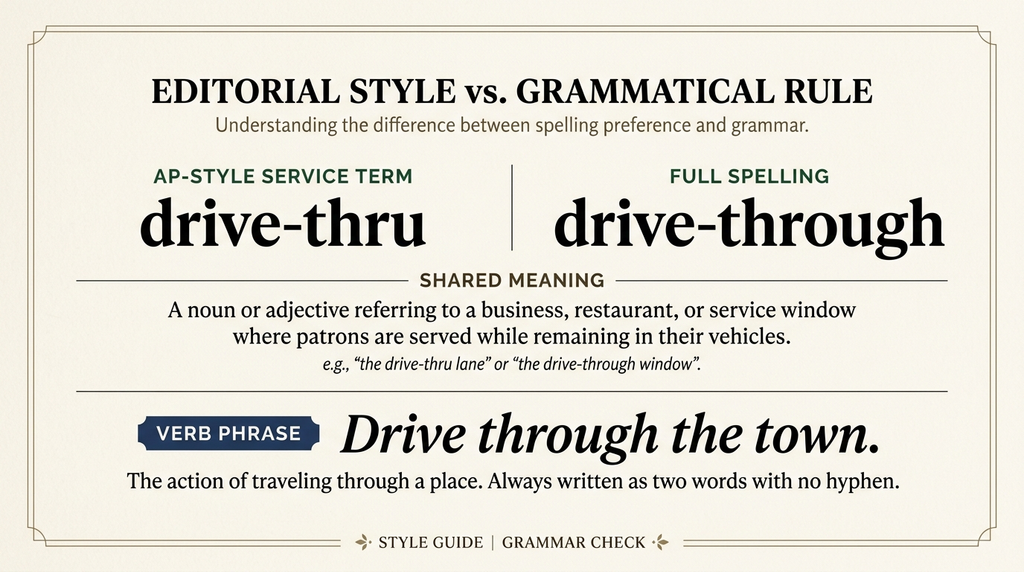
The Associated Press (AP) Stylebook is an important reference for journalists and many news organizations. Its guidance has allowed drive-thru in place of the older preference for drive-through.
For practical editing:
- When following AP style: Use drive-thru for the service term, consistent with the applicable current entry.
- When following a dictionary-led house style: Drive-through is a sound standard choice.
- When following a company’s style guide: Use the spelling specified by that guide.
- When reproducing a business name: Preserve its official spelling.
The distinction is worth understanding: AP style is a specific editorial convention, not a declaration that every other spelling is incorrect. AP also maintains a regularly updated online stylebook, so editors working to a current edition should verify the relevant entry there.
Pronunciation and Spelling Variants
Both drive-thru and drive-through are usually pronounced the same way in ordinary speech. The difference is in spelling, not meaning or pronunciation.
A simple pronunciation guide is:
- Drive: /draɪv/ — rhymes with five.
- Through: /θruː/ — begins with the unvoiced “th” sound and rhymes with blue.
- Thru: /θruː/ — pronounced the same as through.
The full expression is approximately “DRIVE-throo,” with the main emphasis on drive.
Common misspellings include drive thorugh, drive tro, drive drue, drive tr, and drivetruh. These are typing errors, not standard alternatives. In particular, remember the spelling through, with h before r.
Frequently Asked Questions
1. Is it “drive thru” or “drive through”?
Both drive-thru and drive-through are correct when naming a service that allows customers to remain in their vehicles. Use drive through without a hyphen when describing movement, as in “We drive through the city.”
2. How do you spell drive-thru?
Spell it drive-thru, with a hyphen. The full alternative is drive-through, also with a hyphen.
3. Is drive-thru one word or two?
Neither spelling is technically a single unhyphenated word. Drive-thru and drive-through are hyphenated compounds, while drive through is a two-word verb phrase.
4. What is the meaning of drive-thru?
A drive-thru is a service that allows people in vehicles to order, pay for, or collect goods without entering a building. Restaurants, coffee shops, pharmacies, and banks may offer this service.
5. What is the drive-thru meaning in Hindi?
Drive-thru (ड्राइव-थ्रू) का अर्थ है ऐसी सेवा जहाँ ग्राहक अपनी गाड़ी से बाहर निकले बिना सामान ऑर्डर कर सकते हैं, भुगतान कर सकते हैं या सामान प्राप्त कर सकते हैं।
For example, drive-thru restaurant means a restaurant where customers can order or collect food while staying in their vehicles.
6. Is “drive through” ever correct without a hyphen?
Yes. It is correct when drive is a verb and through indicates movement across or within an area.
Example: “We drive through the park every weekend.”
The hyphenated form is used when the expression functions as a compound noun or adjective: “The drive-through is open.”
7. What is the plural of drive-thru?
The usual plural is drive-thrus. The plural of drive-through is drive-throughs.
Examples:
- Two drive-thrus are available on this road.
- Several drive-throughs serve the surrounding neighborhoods.
Do not add an apostrophe merely to make either word plural.
8. When was the first drive-through restaurant opened?
Red’s Giant Hamburg in Springfield, Missouri, opened in 1947 and is widely credited with being an early drive-through restaurant. In-N-Out Burger opened its first restaurant in California in 1948 and introduced a two-way speaker system for ordering. Historical accounts differ over which establishment deserves the title of the first true drive-through, so it is best to acknowledge that distinction.
9. What drive-throughs are open near me?
Opening hours depend on your location, the business, and the day. Check the business’s official website or a current map listing for its drive-through hours. A restaurant’s main premises may be open while its drive-through service operates on a different schedule.
10. Is “drive-thru” acceptable in formal writing?
Yes, provided it fits the publication’s style. It is an established spelling, not simply a typographical error. However, drive-through is a good choice when a more traditional full spelling is preferred.
11. Is there a difference between a drive-in and a drive-through?
Yes. A traditional drive-in allows customers to park and often eat or receive service while remaining in their vehicles. A drive-through generally lets customers order or collect something without parking for a meal or entering the building. Although the concepts overlap historically, they describe different service arrangements.
12. Should I write “drive-through restaurant” or “drive-thru restaurant”?
Both are acceptable. The first uses the full spelling; the second uses the shorter variant. Choose according to your audience, publication style, or the business’s official wording.
Final Takeaway
Use drive-thru or drive-through for the service, and drive through for the action.
Both service-related spellings are correct, and neither inherently describes a different kind of service. For AP-style journalism, use drive-thru in accordance with the relevant style guidance. For general or formal prose, drive-through is a clear alternative.
When proofreading, ask yourself one question: Am I naming a service or describing movement? That distinction will usually tell you which form to choose.